Voice automation in contact centers has moved beyond experimentation. The current challenge is not whether AI voice agents can handle calls, but whether they can do so reliably, at scale, and with measurable operational impact.
In production environments, performance is evaluated through outcomes:
Across deployments, a clear pattern emerges.
Most performance issues are not caused by limitations in language models.They are caused by:
These issues are often invisible during pilot phases. They become evident only when systems are exposed to real call volumes, variability in caller behavior, and operational edge cases.
At that point, minor inefficiencies scale into:
High-performing AI voice deployments are therefore not built around conversational capability alone. They are built around execution discipline.
This includes:
The following 15 rules reflect these principles. They are derived from patterns observed in call-heavy environments where voice remains a primary interaction channel and where automation must operate with the same consistency as trained human agents.
The effectiveness of an AI voice agent should be evaluated through clearly defined operational outcomes. These outcomes determine whether automation is reducing workload or redistributing it.
The system correctly identifies the caller’s objective without requiring multiple attempts or rephrasing. Low intent accuracy leads directly to incorrect workflow selection and downstream failure.
The requested action is completed during the call. This includes bookings, updates, issue resolution, or qualification. Partial completion or deferral introduces follow-up workload.
When escalation is required, it is triggered intentionally and includes sufficient context for the receiving agent. Unstructured escalation increases handling time and creates repetition.
The same issue does not generate additional interactions. Repeat calls are a direct indicator of incomplete or incorrect execution.
These four metrics collectively influence:
These outcome improvements directly impact ROI across contact center operations.
In high-volume environments, even small improvements in these areas produce significant operational impact.
Effective implementation does not begin with broad coverage. It begins with controlled depth.
A typical deployment approach should:
Each rule below addresses a specific failure mode observed in production systems.
Initial deployment should focus on a single, well-defined interaction type with:
Examples include:
This approach enables:
Attempting to automate multiple interaction types simultaneously introduces variability that reduces observability and delays optimization.
For a broader context, explore common AI use cases in contact centers.
The opening interaction should transition the caller into the workflow as quickly as possible.
Effective greetings:
They avoid:
In high-volume environments, greeting design directly impacts:
Voice interactions introduce constraints that differ from text-based systems. Multi-part prompts increase cognitive load and reduce input accuracy.
Sequential questioning ensures:
For example, collecting:
Should be handled as separate steps, not combined into a single prompt.
This structure improves:
Execution without validation introduces risk, particularly when actions affect:
Confirmation layers should be applied to:
This reduces:
In high-volume environments, even a small error rate at this stage creates measurable cost.
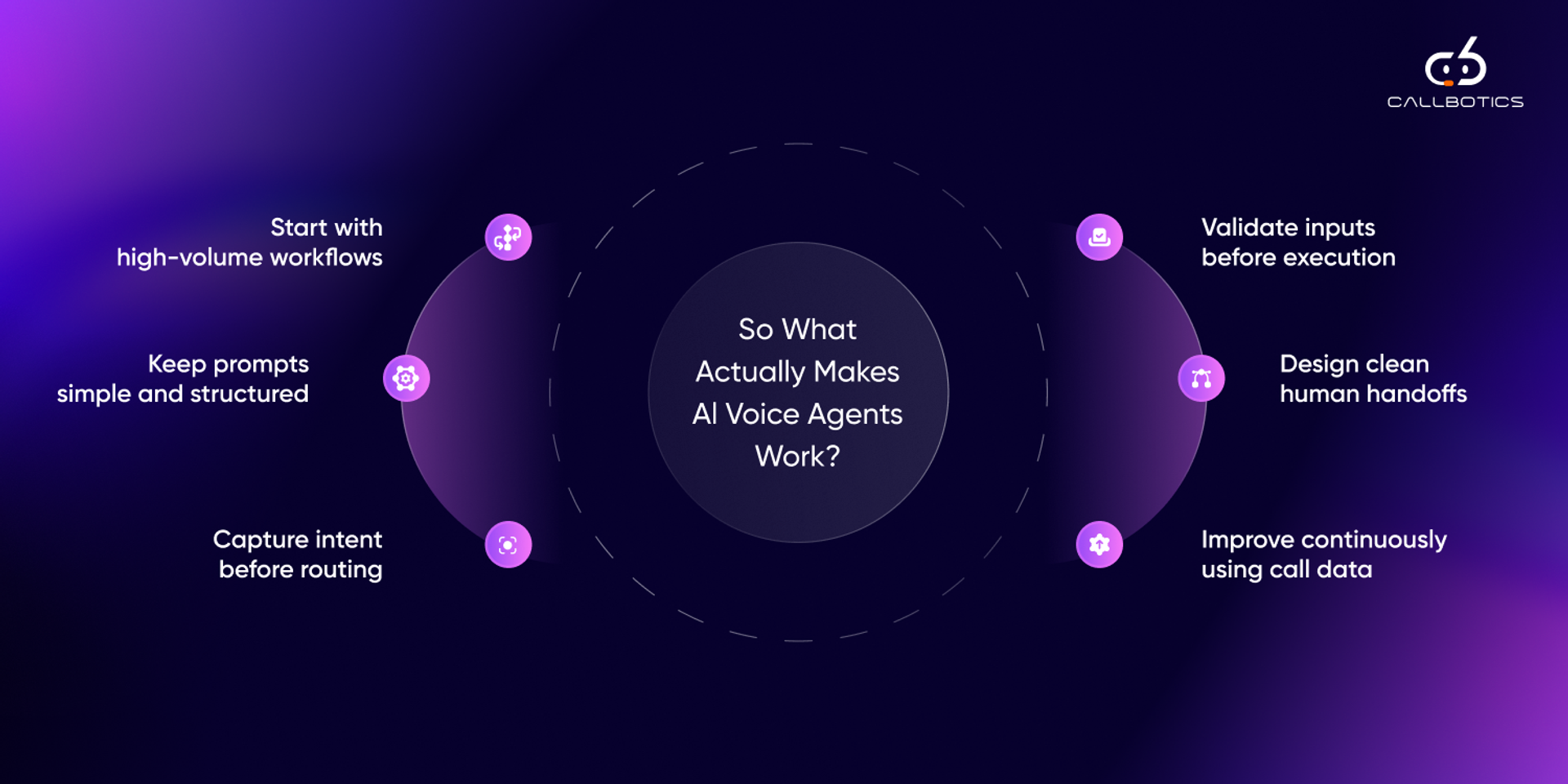
Traditional IVR systems rely on fixed navigation paths. These systems perform poorly when the caller's intent does not align with predefined options.
Intent-first systems:
This improves:
It also enables the system to handle variations in how callers express the same request.
Automation should not create containment at the cost of resolution.
A well-designed system provides:
Escalation is not a failure state. It is a controlled transition for scenarios where automation should not proceed.
When escalation is delayed or hidden:
Clear escalation pathways improve:
Escalation without context introduces inefficiency.
Before transferring, the system should capture:
This context should be passed into:
This ensures:
In high-volume environments, this directly reduces:
Repetition is one of the most common causes of call abandonment.
Loops typically occur when:
Effective handling includes:
For example:
This structure prevents:
Response design directly impacts comprehension and progression.
Effective responses:
In voice interactions, long responses:
Structured responses improve:
Incorrect execution is more costly than escalation.
Systems should:
This is particularly critical for:
Guardrails ensure:
Response accuracy depends on the quality of the underlying information.
Knowledge sources must be:
Outdated or inconsistent knowledge leads to:
Regular updates should be tied to:
Production environments introduce variability that is not present in controlled testing.
Systems must handle:
Design considerations include:
Robust handling of real-world variability improves:
Certain workflows require strict control and auditability.
These include:
Systems should implement:
Compliance design should be embedded within workflows, not added as a post-layer.
Aggregate metrics do not provide actionable insights.
Instead of overall averages, track:
This enables:
Intent-level visibility is essential for scaling automation effectively.
Optimization should be driven by observed behavior, not assumptions.
Inputs for improvement include:
A weekly or bi-weekly review cycle should:
Continuous iteration is what converts a functional system into a high-performing one.
Across deployments, several recurring patterns limit effectiveness.
Deploying across multiple use cases without validating core workflows reduces clarity on what is working and what is not.
Lack of clear transfer conditions or missing context leads to inefficient human handling.
Ambiguous questions increase error rates and extend call duration.
Lack of integration with CRM, scheduling, or backend systems prevents end-to-end task completion.
Without intent-level tracking, optimization becomes reactive and unfocused.
These issues are typically architectural, not technical.
Identify the highest-volume interaction types and validate:
Most operational impact comes from a small number of intents.
Validate:
Edge-case handling determines system reliability.
Verify:
This ensures that automation is not only conversationally correct but operationally complete.
A structured implementation approach ensures these workflows deploy reliably at scale.
Applying best practices consistently across thousands of interactions requires more than workflow design. It requires infrastructure that enforces execution, captures outcomes, and enables continuous optimization.
CallBotics is designed as an execution layer for voice-driven operations, where conversations, decisions, and system actions are tightly integrated.
In high-volume environments, the difference between a functional deployment and a high-performing one is determined by:
100 Percent Automated QA
Every interaction is evaluated against defined criteria for correctness, compliance, and policy adherence. This eliminates reliance on sampling-based QA and enables full visibility across all conversations.
Sentiment Analysis
Emotional tone, hesitation patterns, and escalation signals are detected in real time. This allows workflows to adapt dynamically and helps identify friction points across intents.
Custom Dashboards and Reports
Performance is tracked at a granular level, including:
This enables targeted optimization rather than broad adjustments.
Churn Intelligence
Behavioral and conversational signals are used to identify at-risk customers. Patterns such as repeated dissatisfaction or cancellation intent can be flagged early.
Live Monitoring
Supervisors can observe interactions in real time, provide guidance, or intervene when necessary. This is particularly valuable during rollout phases or high-sensitivity workflows.
Latency Tracking
System performance is measured across the interaction pipeline, including:
This ensures that performance bottlenecks are identified and resolved proactively.
Multi-Tenancy Architecture
Supports large-scale deployments across:
While maintaining centralized control and reporting.
The principles outlined in this guide, structured inputs, controlled execution, clean handoffs, and continuous measurement, require system-level enforcement.
Without this:
CallBotics enables:
This converts voice automation from a capability into a measurable operational system.
AI voice agents deliver value when they operate as part of a structured execution framework.
Performance is determined by:
Organizations that focus on these elements achieve:
When implemented correctly, voice automation becomes a core operational layer rather than an auxiliary channel.

Urza Dey (She/They) is a content/copywriter who has been working in the industry for over 5 years now. They have strategized content for multiple brands in marketing, B2B SaaS, HealthTech, EdTech, and more. They like reading, metal music, watching horror films, and talking about magical occult practices.
See how enterprises automate calls, reduce handle time, and improve CX with CallBotics.
CallBotics is an enterprise-ready conversational AI platform, built on 18+ years of contact center leadership experience and designed to deliver structured resolution, stronger customer experience, and measurable performance.