AI voice agents are no longer experimental. Yet many teams still evaluate them like experimental tools.
Pricing comparisons often fixate on per-minute rates and polished demos, while the real cost drivers stay hidden until billing begins.
In reality, AI voice agent pricing varies widely. Costs depend on the provider’s pricing model, the depth of AI capabilities, usage volume, concurrency requirements, integrations, and enterprise needs such as compliance and support. As a result, two platforms with similar demos can look drastically different once real usage starts.
This guide breaks down how AI voice agent pricing actually works, what drives costs up or down, which hidden fees to watch for, and how to estimate a realistic budget for your use case in 2026. It also covers pricing models and ROI considerations to help you make informed purchasing decisions.
AI voice agents are transforming customer engagement by providing intelligent, always-on support across a wide range of industries. Powered by advanced caller speech recognition and natural language processing, these systems can understand and respond to customer inquiries in real time, regardless of language or accent.
This capability allows businesses to offer seamless support in multiple languages, ensuring accessibility for a global customer base.
By automating routine interactions, AI voice agents free up human agents to focus on more complex and high-value tasks, improving both efficiency and service quality.
As advanced speech recognition technology continues to evolve, AI voice agents are becoming an indispensable asset for organizations seeking to enhance customer experience and streamline operations.
AI voice agent platforms generally fall into three pricing structures. Understanding these models is critical before comparing vendors.
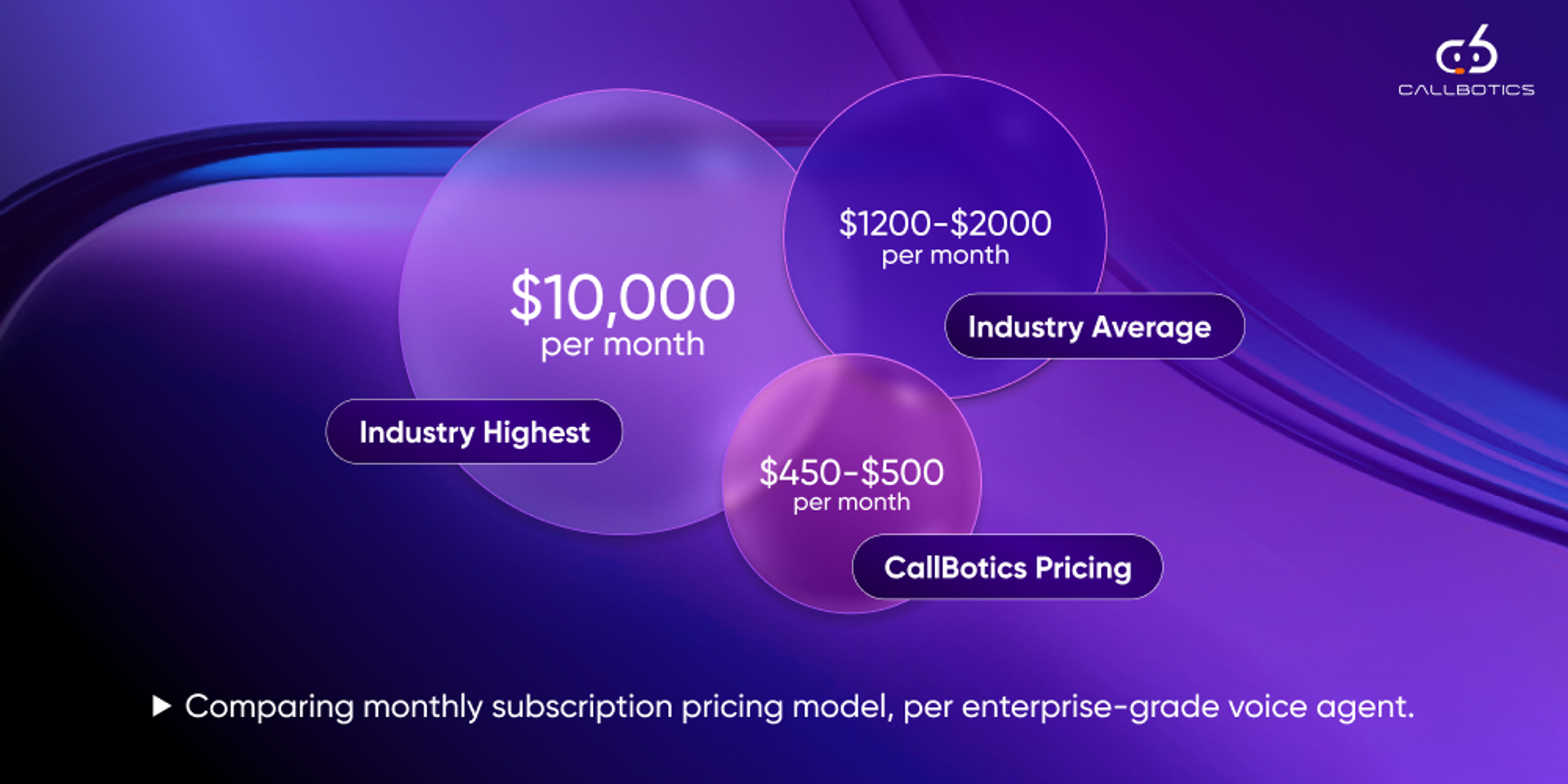
Subscription-based pricing offers a fixed monthly or annual fee for access to the platform, giving teams cost stability and operational clarity. Basic plans in these models offer predictable monthly costs and are ideal for businesses with consistent call volumes. The enterprise-grade pricing average for this model costs around $1200-$2000.
What it includes:
Pros:
Cons:
Basic plans may have limitations in support or included features.
Best fit: This model works best for teams that value predictable costs, controlled scaling, and long-term operational stability while running production-grade contact center workloads.
See how CallBotics’ subscription model delivers predictable costs, built-in support, and smooth scaling for real contact center operations.Usage-based pricing charges based on actual call minutes consumed.
Pay-as-you-go pricing allows businesses to pay only for actual usage, offering flexibility for variable or unpredictable call volumes.
Typical pricing:
Pros:
Cons:
Best fit: This model fits teams that want flexibility and are comfortable monitoring usage closely.
Hybrid models combine a base subscription with usage-based charges.
How it works
Mid-tier plans typically offer a bundled number of minutes (e.g., 2,000–5,000 per month) and additional features, making them attractive for growing businesses.
Advantages
Best fit: Hybrid pricing is common among vendors targeting mid-market and enterprise buyers. Enterprise plan options are available for organizations requiring advanced features, high concurrency, and custom support.
Voice AI pricing is rarely driven by minutes alone. While usage-based rates may look simple upfront, the true cost is shaped by intelligence, scale, and enterprise requirements.
Feature complexity, such as advanced AI capabilities like sentiment analysis or multilingual support, can significantly increase costs due to the additional development and integration effort required. As platforms move beyond basic automation into complex, real-time conversations, pricing increasingly reflects capability rather than call volume.
A solution that seems affordable at low usage can become expensive as call volumes grow, concurrency increases, and integrations or compliance needs are added.
The total cost of ownership includes not just per-minute rates but also expenses related to integrations, compliance, and ongoing support. Understanding these cost drivers upfront helps teams avoid surprises and choose a pricing model that remains predictable as operations scale. Here are some factors to consider:
Advanced AI capabilities increase costs significantly. Feature complexity, such as the inclusion of sentiment analysis or multilingual support, is a key factor in determining overall costs.
Examples include:
Platforms using advanced large language models with real-time processing naturally cost more than rule-based systems.
Two metrics that matter the most here are:
First, the ability to handle concurrent calls efficiently is crucial for scaling operations and managing costs. AI voice agents can manage multiple simultaneous calls, which allows businesses to serve more customers at once without increasing staffing costs.
Second, usage volume is a key factor. Estimating how many calls your business expects to handle is essential for accurate budgeting and cost control. By analyzing your expected call frequency, you can better assess the potential cost savings and operational efficiency gained from implementing an AI voice agent.
Platforms designed for high concurrency can efficiently manage multiple concurrent calls, reducing latency and improving reliability. A platform that looks affordable at 5,000 minutes may become expensive at 100,000 minutes if concurrency pricing is restrictive.
Enterprise use cases often require:
Custom development may be required for complex integrations or unique workflows, which can increase implementation costs.
Some providers include integrations in base plans. Others charge separately for setup, connectors, or ongoing maintenance.
Some platforms offer a visual flow builder, allowing users to design conversation flows without coding.
Regulated industries like healthcare, insurance, and finance add cost layers.
These may include:
Integration with the public switched telephone network (PSTN) may also be required for certain industries, adding another layer of compliance and cost.
Enterprise support plans often cost more than the AI itself. Technical support and dedicated support are often included in higher-tier plans to ensure smooth operation and compliance.
Many voice AI platforms appear cost-effective at first glance, but total spend often increases once real-world usage begins. Overage charges, concurrency limits, integration fees, and premium support costs can quietly inflate monthly bills, especially as call volumes scale. Implementation costs, such as onboarding, training, and customization, can also be a significant part of the total spend.

Understanding these hidden cost drivers upfront helps teams avoid budget surprises and choose a pricing model that stays predictable over time. Some providers offer custom pricing to accommodate unique business needs and usage patterns.
Here are some hidden fees to look out for:
Natural voices and less common languages usually cost more.Some platforms charge:
This adds up quickly for global operations.
Watch for:
These are often buried in pricing pages or contracts.
Some providers charge:
These costs are easy to miss during evaluation.
Discover how CallBotics provides predictable, flexible voice AI pricing that scales with your contact center, eliminating unexpected costs.Comparing voice AI providers requires looking beyond headline pricing. Selecting the right voice AI platform involves evaluating cost, features, and integration capabilities to ensure it fits your business goals and team requirements. The true value of a platform lies in its feature depth, scalability, and ability to support real-world workflows without hidden trade-offs.
For businesses seeking the most cost-effective AI voice agent, it's essential to strike a balance between low cost and key features and reliability, thereby avoiding performance sacrifices. Voice AI agents can automate high-frequency and predictable voice workflows, improving efficiency and cost-effectiveness for your team. Some platforms offer advanced call routing features, allowing businesses to route calls automatically based on customer needs and streamline communication workflows.
Let’s understand different pricing tiers that actually help teams choose a solution that aligns with their use case, volume, and long-term operational needs:
At a high level:
Choose based on your reality, not your demo.
The choice of AI voice is a critical factor in shaping how customers perceive your brand during voice interactions. A natural, expressive AI voice can foster trust and make conversations feel more personal, while a monotone or robotic voice may detract from the customer experience.
When evaluating AI voice options, consider the tone, pitch, and language capabilities to ensure they align with your brand’s personality and your customers’ expectations. Many leading voice AI platforms now offer custom voices, allowing businesses to create a unique brand voice that stands out in the market.
Customization options also enable you to tailor the AI voice to specific use cases or customer segments, further enhancing engagement and satisfaction.
A simple estimation approach helps avoid surprises. Estimation can be a great way to have a predictable pricing strategy, even when you opt for a per-minute pricing model. Since most AI voice agent cost pricing is based on actual usage, such as per minute, per interaction, or per task, accurately estimating actual usage is crucial for effective budgeting.
Managing conversation history is also important, as trimming or limiting conversation history can help control token usage and reduce costs in AI-powered systems that use token-based billing.
Basic formula:
Expected monthly minutes × per-minute rate + fixed fees
Actual usage, measured in minutes or interactions, is the primary factor in determining monthly costs.
For example:
Estimated monthly cost:
Pro Tip: To avoid any unpleasant surprises, always factor in peak months with the heaviest call flows, not averages.
Call volumes rarely stay flat. There are times when your support team might experience sudden high volumes of calls. This can happen because of a number of factors. So, make sure you consider:
In such cases, your pricing model can unexpectedly exceed your budget. A platform that looks affordable today may double in cost within six months if pricing is not designed for scale.
Many AI voice platforms monetize complexity through add-ons and hidden fees. CallBotics takes a different approach by focusing on clarity, scale, and operational ROI. CallBotics offers custom pricing and paid plan options to accommodate the unique needs of enterprise-grade businesses.

Enterprise pricing is available for organizations requiring high-volume support, custom features, and dedicated support to ensure scalability and flexibility.
1. No Setup Fees, No Surprises: CallBotics does not charge any extra implementation or onboarding fees, as the pricing is all-inclusive. Teams can go live without upfront costs that delay ROI.
2. Customizable Pricing Models: CallBotics offers flexible pricing with both per-minute and per-agent subscription options. Custom pricing allows businesses to tailor their plan to specific usage patterns and feature requirements. Pricing remains transparent and usage-aligned, without inflated bundles or locked feature tiers.
3. Faster ROI: Higher call resolutions, around 80% end-to-end resolutions, mean fewer handoffs to human agents. This directly reduces staffing costs and operational overhead, accelerating payback.
4. Enterprise-Ready Features:
Core capabilities of CallBotics voice agents include:
Dedicated support is provided to enterprise customers for implementation and ongoing success.
Teams do not need to upgrade just to access essentials.
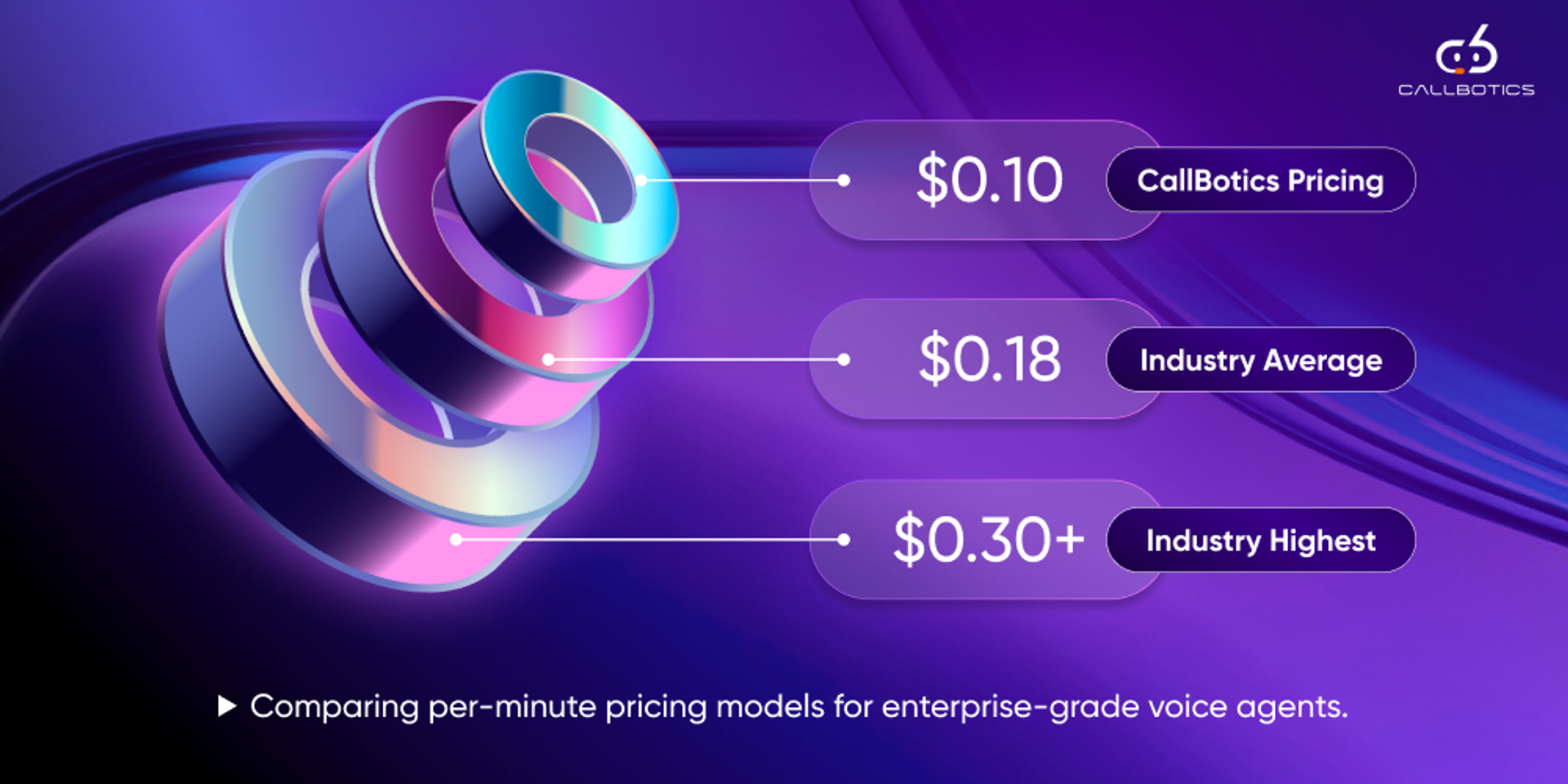
When benchmarked against comparable voice AI platforms, CallBotics follows a more predictable, operator-friendly pricing model that can lead to significant savings compared to traditional pricing models:
The total cost of ownership is lower due to transparent pricing and included features. Predictable monthly costs make budgeting easier for enterprise customers.
This approach simplifies long-term budgeting and provides cost certainty for enterprise-scale contact center operations.
AI voice agent pricing in 2026 is about finding a scalable pricing model without sacrificing your growth, workflow complexity, and risk tolerance. When planning your budget, consider the full range of capabilities an AI agent offers. An AI agent can handle calls, qualify leads, answer FAQs, and integrate with your existing business tools, all of which may impact your overall costs and should be factored into your budget planning.
The smartest buyers:
Platforms like CallBotics reflect where the market is heading. Clear pricing, scalable design, and ROI-driven automation are becoming table stakes rather than differentiators.

Urza Dey (She/They) is a content/copywriter who has been working in the industry for over 5 years now. They have strategized content for multiple brands in marketing, B2B SaaS, HealthTech, EdTech, and more. They like reading, metal music, watching horror films, and talking about magical occult practices.
See how enterprises automate calls, reduce handle time, and improve CX with CallBotics.
CallBotics is an enterprise-ready conversational AI platform, built on 18+ years of contact center leadership experience and designed to deliver structured resolution, stronger customer experience, and measurable performance.