Salesforce has long been the operational backbone for customer data across sales, service, and support teams. It captures interactions, tracks opportunities, and structures workflows across the customer lifecycle.
But in most organizations, execution still happens outside the system.
Calls are handled through separate telephony tools. Notes are added manually after conversations. Follow-ups depend on individual discipline. And critical context often gets lost between touchpoints.
This creates a fundamental gap:
Salesforce stores customer intelligence, but it does not always act on it in real time.
At the same time, customer expectations have shifted toward immediacy, continuity, and contextual engagement across every interaction.
This is where AI voice agents come in.
An AI voice agent integrated with Salesforce transforms the platform from a system of record into a real-time execution layer. It enables organizations to automate conversations, trigger workflows during interactions, and continuously sync outcomes back into Salesforce without manual intervention.
Instead of treating calls as isolated events, every conversation becomes part of a structured, data-driven workflow that updates the CRM, drives actions, and moves customer journeys forward.
This guide explains how AI voice agents integrate with Salesforce, how they automate calling and CRM workflows, and how enterprises use them to scale sales and support operations.
AI voice agents are conversational systems designed to handle real-time voice interactions while executing tasks directly within business systems like Salesforce.
They combine multiple technologies into a single operational layer:
Unlike traditional telephony systems, AI voice agents are not limited to routing or basic automation.
They are capable of:
The system converts spoken language into machine-readable input and generates natural voice responses. Modern systems are designed to handle accents, interruptions, and conversational variability.
AI identifies the purpose behind a conversation, not just keywords. This allows it to understand whether a user wants to resolve an issue, schedule a meeting, or check an order status.
Instead of following rigid scripts, the AI dynamically adjusts conversations based on user input, context, and CRM data.
This is where AI voice agents fundamentally differ from legacy systems. They don’t just understand conversations; they act on them by updating Salesforce records, triggering automations, and completing tasks.
Traditional Salesforce telephony integrations often rely on:
These systems operate outside Salesforce and require human intervention to complete workflows.
AI voice agents operate differently.
They function inside the Salesforce ecosystem as an execution layer where:
The result is a shift from fragmented communication systems to a unified, intelligent interaction model.
As Salesforce adoption has scaled across enterprises, a consistent pattern has emerged.
The platform excels at managing structured customer data, but execution still depends heavily on manual processes.
This gap becomes more visible as organizations grow.
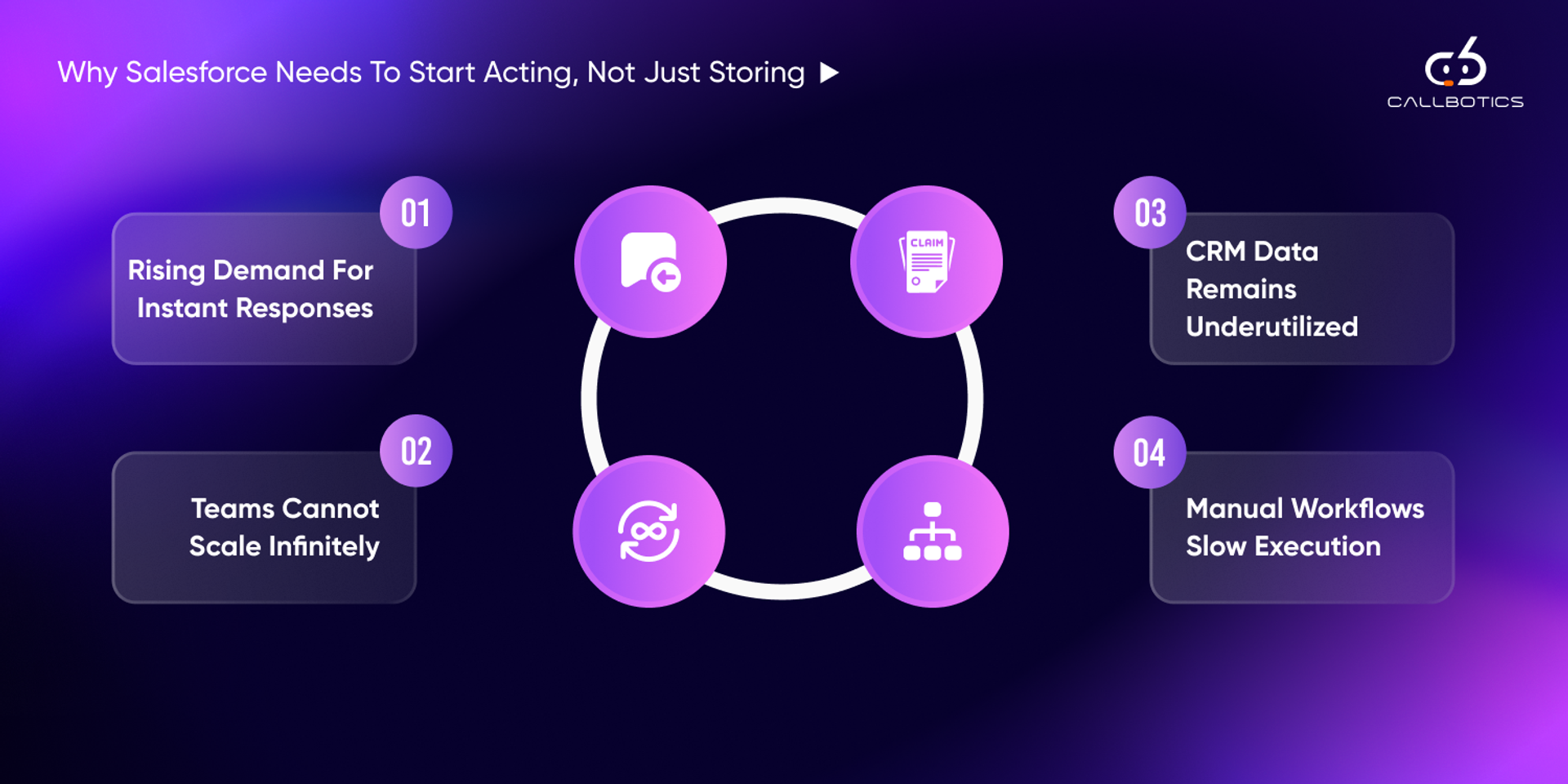
Customers now expect:
Delays or repetitive questioning reduce engagement and impact conversion rates.
Sales and support teams face structural limitations:
Even high-performing teams cannot scale infinitely.
In many Salesforce environments:
This fragmentation reduces Salesforce’s effectiveness as a decision-making system.
Common operational challenges include:
These issues directly impact revenue and customer experience.
Organizations are moving toward systems where:
AI voice agents enable this shift by connecting conversations directly to Salesforce workflows.
Instead of relying on human effort to bridge the gap between interaction and execution, AI closes that loop instantly.
When integrated effectively, Salesforce and AI voice agents create a system where:
This creates a continuous feedback loop where:
Salesforce evolves from a static system of record into a dynamic system that actively drives customer engagement and business outcomes.
AI voice agents access Salesforce data in real time, including:
This enables conversations that are:
Instead of restarting every interaction, the AI continues from where the last one ended.
One of the biggest operational inefficiencies in Salesforce environments is manual data entry.
AI voice agents eliminate this entirely.
They automatically:
This ensures that Salesforce remains:
AI voice agents can execute actions during or immediately after conversations.
These include:
This creates a closed-loop system where:
Voice interactions generate valuable insights that often remain unstructured in traditional systems.
AI voice agents extract and structure this data, including:
This data is stored directly in Salesforce, enabling:
Unlike human-led processes, AI voice agents ensure:
This allows organizations to scale operations without compromising performance or accuracy.
AI voice agents integrate with Salesforce by acting as a real-time bridge between voice interactions and CRM data.
Instead of treating calls as external activities that are logged later, the integration ensures that:
This creates a tightly coupled system where voice is not a channel layered on top of Salesforce, but an operational layer embedded within it.
Integration begins with secure access to Salesforce data.
AI voice platforms typically connect using:
This ensures that the AI agent:
Security is not an afterthought here. It is foundational to enabling real-time execution.
For AI voice agents to operate effectively, conversations must translate into structured CRM data.
This requires mapping voice interaction outputs to Salesforce objects:
During a call, the AI continuously:
This ensures that every conversation becomes a fully documented, actionable record.
Salesforce environments typically rely on CTI (Computer Telephony Integration) frameworks to manage voice interactions.
AI voice agents integrate through:
This enables:
Unlike traditional dialers, AI voice agents do not just connect calls; they also engage callers. They actively participate in and manage the interaction.
One of the defining characteristics of AI voice agents is their ability to update Salesforce during a conversation.
For example:
This eliminates:
Salesforce becomes a live system, not a retrospective one.
Not all interactions can or should be fully automated.
AI voice agents are designed to escalate intelligently when needed.
This includes:
Webhooks and event triggers ensure that:
When a human takes over, they receive:
This removes friction from handoffs and improves resolution speed.
Successful deployment is not just about integration. It requires careful design of workflows, data structures, and conversation logic.
The most effective implementations start with clearly defined use cases.
Focus areas typically include:
Examples:
Each use case requires:
The goal is not to automate everything, but to automate the right things.
Salesforce deployments often operate in regulated environments, making compliance critical.
AI voice systems must support:
Additionally:
This ensures alignment with regulations such as GDPR and industry-specific compliance standards.
AI voice agents must be tested in real-world conditions, not just controlled scenarios.
Key steps include:
Testing should cover:
Because production environments are unpredictable, and the system must handle variability gracefully.
AI voice agents unlock multiple use cases across sales, support, and operations.
AI agents can:
This reduces:
For sales teams, AI voice agents enable:
Instead of relying on SDR availability, outreach becomes:
AI voice agents can:
This removes the back-and-forth typically required for scheduling.
AI helps optimize inbound operations by:
This improves:
AI voice agents can also activate dormant Salesforce data by:
This ensures that:
AI voice agents bring full visibility into Salesforce-driven operations by turning every conversation into structured, analyzable data.
Instead of relying on sampled QA or incomplete reporting, organizations can monitor 100% of interactions in real time. This includes operational metrics such as containment rate, average handling time, and escalation frequency, as well as deeper insights like intent accuracy, objection patterns, and conversion signals.
Because all interaction data is written directly into Salesforce, reporting becomes both operational and strategic. Teams can track how conversations influence pipeline movement, case resolution speed, and customer experience outcomes.
Over time, this creates a continuous feedback loop where:
The result is a system that not only executes but also learns and optimizes continuously.
Learn more about how to automate inbound calls in 2026 with AI Voice Agents.
AI voice agents should handle scale, while human agents handle complexity. Seamless escalation with full context ensures smooth transitions and that customers do not have to repeat information.
Adoption improves when teams understand how AI-driven updates appear in Salesforce and how to collaborate with automated workflows. This reduces friction and increases operational efficiency.
AI systems improve through iteration. Regularly analyzing transcripts, refining intents, and optimizing workflows ensures higher accuracy and better outcomes over time.
Clear communication about AI usage builds trust. Customers should be informed and always have the option to escalate to a human agent when needed.
Scaling AI voice automation within Salesforce requires alignment across infrastructure, workflows, and ownership.
Organizations must plan for:
Pricing should not be evaluated in isolation. While usage-based costs are visible, the real impact comes from reduced manual effort, improved data accuracy, faster response times, and increased pipeline velocity.
The focus should be on total operational value, not just cost per interaction.
| Feature | AI Voice Agents | Traditional CTI / Dialer |
|---|---|---|
| Automation | End-to-end workflow execution | Limited |
| Data capture | Automatic and structured | Manual |
| Personalization | CRM-driven and dynamic | Agent-dependent |
| Scalability | High concurrency | Limited by team size |
| Availability | 24/7 | Business hours |
Choosing the right AI voice agent requires evaluating how well it performs within real Salesforce workflows, not just in isolated demonstrations.
A strong solution must provide deep CRM integration that enables it to read and write Salesforce data dynamically during conversations. Basic integrations that only log activities are not sufficient for enterprise use.
Real-time performance is equally critical. Conversations must feel natural, with low latency and the ability to handle interruptions, pauses, and multi-step interactions without breaking flow.
Workflow flexibility determines long-term scalability. The system should support conditional logic, multi-step automation, and complex decision-making aligned with Salesforce processes.
Finally, compliance and security are essential. Enterprise deployments require encryption, consent management, audit logging, and role-based access controls to ensure data governance and regulatory compliance.
Learn more about how to integrate AI voice agents with your CRM.
Enterprises choose CallBotics because it is designed for production-scale execution inside Salesforce, not just conversational automation.
Many platforms demonstrate strong capabilities in controlled environments but struggle when deployed in real-world conditions where workflows are complex, volumes are high, and data accuracy is critical.
CallBotics is built specifically to operate in these environments.
It is designed for scenarios where:
CallBotics is engineered to handle high-volume inbound and outbound interactions without compromising conversational quality or system performance. It supports parallel execution at scale, enabling consistent engagement across large datasets.
AI voice agents operate directly within Salesforce, accessing and updating data across contacts, leads, cases, and opportunities in real time.
Every interaction:
This ensures that Salesforce remains continuously accurate and actionable.
CallBotics focuses on completing tasks, not just conversations.
During interactions, the system can:
Each conversation results in a clear, measurable outcome.
All interactions are captured, structured, and analyzed, providing complete visibility across voice operations.
Teams gain:
This eliminates reliance on partial QA and enables data-driven decision-making.
CallBotics supports enterprise requirements, including secure data handling, consent tracking, audit logs, and role-based access control.
At the same time, its deployment model enables rapid implementation, allowing teams to move from initial setup to production without extended timelines.
Salesforce is a powerful system for managing customer data, but it does not execute workflows automatically.
AI voice agents bridge this gap by connecting conversations directly to actions. They enable organizations to automate interactions, update CRM data in real time, and trigger workflows without manual effort.
This transforms Salesforce from a passive system of record into an active execution engine.
As AI adoption continues to grow, voice automation is becoming a core operational layer within Salesforce ecosystems, driving efficiency, consistency, and improved customer experience at scale.

Urza Dey (She/They) is a content/copywriter who has been working in the industry for over 5 years now. They have strategized content for multiple brands in marketing, B2B SaaS, HealthTech, EdTech, and more. They like reading, metal music, watching horror films, and talking about magical occult practices.
See how enterprises automate calls, reduce handle time, and improve CX with CallBotics.
CallBotics is an enterprise-ready conversational AI platform, built on 18+ years of contact center leadership experience and designed to deliver structured resolution, stronger customer experience, and measurable performance.