Appointment scheduling calls are among the most repetitive and operationally intensive interactions in many organizations. Healthcare clinics, financial services firms, automotive service centers, legal offices, home services businesses, and retail appointment desks all manage a constant flow of booking, rescheduling, cancellation, confirmation, and reminder calls.
These calls are necessary. They directly impact revenue utilization, customer experience, and operational efficiency. Yet they are highly structured, rule-driven, and time-consuming.
When handled manually, scheduling calls creates predictable challenges:
Automation changes this equation.
Modern AI voice agents allow organizations to automate appointment scheduling calls while maintaining structured workflows, policy enforcement, and calendar accuracy. Booking, rescheduling, confirmations, reminders, and escalation logic can be handled in real time without expanding headcount.
The result is not simply faster call handling. It is better slot utilization, fewer no-shows, improved customer convenience, and measurable operational efficiency.
If voice remains a primary booking channel for your organization, appointment call automation is no longer optional infrastructure. It is an operational multiplier.
Automating appointment scheduling calls means using AI voice agents to handle structured scheduling interactions without requiring a human agent to manage every step.
Automation can manage:
Instead of manually checking availability, collecting customer details, and confirming appointments over the phone, AI voice agents follow predefined workflow logic and business rules.
At its core, scheduling automation connects three elements:
When properly implemented, the system mirrors how a trained front-desk team member operates, while applying policies consistently across every interaction.
For a broader look at how AI transforms call-heavy workflows, read about how to use AI agents to analyze phone calls and unlock insights.
The shift toward automation is driven by scale, consistency, and customer expectations.
Scheduling calls is predictable. Volume fluctuates by time of day and season. Staff capacity does not.
Automation helps stabilize that imbalance.
When lines are busy, callers hang up. When after-hours calls go unanswered, booking intent is delayed or lost. Even small gaps in responsiveness compound over time.
AI voice agents answer instantly. Every call is acknowledged. Booking intent is captured even during peak demand.
For organizations in industries like healthcare, insurance, or retail services, missed calls directly translate to unused time slots and lost revenue.
Learn more about how automation in high-volume environments is handled through AI voice agents.
Front desk teams spend a significant portion of their time on routine scheduling tasks. These interactions follow structured scripts:
Automation handles this structured work consistently, allowing staff to focus on complex inquiries, in-person interactions, and high-value conversations.
The goal is not replacement. It is workload optimization.
Customers increasingly expect flexibility. They want to book or reschedule:
When scheduling systems are accessible only during office hours, friction increases.
AI voice agents enable continuous booking availability without increasing payroll or expanding shifts.
This is especially impactful in industries such as:
Unconfirmed appointments lead to empty slots. Empty slots impact revenue and operational efficiency.
Automated reminder flows:
Structured reminder workflows consistently improve attendance rates.
Organizations often underestimate the cumulative cost of no-shows until they measure it systematically.
For a deeper understanding of call data measurement, read more about how AI voice analytics work.
Appointment automation is not a basic answering system. It is a structured operational workflow that replaces a predictable portion of front-desk labor with consistent, policy-driven execution.
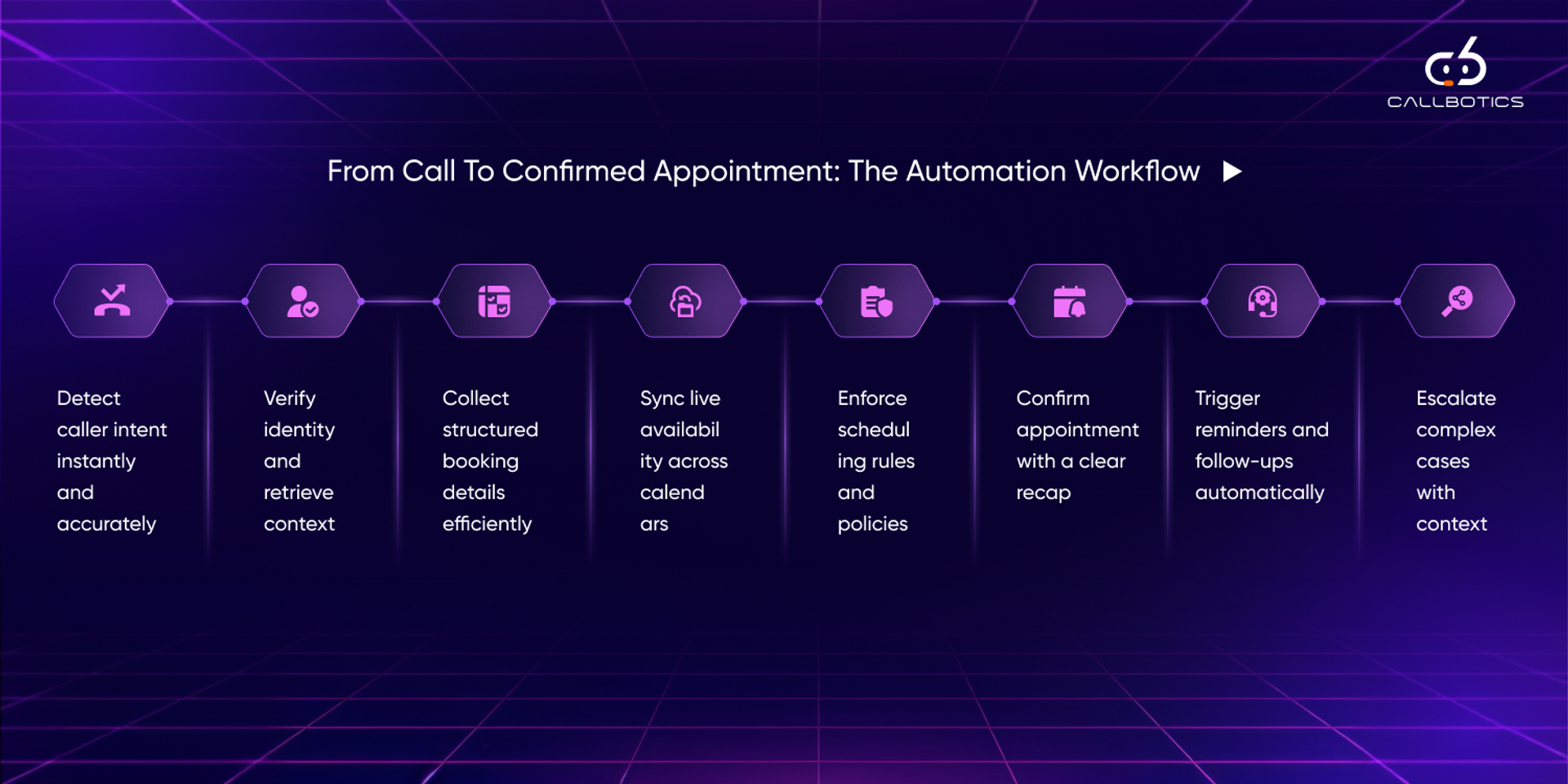
To understand how it works, it helps to examine the full lifecycle of a scheduling interaction.
Every appointment call begins with a classification problem.
Is the caller:
Traditional IVR systems rely on menu trees. Modern AI voice agents interpret natural language input. A caller might say:
“I need to move my appointment from Friday.” “Do you have anything earlier next week?” “I want to book a consultation.” “I’m confirming my appointment for tomorrow.”
The system maps this language to structured intent categories.
Accurate intent detection reduces routing errors and eliminates the need for rigid prompt navigation. It also ensures that the workflow branch selected matches the operational action required.
In high-volume environments, this first step directly impacts resolution rate.
Before gathering booking details, the system must establish identity and context.
For existing customers, this includes:
For new customers, this includes:
Context matters. A returning patient in a healthcare clinic may require eligibility verification. A financial advisory client may need regulatory disclosures. An automotive service customer may have vehicle data tied to prior appointments.
Automation becomes reliable only when it understands the surrounding customer data environment.
Once intent and identity are clear, the system moves into structured data collection.
For new bookings, this typically includes:
Well-designed automation does not simply ask open-ended questions. It narrows options intelligently.
For example:Instead of asking “What time would you like?”, the system may ask: “Would you prefer morning or afternoon?”
This reduces ambiguity and improves scheduling efficiency.
Structured prompts improve:
This is the operational backbone of scheduling automation.
The AI voice agent connects via API to:
It evaluates:
For example, in healthcare:A 30-minute appointment may require a 10-minute buffer before the next patient.
In automotive services:A tire rotation may require 45 minutes, but a full diagnostic requires 90 minutes and access to specific equipment.
In financial advisory:Initial consultations may be longer than follow-ups.
Automation must apply these operational rules dynamically.
Without real-time integration and rule enforcement, automation cannot guarantee accuracy.
Scheduling teams rely on defined business rules. Automation ensures those rules are applied consistently across every interaction.
Common policy checks include:
For example:“If you cancel within 24 hours, a cancellation fee applies.”“We cannot reschedule more than twice without approval.”“Same-day appointments are subject to availability.”
Embedding these policies into the workflow reduces manual error and ensures uniform enforcement.
After a valid slot is selected, confirmation is more than repetition.
Effective confirmation includes:
This structured recap reduces downstream confusion and follow-up calls.
Automation can also trigger immediate digital confirmation via SMS or email, including calendar invites.
Scheduling automation extends beyond the live call.
Post-call workflows may include:
For example:A healthcare clinic may send a reminder 48 hours before, followed by a same-day reminder with fasting instructions.
An automotive center may send a reminder with drop-off instructions.
A legal office may send documentation requirements.
These workflows improve appointment preparedness and reduce no-shows.
No scheduling system is complete without exception logic.
Escalation may trigger when:
Escalation should include:
This ensures that staff do not repeat previously gathered information.
High-performing deployments treat escalation as a structured branch, not a failure.
Appointment automation is most effective when applied to predictable, repeatable scheduling interactions.
When a customer calls to book for the first time, the conversation usually starts broadly and becomes more specific.
They may say, “I need to see someone about an earache,” or “I’d like to schedule a consultation.”
From there, the system guides them naturally through the right questions, confirming the service type, preferred dates, provider availability, and any required details.
Instead of jumping between screens or manually checking rules, the workflow quietly handles intake, record creation, slot matching, and policy checks in the background. The caller experiences a smooth conversation. The business gets a complete, structured booking with confirmation sent immediately.
This approach works especially well in healthcare scheduling, insurance consultations, financial advisory appointments, automotive service centers, and home services dispatch, where accuracy and completeness matter.
Rescheduling often takes longer than a new booking because it requires context. Traditionally, staff must locate the original appointment, review the service type, confirm policy eligibility, and then search for new availability.
In a conversational automated flow, that context is retrieved instantly. The system confirms the existing booking, checks cancellation windows, offers alternative slots, and updates the calendar in real time.
For the caller, it feels like a simple adjustment. Operationally, it prevents voicemail build-up and reduces callback queues that typically follow high reschedule volume periods.
Confirmation calls are not just reminders. There are moments to reinforce clarity.
A conversational confirmation can verify attendance, repeat key details, remind the caller of preparation requirements, and even offer rescheduling options if needed. If confusion or hesitation is detected, the workflow can escalate appropriately.
This proactive confirmation approach improves attendance predictability and helps teams plan staffing with greater confidence.
Reminder flows become more effective when they are contextual rather than generic.
A routine check-up may require a simple reminder, while a high-value consultation or historically high no-show appointment may trigger additional prompts.
The system can adapt based on appointment type, risk profile, and past behavior patterns, ensuring the right level of follow-up without overwhelming the customer.
When cancellations occur, the opportunity cost of an empty slot can be high. Instead of manually calling down a list, the system can automatically identify waitlisted customers, contact them conversationally, confirm acceptance, and update the calendar instantly.
The process feels seamless to the caller, while the business benefits from higher utilization and improved revenue efficiency.
Automation succeeds when foundational systems are aligned.
Live calendar access is non-negotiable.
Static exports or delayed synchronization introduce booking conflicts.
Ensure API connectivity and bidirectional updates.
Document:
Ambiguous rules create inconsistent automation behavior.
Maintain:
Automation relies on structured data integrity.
Establish:
Clear escalation of ownership ensures continuity.
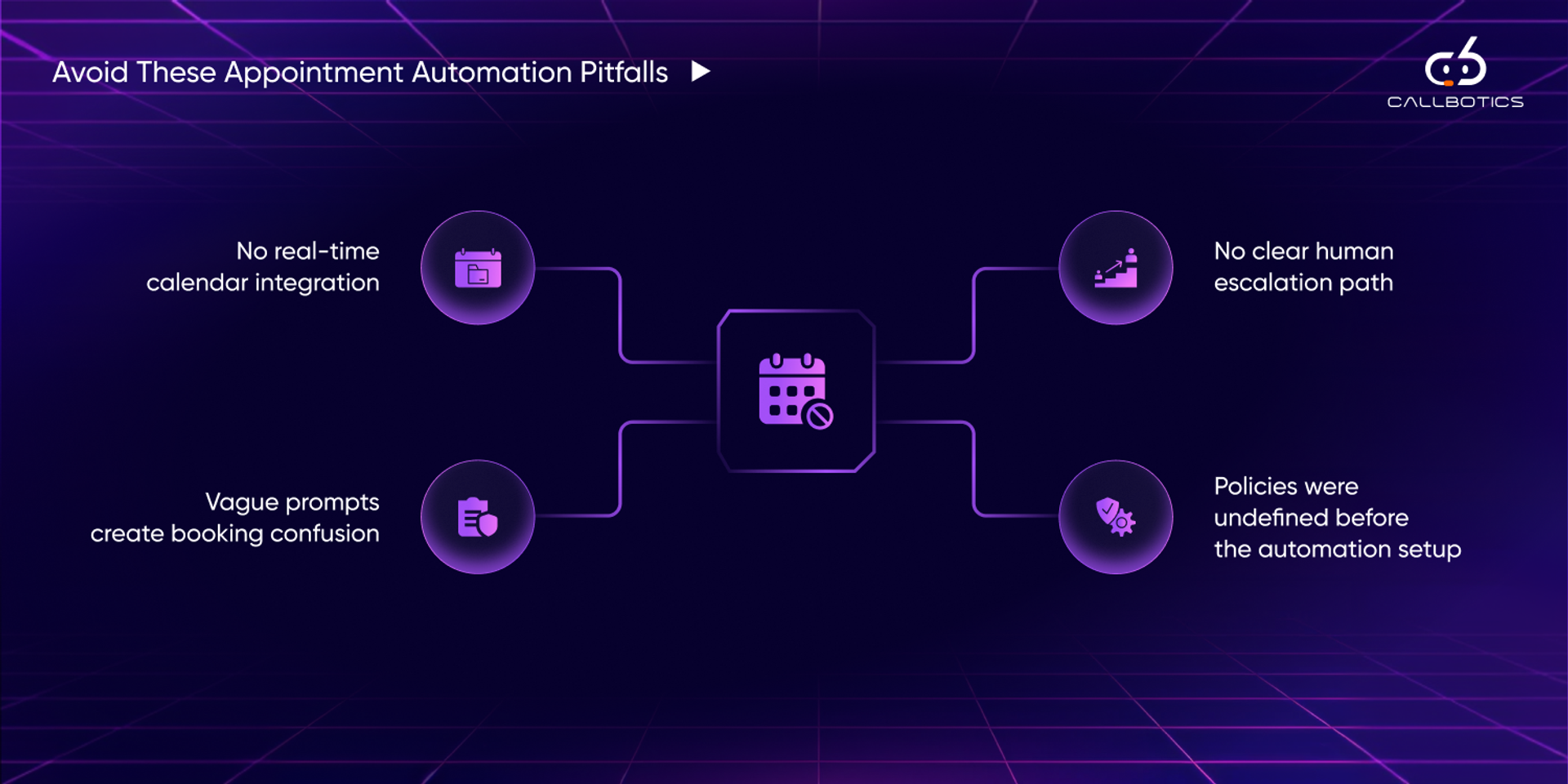
Appointment automation delivers the best results when it is implemented with operational discipline. The most common challenges are not technical limitations, but configuration gaps.
Automation without live calendar access creates scheduling conflicts. If availability is not synced through APIs, the system risks offering outdated time slots or requiring manual correction. Real-time synchronization is foundational for transactional reliability.
Scheduling conversations works best when guided. Open-ended prompts increase ambiguity and call duration. Structured, narrowing questions improve slot matching, reduce confusion, and increase first-call resolution.
Not every call should be fully automated. Urgent cases, policy disputes, and exception-heavy requests require a clear transfer process. Escalation logic must be predefined and include full context handoff.
If booking windows, cancellation rules, deposits, and buffer times are not clearly defined, automation will reflect that ambiguity. Consistency depends on well-documented operational rules.
For more on designing structured AI workflows, you should read: How to Use AI Agents to Analyze Phone Calls and Unlock Insights.
Automating scheduling at scale requires more than answering calls. It requires workflow precision, real-time integration, quality oversight, and measurable outcomes.
CallBotics delivers enterprise-ready AI voice agents built specifically for structured, call-heavy operations.
CallBotics converts SOPs, training materials, and operational documentation into live AI voice agents in about 48 hours. Appointment logic, provider rules, buffer policies, and cancellation workflows are embedded directly into the system.
This enables fast deployment without extended development cycles.
Every scheduling interaction can be automatically evaluated for correctness, compliance, and policy adherence. This ensures booking accuracy and consistent rule enforcement across all calls.
The system detects emotional tone, escalation triggers, and conversational shifts. This helps identify booking friction, hesitation, or dissatisfaction during scheduling conversations.
Organizations gain visibility into booking conversion rates, cancellation trends, reminder performance, and escalation patterns. Workflow performance becomes measurable and optimizable.
Repeated cancellations or a negative tone during scheduling may signal risk. Churn intelligence surfaces these patterns early so teams can intervene appropriately.
Supervisors can listen in real time, provide guidance, or intervene when necessary. This is especially useful during peak periods or operational updates.
Latency tracking measures delays across the interaction pipeline, helping identify integration bottlenecks or performance slowdowns.
Large enterprises can manage multiple locations, providers, or brands within one system while maintaining distinct scheduling rules and centralized reporting.
Appointment scheduling calls are structured, repetitive, and operationally critical.
When connected to live calendar systems and clear business rules, AI voice agents can automate appointment scheduling calls with consistent accuracy. The result is improved slot utilization, reduced staff workload, fewer missed bookings, and greater customer convenience.
The most effective deployments combine workflow automation, quality monitoring, and analytics within a single system. Scheduling automation then becomes a measurable operational infrastructure rather than a standalone answering tool.

See how enterprises automate calls, reduce handle time, and improve CX with CallBotics.
CallBotics is an enterprise-ready conversational AI platform, built on 18+ years of contact center leadership experience and designed to deliver structured resolution, stronger customer experience, and measurable performance.