In modern contact centers, customer patience is measured in seconds. The moment a caller enters a queue, expectations are set, frustration begins to build, and every additional second influences how that interaction will end.
That is why the average speed of answer in call centers remains one of the most closely tracked performance indicators. It is simple, visible, and emotionally charged. Customers feel it immediately, and leaders see it reflected in dashboards every day.
But while ASA is easy to measure, it is often misunderstood.
Many teams focus on lowering the number without understanding what is driving it, or worse, they optimize for speed at the cost of resolution. The result is a contact center that answers calls quickly but still delivers a poor customer experience.
This guide breaks down what call center ASA actually measures, why it matters, what “good” ASA looks like, and how to think about it strategically rather than tactically.
Average speed of answer in call centers refers to the average time a caller waits in the queue before a live agent answers.
It starts counting only after the caller enters the queue. Time spent navigating IVR menus, listening to announcements, or selecting options is usually not included.
In simple terms, ASA answers one question:
“How long does it take for a customer to reach a human once they are waiting?”
The standard formula for call center ASA is:
Total wait time for answered calls ÷ Total number of answered calls
Example:
Average Speed of Answer = 25 seconds
This simplicity is why ASA is widely used as a core call center KPI. But it is also why it can be misleading when viewed in isolation.
Although they are often used interchangeably, the average speed of answer and the average wait time in call centers are not identical.
The average speed of answer typically measures wait time only for calls that were answered
Average wait time in call centers may include abandoned calls, depending on how it is calculated
This distinction matters.
If many callers hang up before reaching an agent, ASA may appear healthy while customer experience deteriorates. In other words, ASA can improve on paper even as frustration increases in reality.
That is why experienced operators never evaluate ASA without context.
Long wait times signal one thing to customers: their time is not valued.
Even when an issue is eventually resolved, excessive waiting erodes trust and increases the likelihood of complaints, negative reviews, and churn. Customers may forgive a slow resolution, but they rarely forgive being ignored.
Furthermore, speed is now the primary currency of trust. In the Salesforce State of the Connected Customer, 64% of consumers say their definition of a 'timely interaction' is an instant, real-time response. When ASA creeps up, you are directly violating the expectation of 2/3 of your audience."
This is why call center ASA is closely tied to CSAT and NPS scores.
Many organizations define service-level agreements around answer times, such as answering 80 percent of calls within 20 seconds.
Failing to meet these SLAs can result in:
In regulated or enterprise environments, ASA is not just an operational metric. It is a contractual obligation.
High ASA often means agents are under constant pressure, juggling overflowing queues and frustrated callers. This leads to:
Ironically, trying to force agents to answer faster without addressing root causes often makes performance worse, not better.
There is no universal “perfect” ASA. What is considered acceptable depends on the industry, the urgency of calls, and customer expectations.
That said, common benchmarks help set a baseline.
| Industry | Common ASA Range |
|---|---|
| Retail | 20–30 seconds |
| Healthcare | 30–60 seconds |
| Banking and Financial Services | 20–40 seconds |
| Telecommunications | 30–45 seconds |
| Travel and Hospitality | 15–30 seconds |
| Technical Support | 30–60 seconds |
These numbers provide guidance, not rules.
For example, a 45-second wait for a billing inquiry may be acceptable, while a 30-second wait for fraud reporting may feel intolerable.
The real goal is not to chase a number, but to align answer speed with customer intent and urgency.
Many teams fall into the trap of treating ASA as a standalone success metric. This often leads to unintended consequences.
Lowering ASA without improving routing or staffing can result in:
In these scenarios, improving call center efficiency becomes impossible because speed is optimized at the expense of outcomes.
ASA should be viewed as a signal, not a goal.
To be meaningful, call center ASA must be evaluated alongside other call center KPIs, such as:
Only when these metrics are viewed together can leaders truly understand performance and identify where intervention is needed.
When the average speed of answer in call centers starts climbing, most teams jump to the same conclusion: “We need more agents.”
Adding agents is often a temporary fix for a structural problem. A recent McKinsey analysis on Agentic AI found that 35% of organizations now plan to automate over 60% of inbound inquiries by 2028 to stabilize their service levels.
In reality, staffing is only one piece of the puzzle. High call center ASA is usually a symptom of deeper structural problems.
Let’s break down the most common causes.
Yes, understaffing increases average wait time in call centers. But most high-ASA environments are not permanently understaffed. They are misaligned.
Common issues include:
When forecasting models rely only on historical averages, they fail to account for:
This results in queues forming faster than agents can absorb them.
Even with enough agents, poor routing can cripple the call center ASA.
Examples include:
When customers land in the wrong queue, they wait longer and often get transferred. Each transfer resets frustration, even if ASA looks acceptable on paper.
Routing inefficiency directly undermines efforts to improve call center efficiency.
Call centers are rarely overwhelmed gradually. They break suddenly.
Common spike triggers:
During spikes, ASA rises exponentially rather than linearly. Queues compound faster than human teams can respond.
Without elastic capacity, average speed of answer in call centers becomes unpredictable and unmanageable.
ASA and AHT are tightly linked.
When handle times increase:
Causes of long AHT include:
Lowering AHT responsibly is one of the most effective ways to reduce average wait time in call centers without sacrificing quality.
Reducing ASA is not about speed alone. It is about flow, predictability, and removing friction.
Below are proven, scalable strategies for reducing ASA while improving the customer experience.
Modern workforce management goes beyond static schedules.
High-performing centers:
This prevents queues from forming before corrective action is taken.
Intent-based routing significantly lowers call center ASA by ensuring:
Routing should consider:
This alone can reduce wait times without adding headcount.
Not every call needs an agent.
High-volume, repetitive inquiries are the biggest contributors to rising ASA. Examples include:
By deflecting these calls through IVR, chat, or voice automation, teams free up agents to handle complex interactions.
This directly improves ASA by reducing queue volume.
Callback technology does not eliminate waiting, but it changes how waiting feels.
Benefits include:
From a metrics perspective, callbacks help stabilize average wait time in call centers during surges.
Rigid skill silos limit responsiveness.
Cross-trained agents:
This flexibility is critical for maintaining consistent call center ASA during unpredictable demand.
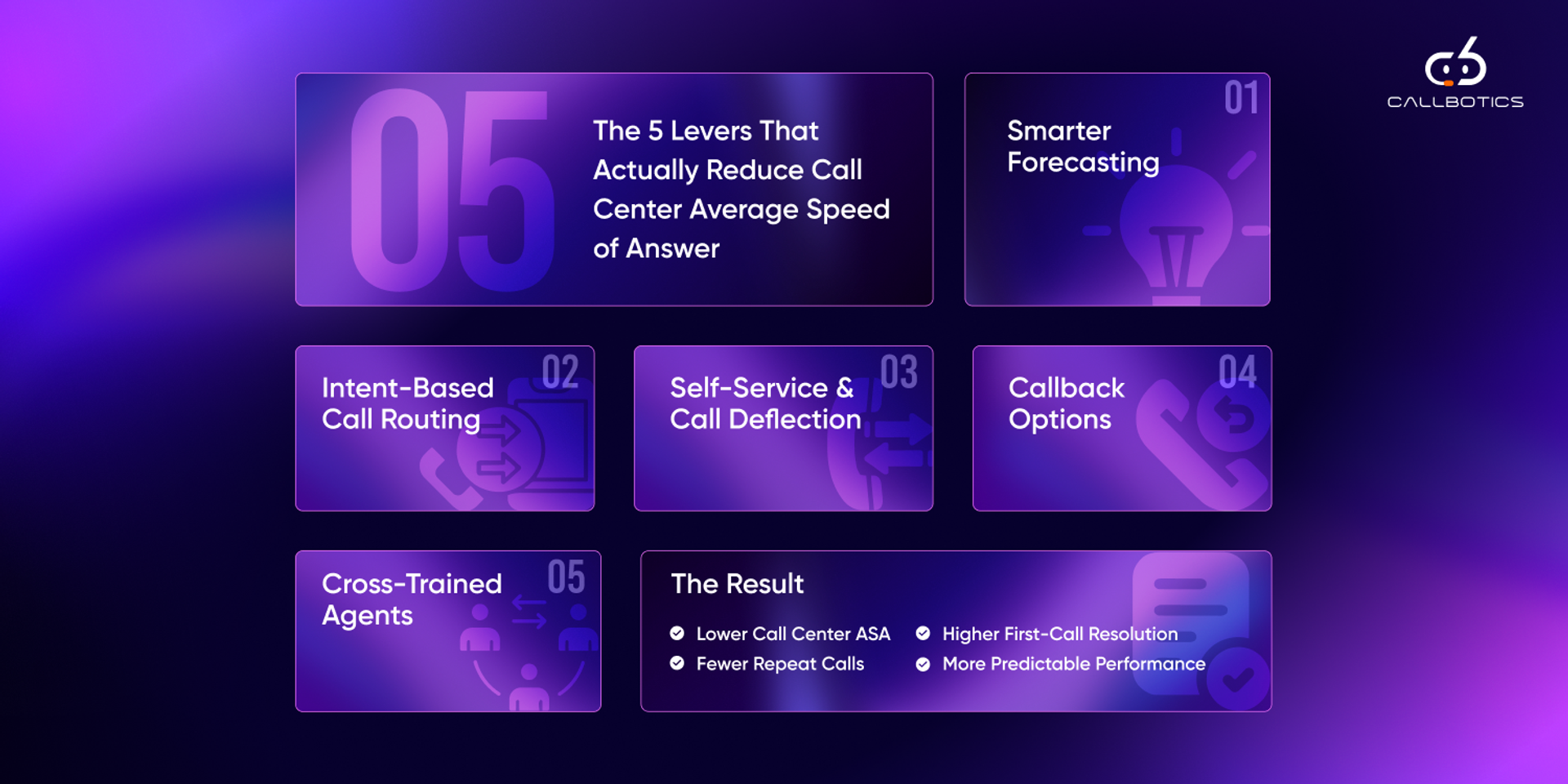
When executed together, these improvements do more than lower ASA.
They:
This is what it truly means to improve call center efficiency.
Most customers actually prefer this path if it's faster; Harvard Business Review reports that 81% of all customers attempt to resolve issues themselves via self-service before ever reaching out to a live representative. High ASA is often a sign that your self-service tools are failing to meet that 81% demand.
At smaller volumes, controlling ASA feels manageable. Teams can adjust staffing, tweak schedules, or temporarily redistribute queues to keep wait times in check.
But as call volumes grow, those levers stop working the way they used to.
What was once a predictable operation becomes fragile. A billing cycle, a policy change, or a service disruption can overwhelm queues. Average wait times in call centers suddenly spike, and recovery can take hours or even days.
This is not because teams are underperforming. It is because traditional call center models are not designed for volatility.
When call center ASA rises, the most common response is to hire more agents. In the short term, this can help. In the long term, it creates new constraints.
Hiring and training take time. Schedules remain fixed. Labor costs increase, while demand continues to fluctuate unpredictably.
As a result, ASA improves briefly, then drifts upward again.
This is why organizations that rely only on staffing changes struggle to sustainably improve call center efficiency. Human capacity scales slowly. Customer demand does not.
Not all calls impact the average speed of answer equally.
A small set of high-frequency, low-complexity calls often consumes a disproportionate share of queue capacity. These include confirmations, status checks, follow-ups, and simple information requests.
When these calls enter the same queues as complex issues, they slow everything down.
Even with good routing and forecasting, queues become congested, agents get overloaded, and the ASA rises for everyone.
The most reliable way to lower call center ASA is not to answer calls faster, but to prevent unnecessary calls from entering agent queues in the first place.
When structured, repeatable conversations are resolved without human involvement:
ASA improves with better flow, not more pressure.
The difference becomes especially clear during peak demand.
| Dimension | Human-Only Model | Automation-Assisted Model |
|---|---|---|
| Reaction to call spikes | Slows quickly | Scales instantly |
| ASA stability | Highly variable | Predictable |
| Agent workload | Reactive and congested | Focused on complex work |
| Transfers | Common | Significantly reduced |
| SLA adherence | Breaks under pressure | Maintained consistently |
This is why automation is now central to modern call center KPIs, not as a cost-cutting tactic, but as a reliability mechanism.
Most customers actually prefer this path if it's faster. A Harvard Business Review report states that 81% of customers attempt to resolve issues themselves via self-service before ever reaching out to a live representative. High ASA is often a sign that your self-service tools are failing to meet that demand.
Not all automation improves ASA in call centers.
Many AI voice tools focus on routing rather than resolution. Others work well in demos but struggle with real-world complexity, concurrent call loads, or mid-call changes in customer intent.
When automation escalates too early or too often, queues still form. ASA still rises. Agents still feel overwhelmed.
If you’re wondering how to reduce ASA, automation must resolve conversations end-to-end, not simply redirect them.
Most AI voice assistants promise automation. CallBotics.ai focuses on outcomes.
CallBotics.ai plays a dedicated role in improving average answer speed in call centers because it was designed for real contact center conditions, not ideal scenarios. It assumes high call volumes, shifting customer intent, peak traffic, and the ongoing need for clean escalation to human agents.
This makes its impact on ASA practical rather than theoretical.
CallBotics.ai stands out because it:
For customers, this results in:
For operations teams, it means:
By removing friction from routine interactions, CallBotics strengthens how teams operate while preserving human judgment where it matters most.
Chasing ASA as a standalone metric rarely delivers lasting results.
Improving the system that produces ASA does.
When unnecessary demand is resolved before it reaches agents, the average speed of answer in call centers stabilizes, customer experience improves, and teams finally gain control over average wait time.
That is the difference between managing ASA reactively and designing operations that naturally keep it low.

See how enterprises automate calls, reduce handle time, and improve CX with CallBotics.
CallBotics is an enterprise-ready conversational AI platform, built on 18+ years of contact center leadership experience and designed to deliver structured resolution, stronger customer experience, and measurable performance.