
Modern contact centers operate in an environment where expectations rise faster than operational capacity. Customers demand clearer answers, faster resolutions and seamless movement across channels. Meanwhile, organizations face increasing cost pressure, higher attrition rates and growing complexity across products, services and compliance layers. As a result, teams experience a sharp increase in inbound call volume, much of it preventable and tied to breakdowns that accumulate across the customer journey.
This is where understanding call reduction strategies for contact centers becomes essential. When done well, call reduction strategies reshape the operating model by eliminating friction that drives unnecessary demand. The objective is not to suppress customer access but to design systems that naturally prevent rework, confusion and unnecessary escalation. When prevention becomes the primary design principle, organizations unlock the full benefits of call reduction across customer experience, operational efficiency and cost optimization.
High call volume usually signals a structural challenge rather than a temporary spike. Broken communication loops create frustrated customers, agents waste time on repeated tasks, leaders struggle to forecast workloads and unresolved issues inflate the total number of incoming calls. Understanding what is call reduction helps leaders recognize that the goal is not about reducing interaction but creating clarity and removing the underlying triggers that inflate demand.
As a strategic discipline, contact center call reduction allows teams to create an environment where customers resolve tasks quickly, agents focus on high-value conversations and leaders maintain visibility and control over operations. This blog builds a detailed, research-backed framework that helps teams reduce call volume through eight enterprise-grade strategies designed for 2026-level operational demands.
In simple terms, how to reduce call volume in a call center begins with understanding the drivers behind customer effort. Effective call reduction eliminates unnecessary, repetitive and preventable calls that originate from unclear systems, broken processes or missing information. These unnecessary calls are often the ones that distract teams the most and consume capacity that would otherwise be available for moments that require human judgment.
Strong call reduction strategies for contact centers distinguish between true demand reduction and improper deflection. Suppressing calls without resolving the underlying friction only shifts the problem to other channels. Genuine demand reduction happens when root causes are addressed and customers move through their journey without encountering blockers.
Leaders must ensure reduction efforts enhance the overall experience instead of restricting access. When clarity increases, workflows become intuitive and customer satisfaction rises because individuals can complete tasks independently. This approach removes rework, tightens processes and supports a high-performing environment where both agents and customers succeed.
Before designing any reduction strategy, teams must understand the specific drivers of high-volume patterns. The following root causes appear consistently across industries and make up a significant share of preventable demand:
Low first call resolution creates persistent loops where customers reach out multiple times, generating avoidable load. These repeat calls usually reflect unclear instructions, missing context or incomplete support during the first call.
Vague language or outdated information forces customers to seek clarification. This becomes even more noticeable when price adjustments, subscription renewals or policy changes occur, prompting more phone calls and confusion across touchpoints.
When organizations do not proactively communicate disruptions, inbound calls spike. Customers call to understand status updates, next steps or expected restoration timelines.
Poorly designed flows or outdated FAQ content lead customers to escalate to a human agent. Strong digital choices reduce dependence on agents and improve clarity early in the journey.
Suboptimal interactive voice response logic expands handling time and increases misrouting. Every unnecessary transfer extends call duration and the likelihood of recontact.
A large percentage of preventable demand originates from ambiguous messaging rather than system failure.
The operational importance of reduction grows each year. Rising staffing requirements and changing workforce expectations increase the cost of handling an average call, and shortage of skilled call center agents intensifies pressure on frontline teams. When demand grows faster than capacity, service levels fall, wait times expand and bottlenecks emerge across critical workflows.
A thoughtful reduction program helps address these pressures directly. By eliminating unnecessary demand, leaders stabilize workloads, reduce burnout and create a more predictable environment for both managers and agents. In high-volume settings, how to reduce call volume becomes a central operational discipline that strengthens resilience and raises service consistency.
Reduction also plays a crucial role in supporting modern customer experience expectations. Customers today expect immediate clarity, quicker resolutions and easy access to digital tools. When unnecessary calls disappear, customers navigate a smoother journey and the organization delivers more reliable service quality.
A strategic reduction effort delivers value in multiple directions. The following advantages highlight why leaders consider reduction a core pillar of contact center operations:
As teams eliminate preventable demand, overall cost per interaction declines. Fewer customer calls generate meaningful cost savings, especially in high-volume organizations.
Frictionless processes help improve first call resolution rates, reducing rework and improving flow efficiency.
Agents allocate time to more meaningful customer issues, rather than repetitive troubleshooting.
With less queue pressure, urgent or complex inquiries are handled quickly and more effectively.
Better clarity and resolution consistency enhances customer satisfaction and strengthens customer loyalty.
Stable demand allows stronger workforce management, accurate forecasting and proactive scheduling.
The following eight strategies combine operational rigor, technology enablement and customer-centered design. These strategies fit modern operating conditions where businesses need to scale without compromising quality or increasing complexity.Improve First Call Resolution
FCR directly influences overall volume patterns. Teams begin by examining call data to identify friction points that cause recontacts. Reviewing transcripts, journeys and follow-ups allows leaders to uncover gaps in process clarity, agent guidance or system connectivity.
Developing strong internal knowledge systems ensures agents have instant access to accurate customer data, policy rules and troubleshooting steps. A unified environment helps reduce toggling and ensures that the agent can confidently guide the customer without delays.
See how AI voice agents improve first call resolution performance.
Empowering agents with decision authority improves effectiveness. When agents understand escalation logic and contextual history, they resolve issues on the first attempt and prevent additional customer effort.
Small adjustments to agent workflow and access to information often deliver large reduction outcomes within measured cycles.
Modern customers expect intuitive digital solutions. Strong self service tools help organizations remove repetitive calls by giving customers everything they need to complete tasks independently.
Effective portals are built on:
When customers find answers swiftly, organizations reduce inbound demand, stabilize operational load and create consistent experiences across channels.
Proactive communication prevents uncertainty-driven demand. Organizations that send timely alerts significantly reduce the need for clarification calls.
Common proactive approaches include notifying customers about:
These updates keep customers informed and reduce avoidable follow-ups, supporting a more predictable call pattern and reducing unnecessary effort.
Routing influences both customer experience and load distribution. Optimizing paths ensures that inquiries move smoothly through the system.
Strong routing programs include:
When routing becomes intuitive, teams experience smoother operations and improved resolution speed across all channels.
Understanding why customers recontact the support center is essential for sustainable reduction. Structured call analysis helps identify how often customers face the same issue, which processes create confusion and where systemic delays contribute to escalations. Repeat patterns usually reveal deeper friction, including broken workflows, unclear communication or gaps in agent guidance.
Teams benefit from categorizing top recurring drivers into product-related issues, policy gaps, lifecycle communication challenges or functionality misunderstandings. Each category can then be approached with targeted improvements that reduce long-term pressure on the call center. Proactive identification of repeat themes allows leaders to redesign processes before volume spikes and before customers develop lasting frustration.
Explore key AI use cases that transform contact center operations.
Repeat problems tend to cluster. Fixing one cluster often reduces multiple related issues at once.
Common repeat drivers with recommended actions
| Driver type | Example indicators | Recommended intervention |
|---|---|---|
| Communication gaps | Multiple clarification requests | Update messaging and customer-facing instructions |
| Product friction | Customers stuck at the same step | Redesign workflow or introduce guided help |
| Delayed processes | Status check calls | Push automated updates and progress notifications |
| Account access | Authentication issues | Strengthen self-service login recovery |
Intelligent automation plays a major role in modern call reduction strategies. AI-powered voice systems, virtual reception assistants and contextual reasoning engines help manage large volumes of routine demand while preserving service quality. AI-supported workflows offer the ability to understand customer intent, recognize emotional signals and personalize the experience based on real-time customer sentiment.
An AI agent can address routine resets, transactional updates, knowledge-based queries or status checks within seconds. It can also provide continuous coverage during peak periods, helping teams handle unexpected surges in inbound calls. These systems also reduce dependency on center agents for repetitive inquiries, allowing teams to allocate time to higher-value tasks.
AI elevates resolution consistency because it uses structured logic, updated knowledge and pattern recognition to guide the conversation. As customer needs evolve, AI systems help analyze journey-level behaviors, detect incoming surges tied to known issues and surface actionable insights that drive better long-term design decisions. When integrated properly, they become a dependable lever in broader reduction strategies.
Learn how conversational AI improves resolution and reduces repeat calls.
Knowledge assets form the foundation of self-service and agent support. High-quality documentation reduces reliance on agents because it provides customers with immediate answers. Maintaining a clear, accurate and continuously updated knowledge environment enhances discoverability and reduces process friction.
Customers rely on support content for step-by-step guidance, troubleshooting instructions and clarity during moments of uncertainty. Well-organized guides and structured help categories reduce confusion early and limit escalation. They also reinforce confidence that the brand understands their challenges and is prepared to help.
Agents benefit from a parallel internal library that removes hesitation during live interactions. Strong documentation also shortens onboarding cycles for new hires and reduces the need for corrective coaching. With regular audits, teams ensure the knowledge base remains aligned with evolving products, services and processes.
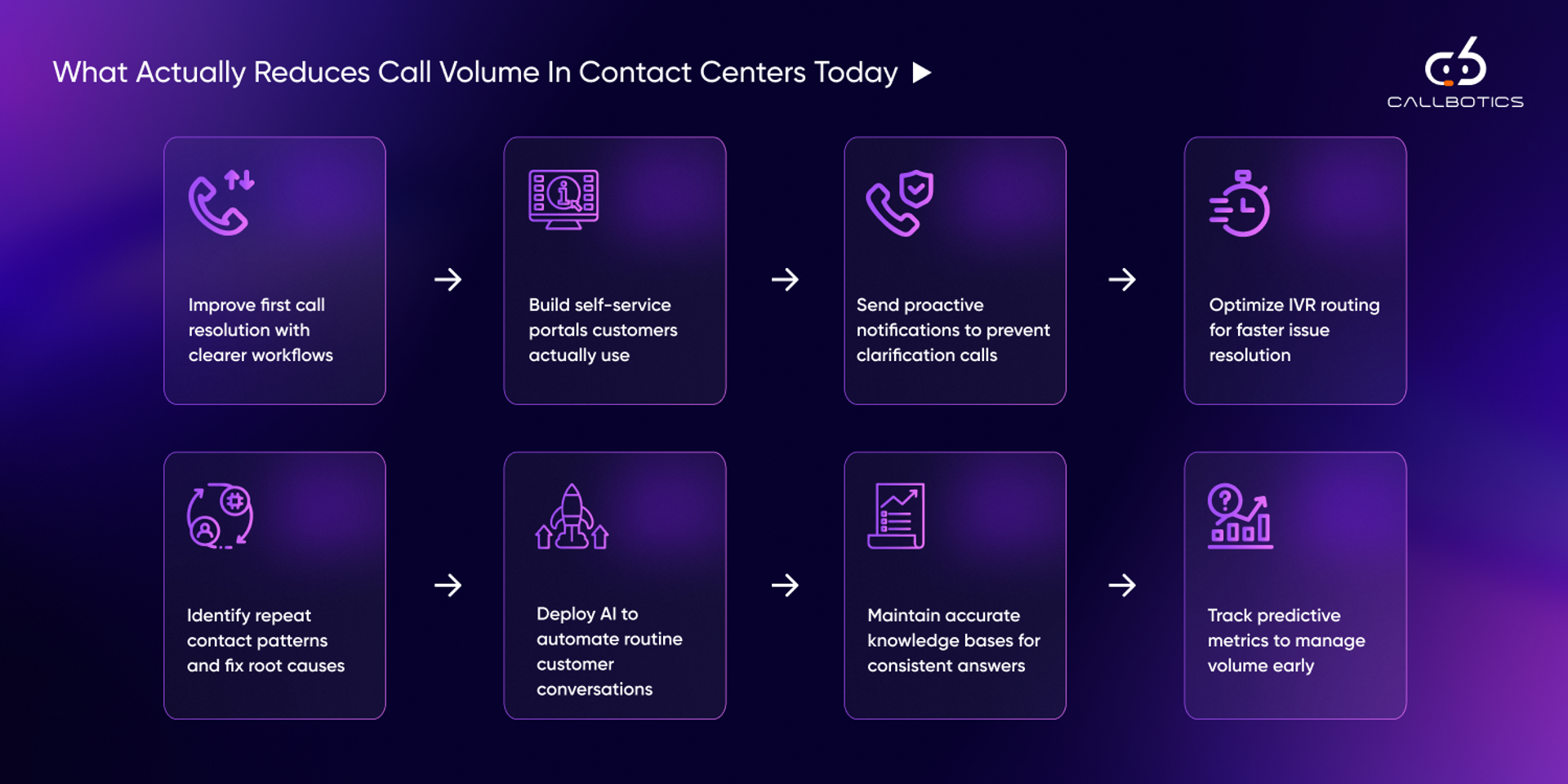
Predictive metrics help business leaders understand and anticipate demand. Volume shifts rarely happen overnight; instead, small signals accumulate over time. By monitoring the right indicators, leaders can identify rising patterns before they impact queue times or staffing requirements.
Key predictive metrics include:
Tracking these signals supports stronger decisions around design, communication and process clarity. Teams can intervene early and prevent temporary challenges from evolving into systemic demand surges.
Leading indicators matter more than lagging indicators when planning reductions.
Long-term improvement depends on systemic redesign rather than moment-to-moment optimizations. Enterprise-grade reduction requires a structured approach that blends prevention, simplification and deeply aligned customer journey insights.
A strong foundation begins with mapping demand across every interaction point. Leaders identify preventable drivers such as policy complexity, unclear instructions or slow internal workflows. Then, they create an improvement roadmap that prioritizes systemic friction before increasing staffing or expanding operational headcount.
Organizations also balance automation with thoughtful human oversight. Automation excels when resolving routine and transactional requests, while humans remain essential for complex judgment-based scenarios. Combining both creates a resilient system that meets customer expectations reliably and at scale.
Alignment with long-term CX goals ensures reduction decisions reinforce clarity, trust and ease of use. When prevention becomes part of operational culture, enterprises build environments where problems resolve once instead of resurfacing across multiple channels.
Reduction programs fail when teams approach them with short-term thinking or incomplete visibility. A few common pitfalls include implementing automation that cannot resolve tasks, prioritizing channel containment instead of full resolution or ignoring emotional context during escalations.
Organizations may also overlook the importance of continuous root-cause review. Without analyzing patterns tied to product friction, communication gaps or process bottlenecks, improvements remain shallow. Another challenge is adopting multiple disconnected systems that do not share data or intent signals, which leads to fragmented experiences and reduced operational clarity.
Sustainable reduction depends on reliable measurement. Leaders evaluate the long-term success of volume reduction programs using several categories:
Understanding whether overall demand stabilizes, decreases or shifts to other channels.
Reduction in operational expenses as preventable demand declines.
Tracking the relationship between improved resolution and reduced recontact patterns.
Whether customers experience a smoother, more predictable journey.
Service levels, queue times and staffing distribution over time.
Stable volume patterns are often the strongest indicator that upstream changes are working.
How CallBotics Enables Contact Center Call Reduction Strategies
CallBotics strengthens enterprise reduction programs by combining structured logic, intelligent automation and real-time operational insights. It is built for environments with changing conditions, unpredictable spikes and complex resolution flows.
Key strengths include:
By focusing on resolution rather than deflection, CallBotics creates a system where efficiency and customer trust grow together. It aligns with enterprise goals to simplify operations, reduce unnecessary demand and deliver consistent clarity across every touchpoint.
Effective call reduction is rooted in strong systems design, operational intelligence and high-quality automation. When teams simplify complex workflows, enhance communication and use advanced technology for routine interactions, they eliminate the friction that drives unnecessary demand. The combination of prevention, clarity and structured AI support enables enterprises to build environments where both customers and agents thrive.
Organizations that redesign processes before expanding capacity create sustainable operational advantages. By applying the eight strategies outlined here and enabling them with modern AI capabilities like those provided by CallBotics, enterprises create stronger service ecosystems and more resilient customer journeys.

See how enterprises automate calls, reduce handle time, and improve CX with CallBotics.
CallBotics is an enterprise-ready conversational AI platform, built on 18+ years of contact center leadership experience and designed to deliver structured resolution, stronger customer experience, and measurable performance.