Both CallBotics and Decagon are built to help businesses automate customer interactions with AI, but the better choice depends on what you need most. Some teams care most about rollout speed, workflow execution, and predictable deployment for voice-heavy operations. Others care more about broader customer experience automation across chat, email, SMS, voice, and API-based surfaces. Decagon publicly positions itself as an AI customer experience platform with omnichannel support, optimization tooling, and enterprise controls, while CallBotics is positioned as an enterprise AI platform for orchestrating customer interactions across channels, with deeper specialization in voice-led workflows and contact center execution.
This is why the comparison is less about who has more features on a checklist and more about operating fit. The real decision usually comes down to channel mix, workflow complexity, integrations, reporting depth, governance needs, pricing style, and how quickly your team wants to move from first use case to live automation. This guide focuses on those buying criteria rather than on broad platform claims alone.
CallBotics is best known for enterprise-ready AI automation with strong voice specialization, fast deployment positioning, omnichannel orchestration, workflow execution, and measurable call outcomes. Its public messaging highlights voice-led customer interaction automation, contact center scaling, 48-hour go-live positioning for suitable workflows, and 18+ years of contact center leadership behind the platform.
Decagon is best known for a broader AI customer experience platform that spans chat, email, voice, SMS, and custom API surfaces. Its public materials emphasize building, optimizing, and scaling AI agents, with testing, experimentation, analytics, traceability, and omnichannel support as core parts of the platform story.
In practice, that means both can support omnichannel automation, but they are often shortlisted for different reasons. CallBotics usually stands out when voice-led execution, faster rollout, and contact center performance matter most. Decagon usually stands out when a team wants a broader support automation platform across channels with strong optimization tooling around the AI agent lifecycle.
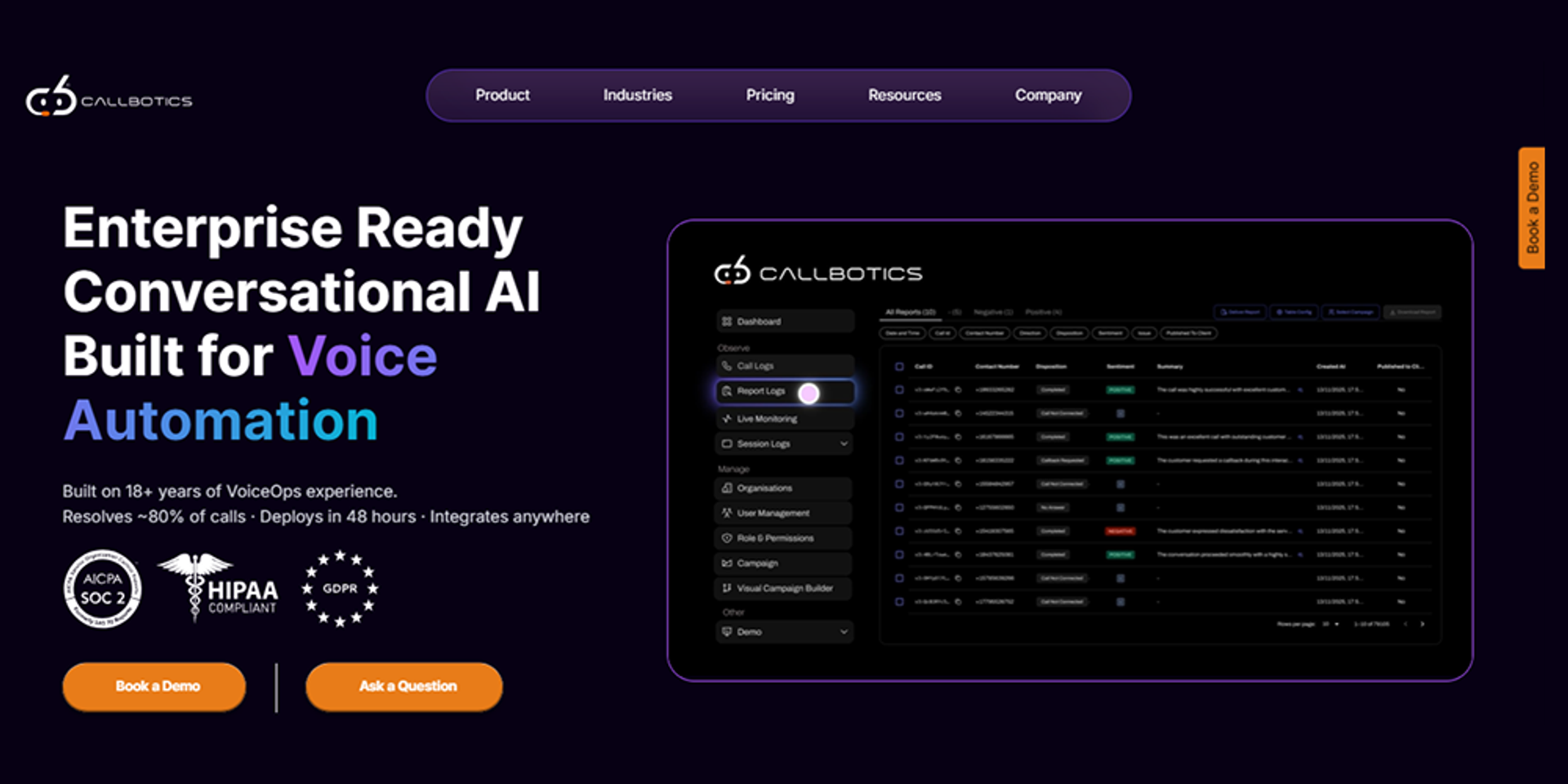
CallBotics is best for teams that want enterprise AI automation with stronger specialization in voice-led workflows and customer interaction execution. It is publicly positioned around inbound and outbound automation, intent-driven handling, summaries, analytics, and structured workflow completion across enterprise environments. Its broader omnichannel positioning includes voice, SMS, and chat, but voice automation remains the clearest strength in its public narrative.
That makes CallBotics especially relevant for contact centers, BPOs, scheduling workflows, lead qualification, support triage, and other structured service operations where routing quality, handoff quality, and measurable workflow outcomes matter more than broad channel sprawl. It also gives CallBotics a more operationally direct feel for buyers who want to move quickly and optimize around real performance metrics.
Decagon is best for teams that want a broader AI customer experience platform across channels. Its public positioning centers on AI agents that can build, optimize, and scale across chat, email, voice, SMS, and APIs, while also supporting memory, testing, experimentation, and action-taking within enterprise support workflows.
That makes Decagon especially relevant for enterprises looking beyond voice into more unified support automation. It is often a stronger consideration when the goal is not only to automate calls but to build a broader customer experience layer across multiple digital and voice channels using a single agent framework.
In practice, both platforms follow a similar setup path. Teams start with one or two high-value interaction types, define the workflow, connect the required systems, test edge cases, launch a pilot, measure outcomes, and then improve the workflow over time. That core rollout logic is similar regardless of the initial use case: appointment scheduling, support triage, FAQs, or outbound follow-up.
The difference is in how each platform frames the process. CallBotics leans more into white-glove rollout, deployment speed, workflow execution, and contact center performance. Decagon leans more toward build, optimize, and scale, with public emphasis on AOPs, testing, experimentation, traceability, and continuous optimization. So the real comparison is not whether both can launch agents. It is the amount of implementation effort the team wants to own and the speed at which they need to see value from the first workflow.
The most important differences are the ones that affect time-to-value, operational fit, and cost behavior over time. For most buyers, that means pricing style, setup effort, workflow depth, channel support, integrations, reporting, scalability, and governance. Both platforms are enterprise-capable, but they are built around slightly different center-of-gravity assumptions.
Pricing is one of the clearest differences because it shapes budgeting, forecasting, and how spending behaves as automation grows. Decagon does not present a simple public self-serve pricing page with obvious packaged plans. Instead, its public materials frame pricing more through enterprise AI agent models and broader business outcomes, which suggests buyers should validate the billing unit, commercial structure, and forecastability during evaluation.
CallBotics, by contrast, leans more openly into transparent and scalable pricing conversations, especially around operational fit and enterprise voice automation. That usually makes it easier for buyers who want clearer budget planning and stronger cost predictability around specific workflows.
Time-to-launch is another important difference. CallBotics has a stronger public story around fast rollout, including 48-hour deployment positioning for suitable workflows. Decagon emphasizes natural-language workflow building through AOPs, templates, connectors, and optimization tooling, but buyers should still expect setup effort to depend on workflow complexity, approvals, integrations, and enterprise change management.
In practice, that means CallBotics looks stronger if your first priority is speed and faster production fit for structured workflows. Decagon looks stronger if your team is willing to take on a broader platform rollout with more testing and optimization infrastructure around the agent lifecycle.
Workflow depth matters because enterprise AI fails quickly when the logic around fallbacks, validation, interruptions, and tool actions is weak. Decagon’s public materials emphasize Agent Operating Procedures, transactional controls, and the ability of AI agents to take actions across connected systems and channels. That gives it a strong platform-led story around workflow governance and broader AI agent design.
CallBotics also supports deep workflow execution, but its positioning is more outcome-led and operationally grounded. That means it tends to feel more aligned to teams that care less about agent-design ideology and more about whether the workflow resolves calls, routes correctly, and performs under real contact center conditions. Both have meaningful workflow depth, but CallBotics frames it through execution, and Decagon frames it through platform building and optimization.
This is an important area where the blog needs to stay fair. Both platforms support omnichannel automation. The difference is that CallBotics has deeper specialization in voice-led workflows and contact center execution, while Decagon is more broadly positioned around customer experience automation across channels. Decagon publicly highlights support across chat, email, voice, SMS, and APIs. CallBotics publicly highlights unified automation across voice, SMS, and chat, with strong emphasis on voice and contact center operations.
That means:
Integrations matter because AI agents create the most value when they can take real actions. Decagon publicly highlights integrations with major enterprise systems and bidirectional action-taking through APIs, which is a strong signal for teams building deeper support workflows across systems.
CallBotics also has a strong integration story, with public messaging around 400+ integrations and workflow execution across enterprise systems. That makes it highly competitive here, especially for teams that want practical deployment fit and action-taking inside voice-heavy workflows rather than only broader platform connectivity.
Analytics are essential because AI platforms improve through iteration, not just at launch. Decagon emphasizes testing, QA, traceability, auditability, experimentation, and workbench-style debugging. That makes it attractive for teams that want strong optimization tooling around agent behavior and enterprise support workflows.
CallBotics, however, has the stronger public emphasis on summaries, transcripts, QA-style visibility, intent-level outcomes, and operational reporting tied directly to call performance. For teams that care most about call insights, queue outcomes, transfer quality, and measurable voice automation performance, this usually makes CallBotics feel more directly aligned to day-to-day service operations.
CTA: Explore CallBotics if you want voice automation with stronger call summaries, intent-level reporting, and operational visibility designed for real contact center teams:Scalability matters most during peak demand, overflow conditions, and large support events. Decagon clearly positions itself for enterprise-scale support across channels, but buyers still need to validate actual peak-load behavior, escalation rules, and consistency across pilot conditions. Its public materials focus more on scale as an enterprise platform than on visible concurrency detail for specific channels.
CallBotics has a stronger public story around scaling voice operations, high-volume call handling, and contact center execution. That makes it easier to evaluate when the buyer’s main concern is voice traffic, queue pressure, and structured workflow performance under peak conditions.
Decagon has a strong public trust and security story, including enterprise security posture, governance, and control-oriented messaging. Buyers should still validate the specifics, but the public positioning is mature and enterprise-forward.
CallBotics also positions itself as enterprise-ready and aligned with serious operational environments. The real difference is mostly in emphasis. Decagon’s public story is more explicitly platform-governance led, while CallBotics balances governance with deployment speed and workflow execution. For many enterprise buyers, that means Decagon may appear stronger in public security branding, but CallBotics remains very competitive for teams that need those controls inside a voice-first operating model.
| Category | CallBotics | Decagon |
|---|---|---|
| Best for | Enterprise AI automation with deeper voice-led specialization | Broader AI customer experience automation across channels |
| Pricing approach | More transparent and packaging-friendly | More enterprise-priced and evaluation-led |
| Setup effort | Faster rollout for structured workflows | Broader platform rollout with heavier optimization tooling |
| Workflow depth | Strong workflow execution and outcome focus | Strong AOP-led agent design and optimization |
| Channel support | Omnichannel with deeper voice specialization | Omnichannel by design across chat, email, voice, SMS, and APIs |
| Integrations | 400+ integrations with workflow execution focus | Strong enterprise connectors and API-led action-taking |
| Analytics | Stronger public emphasis on call insights, summaries, and QA-style visibility | Stronger public emphasis on testing, optimization, and traceability |
| Scalability | Stronger public fit for voice-scale and contact center queue environments | Strong broader enterprise support scale across channels |
| Enterprise controls | Enterprise-ready and operationally grounded | Strong public enterprise security and governance branding |
CallBotics tends to fit best where voice automation is central to operational performance and where teams want measurable results from structured workflows quickly.
CallBotics is a strong fit for high-volume inbound environments where the goal is to answer instantly, reduce hold time, automate common call types, and route exceptions cleanly. Its public positioning around automating significant portions of call volume and reducing operational pressure supports this use case especially well.
Structured workflows with clear end states, such as booked, confirmed, canceled, or rescheduled, are another natural fit. These workflows are easy to measure and align closely with CallBotics’ strengths in voice-led execution.
CallBotics is also well-suited to workflows where agents need to collect details, qualify intent, and pass a clean summary back to downstream systems or human teams. That makes it useful for sales, intake, and structured outbound engagement.
Decagon is often strongest where the business wants a broader customer experience automation layer across channels, rather than a voice-led execution platform first.
Decagon’s public positioning makes it a strong fit for businesses that want one AI agent platform across chat, email, voice, SMS, and APIs, especially when support teams are trying to unify customer interactions across multiple surfaces.
Decagon also highlights voice support and outbound engagement, making it a credible option for enterprises that want voice automation as part of a broader omnichannel support strategy rather than as a standalone voice automation program.
Because Decagon leans heavily into testing, QA, integrations, and optimization, it may appeal most to teams that want strong platform tooling around agent improvement, debugging, and cross-channel support operations over time.
This decision is less about which platform is “better” in the abstract and more about which one aligns better with your deployment model, workflow mix, and reporting needs.
See how CallBotics helps teams upgrade voice AI faster with stronger workflow execution, faster rollout, and better operational visibility from the first use case:Pros
What to validate in a pilot
Pros
What to validate in a pilot
The fastest way to decide is to start from real constraints, not broad brand narratives.
Choose CallBotics if you want enterprise AI automation with deeper voice specialization, faster movement on structured workflows, stronger outcome-focused reporting, and a platform shaped by real contact center operating experience. It is usually the better fit when phone interactions still carry most of the operational weight.
Choose Decagon if you want broader omnichannel automation, stronger platform-led optimization tooling, and a customer support strategy designed from the beginning to support AI agents across multiple surfaces.
A practical way to decide is to test one simpler workflow and one more complex workflow. Compare resolution quality, handoff quality, reporting visibility, escalation behavior, and cost per successful outcome. That will usually tell you whether you need voice-led execution depth or broader agent-platform breadth. This is a practical recommendation based on the public positioning of both platforms.
CallBotics helps teams upgrade voice AI faster by combining deployment speed with workflow execution, omnichannel orchestration, and operator-informed design. Developed by teams with over 18 years of contact center leadership experience, it is built by people who understand queue pressure, routing quality, handoff complexity, and how to improve voice workflows week by week after launch.
What makes CallBotics different:
Both platforms are credible enterprise AI options, but they solve slightly different buying problems. Decagon is a strong fit for teams that want a broader omnichannel AI customer experience platform with a heavier emphasis on testing, optimization, and platform-level support automation. CallBotics is the stronger fit for teams that want enterprise AI automation with deeper voice specialization, faster rollout, clearer workflow outcomes, and a more direct fit for contact center operations.
The best choice comes down to workflow complexity, channel strategy, integration needs, governance requirements, and budget model. If your team wants to move quickly on high-value voice workflows and improve them with robust reporting and operational control, CallBotics is usually the better option.

Urza Dey (She/They) is a content/copywriter who has been working in the industry for over 5 years now. They have strategized content for multiple brands in marketing, B2B SaaS, HealthTech, EdTech, and more. They like reading, metal music, watching horror films, and talking about magical occult practices.
See how enterprises automate calls, reduce handle time, and improve CX with CallBotics.
CallBotics is an enterprise-ready conversational AI platform, built on 18+ years of contact center leadership experience and designed to deliver structured resolution, stronger customer experience, and measurable performance.