Voice AI is no longer something teams are just testing on the side. It is becoming part of how modern customer service actually runs. Zendesk’s 2026 CX Trends reporting says 81% of consumers believe AI has become part of modern customer service, which is why the real question is no longer whether to use AI on calls, but which platform fits your operating model best.
CallBotics and Retell AI can both help teams automate inbound and outbound phone calls with AI voice agents. But the better choice depends on what your team cares about most once the demo is over. For some companies, the priority is enterprise rollout speed. For others, it is predictable costs, better control over workflows, stronger integrations, or clearer visibility into call outcomes.
That is why this comparison is less about picking a universal winner and more about finding the platform that fits your goals, your team structure, and the way you plan to scale voice automation.
CallBotics is usually shortlisted by teams that want enterprise voice automation with faster rollout, more structured workflow handling, and clearer operational visibility. It is a stronger fit for contact centers, BPOs, and call-heavy teams that care about getting into production quickly, keeping implementation friction low, and measuring outcomes beyond simple call completion.
Retell AI is often shortlisted by teams looking for a more usage-based voice agent platform with flexibility at the platform level. It tends to appeal to companies that want to build and scale AI calling workflows with more hands-on control over usage, configuration, and development choices.
At a high level, the difference usually looks like this:
CallBotics is best for teams that want to automate large volumes of phone calls in a way that feels practical, fast, and tied to business outcomes. In simple terms, it is built for contact centers and call-heavy teams that want AI voice agents to do more than answer calls. They want those agents to help resolve calls, reduce pressure on human teams, and improve performance over time.
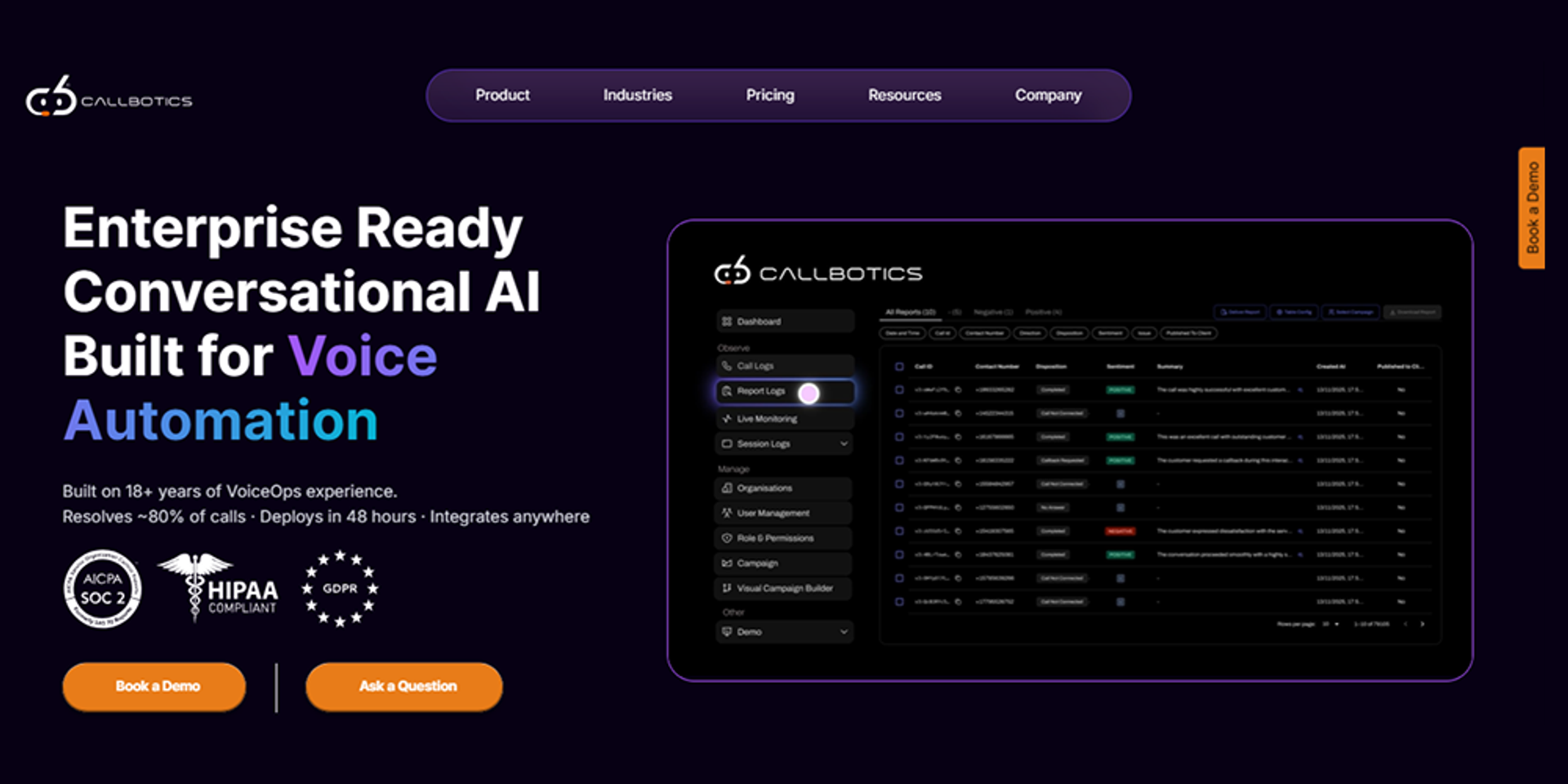
Its strongest fit is voice-first automation at scale. On its website, CallBotics says it is built on 18+ years of contact center experience, can deploy in about 48 hours, and helps resolve around 80% of calls with AI.
The site also highlights 70%+ reduction in operational costs, 60%+ faster task handling, and near-zero wait time as core outcome claims. For teams evaluating platforms, that signals a product designed around rollout speed, workflow execution, and measurable call outcomes, not just conversation quality.
CallBotics is usually the better fit for teams that want to automate calls across real business workflows, connect that automation with enterprise tools, and use built-in insights to understand what is happening across conversations after launch.
If your priority is getting high-value voice workflows live quickly, CallBotics is the better place to start.Retell AI is best for teams looking for a voice AI platform they can use to build, deploy, and manage AI voice agents for call automation. In simple terms, it is designed for companies that want a platform-centered way to launch voice agents across inbound and outbound calling use cases.
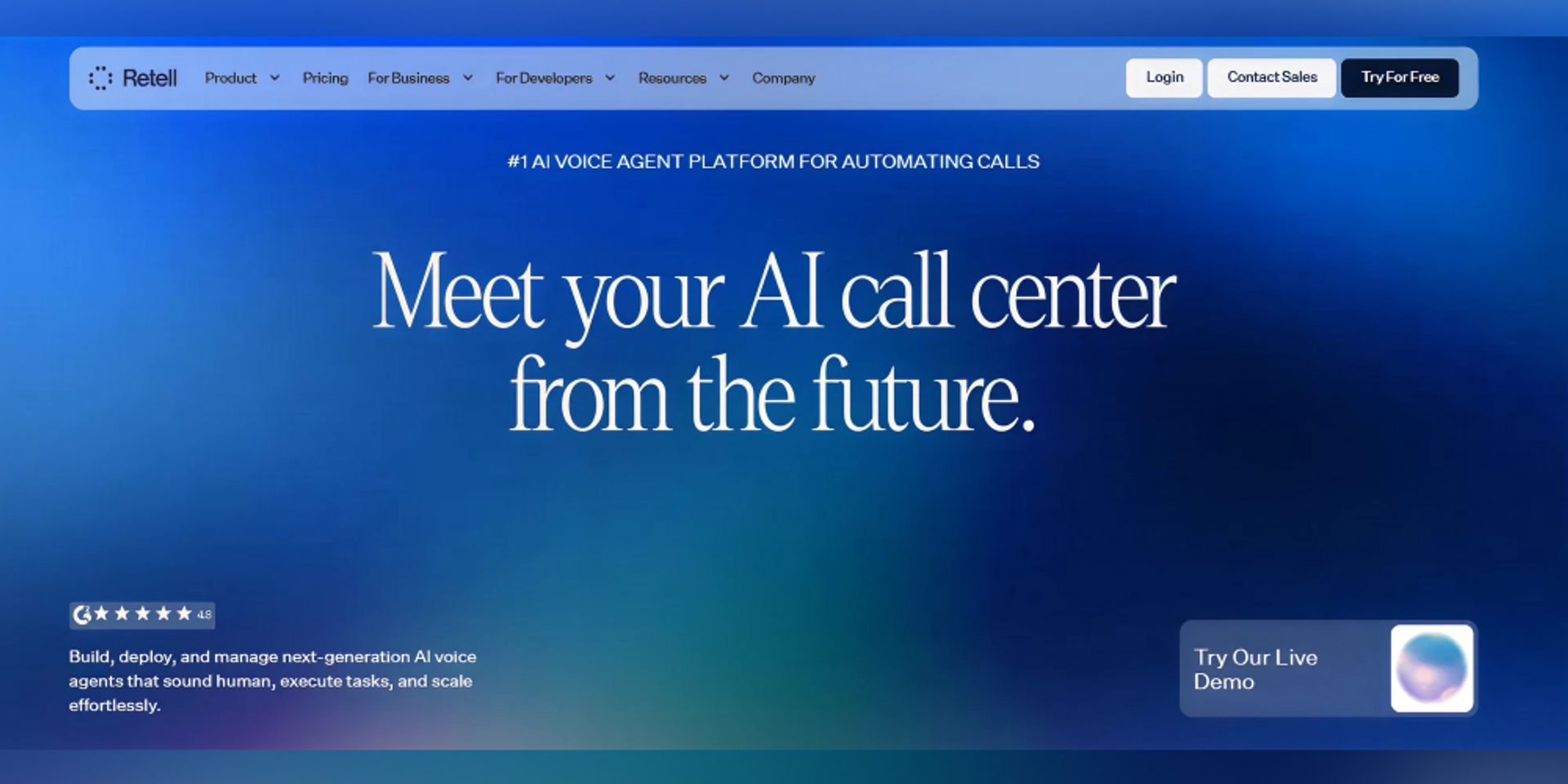
On its homepage, Retell describes itself as the “#1 AI Voice Agent Platform for Automating Calls” and says teams can build, deploy, and manage next-generation AI voice agents from within the platform. It also highlights ~600ms latency, positions that as a responsiveness advantage, and says users get $10 of free usage when they sign up.
Its site also points to customer outcomes, such as a 38% increase in scheduling NPS in one case study example. Together, those details make Retell especially relevant for teams that want a usage-based platform for building and running voice automation with greater platform control.
Retell AI is usually the better fit for teams that want a voice-focused platform for creating, deploying, and monitoring AI agents, especially when they value platform flexibility and usage-based scaling.
At a simple level, CallBotics and Retell AI follow a similar rollout path. You usually start by choosing a call use case, such as appointment booking, lead qualification, claims status, payment reminders, or customer support.
From there, the next step is to design the call flow, connect the right systems, test how the agent handles real conversations, go live in production, and then keep improving performance based on what happens on actual calls.
A typical setup flow usually looks like this:
Start with one clear workflow that has enough volume to matter and enough structure to automate well.
Map what the AI agent should say, what information it needs to collect, when it should ask follow-up questions, and when it should escalate.
Integrate the agent with the systems your team already relies on, such as CRMs, scheduling tools, internal databases, or contact center software.
Check how the agent handles interruptions, unclear answers, repeat questions, missing information, verification steps, and transfers.
Launch the workflow in production once the call path is stable enough for real customer interactions.
Review how calls are actually performing, identify drop-off points or transfer patterns, and make changes week by week.
The difference is usually not the basic sequence. It is how quickly each platform helps you move through that sequence, how much support your team gets during rollout, and how easy it is to improve call performance after launch.
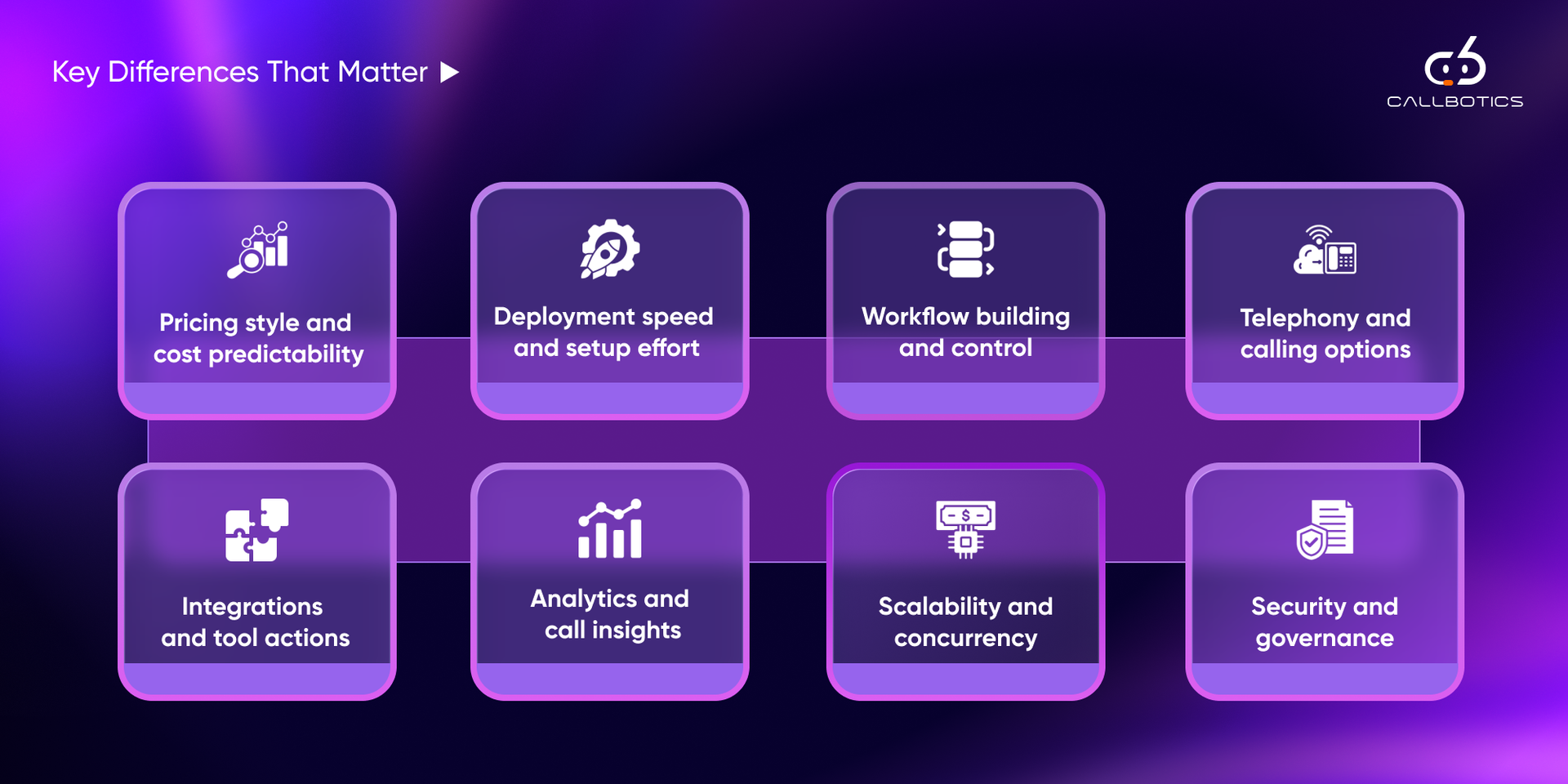
The biggest differences between CallBotics and Retell AI usually show up in the areas that affect rollout speed, day-to-day control, and how costs behave once usage starts growing. On the surface, both platforms help teams automate phone calls with AI voice agents.
But in practice, buyers are usually comparing two different operating styles:
Pricing matters because a platform that looks affordable at low usage may become harder to predict as call volume grows. Retell AI publishes pay-as-you-go pricing and shows voice pricing ranges, while CallBotics offers both per-minute and per-agent pricing, with stronger emphasis on packaged rollout and enterprise support.
That means buyers should compare total cost at expected volume, not just entry pricing. Retell AI shows $10 in free credits and $0.07 to $0.31 per minute for AI voice agents, while CallBotics says it offers both per-minute and per-license models and positions that flexibility as a budgeting advantage.
What buyers should compare here:
Time to launch depends on more than product access. It is shaped by how much work goes into intent mapping, call flow setup, integrations, testing, and QA before the workflow is safe to launch.
CallBotics pushes a more done-for-you model with deployment in 48 hours, end-to-end implementation included, and white-glove onboarding and training, while Retell AI leans more into platform access and self-serve build, test, and deploy motion.
What buyers should compare here:
This area matters because real calls rarely stay on the ideal path. Customers interrupt, ask follow-up questions, change direction, and bring up missing information. A good evaluation should go beyond basic demos and focus on how the platform handles branching, fallbacks, verification, transfers, and multi-step tasks such as scheduling or account updates.
CallBotics frames this around structured workflow execution and customizable workflows, while Retell AI frames it around building and deploying voice agents with flexible orchestration.
What buyers should compare here:
Telephony choices affect the real customer experience, especially for teams handling large inbound volumes or time-sensitive outbound campaigns. Buyers should check how numbers are set up, how routing works, how transfers are handled, and how reliably the platform performs at higher call volumes.
Retell AI explicitly lists telephony options such as custom telephony and support for providers like Twilio, Telynx, and Vonage, while CallBotics presents telephony as part of a more managed enterprise setup.
What buyers should compare here:
Integrations only matter if they help the agent complete useful work during the call. A platform should be able to check records, update systems, create tickets, book appointments, or trigger the next action without forcing the customer into another channel.
CallBotics says it integrates with 400+ tools and platforms, while Retell AI highlights platform integrations and API-driven actions across its ecosystem.
What buyers should compare here:
Good analytics help teams improve results after launch, not just monitor activity. Buyers should compare whether they get transcripts, summaries, intent-level reporting, and post-call analysis that actually helps them improve containment, reduce transfers, and refine workflows over time.
Retell AI includes call analytics and transcripts in its pricing page, while CallBotics emphasizes an advanced analytics dashboard and stronger operational visibility.
What buyers should compare here:
A voice AI platform can perform well in a pilot and still struggle under real demand. That is why teams should validate concurrency, overflow behavior, and what happens when multiple campaigns, queues, or departments are live at the same time.
Retell AI lists 20 free concurrent calls on pay-as-you-go and says higher concurrency is available, while CallBotics highlights hundreds of concurrent AI calls on enterprise packaging.
What buyers should compare here:
Security checks should go beyond trust badges. Enterprise teams should verify how access is controlled, what gets logged, how data is stored, and how the platform handles escalation rules for sensitive calls.
Retell AI’s enterprise pricing includes SSO, role-based access control, HIPAA/BAA, and custom data retention, while CallBotics highlights SOC 2, HIPAA compliance, zero data retention policy, and deployment on AWS HIPAA-eligible servers under a signed BAA.
What buyers should compare here:
| Category | CallBotics | Retell AI |
|---|---|---|
| Best for | Enterprise voice automation | Usage-based voice agent platform |
| Pricing | Per-minute or per-agent pricing with enterprise packaging options | Published pay-as-you-go per-minute pricing |
| Setup | Guided rollout with stronger implementation and onboarding support | More self-serve setup with platform-led deployment |
| Workflow depth | Better suited for structured, multi-step, call-heavy workflows | Flexible for building and managing voice agent flows |
| Integrations | 400+ tools and platforms for workflow automation | API-led integrations and app ecosystem support |
| Analytics | Strong focus on call insights, quality, and outcome visibility | Transcripts, monitoring, and call analytics tools |
| Scalability | Built for high-volume enterprise calling and concurrency | Usage-based scaling with published concurrency support |
| Enterprise controls | Compliance, onboarding support, governance, and SLA-backed reliability | SSO, RBAC, retention controls, and enterprise plan options |
CallBotics tends to fit best when voice is still one of the busiest parts of the operation and the business cares about outcomes, not just automation for its own sake. The strongest use cases are usually the ones where call volume is high, the workflow is repeatable, and success can be measured clearly after the call ends.
When a contact center is flooded with the same types of calls every day, speed matters, but so does control. This is where CallBotics fits well. It can answer high-volume inbound calls immediately, handle common intents in a structured way, and move more complex cases to the right human team without making the caller start over.
A simple example is a support environment where people call for claim status, account updates, payment questions, or service requests. Instead of sending every call into the same queue, the AI agent can handle the routine conversations first and route only the calls that truly need live support.
This usually helps teams:
This is a very natural fit for voice automation because the workflow has a clear end goal. The call either results in a booking, a confirmation, a reschedule, or a cancellation. That makes performance easier to track and improve.
For example, a team can use CallBotics to guide callers through available time slots, collect the right information, confirm details, and complete the action during the conversation itself. The value here is not only speed. It is also reducing missed steps, keeping the process consistent, and making outcomes easier to measure.
This kind of use case works well when teams want:
CallBotics also makes sense when the goal is to qualify interest before handing the conversation to a sales or operations team. Not every lead needs a human conversation first. In many cases, the first step is simply collecting the right details, understanding intent, and deciding who is worth prioritizing.
A common example would be an outbound follow-up flow where the AI agent asks a few qualification questions, captures the caller’s needs, and passes a clean summary to the next team. That gives sales teams a better starting point and cuts down time spent on low-intent conversations.
This is often useful for teams that want to:
Retell AI tends to be a strong fit for teams that want to build and run voice automation in a more usage-based, platform-led way. It is specially relevant for teams that want to create voice workflows inside a dedicated voice AI platform and scale them based on usage.
Retell AI fits well in support and sales environments where teams want AI to handle a large number of phone conversations without building everything from scratch. The site explicitly says it helps large support and sales teams automate calls at scale, and its use case navigation includes lead qualification and customer support. In simple terms, that makes it a practical option for teams that want AI voice agents to answer common support calls, qualify leads, collect details, and manage repeatable conversations more efficiently.
A few signs this use case fits well:
Retell AI also makes sense for teams building voice workflows around common call actions. Its product navigation specifically highlights call transfer, book appointments, knowledge base, and navigate IVR, which shows that the platform is designed for more than just basic conversation handling. This is useful when teams want the agent to do something practical during the call, such as transfer the caller, guide them through menu logic, pull information from a knowledge source, or complete a scheduling task.
What teams should look for in this type of use case:
Retell AI can also be attractive for teams that prefer transparent usage-based pricing, especially when call volume is still changing or the business wants to test a workflow before committing to a larger rollout. Its pricing page publishes pay-as-you-go pricing, includes $10 in free credits, and shows AI voice pricing from $0.07 to $0.31 per minute depending on the setup. That kind of model can be appealing for teams that want a clearer starting point for budgeting or want to experiment without moving straight into a larger enterprise package.
This pricing style is often attractive when:
Both platforms are credible, and neither one needs to be framed negatively to make the comparison useful.
Pros
What to validate in a pilot
Pros
What to validate in a pilot
The fastest way to decide is to start from your real constraints, not from the broadest product story.
Choose CallBotics if voice is your main channel, rollout speed matters, and your team wants stronger support around workflow execution, integrations, and operational reporting. It is usually the better fit for contact centers, BPOs, and enterprise teams that care about faster time-to-value and measurable outcomes such as resolution, routing quality, summaries, and cost control.
Choose Retell AI if you want a more usage-based voice automation model, visible starting prices, and a platform-centered way to build, deploy, and monitor AI voice agents. It is often a practical fit for teams that want flexibility, direct platform control, and a clearer pay-as-you-go path during early rollout or testing.
A practical way to decide is to test two intents: one simple and one medium-complexity. For example, try FAQs plus scheduling, or routing plus status updates. Then compare setup time, containment, transfer quality, summary usefulness, and cost per resolved contact. That will usually give you a clearer answer than a polished demo alone. This is a practical recommendation based on the product differences above.
CallBotics helps teams move faster with voice AI by combining quick rollout with real operational understanding. It is shaped by more than 18 years of contact center and BPO experience, which means it is built by teams that understand what happens in live environments, from queue pressure and routing complexity to handoff quality and the day-to-day behavior of real voice workflows.
What sets CallBotics apart:
CallBotics and Retell AI are both credible voice AI platforms, but they tend to solve slightly different buying needs. Retell AI is often a strong fit for teams that want a usage-based voice agent platform with more direct control over building, deploying, and monitoring call workflows. CallBotics is usually the stronger fit for teams that want voice-first automation, faster time-to-value, practical workflow execution, and clearer operational outcomes in contact center environments.
The best choice depends on your call intents, rollout timeline, integration needs, and budget style. If your first priority is to get high-value voice workflows live quickly and improve them with stronger reporting, workflow control, and operational visibility, CallBotics is usually the better option.

Anindita Majumder is a content and copywriter with about four years of experience across content writing, copywriting, and journalism. Her work has involved building and shaping content for global brands in B2B SaaS tech, healthcare, travel tech, edtech, and more. Her love for reading often spills into the way she ideates. Outside of work, she is a vocalist, which keeps her creativity flowing.
See how enterprises automate calls, reduce handle time, and improve CX with CallBotics.
CallBotics is an enterprise-ready conversational AI platform, built on 18+ years of contact center leadership experience and designed to deliver structured resolution, stronger customer experience, and measurable performance.