Cognigy often comes up early when teams start exploring conversational AI for contact centers, as it’s a familiar brand among enterprise circles. For organizations that handle high call volumes, complex workflows, and strict governance requirements, Cognigy is a natural fit.
However, Cognigy pricing is a major decision point for one simple reason: it’s typically sold through custom plans rather than a public, fixed-price list. That’s normal for enterprise platforms, but it also means you can’t quickly compare it the way you can with vendors that publish subscription tiers.
This guide explains how Cognigy pricing typically works, what drives total cost over time, and how Cognigy compares with CallBotics on pricing transparency, predictability, and overall value.
Caption: Cognigy provides enterprises with AI agents for customer service
Cognigy is designed for large organizations that need conversational AI to operate within their core contact center infrastructure. It’s commonly used to automate customer interactions across voice and digital channels, integrate with CRMs and backend systems, and support multilingual, high-volume operations.
Cognigy also claims that its AI agents improve with every user interaction and continuously acquire new knowledge and customer service skills.
Because it’s an enterprise platform, Cognigy is typically evaluated by organizations that have:
Cognigy does not publish fixed pricing tiers on its website. Instead, pricing is the result of a sales-led process where plans are customized to an organization’s requirements.
Rather than selecting a predefined plan, buyers typically receive a proposal based on how the platform will be used. This considers the channels involved, expected volume, required environments, and the level of support required.
Cognigy pricing is shaped by:
In other words, Cognigy pricing is less about choosing a package and more about defining the scope of use.
Initial pricing is only part of the picture. As conversational AI matures within an organization, costs often increase alongside adoption, scale, and operational complexity.
Cognigy’s costs may not increase due to hidden fees; they may rise simply because the scope expands. What starts as a limited initiative often grows into a broader, business-critical system supporting more use cases, regions, and teams.
The most common long-term cost drivers are:
In most deployments, features are bundled based on what the organization needs to operate conversational AI reliably at scale. As programs mature, additional capabilities are often layered in to support performance tracking and scalability.
Common scope expansions include:
For many enterprises, these elements are essential. They explain why Cognigy’s total cost can grow significantly as AI agents become more deeply embedded in operations.
Although Cognigy does not publish official pricing, external sources offer practical context into how enterprise deployments are commonly structured.
Cloud marketplaces such as AWS Marketplace and Microsoft’s commercial marketplace list Cognigy offerings as annual contracts tied to defined usage limits and bundled components. These listings typically bundle multiple components together, reinforcing Cognigy’s enterprise positioning.
"Our data reveals that the average cost for Cognigy.AI is about $115,000 annually."
Across both marketplaces, Cognigy plans generally include:
These marketplace plans are not meant to cover every possible deployment. Instead, they serve as reference configurations that illustrate how Cognigy structures enterprise contracts for sale through cloud marketplaces.
Vendr, a procurement intelligence platform, provides additional context. Based on aggregated buyer data, Vendr reports that Cognigy deals are typically priced as six-figure annual contracts, with the average yearly cost well above that of lightweight or SMB-focused conversational AI tools.
Cognigy is built around custom, contract-based pricing that adjusts with scope, usage, and enterprise requirements. CallBotics takes a more predictable approach. Its pricing model is designed for contact centers that run consistent, high-volume voice workflows and need cost stability as more AI agents are deployed.
Rather than charging by conversation units or per-minute usage, CallBotics uses a per-agent, tier-based pricing model. This structure is designed to simplify forecasting and eliminate the need to model costs at the level of individual calls or interactions.
Each CallBotics tier bundles core capabilities instead of selling them as separate add-ons. That includes:
For teams handling thousands of calls per day, this model makes it easier to predict monthly spend, even as call volume fluctuates.
Below is an overview of CallBotics’ pricing tiers, along with the types of teams each plan is designed for. Each tier is structured for organizations with steady call volumes and operational complexity, rather than short-term pilots or experimental deployments.
| Plan | Price (Per agent/month) | Key Capabilities | Best Suited For |
|---|---|---|---|
| Professional | $500 | -Inbound and outbound call automation -Appointment booking -No-code workflow builder -Analytics dashboard | Mid-sized teams beginning AI voice automation |
| Growth | $450 | -Higher concurrency -Multi-step workflows -Advanced call routing -Sentiment analysis | Scaling enterprises running multiple workflows |
| Enterprise | Custom | -Full AI voice automation -Unlimited workflows -Industry compliance -High concurrent call capacity -Custom integrations -24/7 support | Large operations with complex compliance and scale needs |
Table caption: CallBotics pricing tiers, core features, and ideal users
Pricing alone doesn’t tell the whole story. How quickly a platform can be deployed and how much ongoing support is required often have a greater impact on the total cost of ownership.
CallBotics emphasizes rapid deployment, with many teams going live in as little as 48 hours. Onboarding is handled through a white-glove process that typically includes workflow setup, system integrations, and enterprise-grade QA.
Ongoing support is bundled rather than metered. This allows teams to maintain concurrency, refine workflows, and scale automation without worrying about additional service fees or usage-based surprises.
By packaging automation, analytics, and support into each tier, CallBotics reduces the operational costs often associated with enterprise conversational AI platforms. Teams achieve strong call resolution and workflow depth without multiple paid add-ons.
Want a clearer cost model? Get a CallBotics pricing walkthrough customized to your call volumes and use cases.When teams compare Cognigy and CallBotics, the decision usually comes down to value over time. Not just the starting price, but how costs behave as conversational AI scales. This includes platform fees, services, support, and the effort required to keep systems running smoothly.
Cognigy uses a contract-based model built around an enterprise scope. Usage, channels, environments, integrations, and support tiers shape pricing. This approach works well for large organizations that expect customization and are comfortable with annual contracts.
CallBotics uses tier-based, per-agent pricing. Costs are easier to forecast because pricing does not change with call minutes or conversation volume. This simplifies budgeting, especially for teams handling high or fluctuating call volumes.
In practice:
Cognigy focuses on enterprise-wide deployment across channels, while CallBotics is optimized for fast, high-resolution voice automation in contact centers.
Ease of setup affects time-to-value and internal workload.
Cognigy deployments usually involve multiple stakeholders, discovery phases, and implementation planning. This is expected in enterprise environments, but it can slow down initial rollout.
CallBotics is designed to go live quickly. Many teams launch within days, not months. Workflow setup and integrations are handled through guided onboarding, reducing reliance on internal development teams.
The decision is less about which platform is “better” and more about which pricing model and operating style fits your organization.
The right choice depends on company size, industry requirements, internal resources, and the level of cost predictability required for your rollout.
Cognigy is a strong fit for large enterprises that view conversational AI as a long-term infrastructure investment rather than a fast deployment initiative.
It makes the most sense when:
In these environments, Cognigy’s flexible architecture and enterprise packaging can justify the added complexity. The trade-off is that pricing is harder to evaluate upfront and often requires detailed scoping before you get a clear number.
CallBotics is better suited for organizations that want to automate voice calls quickly and scale with confidence and without introducing unnecessary pricing complexity.
It is a strong choice when:
For many mid-market and scaling enterprises, CallBotics offers a more straightforward path from evaluation to production. The pricing model is easier to explain internally, and the operational overhead is lower once it is live.
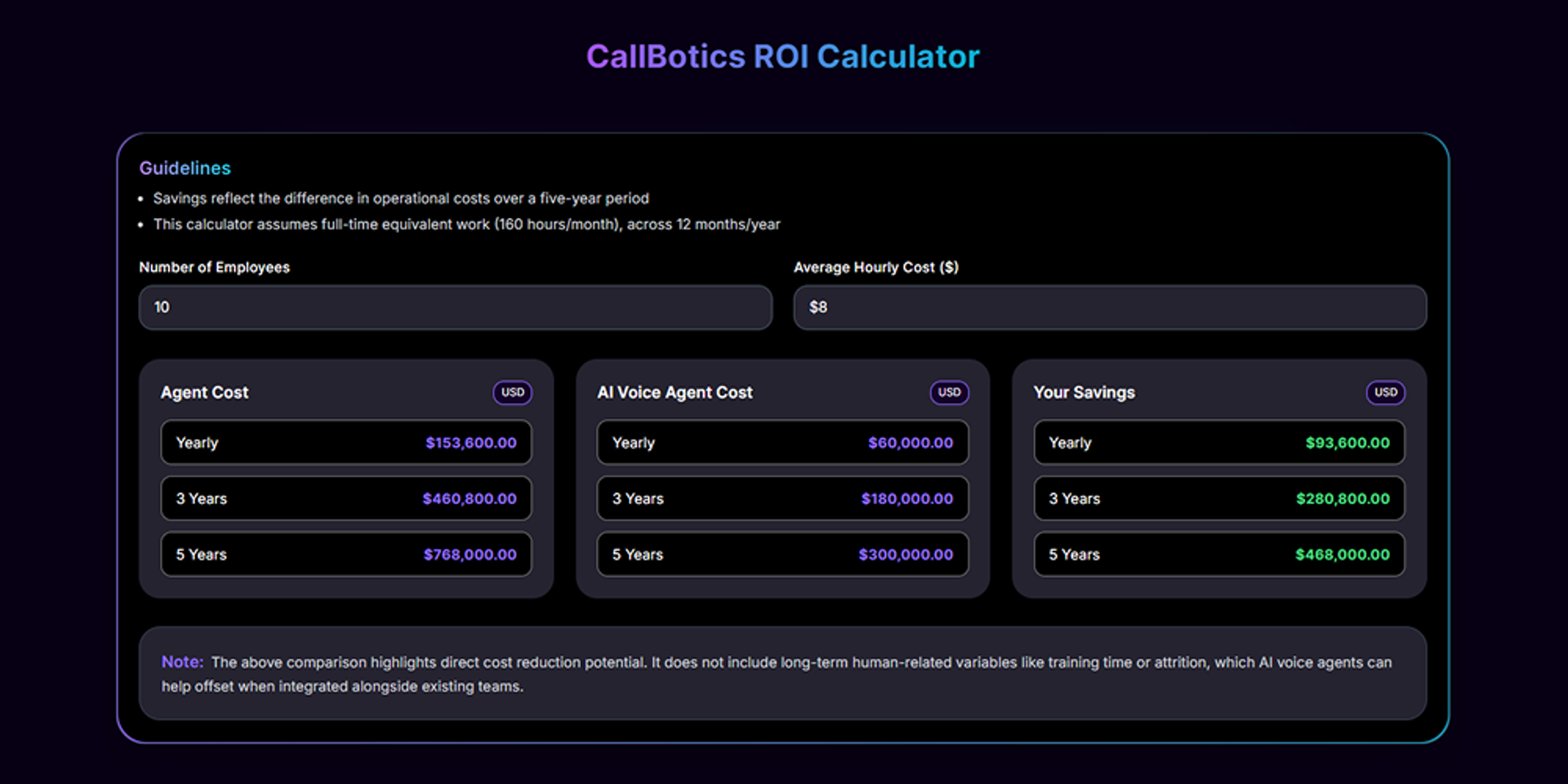
Caption: Use the CallBotics ROI Calculator to check cost savings over 1, 3, and 5 years
If you’re an enterprise that doesn’t mind complex pricing and needs a single platform to run voice and digital automation and support agent-assist workflows, Cognigy is built for you.
If your priority is voice-call containment and resolution with pricing you can easily forecast, CallBotics is the simpler path.
For most contact centers evaluating AI voice agents in 2026, the bigger challenge is not whether the platform is enterprise-grade. The question is whether the solution can move beyond pilots into stable, measurable production without pricing complexity, long rollout cycles, or ongoing technical maintenance.
That is where CallBotics delivers more substantial long-term value. It is designed to launch quickly, resolve routine calls end-to-end, and scale reliably as demand grows.
Teams evaluating AI voice platforms are increasingly focused on how solutions perform once they are operating at scale. CallBotics is built by contact-center practitioners with over 17 years of experience, and it is designed around the realities of high-volume voice operations. Its emphasis on predictable pricing, rapid deployment, and end-to-end call resolution makes it a practical choice for organizations that want to operationalize AI voice with clarity and confidence.
Here are CallBotics’ differentiators that make it a stronger alternative:

Urza Dey (She/They) is a content/copywriter who has been working in the industry for over 5 years now. They have strategized content for multiple brands in marketing, B2B SaaS, HealthTech, EdTech, and more. They like reading, metal music, watching horror films, and talking about magical occult practices.
See how enterprises automate calls, reduce handle time, and improve CX with CallBotics.
CallBotics is an enterprise-ready conversational AI platform, built on 18+ years of contact center leadership experience and designed to deliver structured resolution, stronger customer experience, and measurable performance.