AI customer service platforms have evolved rapidly. What began as simple chatbots has expanded into AI agents capable of handling complex customer interactions across multiple channels.
One company gaining attention in this space is Decagon AI, which builds AI agents designed to resolve customer support issues autonomously. These agents can manage common service interactions such as account inquiries, troubleshooting requests, and billing questions without requiring human intervention.
As organizations evaluate conversational AI vendors, pricing is usually one of the first questions asked.
However, many enterprise AI platforms do not publish fixed pricing tiers. Instead, they provide custom quotes based on deployment scope, automation complexity, and interaction volume. Decagon AI follows this enterprise pricing model, which can make early budget estimation challenging.
Understanding how enterprise AI pricing typically works is therefore important. Costs often include not only the software platform but also implementation, integrations, usage-based charges, and ongoing optimization.
This guide explains how Decagon AI pricing is likely structured, the main factors that influence total cost, and how it compares with solutions such as CallBotics for organizations evaluating AI automation.
Caption: Decagon AI Homepage
Decagon AI is an enterprise conversational AI platform designed to automate customer support operations. The platform uses large language models and workflow automation to handle support requests across digital channels, including chat, email, and messaging.
Its primary goal is automated resolution, meaning the AI agent not only responds to customers but also completes tasks by interacting with backend systems.
Typical automated workflows include:
Instead of simply retrieving knowledge-base answers, Decagon’s AI agents can integrate with internal tools such as helpdesks, CRMs, and payment systems to complete actions during the conversation.
Organizations typically deploy the platform in high-volume support environments, where automation can reduce manual workload and improve response times.
Because of this focus, Decagon is often compared with other enterprise conversational platforms and Decagon AI alternatives designed to automate digital customer support.
Decagon AI does not currently publish public pricing tiers. Instead, organizations must request a custom quote based on their operational requirements.
This approach is common among enterprise AI vendors. Conversational AI deployments often involve integrations, workflow configuration, and infrastructure scaling, which makes fixed pricing difficult.
While the lack of public pricing can make early comparisons harder, understanding the typical structure of enterprise AI pricing helps organizations estimate potential costs.
Software platforms generally follow one of two pricing approaches.
Many SaaS products publish clear pricing tiers with defined usage limits. These plans typically scale based on:
This model is common among small and mid-market SaaS tools.
Enterprise AI platforms typically use custom pricing, with costs based on the complexity of each deployment.
Pricing discussions typically include:
Because these factors vary widely between organizations, vendors typically evaluate the environment before providing pricing.
Organizations seeking an accurate quote for conversational AI should prepare several operational inputs.
Vendors need to understand which customer interactions the AI will automate. Automating FAQs requires significantly less configuration than automating complex workflows such as account changes or troubleshooting.
Expected conversation volume directly affects pricing. Some vendors charge based on conversations, while others charge based on resolutions or compute usage.
Conversational AI platforms may support multiple channels, including:
Supporting additional channels can increase deployment complexity.
Integrations with platforms such as Salesforce, Zendesk, internal databases, or payment systems may require additional configuration and testing.
Organizations often begin with a pilot deployment before expanding automation across teams, departments, or regions.
Providing this information early helps vendors deliver more accurate pricing estimates.
Although Decagon AI does not publicly list pricing, most enterprise conversational AI platforms follow a similar cost structure.
Enterprise AI platforms typically charge a base subscription fee for access.
This fee usually includes:
The base license often represents only part of the total cost, with usage and implementation fees contributing significantly to overall spend.
Most conversational AI systems also include usage-based pricing.
Usage may be measured through:
This model allows organizations to scale automation gradually, but also means costs increase as usage grows.
Enterprise AI deployments typically require implementation services before going live.
These services may include:
Depending on deployment complexity, implementation can represent a significant portion of the first-year investment.
Enterprise deployments often include additional support services such as:
These services ensure reliability and continuous improvement but may increase the total contract value.
A vendor quote typically reflects only the initial deployment scope. In practice, the total cost of conversational AI depends on several operational variables that affect implementation complexity, infrastructure usage, and long-term maintenance.
Understanding these factors helps organizations estimate the real cost of deploying AI support agents at scale.
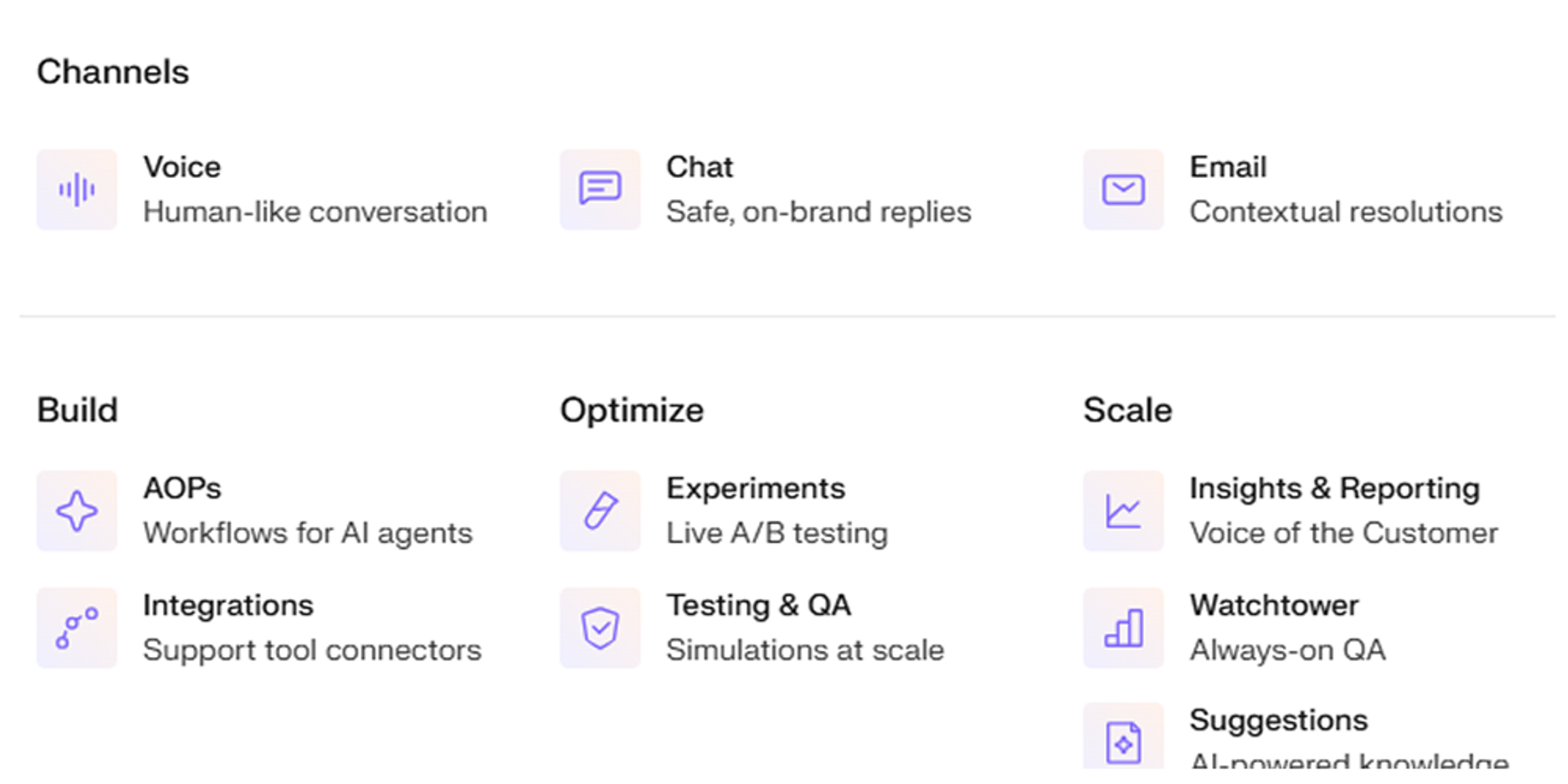
Caption: Decagon AI Offerings
Customer support workflows vary widely in complexity, which directly affects automation costs.
Simple interactions such as FAQs or order status requests require minimal workflow logic and are relatively easy to automate.
More advanced workflows may include:
These scenarios often require branching logic, system integrations, and policy enforcement.
As automation depth increases, platforms typically require additional training data, integration layers, and testing. This increases both implementation effort and platform cost.
Conversational AI platforms rarely operate independently. To resolve issues end-to-end, they usually integrate with internal systems such as:
These integrations allow AI agents to retrieve customer data and perform actions during a conversation.
However, integration complexity varies significantly between organizations. Companies with highly customized systems often require additional development work, which can increase implementation costs.
Usage volume is another major cost driver.
Many conversational AI platforms charge based on interaction volume or compute usage. Organizations handling large numbers of support requests will therefore see higher platform costs.
Contact centers also experience fluctuations in demand. Examples include:
AI systems must handle these spikes without performance degradation.
For this reason, vendors often price infrastructure based on both total interaction volume and peak concurrency, meaning the number of conversations handled simultaneously.
Higher concurrency requirements typically increase infrastructure costs.
Organizations in regulated industries often require advanced security and compliance capabilities.
Common requirements include:
Supporting these standards requires additional infrastructure and security processes. As a result, deployments in regulated environments may involve higher implementation and platform costs.
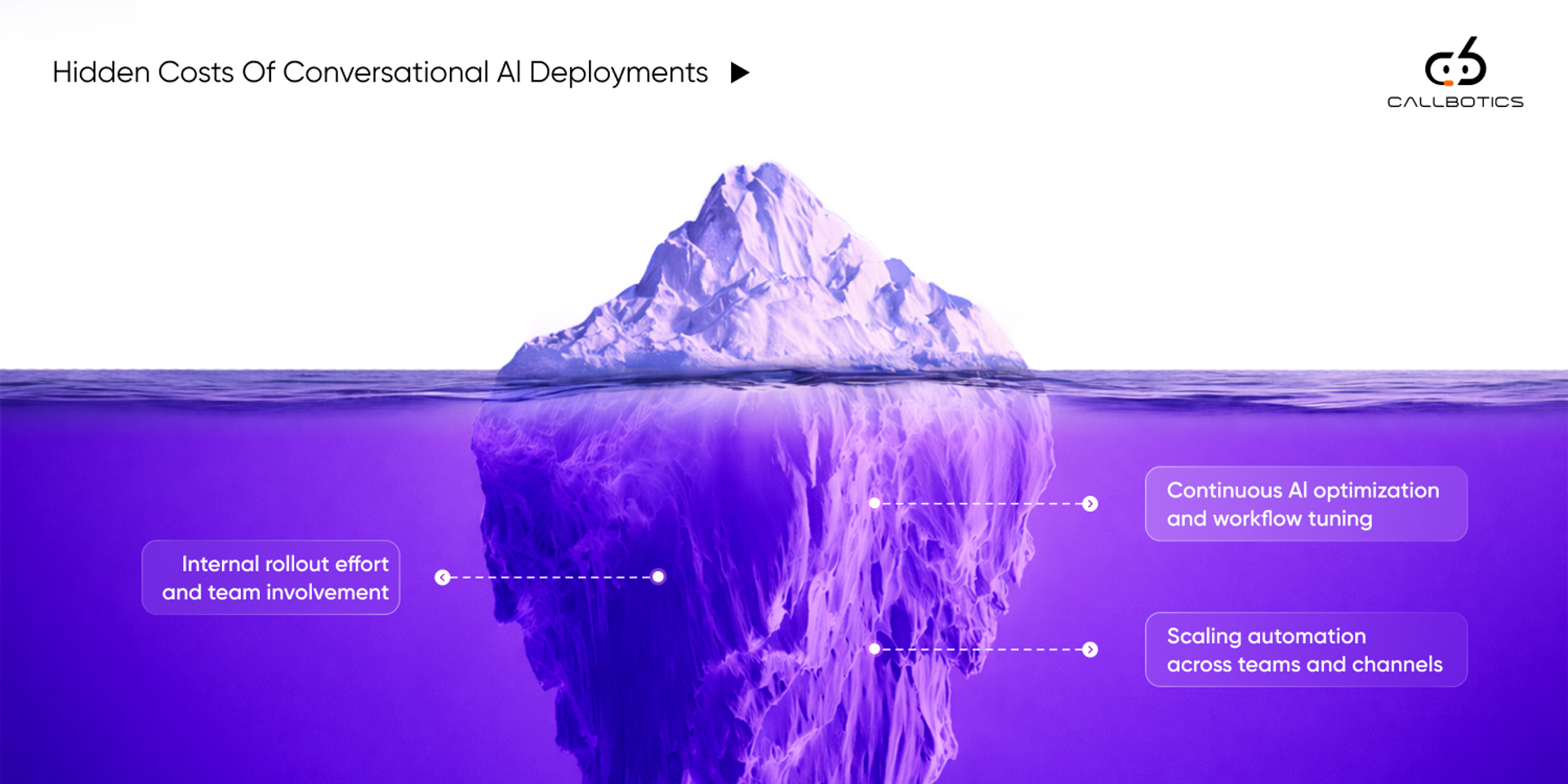
When evaluating conversational AI platforms, buyers often focus on visible costs such as platform licenses or usage fees.
However, enterprise deployments frequently include indirect costs that appear during implementation and ongoing operations.
Understanding these factors helps organizations estimate the full cost of AI automation.
Even when vendors provide implementation support, internal teams usually play a significant role in deployment.
Common responsibilities include:
Operations leaders, IT teams, and support managers typically invest time ensuring that AI workflows behave correctly in real-world conditions.
These internal resource costs rarely appear in vendor quotes but can influence the overall rollout effort.
Conversational AI systems rarely achieve optimal performance immediately after launch.
Most deployments improve gradually through ongoing refinement.
Typical optimization tasks include:
Organizations that succeed with AI automation usually treat optimization as a continuous process rather than a one-time setup.
Many AI deployments begin with a limited pilot or a single support workflow.
Once automation proves effective, organizations often expand the system across additional teams or channels. Examples include:
Each expansion may require new integrations, workflow updates, and additional infrastructure capacity.
As automation scales, these factors can significantly influence the long-term cost of ownership.
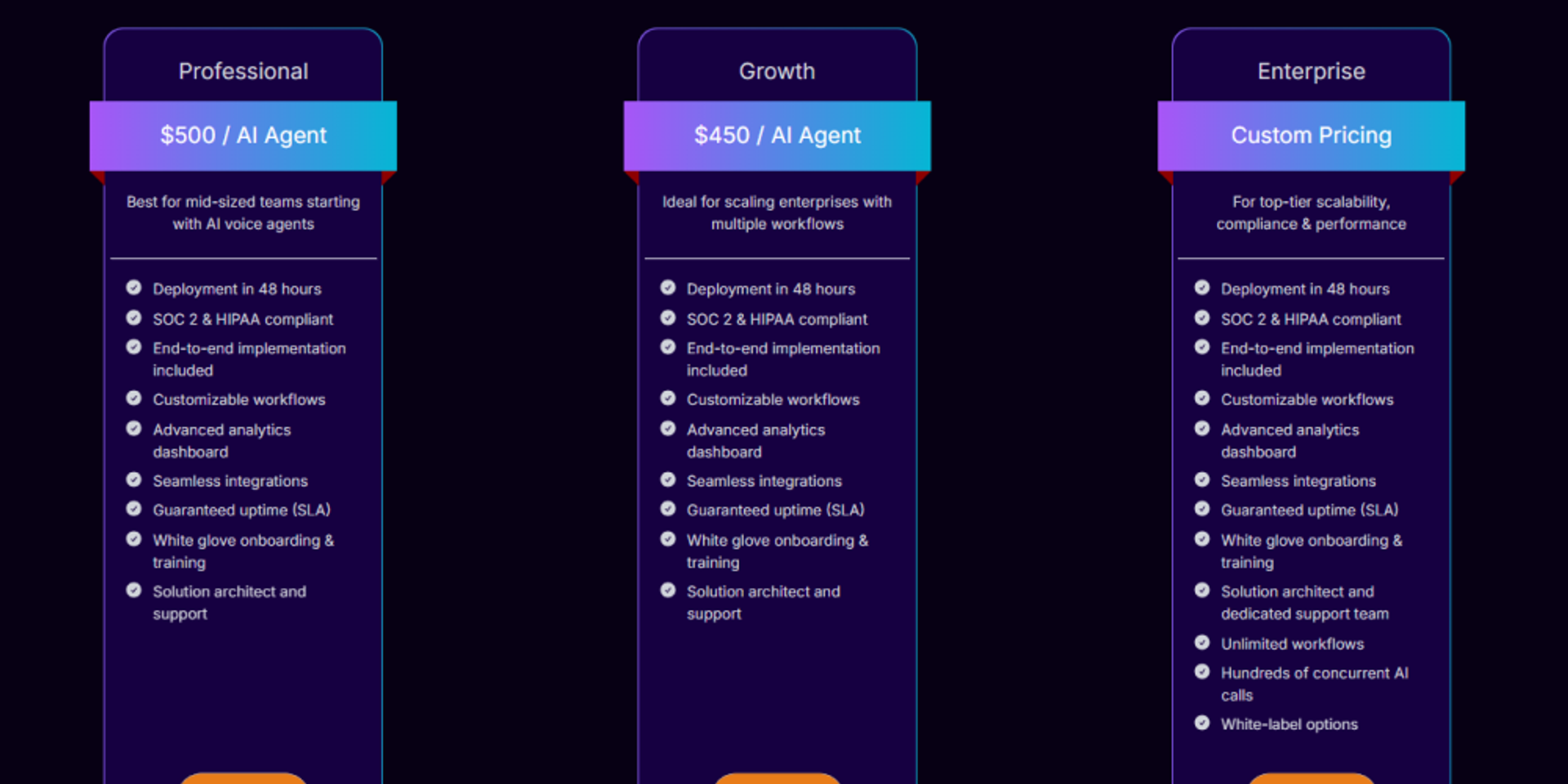
Caption: CallBotics PricingCallBotics focuses on AI voice automation for contact center workflows, which can significantly reduce call-handling costs and improve resolution rates.
Unlike many enterprise AI platforms that rely entirely on custom pricing discussions, CallBotics structures pricing around automation scale and operational scope.
CallBotics pricing typically depends on:
This allows organizations to evaluate automation based on operational outcomes such as cost per call and resolution rates.
Implementation timelines often affect how quickly AI automation delivers value.
CallBotics enables rapid deployment by converting operational documentation into AI workflows. In many cases, voice agents can go live in about 48 hours.
Evaluating conversational AI platforms involves more than comparing headline pricing. Organizations typically assess vendors based on pricing transparency, deployment complexity, operational impact, and long-term scalability.
While both Decagon AI and CallBotics operate in the conversational AI automation space, their focus differs. Decagon primarily targets digital customer support automation, while CallBotics focuses on voice automation for contact center workflows.
| Evaluation Area | Decagon AI | CallBotics |
|---|---|---|
| Pricing Model | Enterprise quote-based pricing | Pricing aligned with automation scope |
| Pricing Visibility | Pricing available after sales engagement | Easier early-stage estimation |
| Primary Focus | Chat and digital support automation | Voice automation for contact centers |
| Deployment Timeline | Often, several weeks, depending on integrations | AI voice agents live for ~48 hours |
| Implementation | Integration-heavy setup | White-glove implementation included |
| Conversation Handling | Structured ticket automation | Multi-step voice conversations |
| Analytics | Varies by deployment | Built-in QA, sentiment, and dashboards |
| Best Fit | Messaging-heavy support teams | High call-volume environments |
Decagon AI follows a quote-based enterprise pricing model, where final costs depend on deployment complexity.
Pricing discussions typically consider:
Because these variables vary across organizations, pricing can differ significantly between deployments.
CallBotics structures pricing around automation scope and call volume, allowing organizations to estimate costs earlier in the vendor evaluation process.
To understand how voice automation affects contact center performance, see how AI Voice analytics works.
Implementation timelines strongly influence the ROI of AI automation.
Enterprise conversational AI deployments often require weeks of integration and workflow configuration before becoming operational.
CallBotics reduces deployment time by converting operational documentation such as SOPs, training materials, and existing workflows into automation logic. In many cases, AI voice agents can go live in approximately 48 hours.
Faster deployment allows organizations to begin realizing operational value sooner.
Decagon AI is designed primarily for digital support automation, especially messaging channels like chat and email. These environments typically involve structured ticket workflows.
CallBotics focuses on voice automation, where interactions are longer and more dynamic. Voice conversations often include:
Automating these workflows requires systems specifically designed for real-time conversational complexity.
Organizations whose service operations rely heavily on phone interactions often evaluate voice-first automation platforms alongside messaging-focused systems.
Beyond platform pricing, organizations should consider how costs evolve as automation expands.
Common scaling factors include:
Platforms requiring engineering resources for updates can introduce additional operational overhead.
Solutions that include built-in workflow management and analytics typically reduce the effort required to maintain automation at scale.
Because Decagon AI does not publish public pricing, costs are typically estimated based on enterprise deployments.
| Cost Component | Description |
|---|---|
| Platform License | Base subscription for platform access |
| Usage Fees | Conversations, resolutions, or compute usage |
| Implementation | Integrations, workflow setup, deployment |
| Support | Enterprise support and success services |
| Optimization | Ongoing tuning and monitoring |
Actual pricing depends on the scale and complexity of automation.
Decagon AI may be effective for organizations focused on scaling digital customer support automation. However, determining its value requires evaluating operational priorities and internal resources.
Decagon AI may be a strong fit for organizations that:
In these environments, conversational AI can reduce manual workload and improve response times.
CallBotics may be a stronger fit when voice automation is the primary operational priority, particularly for organizations managing large call volumes.
The platform is designed specifically for contact center environments, where AI voice agents must handle longer conversations, multi-step workflows, and real-time customer interactions.
Rather than functioning as a standalone chatbot layer, CallBotics integrates automation directly into operational processes. This allows organizations to automate calls while maintaining visibility into performance and customer outcomes.
| Capability | Function |
|---|---|
| 100 Percent Automated QA | Evaluates every interaction for compliance and accuracy |
| Sentiment Analysis | Detects tone shifts and escalation signals |
| Custom Dashboards and Reports | Tracks outcomes and call performance |
| Churn Intelligence | Identifies customers at risk based on behavioral signals |
| Live Monitoring | Allows supervisors to intervene in real time |
| Latency Tracking | Measures delays across the interaction pipeline |
| Multi-Tenancy Architecture | Supports enterprises managing multiple teams |
These capabilities allow organizations to treat voice automation as a core operational system rather than a standalone AI tool.
Before selecting any conversational AI platform, organizations should evaluate both pricing structure and operational fit.
Conversational AI adoption is increasing rapidly across customer service operations, yet many organizations still face challenges with slow deployments and limited visibility into performance.
CallBotics addresses these challenges by focusing on production-ready AI voice automation built specifically for contact center environments.
The platform integrates AI voice agents directly into operational workflows, allowing organizations to automate high-volume call interactions while maintaining detailed performance insights.
CallBotics is designed to function as an operational automation layer rather than a standalone AI tool. Several capabilities distinguish the platform in voice-first automation environments:
Once voice automation is deployed, the same workflow intelligence can extend across channels such as chat, SMS, and email.
Organizations exploring automation strategies can learn more through:
Conversational AI is becoming an essential component of modern customer service infrastructure.
Decagon AI follows a traditional enterprise pricing model where costs depend on deployment scope, interaction volume, and integrations. While this allows tailored deployments, it can make early cost estimation more challenging.
Organizations evaluating AI automation platforms should therefore consider not only pricing but also deployment effort, scalability, and operational alignment.
Platforms such as CallBotics demonstrate how voice-first automation architectures can reduce deployment timelines while improving operational visibility.
Ultimately, successful AI automation strategies align technology capabilities with real contact center workflows.

Urza Dey (She/They) is a content/copywriter who has been working in the industry for over 5 years now. They have strategized content for multiple brands in marketing, B2B SaaS, HealthTech, EdTech, and more. They like reading, metal music, watching horror films, and talking about magical occult practices.
See how enterprises automate calls, reduce handle time, and improve CX with CallBotics.
CallBotics is an enterprise-ready conversational AI platform, built on 18+ years of contact center leadership experience and designed to deliver structured resolution, stronger customer experience, and measurable performance.