For decades, Interactive Voice Response systems have served as the front door of customer service. The familiar experience of navigating “Press 1 for billing, press 2 for support” menus was designed to route callers efficiently while minimizing staffing costs. For businesses, IVR delivered consistency and scalability. For customers, however, it often created friction, repetition, and frustration.
Despite widespread complaints, many organizations still rely on traditional IVR because it is predictable, deeply embedded in legacy infrastructure, and relatively inexpensive to operate for simple routing tasks.
Customer expectations have changed dramatically. Callers now expect immediate understanding, personalized interactions, and resolution during the first contact. Long menus and transfers increasingly feel outdated.
AI voice agents represent a fundamentally different approach. Instead of forcing callers through rigid trees, they enable natural conversations that identify intent, ask clarifying questions, access business systems, and complete tasks.
The difference is not cosmetic. It directly affects containment rates, first-call resolution, customer satisfaction, and operational costs.
Industry benchmarks illustrate this shift clearly:
This guide explains how IVR and AI voice agents differ, where each approach works best, and how to choose the right solution for specific call flows.
Traditional IVR is an automated telephony system that interacts with callers using prerecorded prompts and keypad inputs, sometimes supplemented by basic speech recognition.
Its core function is routing rather than resolution.
Typical IVR capabilities include:
A standard interaction might proceed as:
“Press 1 for account balance. Press 2 for technical support. Press 3 for billing.”
Once a selection is made, the system routes the call accordingly.
IVR works well when needs are predictable and easily categorized. It is deterministic, scalable, and inexpensive to operate for high-volume environments.
However, real customer inquiries rarely fit neatly into predefined categories. Callers may have multiple issues, unclear terminology, or emotional urgency that menus cannot accommodate. As a result, many interactions involve trial-and-error navigation before reaching the correct destination.
Another limitation is the lack of context. IVR systems typically treat each call as isolated, even if the caller recently interacted with the organization through another channel. This leads to repetitive authentication steps and redundant explanations.
Despite these limitations, IVR remains valuable where strict process control, predictable routing, and low operational risk are priorities.
An AI voice agent is a conversational system that understands natural language, interprets intent, maintains context, and performs actions across business systems.
Instead of navigating menus, callers simply state what they need.
Example:
“I need to change my delivery date and update my address.”
An AI voice agent can:
This transforms the call from routing to resolution.
AI voice agents combine speech recognition, natural language understanding, reasoning, and workflow orchestration. Unlike earlier voice bots that relied on rigid scripts, modern agents can adapt dynamically based on the conversation.
They integrate with CRM platforms, billing systems, scheduling tools, knowledge bases, authentication services, and operational databases. This connectivity enables them to act as digital employees rather than informational kiosks.
Their ability to complete tasks is why they achieve significantly higher containment and resolution rates than IVR. Instead of transferring customers to humans for execution, they perform the work directly.
Understanding the call-flow differences highlights why the customer experience diverges so dramatically.
The flow is linear and predetermined.
The flow is adaptive and conversational.
| Dimension | Traditional IVR | AI Voice Agent |
|---|---|---|
| Primary purpose | Route callers to the correct destination | Understand intent and resolve requests |
| Interaction style | Menu navigation with keypad or limited voice input | Natural conversation using speech |
| Customer effort | High when menus are long or unclear | Low because callers speak freely |
| Issue resolution | Limited. Most issues require transfer | Can resolve many issues end-to-end |
| Containment rate | Typically, 20 to 40 percent | Often, 50 to 75 percent, depending on the workflow |
| First-call resolution | About 65 to 75 percent for simple cases | Often, 85 to 95 percent |
| Personalization | Same experience for most callers | Context-aware using account data and history |
| Handling complex requests | Poor. Requires human escalation | Strong. Supports multi-step problem solving |
| Setup approach | Fixed call trees and prerecorded prompts | Workflow design with adaptive logic |
| Maintenance | Manual updates required for menu changes | Improves through analytics and training |
| Data captured | Call routing metrics and durations | Transcripts, intent, sentiment, outcomes |
| Customer satisfaction impact | Can decline with complex menus | Typically improves CSAT and reduces frustration |
| Scalability | Limited by routing capacity and staffing | Scales without proportional headcount |
| Best use cases | Department routing, office hours, and simple inquiries | Scheduling, support resolution, qualification, transactions |
| Business impact | Efficiency in directing calls | Efficiency in solving problems |
Customer experience is often the most visible distinction.
IVR interactions resemble navigating a website using only numbered links. The user must translate their problem into the system’s categories. If the correct option is unclear, they may choose incorrectly, leading to misrouting.
AI voice agents reverse this dynamic. The caller describes the problem in their own words, and the system interprets it.
This shift reduces cognitive load, especially during stressful situations such as medical issues, financial concerns, or service outages.
Organizations deploying conversational AI frequently observe measurable improvements in satisfaction metrics, including CSAT, Net Promoter Score, and customer effort scores. Reduced frustration also correlates with lower churn risk, as explored in Using AI Voice Agents to Reduce Customer Churn in Contact Centers.
IVR routes problems. AI agents solve them.
Example:
IVR → Transfers the caller to the billing queue
AI agent → Retrieves invoice, processes payment, confirms outcome
Because AI agents execute tasks, they reduce transfers and hold times.
IVR requires manual configuration of decision trees and prerecorded prompts. Changes often involve significant effort.
AI voice agents improve through training and analytics rather than structural redesign. New intents or workflows can be added without rebuilding entire menus.
Traditional IVR treats callers uniformly.
AI voice agents personalize interactions using:
This reduces repetition and improves efficiency.
IVR analytics focus on operational metrics such as call distribution and queue times.
AI voice agents generate richer insights:
These insights enable continuous improvement. Organizations can identify recurring issues, policy confusion, or product gaps directly from conversations. For example, detailed analysis techniques are explored in How to Use AI Agents to Analyze Phone Calls and Unlock Insights.
IVR remains useful in specific scenarios where simplicity and predictability matter more than flexibility.
When callers only need to reach the correct team, menus are efficient.
Examples:
Press 1 for billingPress 2 for salesPress 3 for support
This reduces misrouting without requiring complex automation.
IVR is effective for:
For organizations needing more advanced coverage, conversational automation can extend support beyond basic messaging. After-Hours Support with AI Voice Agents explains how businesses prevent missed opportunities outside operating hours.
Industries with standardized processes benefit from predictable routing logic.
Examples include utilities, government services, and large enterprises handling routine inquiries.
AI voice agents deliver the greatest impact when interactions involve multiple steps, uncertainty, or decision-making.
Scheduling conversations often includes constraints such as availability windows, preferences, eligibility rules, and cancellations. Traditional IVR can route callers to scheduling teams, but it cannot manage negotiation or exceptions.
AI agents can check calendars, suggest alternatives, enforce policies, and finalize bookings without human involvement.
Inbound calls from prospective customers represent high-value opportunities. AI agents can ask discovery questions, assess urgency, collect details, and route qualified prospects directly to sales teams.
Outbound use cases include appointment reminders, payment follow-ups, and re-engagement campaigns. Because the agent can respond dynamically, conversations feel less scripted and more personalized.
Many support issues require iterative troubleshooting. Customers may not know the root cause, so the system must guide them through diagnostic steps.
AI agents can ask clarifying questions, reference knowledge bases, and adjust recommendations based on responses. This reduces the need for human involvement while maintaining accuracy.
Even when human support is necessary, AI agents can gather details first, reducing handle time and improving outcomes.
Organizations using this approach often see improvements in first-call resolution, a topic explored further in How AI Voice Agents Improve First Call Resolution in Contact Centers.
Cost comparisons between IVR and AI voice agents often overlook the value of resolution versus routing.
IVR reduces the time spent directing calls to the appropriate department. This can lower operational costs for organizations handling large volumes of simple inquiries.
However, because IVR rarely resolves issues fully, human agents still perform most work. Savings are therefore incremental rather than transformational.
AI voice agents reduce the total amount of human labor required per interaction by resolving issues directly.
Reported benefits include:
Traditional staffing models scale linearly. Handling twice the call volume requires roughly twice the staff.
AI introduces non-linear scaling. Once deployed, agents can handle additional interactions with minimal incremental cost, making them particularly valuable during demand spikes.
Additional benefits include reduced training requirements, lower turnover impact, and consistent service quality across shifts and regions.
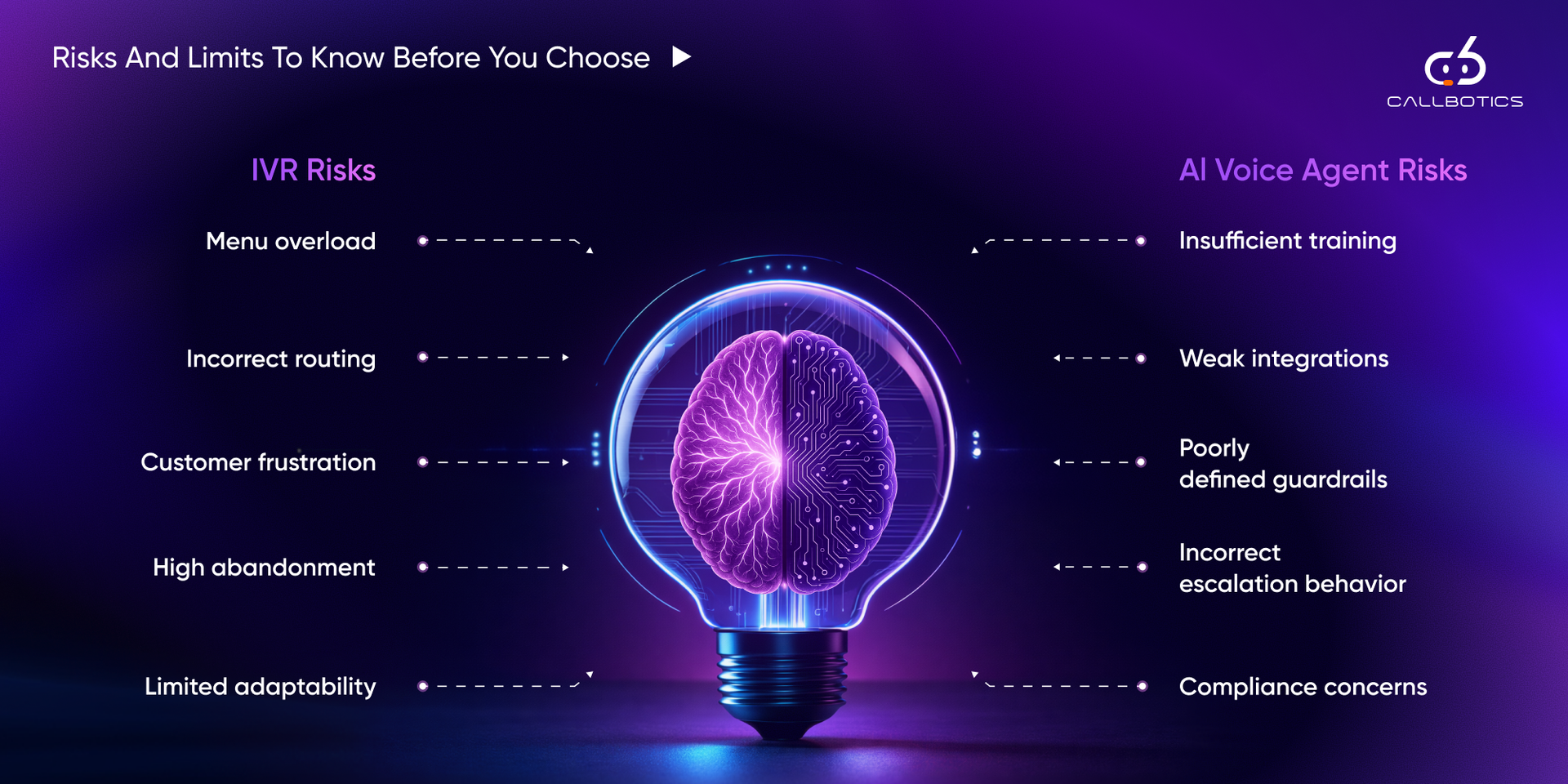
Successful deployments require testing, monitoring, and governance.
Choosing between IVR and AI voice agents should be driven by operational goals rather than technology trends.
Analyze call data to identify dominant request types. Many organizations discover that a small number of intents generate the majority of volume.
Simple routing requests may remain suitable for IVR, while complex interactions represent high-value automation opportunities.
Define success metrics before selecting technology.
Examples:
IVR primarily optimizes routing efficiency. AI voice agents optimize outcome efficiency.
Hybrid architectures often provide the best balance of reliability and flexibility.
For example:
This approach allows gradual modernization while protecting existing investments.
Organizations modernizing legacy IVR systems need more than conversational capability. They need production-grade automation that integrates cleanly into existing operations without introducing risk.
CallBotics delivers operator-built AI voice agents designed for real-world contact center environments. Unlike experimental voice tools focused on demos or pilots, the platform is production-ready from day one, with governance, escalation control, and compliance built into the architecture.
The system enables:
Because analytics is integrated at the execution layer, teams gain clear visibility into containment, resolution rates, escalation triggers, and performance trends without deploying separate monitoring tools. Automation is measured by outcomes, not interactions.
With deployment timelines as short as 48 hours for defined workflows, organizations can validate performance quickly and scale responsibly.
Built by experienced contact center operators, CallBotics emphasizes operational reliability, governance-first design, and measurable improvements in resolution rather than experimental automation.
Traditional IVR systems were designed for an era when automation meant directing traffic rather than completing work. They remain useful for structured routing and predictable processes.
AI voice agents reflect a new paradigm focused on understanding intent and delivering outcomes.
A simple rule applies:
Use IVR for routing. Use AI voice agents for resolution.
Organizations that align technology choice with specific call types typically achieve the best results. Starting with a small number of high-impact workflows allows teams to validate performance, refine governance, and build confidence before scaling.
As customer expectations continue to evolve, the ability to handle conversations intelligently rather than mechanically will increasingly define competitive advantage in customer service.
Automation is no longer about replacing humans. It is about enabling faster, more consistent, and more scalable outcomes.

Urza Dey (She/They) is a content/copywriter who has been working in the industry for over 5 years now. They have strategized content for multiple brands in marketing, B2B SaaS, HealthTech, EdTech, and more. They like reading, metal music, watching horror films, and talking about magical occult practices.
See how enterprises automate calls, reduce handle time, and improve CX with CallBotics.
CallBotics is an enterprise-ready conversational AI platform, built on 18+ years of contact center leadership experience and designed to deliver structured resolution, stronger customer experience, and measurable performance.