Poly AI has established itself as one of the leading solutions in today’s conversational AI landscape. But when it comes to AI platforms, it is never a one-size-fits-all situation in the real world.
On a broader scale, Poly AI has become a go-to solution for many. But it may not be the perfect fit for every business model, tech stack, or deployment timeline. As more companies look for faster setup, deeper customization, flexible pricing, or support for industry-specific workflows, many begin exploring alternatives that align better with their goals. The market for Poly AI alternatives is diverse, offering a wide range of options with varying features, pricing, and capabilities to suit different user needs.
This guide highlights the leading Poly.ai alternatives in 2026 and what each one brings to the table so teams can choose the platform that fits their needs, not just the biggest name in the market.
Poly.ai is a well-known voice automation platform that helps businesses handle calls with natural-sounding AI agents and reliable enterprise-level support. Many companies use it to streamline customer service, reduce call center load, and offer consistent phone experiences at scale. As the voice AI landscape continues to evolve, however, different teams often develop new priorities around flexibility, integration depth, pricing, or deployment speed.
Let’s dive into some common priorities that might drive businesses to look for alternatives in 2026.
Additionally, businesses may seek alternatives to improve service quality and better align with customer-centric brands, especially in industries like telecommunications and financial services, where customer experience and brand consistency are critical.
| Tool Name | Key Features | Pricing |
|---|---|---|
| CallBotics.ai | - Pre-trained AI voice agents - 80%+ resolution rate - 48-hour deployment - High compliance support | Custom pricing |
| Vapi AI | - API-native control - < 500ms latency - 100+ language support - BYO models | Pay As You Go and Enterprise (Custom pricing) |
| Bland AI | - “Pathways” decision trees - SOC2, HIPAA, GDPR compliance - 100+ languages | Costs $0.09/minute and is billed to the exact second |
| Retell AI | - No-code builder - Multi-step convos - Auto IVR & CRM integration | Pay As You Go and Enterprise (Custom pricing) |
| Goodcall | - No-code setup - Lead capture - AI call handling & scheduling | Starts at $59/month per agent |
| Play.ai | - 200+ voices - Real-time emotional tone detection - Multi-speaker support | Custom pricing |
| Vocode.dev | - Telephony + Zoom - SDKs & streaming - Emotion tracking | Custom pricing |
| Synthflow AI | - Drag-and-drop builder - 50+ languages - CRM integration | Starts at $29/month for 50 mins |
| Decagon | - NL-based agent config - Unified interface - CRM & Helpdesk APIs | Custom pricing |
| Google Dialogflow | - NLU & voice/chat AI - Pre-built templates - Visual flow builder | Custom pricing |
Now that we have a fair understanding of what each Poly.ai alternative brings to the table (pun intended!), let’s take a closer look at each tool’s features, pros and cons, and overall performance.
CallBotics is an enterprise AI voice agent platform for contact centers and call-heavy workflows, built from nearly two decades of large-scale voice operations. It helps contact centers deploy faster, reduce operational load, and improve core metrics such as AHT, FCR, and occupancy. It uses pre-trained enterprise-grade AI voice agents built from nearly two decades of operational experience to nearly eliminate wait times. The platform connects with existing contact-center systems to handle routine inquiries, transactional calls, and multi-step processes with human-like accuracy. CallBotics is a strong PolyAI alternative for teams that need full workflow automation and consistent resolution at scale.
CallBotics fits well in call-heavy workflows like contact centers and compliance-driven industries (healthcare, insurance, and complex support teams). It is capable of handling complex customer inquiries through human-like conversations in these settings.
A nationwide U.S.-based medical record retrieval enterprise relied on high-volume outbound calling to hospitals, clinics, and provider offices to confirm record availability and timelines, but the process was labor-intensive, costly, and difficult to scale. Agents spent most of their time navigating IVRs, leaving voicemails, and logging routine status updates, leading to rising operational costs and inconsistent turnaround times.
The organization deployed CallBotics to automate these repetitive follow-ups without disrupting ongoing operations or requiring custom system development. AI voice agents independently placed outbound calls, navigated complex phone trees, captured record status updates, and synced outcomes directly into internal workflows, while only edge cases were routed to human teams with full context. Here's what they accomplished:
“The biggest shift was not just cost reduction, but predictability. We finally had control over volume without burning out teams.”
— Operations Leader, U.S. Record Retrieval Enterprise
Book a free 5,000-minute production trial here and see how Callbotics performs in your workflow.
Vapi AI is an API first voice automation platform built for teams that want complete control over how their voice agents behave. With advanced AI capabilities, Vapi enables building custom voice agents that can handle complex conversational logic, generate content, and understand customer intent. It offers low-latency performance, multilingual coverage, and a developer-friendly architecture that allows deep customization. Technical teams often choose Vapi when they prefer to design conversational logic programmatically rather than through a visual builder.
Vapi fits well in engineering-driven teams that want to build bespoke voice AI experiences with full control over models and infrastructure.
Bland AI is a voice automation platform built for teams that want strong control over call behavior, data flow, and compliance. It supports multiple languages and offers a flexible prompt-based setup that allows businesses to design custom voice interactions without rigid templates. Bland AI also supports customer sentiment analysis, enabling teams to monitor and improve service quality by understanding customer emotions and feedback in real time. Bland, as an alternative to Poly AI, is frequently chosen by teams that prioritize security, customization, and the ability to maintain consistent conversational logic at scale.
Bland fits well in teams that need customizable conversational flows with strong compliance support to solve customer inquiries.
Starts at $0.09 per minute and is billed to the exact second.
Retell AI is a no-code voice automation platform designed for teams that want to build conversational agents quickly without writing code. It allows teams to build virtual agents for voice automation without coding. It supports real-time interactions, multi-step conversations, and seamless integrations with CRMs and telephony systems. Retell is often selected by organizations that value rapid deployment and an intuitive drag-and-drop builder for creating custom call flows.
Retell fits well in teams that want to launch voice agents quickly and manage updates internally without developer involvement.
Available in Pay As You Go and Enterprise plans with custom pricing.
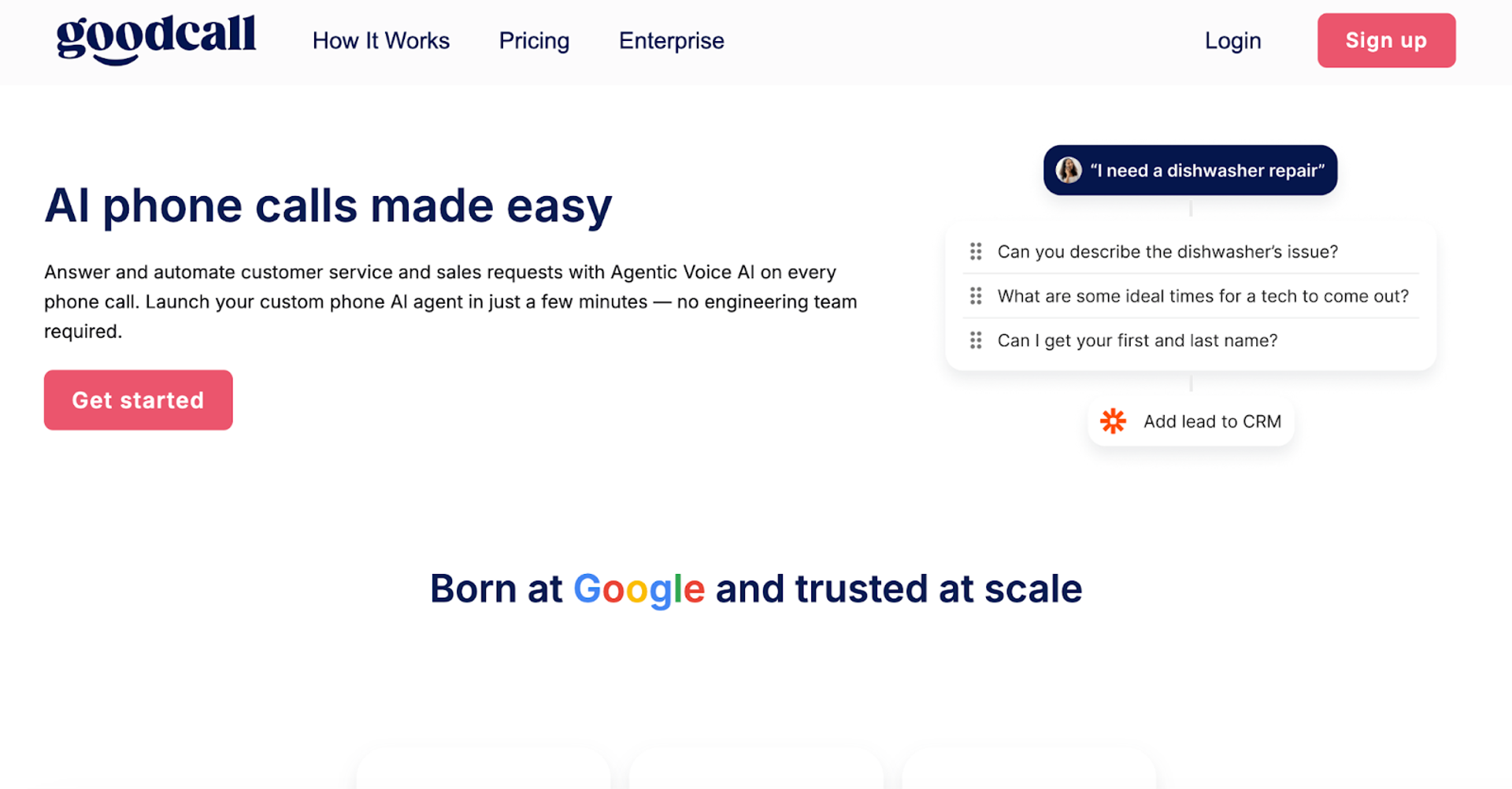
Goodcall is a no-code phone automation platform designed to help small and mid-sized businesses handle inbound calls, capture leads, and book appointments through conversational AI. It focuses on quick setup and practical functionality, making it a good option for teams that want to automate basic customer interactions without engineering resources. Goodcall is also a strong choice for e-commerce businesses looking to automate customer support and lead capture. Goodcall is commonly used by service businesses, local shops, and teams looking to streamline call handling and scheduling.
Goodcall fits well in small to mid-sized businesses that need simple, automated phone support and appointment handling.
Starts at $59 per month per agent for the Starter plan, with higher tier options at $99 and $199 per agent per month.
Play.ai is a voice synthesis and conversational audio platform focused on generating realistic, emotionally expressive speech. It can also be used as a character AI platform for creating engaging, persona-driven conversational experiences. It is commonly used by teams that prioritize natural voice quality, multi-speaker audio, and tone adaptation for richer conversational experiences. Play.ai appeals to organizations that want voice automation paired with high-fidelity sound and dynamic emotional cues.
Play.ai fits well in teams that want lifelike audio experiences, emotional tone control, or custom voice creation for branding and interactive applications.
Custom pricing based on usage and feature requirements.
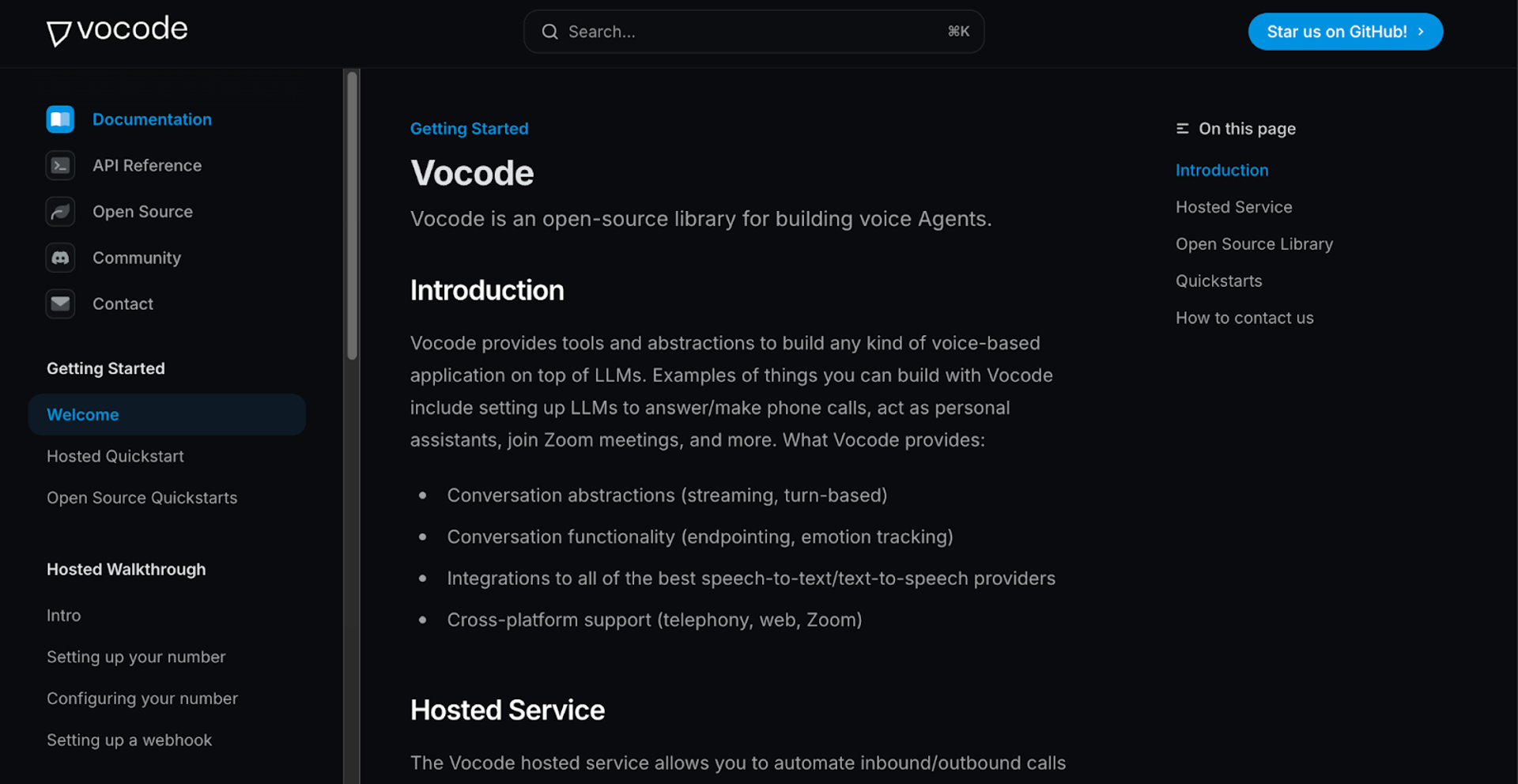
Vocode is a developer-focused toolkit for building real-time voice agents using existing large language models. It offers SDKs, telephony support, and streaming capabilities that allow teams to create conversational experiences across phone calls, Zoom, web chat, and other communication channels. Vocode allows teams with technical knowledge to build custom AI agents tailored to specific business needs. Vocode is often chosen by engineering teams that want to build custom voice applications without managing complex AI infrastructure themselves.
Vocode fits well in technical teams that want to build tailored voice AI experiences using SDKs and existing LLM providers.
Custom pricing based on usage, integrations, and deployment needs.
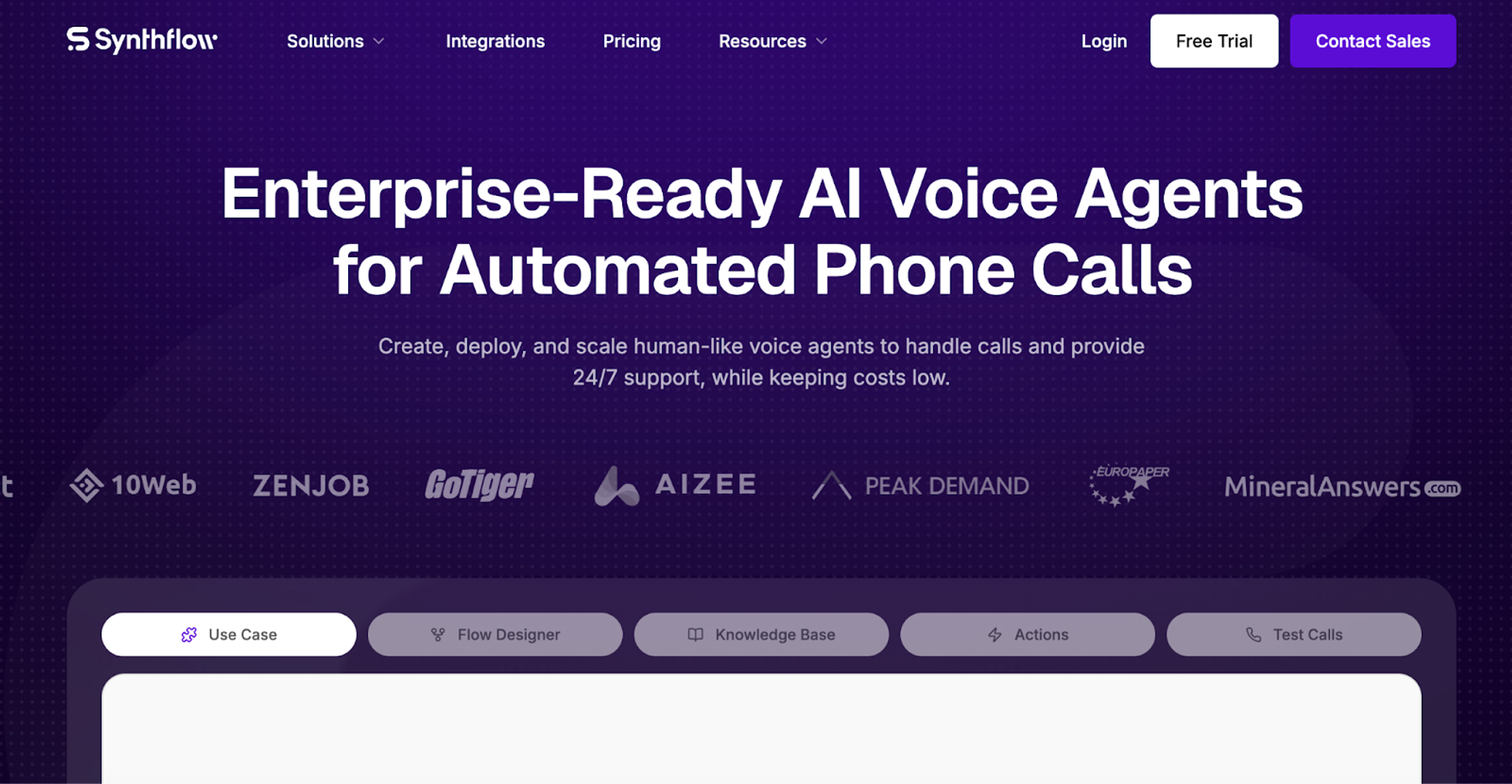
Synthflow AI is a no-code voice agent builder designed for teams that want to create conversational phone workflows quickly. Synthflow AI enables businesses to create AI agents for automating phone and digital customer interactions. With drag-and-drop call logic, multilingual support, and CRM integrations, it appeals to businesses that prefer a straightforward interface over complex development tools. Synthflow is often chosen by users who want to automate lead handling, appointment booking, and customer interactions with minimal technical setup.
Synthflow fits well in teams that want simple, fast-to-deploy voice agents for lead management and appointment workflows.
Starter plan begins at $29 per month for 50 minutes, with higher tiers at $450, $900, and $1400 per month depending on usage, plus enterprise options.
Decagon is a conversational AI platform that lets teams build voice agents using natural language instructions instead of traditional coding. Its interface converts plain language descriptions into underlying logic, making it easier for non-technical users to create automated workflows while still giving developers room to customize integrations and guardrails. Decagon's natural language configuration also helps in maintaining context throughout customer conversations, ensuring coherent and consistent interactions. Decagon is often selected by teams that want a balance between ease of use and technical flexibility.
Decagon fits well in teams that want low-code workflow creation with the option to add technical depth when needed.
Custom pricing based on usage and integration requirements.
Google Dialogflow is a conversational AI framework used to build both voice and chat-based virtual agents. It excels at managing multi-turn conversations across voice and chat channels, enabling complex customer interactions and extended, multi-step dialogues. It offers natural language understanding, visual flow design tools, and strong integration support through Google Cloud services. Dialogflow is often used by teams that want a flexible, well-supported platform for building interactive experiences across phone systems, apps, and web channels.
Dialogflow fits well in teams that want a reliable, scalable platform for multi-channel conversational experiences across voice, chat, and messaging apps.
Custom pricing is offered through Google Cloud based on usage, model selection, and deployment scale.
If faster deployment and more flexible voice automation are priorities for your team, a CallBotics demo is the easiest way to evaluate its impact on your operations.When you’re picking a Voice AI SaaS platform, don’t stop at the basic features or a slick interface. Robust AI technology is essential for delivering advanced features and reliable performance in voice AI platforms. Below are some of the key features to look for in an AI voice platform:
| Feature | Why It Matters |
|---|---|
| Natural language processing | Customers will stay longer and feel more comfortable if the voice sounds natural and responsive, rather than robotic or awkward in tone, even during a multi-turn conversation. |
| No-code builder | Your team can launch and update AI voice agents fast without waiting on developers or writing a single line of code. |
| Integrations | You can easily connect the platform to your CRM, calendar, helpdesk, and other tools already in use. |
| Analytics | Use performance data to improve scripts, fix weak spots, and track outcomes without relying on guesswork. |
| Transparent pricing | Always check for hidden fees because unclear pricing can cause unexpected bills and budget headaches later. |
| Multi-language support | You can expand into new regions quickly if your bot can already speak multiple languages. |
| Compliance | If your platform fails to comply with key privacy laws and compliance around customer data, you risk fines or losing the trust of paying customers. |
Poly.ai remains a solid option for enterprise teams with established workflows and dedicated technical resources. However, organizations that prioritize faster deployment, flexible configuration, and natural-sounding voice automation often evaluate CallBotics as a strong alternative. CallBotics is designed to help teams launch voice agents capable of natural conversations quickly and manage high-volume interactions without complex implementation requirements. Importantly, CallBotics is built to work alongside call center agents, automating routine tasks so that human agents can focus on complex issues that need emotional intelligence.
Here are some key differentiators to note:
AI-powered call centers are pioneering a new era of customer service, enabling businesses to deliver fast, personalized, and efficient support at scale. With a growing array of some of the best Poly AI alternatives available, organizations now have the flexibility to choose a conversational AI platform that best fits their unique requirements. When evaluating options, it’s essential to prioritize features such as multi-language support, advanced capabilities like sentiment analysis and custom character creation, along with seamless integration with existing systems.
Look for platforms that offer transparent pricing, intuitive no-code tools, and drag-and-drop interfaces to simplify customization and deployment. Advanced features, such as real-time analytics, multi-channel support, and the ability to create custom AI characters, can further enhance customer engagement and satisfaction. As the conversational AI space continues to evolve, staying informed about the latest trends and technologies will help businesses maintain a competitive edge.
By selecting the right alternative to Poly AI as your AI-powered call center solution, companies can not only improve customer satisfaction and reduce operational costs while driving long-term growth through AI capabilities. Investing in a robust, flexible, and future-ready conversational AI platform is key to thriving in today’s dynamic customer service landscape.

Urza Dey (She/They) is a content/copywriter who has been working in the industry for over 5 years now. They have strategized content for multiple brands in marketing, B2B SaaS, HealthTech, EdTech, and more. They like reading, metal music, watching horror films, and talking about magical occult practices.
See how enterprises automate calls, reduce handle time, and improve CX with CallBotics.
CallBotics is an enterprise-ready conversational AI platform, built on 18+ years of contact center leadership experience and designed to deliver structured resolution, stronger customer experience, and measurable performance.