Enterprise adoption of voice AI is accelerating across contact centers, healthcare operations, financial services, and customer support environments. However, compliance remains the single largest barrier to deployment.
Most organizations discover compliance gaps during vendor security reviews rather than before deployment. Legal teams begin asking questions about data residency, consent management, and subprocessor disclosures. Security teams request SOC 2 reports, encryption details, and access controls. Operations teams realize that call recording rules vary by region and industry.
At that stage, remediation becomes expensive and delays deployment timelines.
Voice AI introduces regulatory complexity that does not exist in many text-based AI systems. Live conversations can contain personally identifiable information, payment data, or protected health information. Voice data may also be considered biometric in certain jurisdictions.
This checklist is designed to help enterprise teams evaluate voice AI compliance before deployment. It organizes the most important regulatory and operational checks across seven compliance domains so legal, security, and engineering teams can review them systematically.
Used correctly, this checklist helps organizations deploy voice AI platforms with confidence while avoiding costly compliance issues later.
Voice AI creates a significantly larger compliance surface than text-based automation systems.
Text interactions typically process structured messages or typed queries. Voice interactions involve real-time conversations that may include sensitive information before systems have an opportunity to classify or filter the data.
Several factors increase the complexity of compliance for voice systems.
In certain jurisdictions, voice characteristics can be considered biometric data. Laws such as the Illinois Biometric Information Privacy Act impose strict requirements on the collection, storage, and use of biometric identifiers.
Organizations must evaluate whether voice recordings or voiceprints fall under biometric regulation.
During live calls, customers may share personal information such as addresses, account numbers, or health information. Systems must handle these disclosures securely in real time rather than after processing.
This requires encryption, access controls, and proper mechanisms for redacting transcripts.
Call recording regulations differ by location.
Some jurisdictions allow recording with one-party consent. Others require explicit consent from all parties before recording begins.
Organizations operating across multiple regions must configure recording disclosures based on caller location.
Many regulations require callers to be informed that they are interacting with an automated system.
This disclosure must occur at the beginning of the conversation and must be recorded for compliance purposes.
Because voice interactions occur in real time and span multiple regulatory environments, compliance must be built into the system's architecture rather than added later.
Compliance and governance frameworks are also closely linked to operational performance metrics, such as first-call resolution rates and call containment.
Understanding these metrics helps organizations evaluate the real impact of automation deployments.
Enterprise voice AI deployments must navigate several regulatory frameworks. The most relevant regulations depend on industry, geography, and the type of data processed during conversations.
Below are the most common security frameworks enterprise teams encounter when deploying voice AI.
The General Data Protection Regulation governs the processing of personal data of individuals in the European Union.
Voice AI systems must comply with the GDPR when processing personal data of EU residents.
Key requirements include explicit consent for call recording, the ability for individuals to request deletion of their data, and transparency around data processing activities.
Organizations must also conduct Data Protection Impact Assessments when deploying high-risk systems.
Penalties can reach €20 million or 4 percent of global annual revenue.
The Health Insurance Portability and Accountability Act applies when voice AI systems process protected health information.
Healthcare providers, insurers, and service vendors must sign Business Associate Agreements with any technology vendor that handles PHI.
Voice AI platforms must implement administrative, technical, and physical safeguards to protect healthcare data.
Violations can result in penalties ranging from $100 to $1.5 million per violation category annually.
The Telephone Consumer Protection Act regulates automated outbound calling in the United States.
Organizations using AI to initiate outbound calls must obtain prior consent and comply with the 'Do Not Call registry' requirements.
TCPA rules apply differently to inbound and outbound interactions.
Penalties can reach $1,500 per violation.
The European Union AI Act introduces a risk-based classification system for AI systems.
Many voice AI deployments used in customer service environments fall into limited-risk or high-risk categories.
High-risk systems must meet additional transparency, governance, and monitoring requirements.
Full enforcement for many high-risk provisions begins in August 2026.
Penalties can reach €35 million or 7 percent of global revenue.
The United States does not have a single federal AI regulation.
Instead, organizations must navigate a growing patchwork of state laws such as the California Consumer Privacy Act and Colorado AI regulations.
These laws grant consumers rights related to data access, deletion, and opt-out requests.
Some states also impose rules around automated decision systems.
The Payment Card Industry Data Security Standard applies when voice AI systems handle cardholder data.
Organizations must ensure payment information is protected during calls.
Security practices such as DTMF masking and pause-and-resume recording are commonly required when payment data is entered.
Failure to comply can result in financial penalties and loss of payment processing privileges.
Evaluating voice AI vendors for compliance readiness? Explore how CallBotics supports enterprise security reviews with structured governance controls and transparent compliance documentation.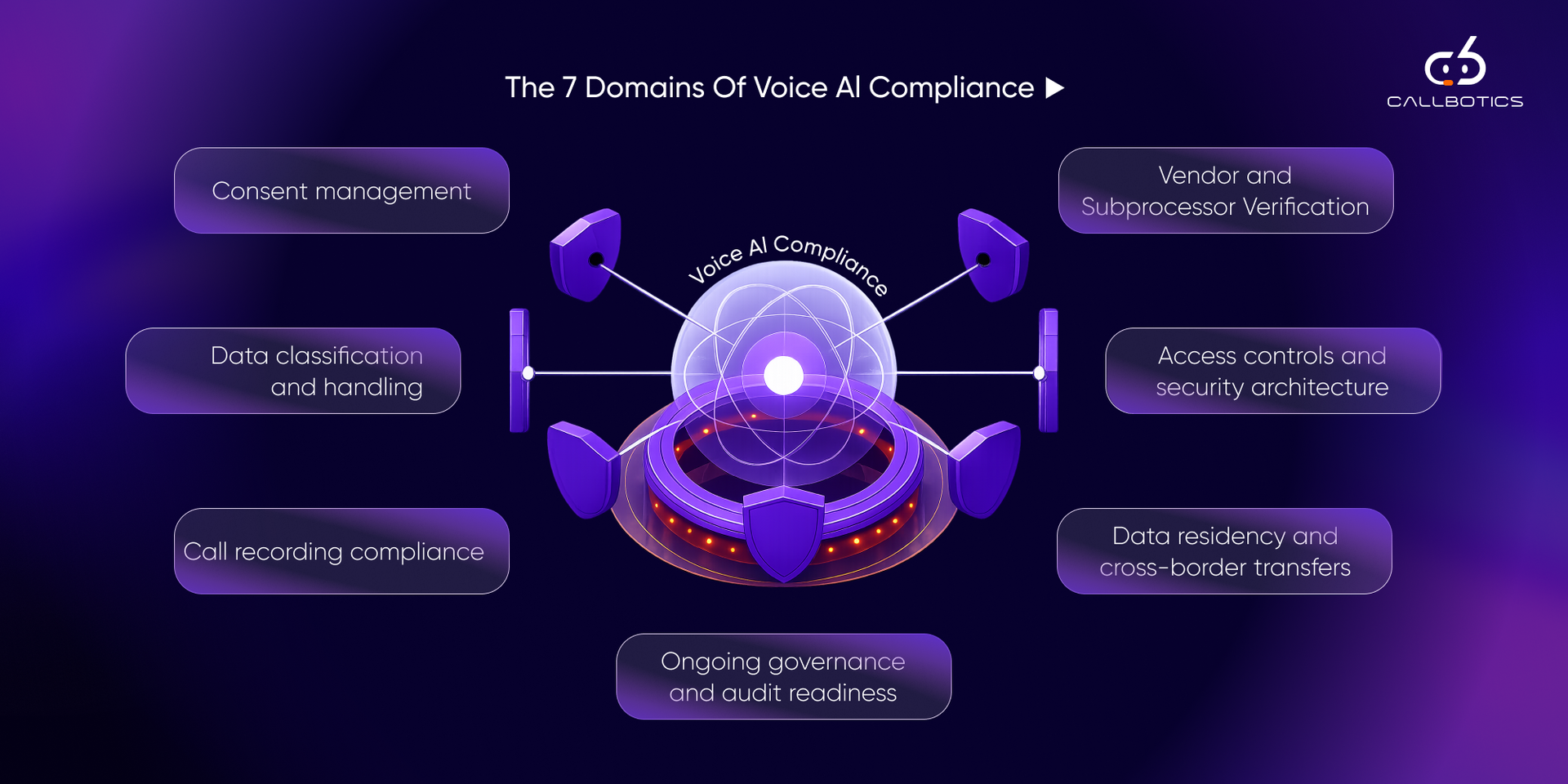
Enterprise voice AI deployments should be reviewed across seven compliance domains.
Each domain represents a critical control area that legal, security, and engineering teams must evaluate before deployment.
Organizations must verify that callers provide explicit consent when required by regulation.
Consent should include disclosure that the call may be recorded and that the caller is interacting with an automated system.
Consent mechanisms should be specific to the purpose of the interaction rather than bundled into general terms and conditions. Systems should log consent with timestamps to enable organizations to demonstrate compliance during audits. Ownership typically sits with legal and compliance teams.
Voice interactions may contain several types of sensitive data, including personally identifiable information, protected health information, and payment details.
Organizations should classify data types and implement policies that govern how each category is processed and stored. Encryption should be enforced both during transmission and when data is stored. Transcripts should include automated redaction mechanisms for sensitive information.
Data retention and deletion policies should be clearly defined. Security and engineering teams typically own this domain.
Recording rules vary by jurisdiction.
Systems should be able to configure recording disclosures based on caller location and applicable law. Organizations must ensure callers receive appropriate notifications before recording begins. Compliance checks should also include storage policies for recorded calls and transcripts.
Legal and operations teams typically manage this domain.
Enterprise procurement teams should verify the security posture of any voice AI vendor before signing contracts.
Organizations should request the vendor’s SOC 2 Type II report rather than relying on marketing claims. Healthcare deployments should confirm the availability of Business Associate Agreements. Data processing agreements should clearly list subprocessors and data handling responsibilities.
Vendor risk management and security teams typically own this review.
Voice AI platforms must implement strong security controls.
These controls include role-based access permissions, multi-factor authentication, and centralized identity management. Audit logs should track user activity across the system. Incident response procedures should be documented and tested.
Enterprise voice automation platforms also connect directly to operational systems, such as CRM platforms, enabling customer conversations to trigger workflows automatically. Security and engineering teams typically manage these safeguards.
Data residency requirements can affect organizations operating in multiple regions. Certain jurisdictions require customer data to remain within specific geographic boundaries.
Enterprise teams should confirm that vendors can process and store data in approved regions. Contracts should clearly define where data is stored and processed. Legal and compliance teams typically oversee this domain.
Compliance does not end once a system is deployed.
Organizations should schedule regular reviews of AI systems to ensure ongoing compliance with regulatory requirements. Responsibilities should be assigned across legal, security, engineering, and operations teams.
Audit preparation should include documentation of vendor certifications, data flows, and security controls. Governance teams typically oversee these processes.
While the core compliance framework remains consistent, regulatory priorities vary across industries.
Healthcare deployments must prioritize HIPAA compliance and the protection of PHI.
Organizations should ensure that transcripts automatically redact sensitive medical information.
Vendor contracts should include Business Associate Agreements and zero-retention policies for external language models.
Testing should include real-world conversation scenarios to identify potential PHI exposure.
Financial institutions must comply with PCI DSS when processing payment information during calls.
Audit trails are also important for supervisory review of customer interactions.
SOC 2 Type II certification is commonly required during vendor procurement.
BPO environments must support multiple clients across different regulatory environments.
Platforms should support jurisdiction-based recording rules and consent mechanisms.
Outbound campaigns must comply with TCPA and Do Not Call registry requirements.
Client-specific data handling agreements are also common.
Telecom operators may handle subscriber voice data at the network level.
This creates additional regulatory requirements related to data access and subscriber privacy.
Systems embedded within telecom infrastructure must also comply with national telecommunications regulations.
Many organizations encounter similar issues during vendor security reviews.
One of the most common problems is bundled consent. Some systems rely on general terms of service rather than explicit consent for call recording or automated interaction.
Another common issue is vendors displaying a SOC 2 certification badge without providing the actual SOC 2 Type II report.
Organizations may also overlook subcontractor disclosures, particularly when vendors rely on external AI providers.
Outbound calling compliance is another frequent failure point. Some systems initiate automated calls without verifying Do Not Call registry requirements.
Identifying these issues early helps organizations avoid compliance risks later.
Enterprise teams should follow a structured process when evaluating voice AI vendors.
First, request the vendor’s SOC 2 Type II report and review its scope.
Second, verify whether the vendor supports industry-specific agreements such as HIPAA Business Associate Agreements.
Third, review the vendor’s data processing agreement to confirm all subprocessors are disclosed.
Fourth, confirm the vendor’s data residency options align with regulatory requirements.
Finally, evaluate whether the platform supports consent management, access controls, and audit logging.
This structured evaluation process reduces the risk of deploying systems that fail security or compliance reviews.
Before deploying voice automation, ensure your platform meets enterprise compliance standards. See how CallBotics is designed to support consent management, audit visibility, and secure integrations across enterprise environments.Enterprise deployments require more than basic automation. They require governance, auditability, and operational transparency built into the platform from day one. CallBotics is an enterprise AI voice automation platform built by teams with over 17 years of experience in the contact center industry, and its architecture reflects the real compliance requirements that regulated customer operations face. From data governance and access control to audit visibility and operational monitoring, the platform is structured to help organizations deploy voice automation while maintaining the security, accountability, and compliance oversight enterprise environments require.
What makes CallBotics different from typical AI voice platforms
Compliance is not a one-time milestone in voice AI deployment.
It is an operational discipline that requires continuous monitoring, governance, and vendor oversight.
Enterprise teams should treat this checklist as both a pre-deployment review and an ongoing audit framework.
By assigning ownership across legal, security, engineering, and operations teams, organizations can deploy voice AI systems confidently while maintaining regulatory compliance.
Voice AI can deliver significant operational value, but only when compliance is designed into the system from the start.

Urza Dey (She/They) is a content/copywriter who has been working in the industry for over 5 years now. They have strategized content for multiple brands in marketing, B2B SaaS, HealthTech, EdTech, and more. They like reading, metal music, watching horror films, and talking about magical occult practices.
See how enterprises automate calls, reduce handle time, and improve CX with CallBotics.
CallBotics is an enterprise-ready conversational AI platform, built on 18+ years of contact center leadership experience and designed to deliver structured resolution, stronger customer experience, and measurable performance.