After-hours calls are no longer a secondary concern. They are a consistent and valuable part of customer demand.
Customers reach out in the evenings, late at night, and on weekends because that is when they have time to act. These calls often involve scheduling, confirmations, urgent questions, or final decisions. When those calls are not handled immediately, intent fades and opportunities disappear.
For many organizations, after-hours coverage still relies on traditional methods such as voicemail, limited on-call availability, or delayed follow-ups. These approaches were designed to acknowledge calls, not to resolve them.
This is where after-hours support with AI voice agents changes the model. AI voice agents enable businesses to remain responsive outside business hours, complete routine tasks in real time, and maintain consistency without expanding operational complexity. When implemented correctly, they extend service continuity rather than disrupt existing workflows.
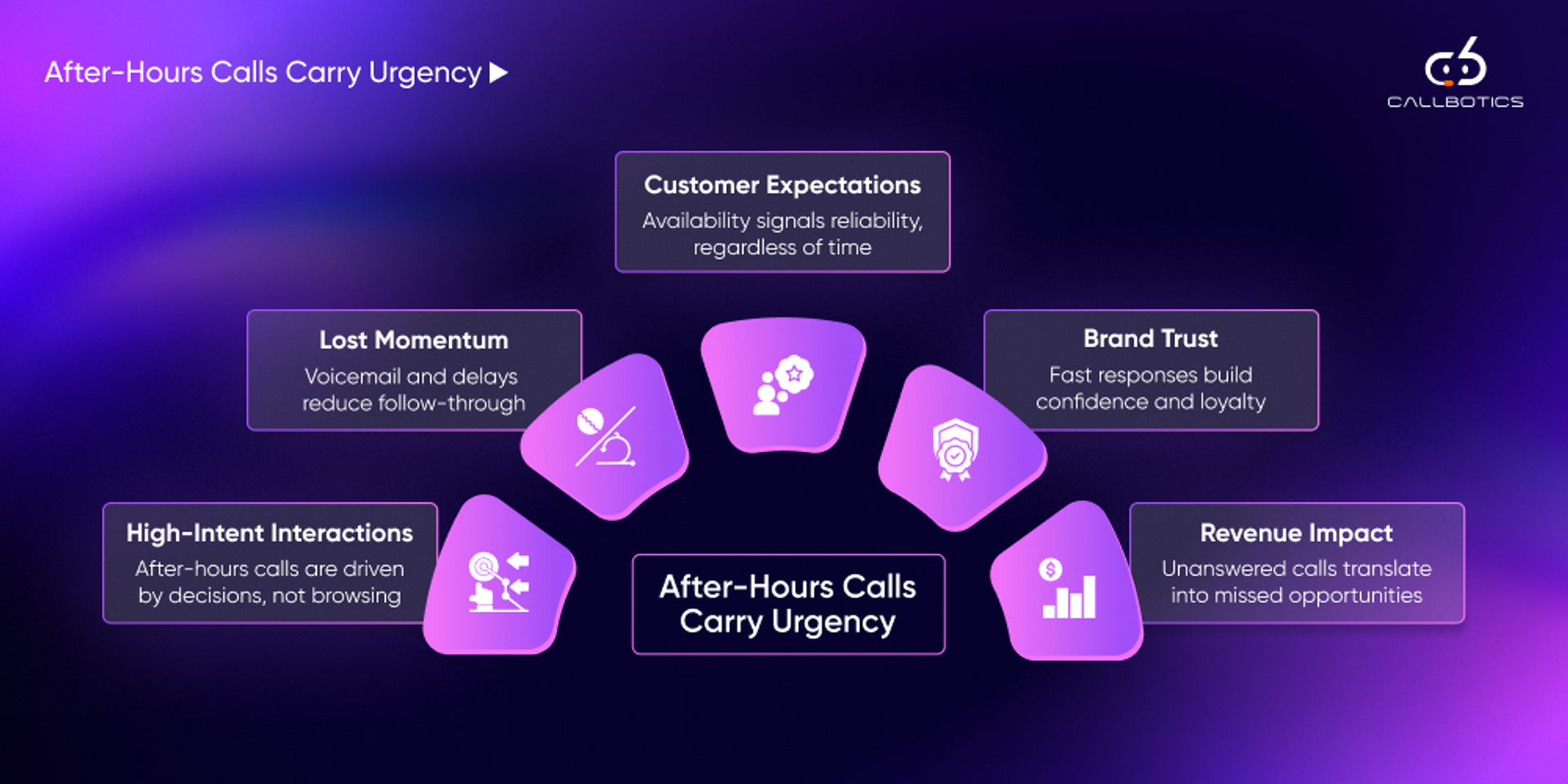
After-hours support directly affects revenue, customer experience, and trust.
Customers do not separate service expectations by business hours. When they reach out and receive no response, they interpret it as unavailability. Even when follow-ups occur later, the initial impression often lingers.
After-hours demand also behaves differently. These interactions are typically purposeful. Customers are not browsing. They are trying to complete something.
Missed calls represent missed intent.
When after-hours calls are routed to voicemail or deferred, a large portion of callers do not re-engage. Even when they do, the likelihood of completing the original action decreases significantly.
Voicemail captures information, but it does not preserve urgency. By the time teams respond during the next business window, the opportunity may no longer be active.
Over time, this creates a silent but material revenue gap that is difficult to track yet consistently impacts growth.
Responsiveness signals reliability.
When customers receive immediate, clear responses outside business hours, it reinforces confidence. When they do not, it introduces friction and uncertainty.
After-hours silence can undermine otherwise strong service experiences. Customers remember the delay, not the reason behind it.
Availability has become part of how customers judge professionalism.
Most after-hours call handling relies on legacy approaches that were not designed for modern expectations or scale.
Traditional after-hours coverage models require maintaining availability even when call volume fluctuates. This leads to inefficiencies where resources are underutilized during quiet periods and stretched during spikes.
As coverage windows expand, costs rise faster than the value delivered.
After-hours handling often depends on limited access to systems and deferred workflows. Calls may be acknowledged but not resolved, pushing action to the next business day.
This delay impacts resolution time and creates additional follow-up work.
Expanding traditional coverage across multiple regions or languages requires significant planning and coordination. Adjusting quickly to demand changes is difficult.
As organizations grow, these constraints become more visible and harder to manage.
| Aspect | Traditional After-Hours Handling | Modern Customer Expectation |
|---|---|---|
| Call response | Voicemail or limited coverage | Immediate engagement |
| Resolution timing | Deferred to next business day | Real-time completion |
| Experience consistency | Varies by coverage window | Uniform across all hours |
| Scalability | Slow and resource-intensive | Flexible and on-demand |
| Customer perception | Unavailable or delayed | Reliable and responsive |
This gap between how after-hours support traditionally works and what customers now expect is where change becomes necessary.
The core challenge of after-hours support is not answering the phone. It is continuing the interaction with the same level of clarity and intent that exists during business hours.
Traditional methods were designed to acknowledge contact and defer action. After-hours support with AI voice agents is designed to continue workflows in real time, without interruption.
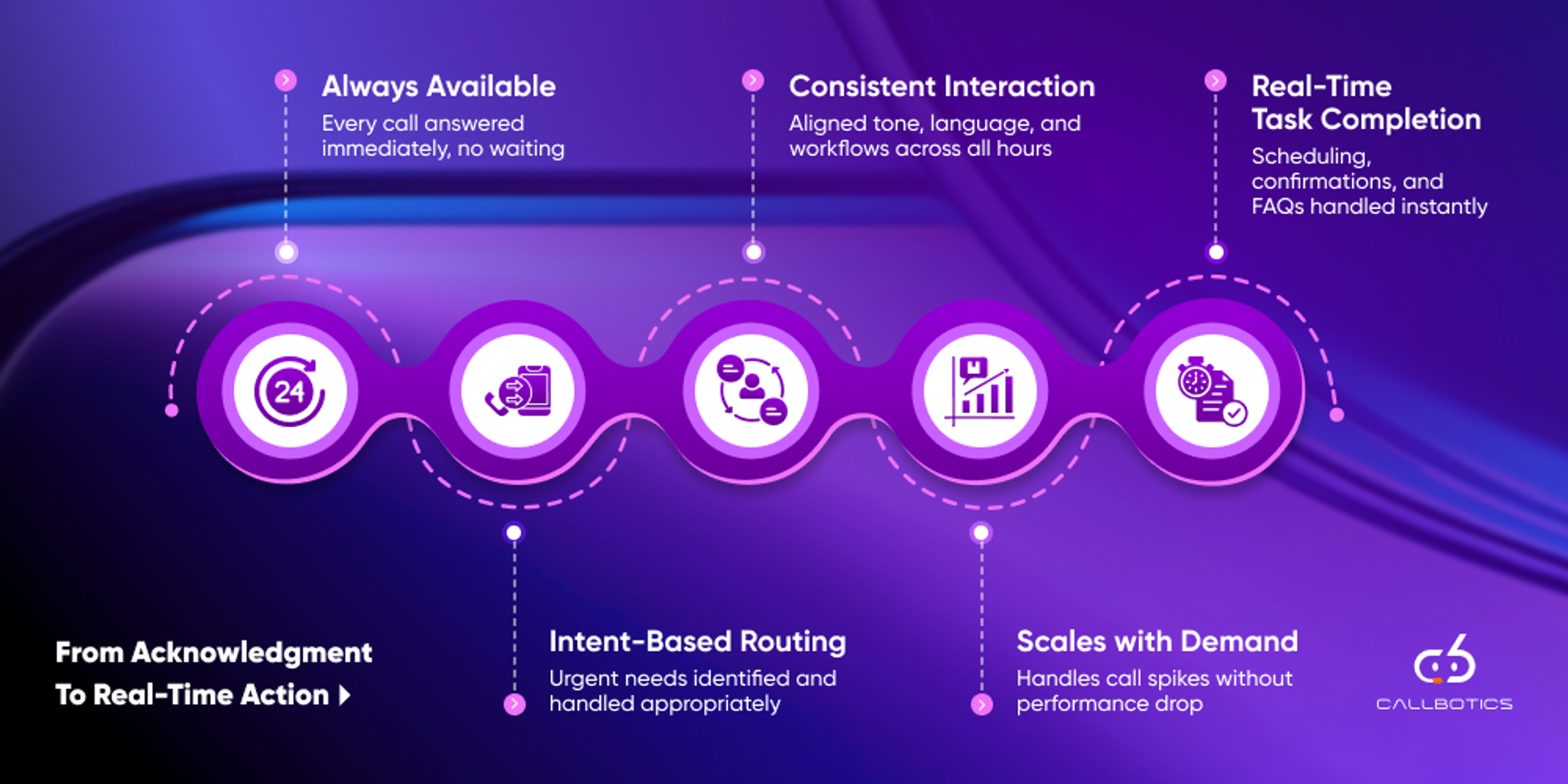
AI voice agents do this by combining immediate availability, consistent interaction logic, and direct system connectivity.
After-hours demand does not arrive on a schedule. It arrives when customers are ready.
AI voice agents provide continuous availability without reliance on fixed coverage windows. Every call is answered immediately. There is no waiting, no voicemail, and no uncertainty about whether the interaction will move forward.
This immediacy preserves intent. Customers remain engaged because the system responds at the moment of need, not hours later.
Immediate response also reduces repeated attempts, follow-up congestion, and next-day backlog.
Consistency is one of the most difficult aspects of after-hours support to maintain using traditional approaches.
AI voice agents operate from a defined interaction model. Tone, language, and responses remain aligned with brand and policy standards across every call, regardless of time or volume.
This consistency ensures that after-hours interactions feel intentional, not improvised. Customers receive the same quality of information and guidance whether they call at noon or midnight.
Consistency also reduces risk by ensuring that approved language and workflows are always followed.
A large percentage of after-hours calls involve tasks that can be completed immediately when systems are connected properly.
AI voice agents can reliably handle:
Instead of deferring these actions, AI voice agents complete them in real time and sync outcomes directly into operational systems.
This reduces friction for customers and prevents work from piling up for the next business day.
After-hours coverage using traditional methods requires maintaining availability even when call volume fluctuates. This creates inefficiencies during low-demand periods and pressure during spikes.
AI voice agents operate differently. They scale automatically with call volume and do not require incremental planning to handle increases in demand.
This leads to:
Cost efficiency here is not about reduction alone. It is about aligning spend with actual demand rather than fixed coverage assumptions.
Not all AI voice platforms are designed for after-hours use. Some are optimized for simple routing or daytime interactions. After-hours support requires a different level of reliability.
After-hours interactions must connect to real systems to be useful.
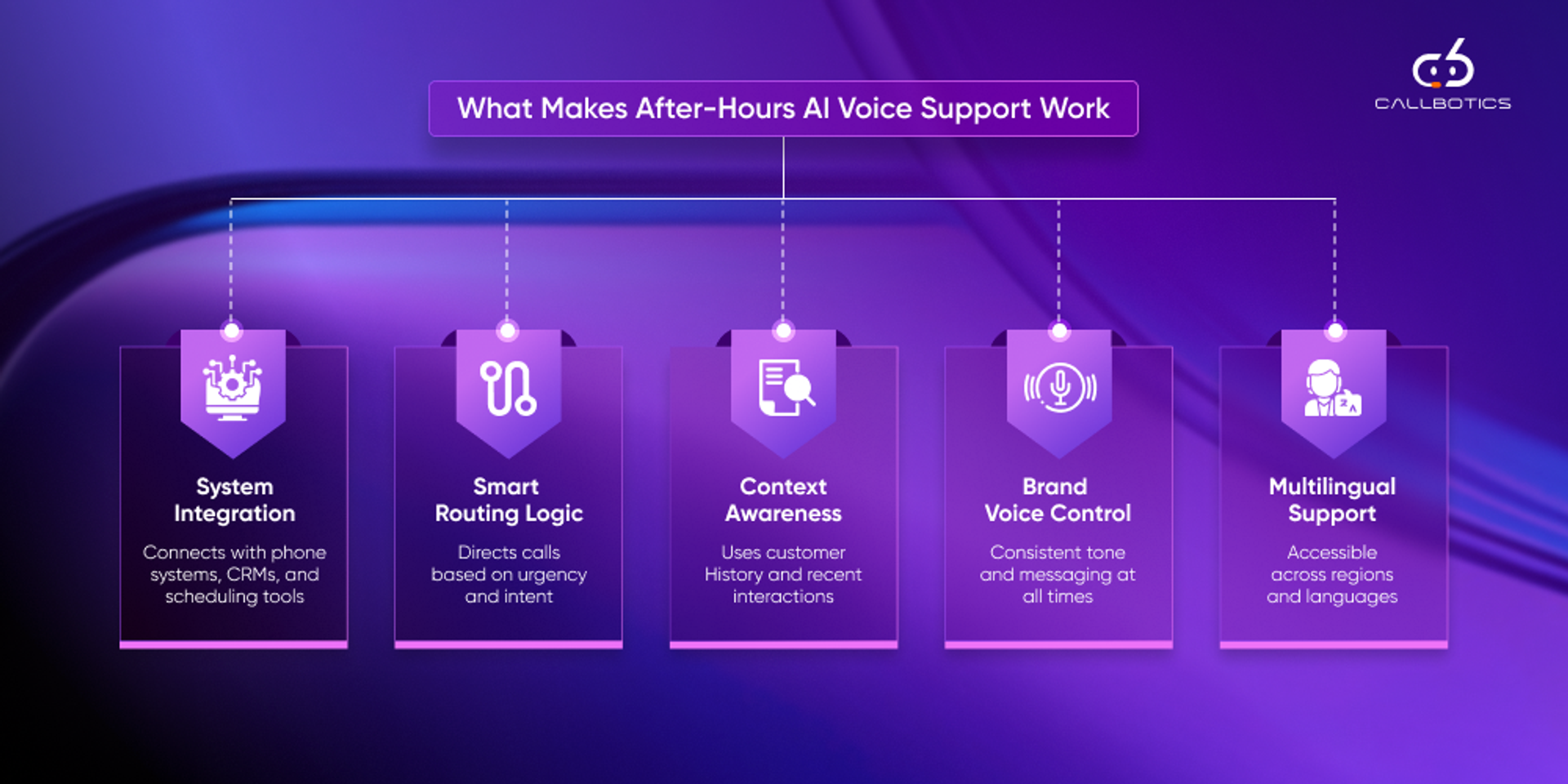
AI voice agents should integrate directly with phone infrastructure, scheduling tools, CRM platforms, and case management systems. This ensures that actions taken after hours are immediately reflected across operations.
Without integration, AI becomes an isolated layer that creates reconciliation work later.
After-hours support requires clear decision paths.
AI voice agents should be able to identify urgency, intent, and complexity, then route interactions accordingly. Some calls should be resolved fully. Others should be escalated immediately based on predefined rules.
This routing logic ensures that critical situations are handled appropriately without unnecessary deferral.
Effective after-hours AI relies on current information.
Knowledge bases must be synchronized so responses remain accurate. Context awareness allows the system to recognize returning callers, reference recent interactions, and avoid redundant questions.
This makes conversations shorter, clearer, and more effective.
After-hours interactions represent the brand just as much as daytime ones.
AI voice agents should support customization of language, tone, and phrasing so interactions feel professional and aligned with brand identity.
Multilingual capability is also essential for organizations serving diverse audiences or operating across regions.
Delivering reliable after-hours support requires more than answering calls. It requires systems that can handle real-world variability while maintaining clarity, consistency, and accountability.
CallBotics was designed specifically for these conditions. Rather than assuming ideal call flows or predictable demand, it is built around how after-hours interactions actually behave: higher urgency, shifting intent, uneven call volume, and the need for dependable escalation paths.
This design philosophy aligns directly with the requirements of after-hours support with AI voice agents.
After-hours gaps are often discovered when they begin impacting outcomes. Addressing them quickly matters.
CallBotics is ready to deploy in 48 hours, allowing organizations to extend after-hours coverage without long implementation cycles or operational disruption. This makes it possible to respond to demand changes, seasonal spikes, or expansion needs without delay.
After-hours support works best when costs align with usage and outcomes.
CallBotics offers clear, predictable pricing structures that avoid hidden charges or unexpected scaling costs. This allows teams to plan after-hours coverage confidently and measure performance without financial uncertainty.
CallBotics is designed to resolve structured conversations end-to-end rather than stopping at routing or acknowledgment.
By completing tasks such as scheduling, confirmations, information capture, and status updates in real time, CallBotics reduces deferred work and next-day follow-up volume. This preserves continuity and ensures after-hours interactions result in completed actions.
Visibility is essential for maintaining quality outside business hours.
CallBotics includes built-in real-time analytics that make after-hours performance measurable. Teams can monitor call volume, resolution rates, escalation patterns, and trends over time, allowing continuous refinement without guesswork.
Evaluating after-hours support with AI voice agents requires metrics that reflect continuity and outcomes rather than simple availability.
Key indicators include how quickly calls are answered, how many are handled without deferral, and how often after-hours interactions result in completed actions or captured opportunities.
Improvements in these areas signal that after-hours intent is being preserved.
Customer experience does not pause after hours. Measuring satisfaction specifically during off-hours interactions provides insight into how well the system maintains clarity and ease of use when traditional support is unavailable.
Lower effort scores indicate smoother resolution and fewer follow-ups.
ROI for after-hours AI support is best measured through reduced backlog, improved conversion, and predictable operating costs rather than direct comparisons to legacy coverage models.
The goal is alignment between demand, responsiveness, and cost.
After-hours interactions shape how customers perceive reliability, professionalism, and trust. Silence or delay during these moments creates friction that even strong daytime service cannot fully offset.
After-hours support with AI voice agents allows organizations to extend clarity, responsiveness, and continuity beyond business hours without adding complexity. When designed around real operational conditions, it transforms after-hours support from a vulnerability into a strength.
CallBotics enables this shift by focusing on resolution, visibility, and rapid deployment. It strengthens how teams operate by removing friction from routine interactions while preserving control and oversight where it matters most.
If after-hours demand matters to your customers, it should matter to your systems as well.
Explore a CallBotics demo or connect with the team to see how after-hours support can work without compromise.

See how enterprises automate calls, reduce handle time, and improve CX with CallBotics.
CallBotics is an enterprise-ready conversational AI platform, built on 18+ years of contact center leadership experience and designed to deliver structured resolution, stronger customer experience, and measurable performance.