

Contact centers sit at the heart of modern customer operations. They handle rising volumes, growing customer expectations, and increasingly complex communication channels. At the same time, leaders are expected to improve operational efficiency without compromising customer experience.
This is where artificial intelligence is changing the equation. Platforms like CallBotics enhance operations significantly through AI voice agents designed for real, high-volume environments.
When applied with intent, AI reduces inefficiencies, improves resolution speed, and drives improved customer satisfaction in measurable ways.
At a leadership level, ROI answers one core question:
Are we getting measurable value from what we invest?
In a contact center, that question now goes beyond staffing efficiency or technology spend.
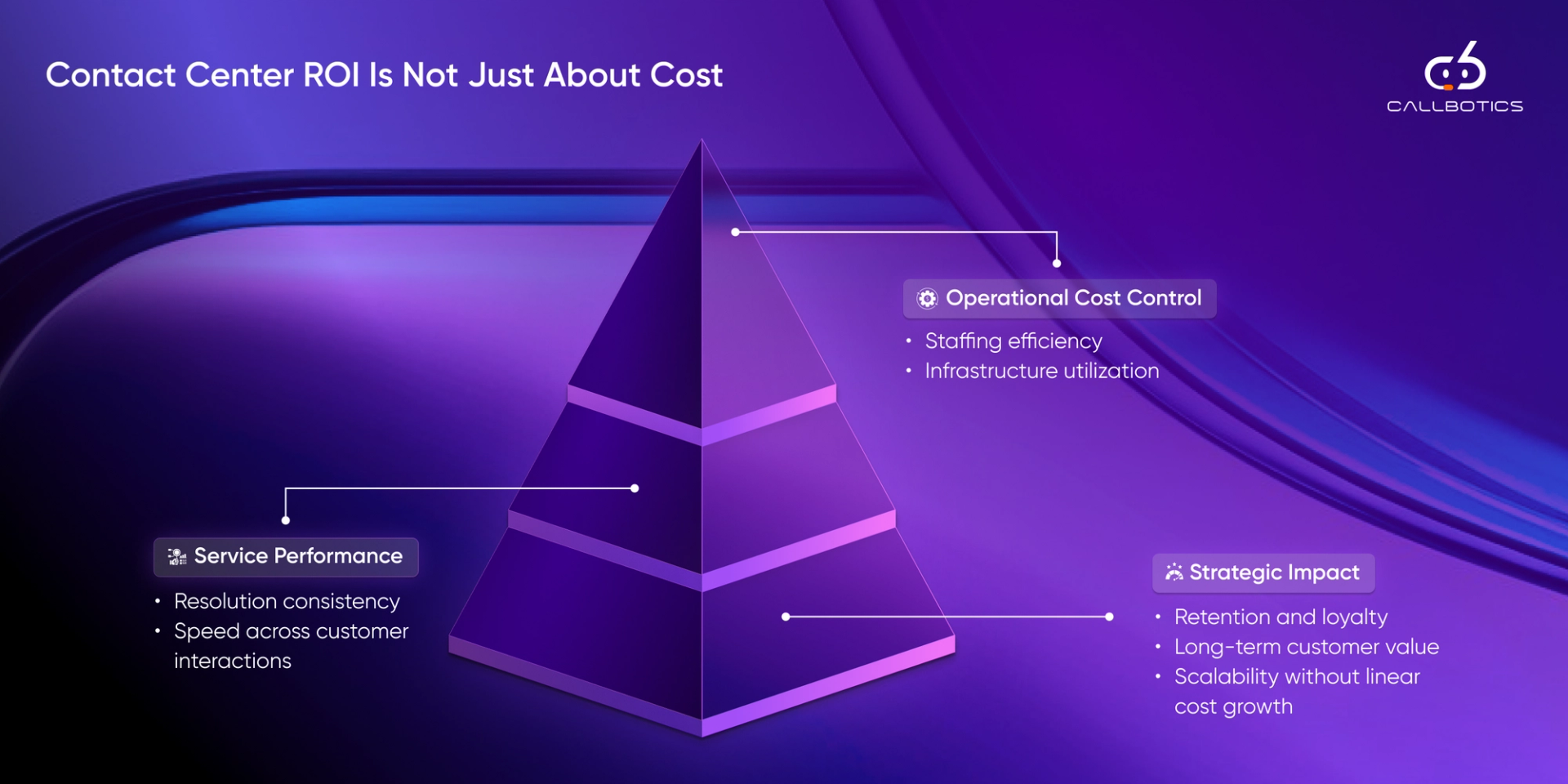
Historically, ROI discussions focused on:
Today, ROI reflects something broader.
Contact center ROI measures how effectively effort translates into:
This shift matters because contact centers influence outcomes far beyond cost.
As a result, contact center leaders increasingly see AI not as a technology upgrade, but as a strategic investment tied to real value and long-term performance.
When AI is deployed thoughtfully:
This is why conversations around ROI of AI now focus on real ROI, measurable outcomes, and sustainable impact rather than experimentation.
ROI becomes practical only when it is tied to metrics that leadership teams already track and trust. These metrics explain what is happening, why it matters, and how AI changes the outcome in a measurable way.
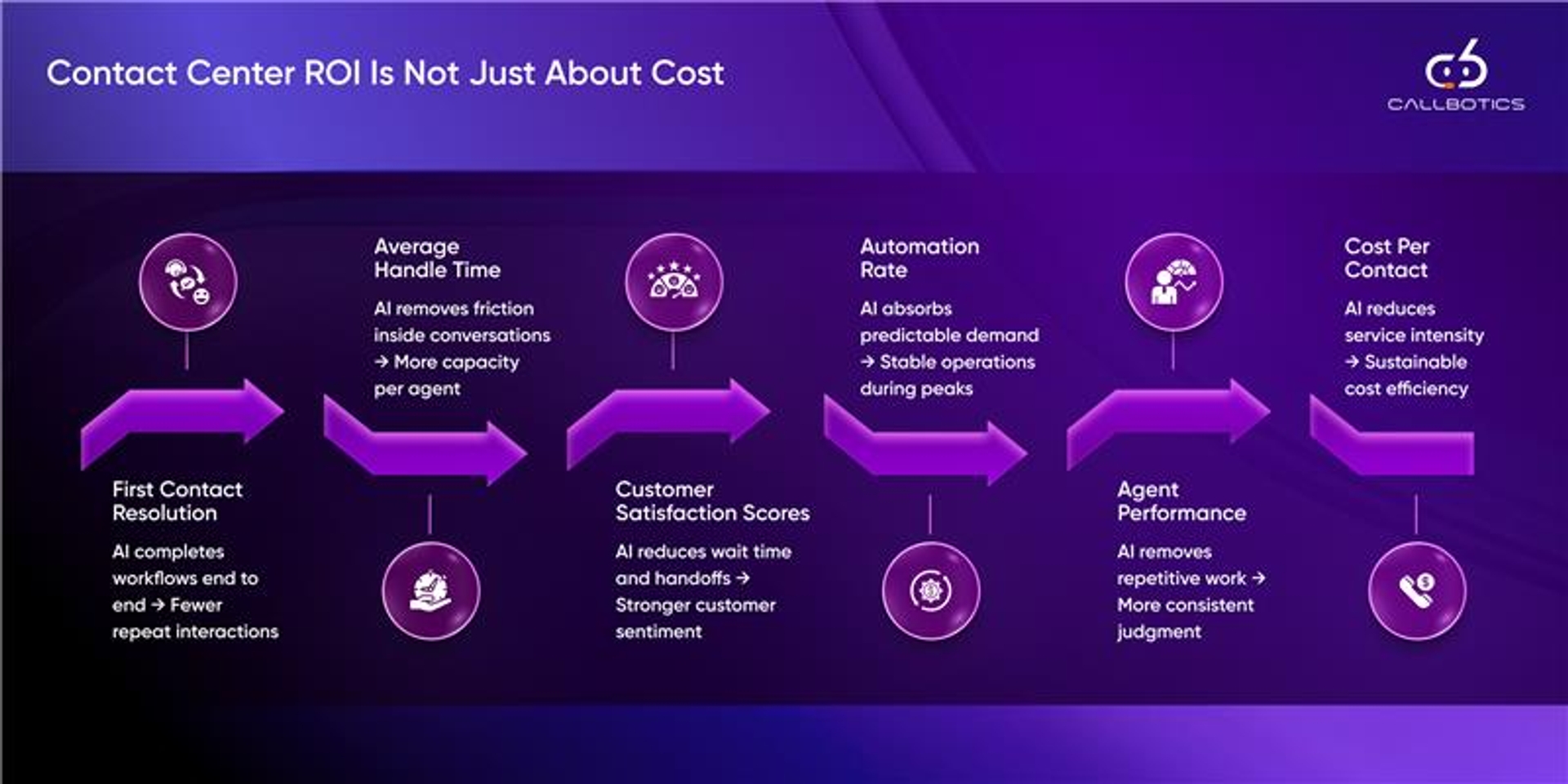
Below are the core metrics that define contact center ROI in real operating environments.
What it measures
First contact resolution tracks how often a customer issue is fully resolved in a single interaction, without follow-ups or repeat calls.
Why it matters
Repeat calls quietly inflate volume, staffing needs, and support costs. Every unresolved issue re-enters the queue and competes with new demand.
How AI impacts it
AI improves resolution by completing structured workflows end-to-end. A well-designed AI agent can verify details, handle branching logic, and confirm completion before closing the interaction. As resolution improves, overall call volume stabilizes, and queues shorten.
What it measures
Average handle time captures the total time spent per interaction, including talk time and follow-up work.
Why it matters
Long handle times usually indicate friction, such as manual verification, system switching, or repetitive explanations. Even small reductions can unlock meaningful cost efficiency at scale.
How AI impacts it
AI removes routine steps from the conversation. Identity checks, data lookups, and post-call summaries are handled automatically using AI tools, allowing interactions to move faster without sacrificing clarity or service quality.
What they measure
Customer satisfaction scores reflect how customers feel once the interaction ends.
Why they matter
Satisfaction is closely tied to effort and clarity, not just speed. Poor experiences erode trust and shorten customer lifetime value.
How AI impacts them
IBM found that organizations with mature AI programmes reported 17% higher customer satisfaction than their peers. AI improves outcomes by reducing wait times, minimizing transfers, and delivering consistent resolution, leading to stronger customer satisfaction and improved customer sentiment.
What it measures
Automation rate measures the share of customer interactions resolved through automation.
Why it matters
Higher automation enables contact centers to absorb demand spikes without increasing headcount, thereby improving resilience during peak periods.
How AI impacts it
With conversational AI, routine requests such as order status checks or account updates are resolved instantly. As AI adoption increases, contact center automation becomes a reliable lever for scale rather than a risk factor.
What it measures
Agent performance reflects how effectively teams handle interactions that require judgment, empathy, or problem-solving.
Why it matters
Blending routine and complex interactions in a single queue introduces context switching, which can impact consistency at scale.
How AI impacts it
Automating predictable workflows allows greater emphasis on complex, high-value cases, driving better consistency and outcomes.
What it measures
Cost per contact combines capacity, tooling, and time into a single financial metric.
Why it matters
This is where ROI becomes visible. Lower cost per contact directly translates into cost savings and cost reduction at scale.
How AI impacts it
As automation increases and handle time drops, operational intensity declines. IBM’s research also shows that conversational AI reduces cost per contact by 23.5% and boosts annual revenue by 4%, demonstrating that automation can simultaneously deliver savings and growth.
Individually, each metric shows a slice of performance.
Together, they explain the full ROI story:
This is how AI’s ability to drive measurable improvements translates into real-world impact.
Improving ROI with AI is not about adding more technology. It is about deliberately applying AI, measuring the right things, and adjusting quickly. The organizations seeing the strongest results treat AI as an operational system, not a one-time deployment.
The following section breaks down what that looks like in practice:
Before adding AI into live workflows, leaders establish a clear baseline. This step is critical because ROI only exists when change can be measured.
At a minimum, teams document:
These baseline metrics become the reference point for ROI calculation. It also aligns operations, finance, and leadership on what “improvement” actually means.
Organizations that skip this step often struggle to measure success, even when AI performs well.
ROI accelerates when AI is applied to the right problems first. The goal is not to automate everything, but to focus on clear automation opportunities.
High-impact use cases share three traits:
Common examples include:
This is where AI powered systems built on generative AI and AI models outperform rigid scripts. They adapt to variations while still completing the interaction end-to-end.
AI initiatives succeed when they are tied directly to outcomes leadership already cares about.
Instead of asking “what can AI do,” effective teams ask:
This alignment is what turns AI from experimentation into AI driven transformation with measurable business outcomes.
Mature environments separate structured execution from judgment-intensive scenarios, enabling automation without compromising decision quality.
To make this work, organizations:
This approach improves consistency, morale, and long-term performance.
AI creates value beyond resolution. Every interaction generates structured insight.
This is where many teams leave value unrealized.
High-performing teams use:
These insights enable continuous improvement and continuous optimization, rather than static automation that degrades over time.
A Practical Tip for Leaders
In the first 90 days after deployment:
Early optimization delivers outsized impact and accelerates real value realization.
Before vs. After: AI ROI Snapshot
Rather than looking at ROI as a single number, most contact center leaders evaluate change through operating scenarios. The real question is not “how much did we save,” but “how does the contact center behave differently once AI is in place?”
In a typical pre-AI environment, outcomes are driven largely by volume and staffing availability.
As demand rises, so do costs.
After AI is deployed across repeatable workflows, the operating model begins to shift.
Instead of reacting to volume, teams manage outcomes. Automation absorbs routine demand, while agents spend their time where judgment and empathy matter most.
| Area | Before Optimization | After AI Adoption | ROI Impact |
|---|---|---|---|
| Resolution Speed | Long handle times, friction-heavy flows | Faster, cleaner resolutions | Higher capacity per agent |
| Customer Experience | Waits, transfers, repetitive calls | Quicker answers, fewer handoffs | Improved satisfaction and retention |
| Agent Utilization | Mixed workloads, inconsistency | Focus on complex, high-value cases | Better use of specialized capacity |
| Cost Efficiency | Costs rise with volume | Costs stabilize as demand grows | Sustainable cost control |
| Operational Visibility | Limited, sampled insights | Real-time, structured data | Decisions backed by evidence |
| Long-Term Performance | Static processes | Continuous optimization | Compounding ROI over time |
In 2026, improving ROI with AI is less about adopting more technology and more about how AI performs inside live operations. Enterprises that see real returns are not treating AI as a side project or a one-time deployment. They are embedding it directly into call flows, measuring outcomes in real time, and adjusting based on what actually happens on the floor. Resolution, throughput, and operational stability are where ROI shows up, not in feature checklists.
This is where many AI initiatives break down. Systems built for demos or narrow use cases struggle once call volumes rise, IVRs behave unpredictably, or intent shifts mid-interaction.
CallBotics was built by operators with over 17 years of industry experience to operate in those conditions. By handling high-volume, structured interactions end-to-end and escalating only when judgment is required, organizations can absorb demand, reduce the cost per interaction, and improve resolution without expanding headcount or reworking existing processes.
Because CallBotics runs alongside existing systems, impact is visible quickly. Teams can benchmark performance before and after deployment, continuously tune workflows, and use real interaction data to improve outcomes over time. AI stops being an experiment and starts behaving like production infrastructure.
What makes CallBotics different in driving ROI:

See how enterprises automate calls, reduce handle time, and improve CX with CallBotics.
CallBotics is an enterprise-ready conversational AI platform, built on 18+ years of contact center leadership experience and designed to deliver structured resolution, stronger customer experience, and measurable performance.