
AI voice agents have moved from experimentation to production across customer service environments. As organizations deploy voice automation at scale, success is no longer defined by whether an AI can answer calls, but by how consistently it resolves them, how efficiently it operates under real-world conditions, and how clearly its performance can be measured.
That is where call metrics for AI voice agents become critical. Metrics translate conversations into operational signals. They help teams understand whether automation is actually reducing workload, improving customer experience, and delivering measurable return on investment. Without the right metrics, AI performance becomes anecdotal, tuning becomes reactive, and scaling introduces risk instead of reliability.
This guide explains which call metrics matter most, how to interpret them correctly, and how they connect directly to customer outcomes and operational efficiency.
AI voice agents operate differently from traditional call centers. They do not get tired, but they do not self-correct either. Their performance depends entirely on how well conversations are designed, monitored, and refined over time. Unlike human teams, there is no instinct or experience to compensate for gaps in logic or flow. Every outcome is a direct reflection of the system design. That makes performance visibility non-negotiable from day one.
Metrics provide the feedback loop that enables improvement. They allow teams to:
Without clear metrics, AI deployments often plateau. With the right metrics, AI becomes a controllable, optimizable part of the contact center operating model.
Traditional call center metrics were designed around human behavior. They measure productivity, staffing efficiency, and adherence at the agent level. AI voice agents require a different approach because performance depends on system design, decision logic, and accuracy at scale. Teams need to evaluate whether the AI correctly understood intent, made the right decisions, and completed the workflow without breakdowns. The emphasis shifts from managing individual performance to validating how consistently the system executes across interactions.
Human-only metrics focus on agent productivity and staffing efficiency. AI introduces performance dimensions related to understanding, decision-making, and system accuracy. This is why AI call center metrics must account for:
Measuring AI performance requires tracking how the system behaves across thousands of interactions, not how an individual performs on a single call.
These core metrics determine whether an AI voice agent is delivering reliable outcomes at scale. They show whether the system is understanding intent correctly, resolving calls efficiently, and handing off at the right moments when automation should stop. Without these measures, teams cannot tell whether performance is actually improving or whether problems are simply being hidden behind call volume reduction. These metrics also help separate superficial automation wins from meaningful operational outcomes. Together, they form the foundation for measuring AI voice agent performance.
Intent recognition accuracy measures how often the AI correctly identifies the caller’s purpose early in the interaction. This metric directly influences routing, resolution, and escalation behavior.
Low intent accuracy creates downstream failures. Calls take longer, escalations increase, and customers repeat themselves. High intent accuracy improves resolution speed and reduces unnecessary transfers.
Teams should monitor intent accuracy by intent category rather than as an overall percentage. This helps identify which call types require retraining or redesign.
Automation rate measures the percentage of calls fully resolved by the AI without human involvement. It reflects the extent of demand the AI is absorbing from the contact center.
A healthy automation rate indicates that structured, repeatable conversations are being handled end-to-end. It should be evaluated alongside resolution quality, not in isolation.
High containment with poor outcomes creates hidden costs. Sustainable automation balances volume reduction with successful completion.
AHT measures the total time spent handling an interaction. For AI, this metric reflects conversation efficiency rather than agent speed.
Shorter AHT often indicates clear intent recognition, concise responses, and effective flow design. However, AHT should always be evaluated alongside resolution and sentiment metrics to ensure efficiency does not degrade experience.
FCR measures how often a customer’s issue is resolved within a single interaction, regardless of whether it is handled by AI alone or involves escalation.
For AI voice agents, FCR is one of the strongest indicators of real value. It reflects understanding, accuracy, and clarity of outcomes.
Improving FCR reduces repeat calls, lowers operational cost, and strengthens customer confidence in automation.
Escalation rate shows how often calls are transferred from AI to human agents. This metric should be interpreted carefully.
Escalation is not a failure when it happens for the right reasons. The goal is controlled escalation with full context, not zero escalation.
Tracking escalation reasons alongside escalation volume helps teams distinguish between necessary handoffs and avoidable failures.
This metric evaluates whether AI responses are factually correct, contextually appropriate, and aligned with the caller’s intent.
Response accuracy goes beyond transcription. It includes whether information is up to date, whether policies are applied correctly, and whether answers align with the customer’s situation.
Consistent response accuracy builds trust and reduces verification calls.
Customer sentiment measures emotional tone during the interaction and how it changes over time. It is a critical input for escalation decisions and experience evaluation.
Positive sentiment trends indicate clarity and confidence. Negative sentiment signals confusion, friction, or dissatisfaction.
When combined with resolution metrics, sentiment provides a balanced view of efficiency and experience within customer service AI analytics.
AI error rate reflects system-level failures, including misinterpreted intents, incorrect responses, dropped calls, and broken flows.
This metric is essential for operational reliability. Small error rates can have large downstream effects at scale.
Monitoring errors by type and frequency allows teams to prioritize fixes that improve overall system stability.
Call completion rate measures how often interactions reach a clear end state, such as resolution, scheduled follow-up, or informed escalation.
High completion rates indicate well-designed conversations and predictable outcomes. Low completion rates often point to flow gaps or unclear next steps.
See how CallBotics helps teams track intent accuracy, escalation patterns, and resolution performance in real time so voice automation improves with every workflow.| Metric Category | What It Measures | Why It Matters |
|---|---|---|
| Intent Accuracy | Correct identification of the caller needs | Drives routing, resolution, and efficiency |
| Automation Rate | Calls resolved end-to-end by AI | Reduces agent workload and cost |
| AHT | Interaction duration | Reflects conversation efficiency |
| FCR | Resolution in one interaction | Reduces repeat demand |
| Escalation Rate | AI-to-human handoffs | Indicates coverage and control |
| Response Accuracy | Correctness and relevance | Builds trust and consistency |
| Sentiment Score | Emotional experience | Connects efficiency to CX |
| Error Rate | System failures | Protects reliability at scale |
| Completion Rate | Clear outcomes achieved | Ensures conversations finish cleanly |
Once you have the core metrics under control, supporting metrics help explain what is actually causing performance drift. They show why escalation rates change, why completion rates drop, and why calls become longer even when top-line metrics appear stable. These metrics are important because they reveal the operational reasons behind performance movement, not just the outcome itself. They help teams diagnose where the workflow, integration layer, or conversation design is weakening. That makes them essential for improving AI voice agent performance with precision rather than guesswork.
Knowledge retrieval speed measures how quickly the system can pull the right information after it has identified intent. It is especially important when the voice agent depends on real-time data from CRMs, scheduling tools, policy platforms, or billing systems.
When retrieval is slow, three things typically happen:
This metric is a reliable early warning sign for integration bottlenecks, slow databases, or weak knowledge structure.
Escalation frequency is only half the story. Transfer quality measures whether a handoff helps the human agent resolve the issue faster or simply shifts the problem.
A high-quality transfer usually includes:
When transfer quality is strong, customers do not repeat themselves, and agents do not restart discovery. That shows up as better resolution and a shorter overall time-to-close.
Post-call summaries affect analytics, coaching, compliance documentation, and follow-up workflows. Summary accuracy measures whether the system captures what actually happened.
This is not a nice-to-have metric. If summaries are wrong, reporting becomes unreliable, and teams make decisions based on noise.
Strong summary accuracy tends to improve:
AI-preferred flows are structured paths that reliably lead to a clean outcome. Tracking how often customers actually enter these flows and complete them shows whether your design matches real caller behavior.
Low usage of preferred flows can signal:
Improving this metric often increases completion and reduces escalation without adding new intents.
Metrics only matter when they lead to action. The goal is not to collect performance data for reporting, but to use it to identify weaknesses, improve workflows, and increase reliability over time. Teams that improve AI voice agents successfully treat metrics as part of an operating process, not a dashboard exercise. They use them to spot issues early, understand what changed, and make targeted fixes at the workflow level. That is what turns measurement into a practical improvement loop.
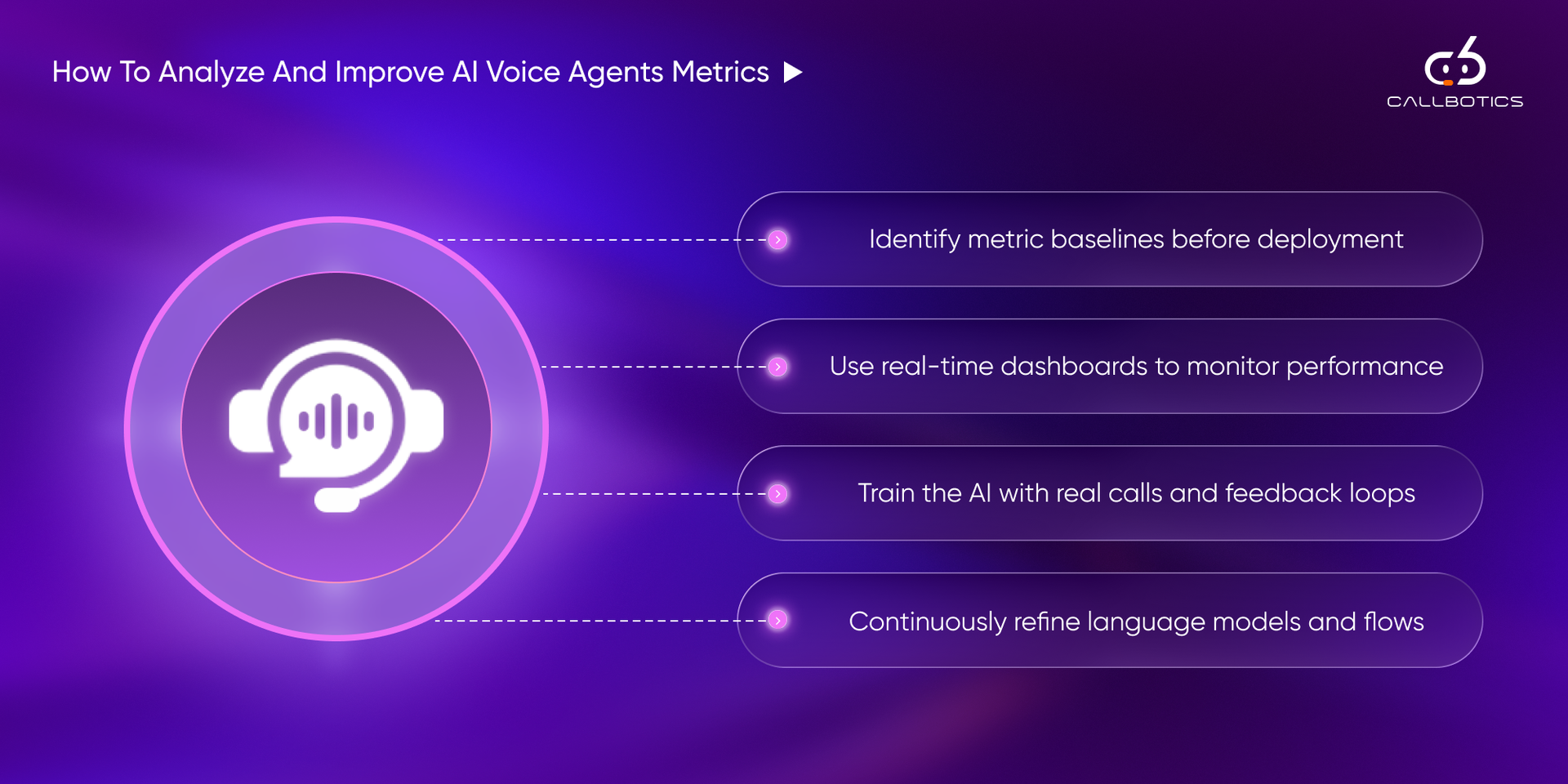
Baselines create clarity. Without them, teams cannot confidently say whether the system improved or simply fluctuated.
Before rollout, define:
Baselines should be set at the workflow level, not at the overall level. Overall averages hide the intents that break first.
Real-time visibility prevents small issues from becoming systemic. Dashboards should surface:
If teams only review weekly reports, they usually find problems after customers have already felt them.
Read more about how CallBotics emphasizes custom metrics and reporting as a core capability, including defining KPIs by outcome and workflow.Training improves when it is connected to real production calls. The most effective feedback loops usually include:
Production voice environments change. Customer language evolves, policies change, and volume patterns shift. Continuous refinement keeps the system stable under real operating conditions.
What refinement typically looks like in practice:
Refinement should always be tied to measurable movement in completion, escalation quality, and sentiment trends.
Explore how CallBotics gives teams real-time visibility into completion, escalation, and resolution metrics so AI voice performance can be improved with confidence.Metrics matter when they translate into visible improvements in real interactions. The impact shows up in fewer transfers, faster resolutions, and more predictable outcomes across high-volume workflows. These examples highlight how specific metrics guide targeted changes rather than broad system tweaks. Each improvement is tied to a measurable shift in behavior, not just a general optimization effort. This is how teams connect performance data directly to operational results.
Telecom environments see frequent spikes during outages, billing cycles, and plan changes. Teams reduce escalations by improving intent mapping for the highest-volume categories, then tightening preferred flows that close calls cleanly.
E-commerce workflows improve when teams focus on retrieval speed and completion. Order status is not a difficult conversation, but it is highly dependent on fast, accurate access to shipping and order systems.
Banking interactions often include stress and urgency. Sentiment trend monitoring helps teams identify exactly which steps cause frustration, usually identity verification, disputed transactions, or status uncertainty. Fine-tuning those steps improves trust and reduces repeat calls.
Appointment calls improve when teams track summary accuracy and transfer quality. Scheduling is structured, but errors create repeat contacts. Tightening confirmation steps and improving handoff context increase completion and reduce rework.
Read more about how CallBotics implements this process to achieve cost reduction, quality performance, and success rates at scale.Tracking metrics is only valuable when the AI platform is designed to act on them. Many voice AI systems surface data but leave teams to independently interpret, reconcile, and operationalize insights, which is often where performance stalls.
CallBotics was designed around real contact center operating conditions, shaped by 18+ years of experience in customer operations where call volumes fluctuate, customer intent shifts mid-conversation, and performance must remain stable under peak demand. Its approach aligns directly with the metrics discussed throughout this guide, connecting visibility, workflow execution, and operational control in a way that supports continuous improvement.
Key characteristics that connect CallBotics to measurable performance outcomes include:
AI voice agent metrics help contact centers answer a simple question: is the system actually working the way it should? They show whether the agent is understanding callers, completing tasks, handing off at the right time, and improving outcomes at scale. Instead of judging performance based on assumptions or isolated call reviews, teams can see what is happening inside live workflows and make better decisions from there.
That has a direct effect on daily operations. Teams can catch weak spots earlier, fix flows that are causing avoidable escalations, and improve resolution without losing control of the customer experience. CallBotics supports this with built-in QA, real-time reporting, and workflow-level visibility, giving operators the data they need to refine performance continuously and run voice automation as a dependable part of customer service.

See how enterprises automate calls, reduce handle time, and improve CX with CallBotics.
CallBotics is an enterprise-ready conversational AI platform, built on 18+ years of contact center leadership experience and designed to deliver structured resolution, stronger customer experience, and measurable performance.