Every contact center experiences volume fluctuations. Moreover, this recent study shows that 71% of Gen Z respondents believe live phone calls are the quickest and easiest way to resolve customer care issues.
What separates resilient operations from fragile ones is not whether spikes happen, but how prepared the system is when they do.
Call center call spikes typically expose three weaknesses at once:
When these failures stack together, even well-staffed teams struggle. Average speed of answer rises, queues grow unpredictably, agents lose context, and customers abandon or repeat calls.
The goal is not to eliminate spikes entirely. The goal is to handle peak call times without losing control of experience, cost, or outcomes.
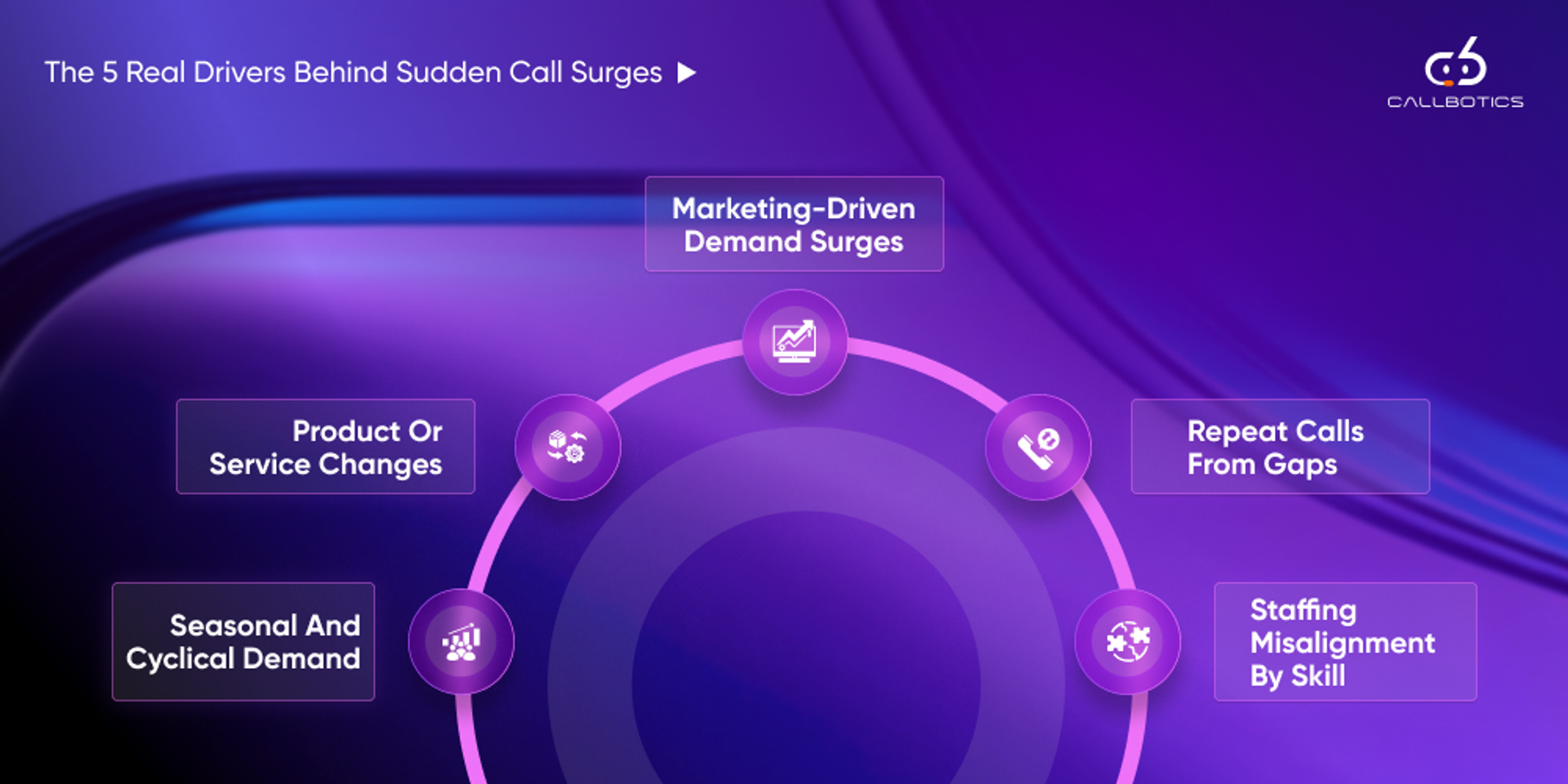
Below are the most common drivers, observed consistently across industries.
Billing cycles, enrollment periods, holidays, and renewals create predictable surges. These are the easiest spikes to plan for, yet many teams still under-forecast them.
New features, outages, pricing updates, or policy changes often trigger sudden inbound volume, especially when communication is unclear or fragmented across channels.
Campaigns that increase sign-ups or transactions without corresponding support readiness almost always lead to overflow. Growth without service alignment creates artificial spikes.
When customers cannot resolve an issue on the first attempt, they call again. Repeat calls quietly inflate volume and make spikes appear larger than they truly are.
Many spikes are not caused by too few agents overall, but by agents being unavailable at the wrong time, on the wrong queue, or without the right skills.
Understanding these causes matters because it determines the solution. Not every spike should be solved with more people.
When spikes are mismanaged, the cost shows up in multiple places:
Most importantly, performance becomes unpredictable. Leadership loses confidence in forecasts, and operations shift into reactive mode.
This is why call center overflow solutions must be designed intentionally, not added as a last-minute patch.
A more stable operating model is built on three principles:
These principles guide every effective strategy that follows.
One of the fastest ways to reduce call spikes is to stop preventable calls from entering the system at all.
This includes:
When customers know what is happening, they are less likely to call repeatedly or escalate prematurely.
Prevention does not eliminate demand. It reshapes it into something manageable.
Call center automation fails when it is treated as a barrier between customers and agents. It succeeds when it acts as a capable first-line resolver.
Effective automation during spikes focuses on:
This distinction matters, especially at scale.
Before diving into tactics, it helps to see how strong teams structure their response.
| Challenge During Spikes | What Breaks | What Strong Teams Do |
|---|---|---|
| Sudden volume surges | Static schedules | Forecast intraday and adjust in real time |
| Long wait times | FIFO queues | Prioritize by intent and urgency |
| Agent overload | Manual handling | Automate structured conversations |
| Repeat calls | Poor resolution | Close loops clearly on first contact |
| Unpredictable overflow | Ad-hoc fixes | Design overflow paths in advance |
Most forecasting models fail during spikes because they are built for averages, not volatility.
Effective teams forecast in short intervals (15–30 minutes) and update continuously as conditions change. This allows supervisors to react before queues form instead of after SLAs are already missed.
What matters most here is not long-term accuracy, but early deviation detection.
Key practices:
This is foundational to managing high call volumes without burning out agents.
Static schedules break first during spikes.
Teams that manage volatility well build elastic capacity into their model. This does not always mean more full-time agents. It often means:
Flexibility absorbs shock. Rigid staffing amplifies it.
Routing by department is one of the biggest contributors to congestion during spikes.
High-performing centers route by why the customer is calling, not where the call lands organizationally.
This reduces:
Intent-based routing is a prerequisite for both automation and intelligent escalation.
Self-service only works when it resolves the issue completely.
During spikes, poorly designed IVRs and portals increase volume by frustrating customers and pushing them back into live queues.
Effective self-service during peak periods focuses on:
This is one of the most reliable ways to reduce call spikes without adding headcount.
This is where call center automation either succeeds or fails.
Automation that only triages or routes does not meaningfully reduce load during spikes. It simply moves the bottleneck.
High-performing teams use AI voice agents to:
This is the difference between automation as a filter and automation as capacity.
When done correctly, AI voice agents stabilize performance during spikes instead of degrading it.
Holding customers in long queues during spikes damages experience and inflates abandonment.
Callback systems work when they are:
Callbacks flatten demand without suppressing it. They are a practical, customer-friendly way to handle peak call times.
Spikes expose specialization risk.
Teams that rely on narrowly trained agents struggle when one queue surges unexpectedly. Cross-training creates operational resilience.
Effective cross-training focuses on:
This turns staffing into a shared pool rather than isolated silos.
Dashboards are only useful if someone is empowered to act on them.
During spikes, leading teams monitor:
They intervene early by:
This is where call center overflow solutions either prevent collapse or arrive too late to matter.
Spikes should make the system smarter over time.
After-action reviews focus on:
This feedback loop is how organizations move from reactive to predictive operations.
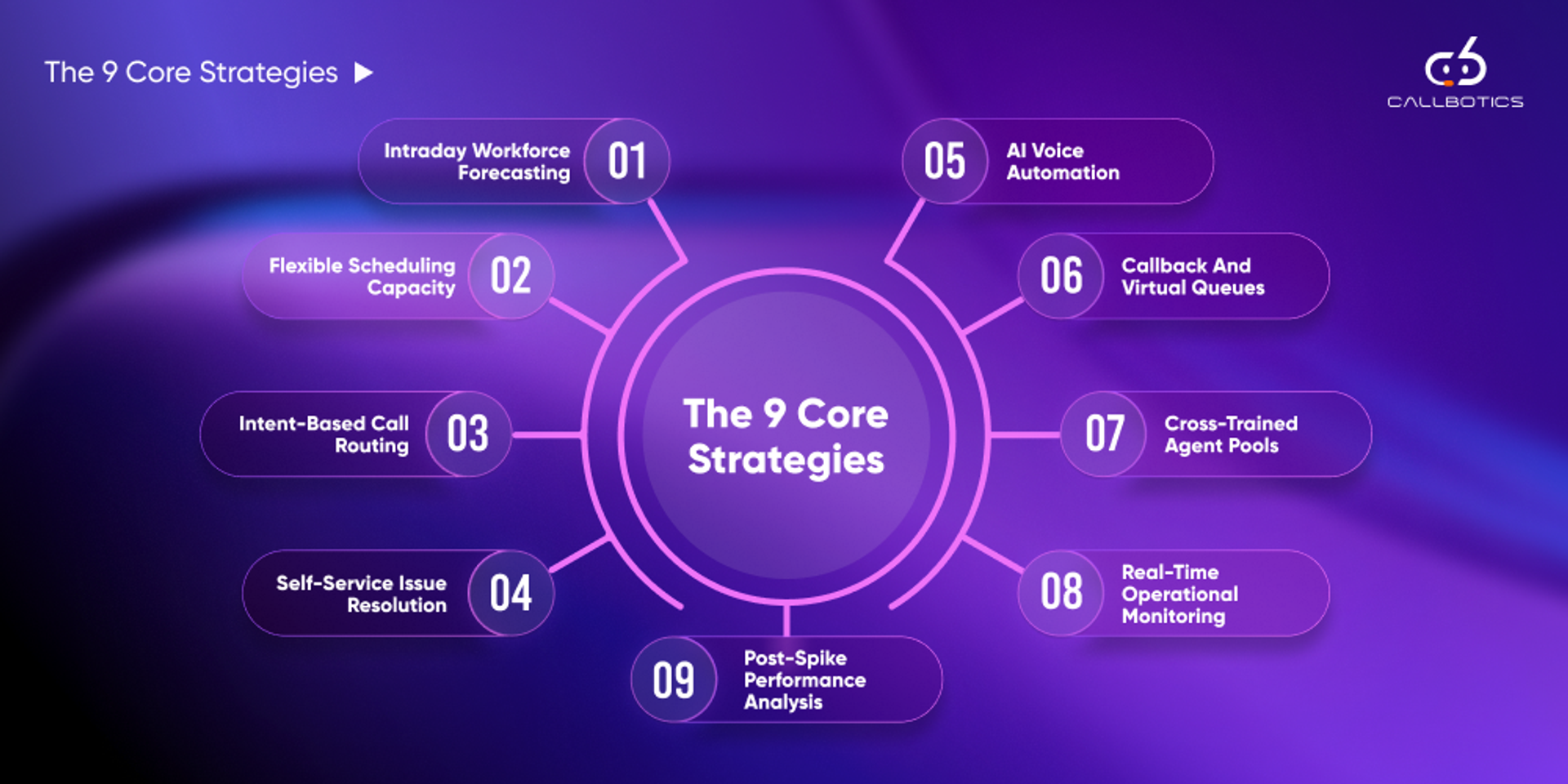
None of these approaches succeed in isolation. High-ranking blogs consistently emphasize system-level coordination, not individual tactics.
| Strategy Area | Primary Impact During Spikes |
|---|---|
| Forecasting & Scheduling | Prevents surprise overload |
| Routing & Prioritization | Reduces congestion and transfers |
| Self-Service & Automation | Lowers live queue demand |
| Callbacks & Overflow | Smooths peak pressure |
| Analytics & Review | Improves future resilience |
This is what sustainable managing high call volumes looks like in practice.
Many teams attempt these strategies but struggle with execution because their tools were designed for ideal conditions.
Platforms like CallBotics.ai are built specifically for environments where spikes are normal, not exceptional. Its ability to resolve structured conversations end-to-end, adapt tone using real-time sentiment, and scale without performance degradation directly supports the strategies above rather than replacing them.
One of the most consistent mistakes across struggling operations is measuring the wrong outcomes during peaks.
When volume rises, teams often fixate on:
These metrics tell you how busy the center was. They do not tell you whether the system held up.
High-performing teams evaluate spikes differently.
The most useful spike metrics fall into three categories.
These show whether demand was handled efficiently or leaked back into the system.
Key indicators:
If these numbers degrade sharply during peaks, volume is not the core issue. Resolution quality is.
Spikes amplify customer sensitivity. Small failures feel bigger under stress.
Track:
Stability matters more than perfection when you handle peak call times.
These metrics indicate whether leadership stayed ahead of the surge.
Examples:
Predictability is the difference between calm control and emergency response.
Post-spike reviews are where long-term improvement happens.
Top teams avoid vague questions like “What went wrong?” Instead, they ask structured, answerable questions:
This turns spikes into data, not just stress.
Here’s a practical way teams organize spike learnings.
| Review Area | What to Look For | Why It Matters |
|---|---|---|
| Demand Source | Triggers and timelines | Improves forecasting |
| Call Mix | High-frequency intents | Identifies automation candidates |
| Resolution Gaps | Repeat and transferred calls | Reveals friction |
| Automation Performance | Drop-offs and completions | Refines self-service |
| Escalation Quality | Context passed to agents | Protects CX |
This framework shows up repeatedly in content that ranks well because it reflects how operators actually think.
The most effective way to reduce call spikes is not reacting faster next time. It is removing unnecessary demand before it forms.
That means:
Every unresolved call today becomes volume tomorrow.
Call center automation works when it is treated as operational capacity, not as a gatekeeper.
Automation earns its place when it:
This is especially critical during spikes, when inconsistency compounds quickly.
Most AI voice assistants are built for clean demos and ideal call flows.
CallBotics.ai was designed for the opposite.
It assumes:
In practical terms, this means CallBotics.ai supports spike management by:
For customers, this results in fewer transfers, shorter wait times, and clearer resolution.For teams, it creates predictable performance during periods where unpredictability is usually the norm.
CallBotics.ai does not replace agents. It protects them by removing friction from routine interactions and preserving human judgment where it matters most.
Call spikes are not isolated events. They are the result of how demand is forecasted, how calls are routed, how issues are resolved, and how systems behave under pressure.
Throughout this guide, the pattern is consistent. Contact centers that perform well during spikes do not rely on a single tactic. They combine intraday forecasting, flexible staffing, intent-based routing, effective self-service, structured automation, and clearly defined overflow paths. They monitor conditions in real time, intervene early, and use post-spike analysis to improve the next response.
Most importantly, they design their operations around resolution, not volume. When issues are closed clearly and consistently, repeat calls fall, queues stabilize, and peak traffic becomes manageable instead of disruptive.

See how enterprises automate calls, reduce handle time, and improve CX with CallBotics.
CallBotics is an enterprise-ready conversational AI platform, built on 18+ years of contact center leadership experience and designed to deliver structured resolution, stronger customer experience, and measurable performance.