Routing is one of the most overlooked parts of the customer experience, but it shapes almost everything that happens after a call begins. When callers are sent to the wrong queue, transferred multiple times, or forced to repeat their issue, frustration builds quickly. What feels like a small routing mistake internally often shows up externally as long hold times, poor first-call resolution, and lower customer satisfaction.
This is where AI call routing changes the experience. Instead of relying only on menu selections or static queue rules, AI call routing uses caller intent, context, and follow-up details to send people to the right team or workflow faster. In some cases, it can even resolve simple issues before a transfer is needed.
This guide explains what AI call routing is, how it works, where it improves customer experience, and how businesses can measure whether it is actually working.
Before comparing systems or evaluating results, it helps to define AI call routing simply. Many businesses still think of call routing as a basic phone tree or queue assignment function. In reality, AI call routing is much more dynamic, routing calls based on caller intent and context rather than solely on static menu logic.
AI call routing is the process of using conversational AI to understand why someone is calling, gather the details needed to classify the request, and then send the call to the right team, queue, agent group, or workflow. Instead of forcing the caller to navigate a rigid set of menu options, the system listens to what they mean, asks clarifying questions when needed, and makes a more informed routing decision.
That matters because customers do not always know which department they need. They describe their problem in natural language, often with partial information, and expect the business to guide them to the right place quickly. AI call routing is designed to handle that reality more effectively than traditional routing systems.
To understand why AI call routing matters, it helps to look at how most call routing still works today. Traditional systems were built for predictability and control, but they often create friction because they assume callers can neatly fit themselves into predefined options. That works for simple department selection, but it breaks down when the reason for the call is more specific, ambiguous, or urgent.
The most common routing experience is still the basic menu: press 1 for sales, press 2 for billing, press 3 for support. This structure is easy to set up, but it places the burden on the caller to determine which option best fits their issue. In many cases, they are guessing.
That guesswork creates friction immediately. Customers may choose the wrong path because the menu options are too broad or confusing, or simply do not reflect how they think about their issue. Once that happens, the rest of the call starts from the wrong place, which often leads to transfers, repetition, and wasted time.
More advanced contact centers often use skill-based routing, where calls are sent to agents or teams based on queue rules, language, location, or specialty. This is more useful than a basic auto attendant, but it still falls short when the system lacks sufficient context before routing.
If the routing engine only knows that the caller selected “support,” it may still send the call to a broad queue without understanding whether the issue is billing-related, technical, urgent, or tied to a specific product. That means the caller may land with a team that has the right general skill set but not the right context to resolve the issue quickly.
Every wrong transfer creates compounding damage. It increases average handle time, forces the caller to explain the issue again, and often raises frustration before the right team even joins the conversation. What could have been a fast interaction becomes a multi-step recovery process.
This is why routing quality matters so much. A single bad routing decision does not just affect the first few minutes of the call. It influences downstream satisfaction, resolution speed, repeat contact rates, and agent workload.
AI call routing works best when the process feels invisible to the caller. The goal is not to make the interaction sound more advanced for its own sake, but to move the caller toward the right outcome with fewer steps and less confusion. In practice, that usually follows a simple sequence.
Instead of making the caller choose from a list of menu options, the system asks an open question such as, “How can I help you today?” The caller responds in their own words, and the AI identifies the likely intent based on what they say.
This is important because natural language provides more signal than menu input. A caller might say, “I was charged twice for my last order,” which tells the system much more than selecting “billing” from a menu. The AI can use that information to classify the issue more precisely from the beginning.
Once the likely intent is identified, the AI may ask one or two short follow-up questions to gather the details needed for better routing. This could include account type, order number, location, urgency, product line, or whether the caller is an existing customer.
These questions are not meant to create friction. They are meant to reduce it later. A small amount of context collected upfront can prevent misrouting, reduce transfer rates, and help the next step in the interaction start with useful information.
After intent and context are captured, the system routes the call to the most appropriate destination. That could be a specific department, a specialized queue, an available agent group, a regional office, or even an automated workflow for simple requests.
This is where AI routing differs most from static systems. It does not just send the call to a broad category. It uses a combination of intent and details to make a more specific routing decision, improving the chances of getting it right on the first try.
If the call is transferred to a human, the AI can pass along a brief summary of what the caller needs and what information has already been collected. That gives the agent immediate context before they join the call.
This matters because smart handoffs reduce the number of “Can you tell me what happened again?” moments. The caller feels like the business is listening across the interaction, not restarting the process every time someone new joins.
Over time, AI call routing can improve by learning from call outcomes. If certain intents are frequently misrouted, escalated, or transferred, those patterns can be used to refine the routing logic. If one follow-up question consistently improves routing accuracy, the workflow can be updated to include it earlier.
This is one of the biggest operational advantages of AI routing. It is not fixed after launch. It can be tuned using real call data, so routing gets smarter over time rather than staying static.
Want enterprise-grade AI voice agents that capture intent, route intelligently, and support real workflows at scale? Explore CallBotics.When routing works well, customers rarely think about it. They just feel that the interaction was fast, clear, and efficient. When it works poorly, they notice immediately. That is why AI call routing has such a direct effect on customer experience. It changes not just where the call goes, but how the entire interaction feels.
Correct routing reduces the amount of time callers spend waiting in the wrong place. Instead of entering a general queue and being passed around, customers are directed more accurately from the beginning. This shortens the path to the right person or workflow and reduces the number of handoffs needed to resolve the issue.
In peak periods, this effect becomes even more valuable. Smarter routing helps distribute calls more efficiently and prevents avoidable queue pressure created by misrouted traffic.
One of the most frustrating parts of traditional call handling is having to repeat the same information multiple times. AI call routing reduces this by collecting details upfront and carrying that context forward into the next step.
When the receiving team or agent already knows the issue type, urgency, or account details, the conversation starts with progress instead of repetition. That makes the experience feel more coordinated and less exhausting for the caller.
Customer experience improves when the issue is solved quickly, not just answered quickly. Better routing increases the likelihood that the caller reaches the team best equipped to handle the request on the first attempt. That has a direct impact on first-call resolution and reduces the chance of repeat contact.
This is especially important for complex support or billing-related interactions, where reaching the wrong team first can add significant delay even if the overall queue time was short.
During high-volume periods, routing quality becomes even more important because small inefficiencies scale quickly. AI routing helps reduce overload by classifying calls more intelligently, prioritizing urgent requests, and in some cases resolving simple inquiries before they reach human teams.
That creates a better customer experience and a more manageable workload for the contact center. Instead of every call entering the same broad queue structure, the system helps direct traffic with more precision.
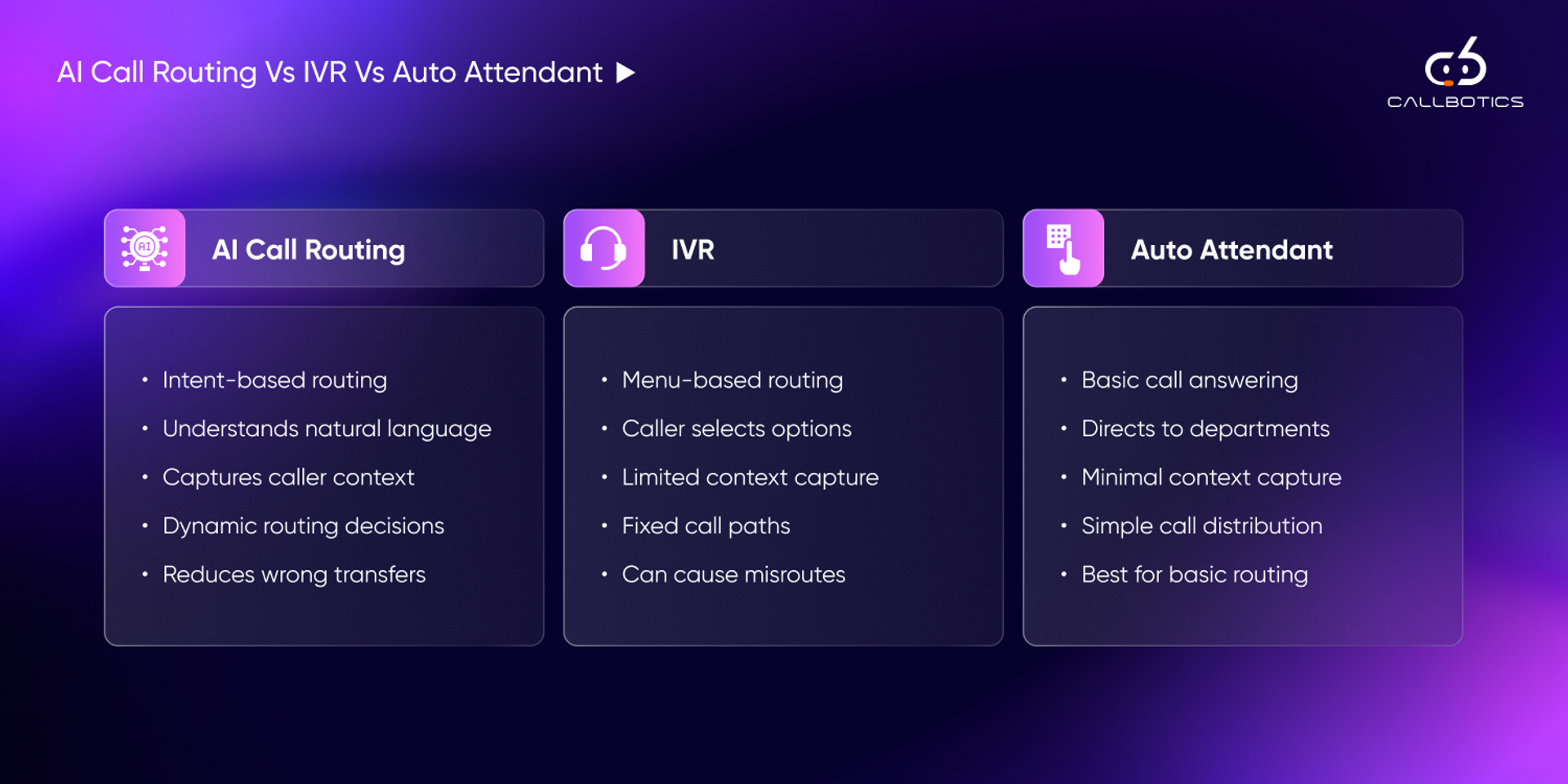
Businesses do not necessarily need to replace every existing routing layer to benefit from AI. In many environments, IVR, auto attendants, and AI routing can coexist. The key is understanding what each system is good at and where traditional approaches start to create friction.
Traditional IVR and auto attendants still work well for simple, predictable routing needs. Examples include after-hours call handling, directing callers to a small number of departments, or sharing basic information like office hours and locations.
If the call reasons are limited and customers usually know exactly where they need to go, a simple routing menu may be enough. The issue is not that IVR is always bad. It is that it becomes inefficient once call intent becomes more varied or less obvious.
AI routing becomes more valuable when callers are unsure where they belong, when call reasons are more nuanced, or when transfer rates are high. It is especially useful for support-heavy environments, multi-location operations, and businesses where getting to the right expert quickly makes a clear difference in resolution quality.
In these cases, letting the caller speak naturally and collecting a small amount of context often yields better routing decisions than relying solely on a menu tree.
For many organizations, the best setup is hybrid. A basic IVR may still handle simple department selection, after-hours logic, or straightforward overflow rules, while AI routing takes over for more complex or ambiguous intents.
This approach allows teams to modernize routing without rebuilding everything at once. It also helps reduce risk by applying AI where it creates the most value rather than forcing it into every interaction unnecessarily.
Curious where AI fits in the broader contact center stack? See how modern AI call centers differ from traditional call center models.AI call routing creates the most value when the business handles a mix of structured requests, uncertain callers, and high-volume traffic. The strongest use cases are those in which intent capture and better routing decisions can reduce friction immediately and improve measurable outcomes.
Support environments are among the best places to use AI routing, as callers often arrive with varied issues and urgency levels. The AI can identify whether the problem is technical, account-related, order-related, or high-priority before the call reaches an agent.
That improves intake quality and ensures the caller enters the support workflow with more structure and less guesswork.
Billing calls are often sensitive and time-consuming when routed incorrectly. AI routing can gather plan type, account category, verification details, or issue type before sending the caller to the right billing or account team.
This helps reduce escalations and improves the chances of getting billing-related issues resolved faster.
For inbound sales calls, AI routing can capture whether the caller is a new lead, existing customer, partner, or enterprise prospect. It can also gather company size, product interest, or region before connecting the call to the right rep.
This is useful because it improves qualification speed and helps ensure higher-value opportunities reach the right team without delay.
Scheduling-related calls often depend on provider type, location, timing, and service category. AI routing can quickly gather those details and send the caller to the right scheduling workflow or team, rather than a generic front-desk queue.
This is especially valuable in healthcare, home services, salons, and multi-site service businesses.
Businesses with multiple branches or service regions often struggle with callers reaching the wrong location. AI routing can use natural language plus location or service details to guide the caller to the nearest or most relevant branch with fewer steps.
That reduces both customer confusion and the volume of internal transfers across locations.
Routing improvements should be measured, not assumed. A system may sound more modern, but the real question is whether it is improving operational outcomes and customer experience. The right KPIs help teams validate that the routing logic is actually working.
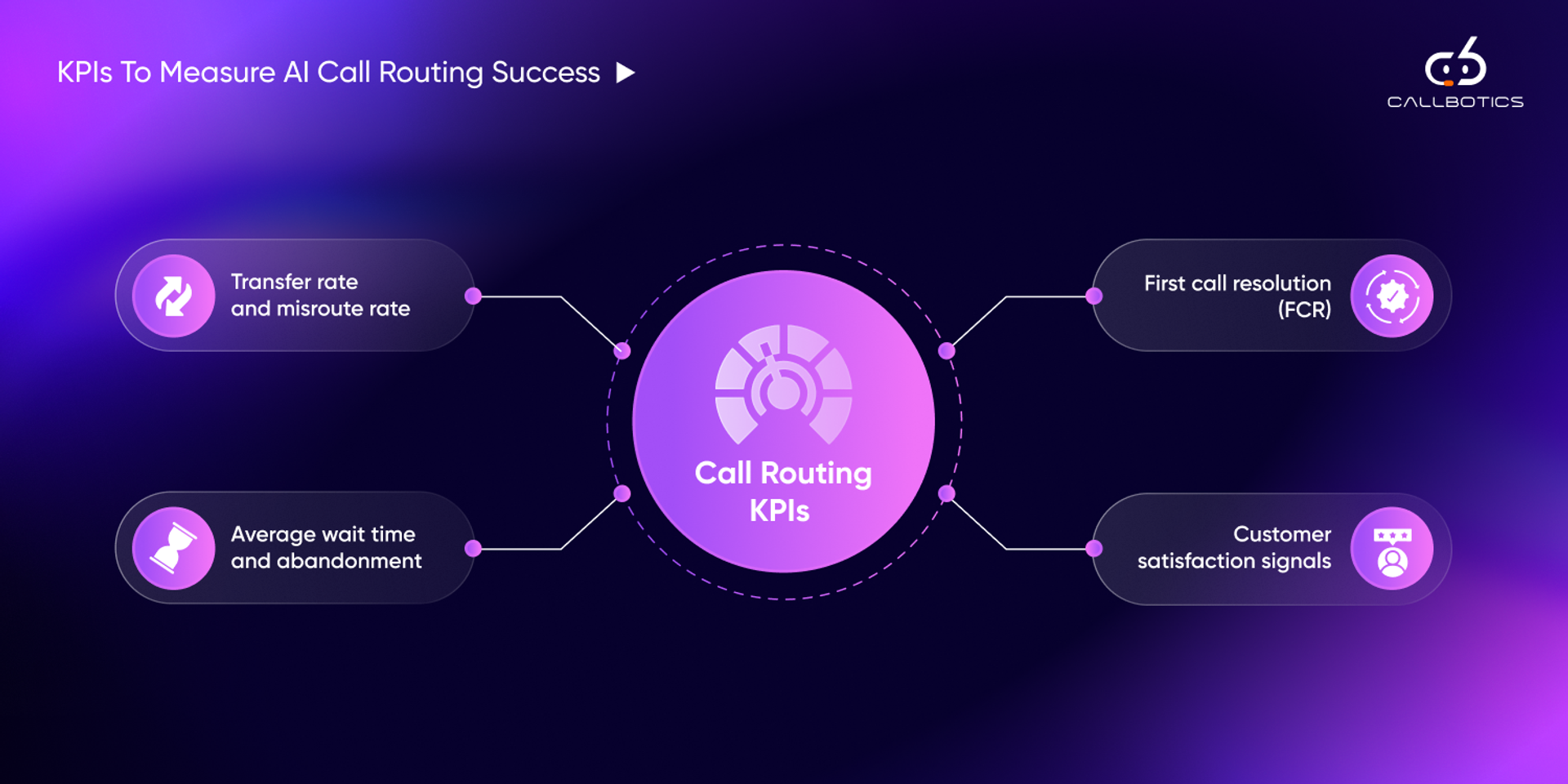
One of the clearest indicators of routing quality is whether calls reach the right destination the first time. The transfer rate shows how often calls are rerouted after the initial routing, while the misroute rate captures whether the initial routing decision was incorrect.
If these metrics remain high, the issue may be unclear prompts, weak intent capture, or missing follow-up questions.
If AI routing is working well, customers should spend less time waiting in the wrong queues and less time giving up before they get help. Tracking average wait time and abandonment rate helps show whether the experience is becoming more efficient from the caller’s perspective.
This is especially important during peak traffic, where routing quality has a strong effect on queue performance.
The purpose of better routing is not just to move calls faster. It is to improve the chances of solving the issue in one interaction. FCR is one of the most important outcome metrics because it reflects whether the routing decision led to a real resolution.
Improved FCR often signals that the customer reached the right destination with the right context attached.
CSAT, short post-call ratings, sentiment signals, and complaint patterns all help validate whether callers actually feel the difference. Routing quality strongly influences satisfaction because it affects speed, repetition, and effort throughout the interaction.
If routing improves operational metrics but satisfaction remains flat, the handoff experience or downstream workflow may still need attention.
Want better visibility into routing performance, call outcomes, and customer experience? Explore how CallBotics helps teams improve routing with more control and insight.Common Mistakes to Avoid with AI Call Routing
AI call routing works best when the implementation stays focused, practical, and tied to real routing outcomes. Even strong technology can underperform if the workflow is too broad, the prompts are unclear, or the handoff logic is weak. The most common mistakes usually come from trying to do too much too early without enough structure around routing decisions.
Better routing requires more than just intent detection. It requires a platform that can capture context, support clean handoffs, integrate with business systems, and improve over time using real call outcomes. CallBotics is designed for exactly that kind of operational routing environment. Developed by teams with over 17 years of contact center experience, the platform helps businesses route calls more intelligently while reducing customer effort and transfer friction.
What makes CallBotics different:
This helps teams move from static menus and reactive transfers to more accurate, more scalable call routing that improves both customer experience and operational efficiency.
AI call routing improves customer experience by getting callers to the right place faster, with less confusion, fewer transfers, and less repetition. Instead of forcing customers to interpret menus and hope they choose correctly, it allows businesses to route based on intent, context, and real needs. That leads to better first-call outcomes and a smoother experience across the entire interaction.
The biggest advantage is not just that routing becomes smarter. It is hoped that the whole support experience becomes more coordinated. When AI routing is paired with smart handoffs, useful integrations, and clear KPIs, it can reduce customer friction and create a more efficient operating model for the business. For teams dealing with high transfer rates, long queues, or complex support, it is one of the most practical ways to improve the customer experience without redesigning the entire contact center at once.

Urza Dey (She/They) is a content/copywriter who has been working in the industry for over 5 years now. They have strategized content for multiple brands in marketing, B2B SaaS, HealthTech, EdTech, and more. They like reading, metal music, watching horror films, and talking about magical occult practices.
See how enterprises automate calls, reduce handle time, and improve CX with CallBotics.
CallBotics is an enterprise-ready conversational AI platform, built on 18+ years of contact center leadership experience and designed to deliver structured resolution, stronger customer experience, and measurable performance.