Customer support queues were never designed for today’s demand. Most contact center models still assume call volume is relatively predictable and staffing can be adjusted accordingly. In reality, neither of these assumptions holds anymore.
Call volumes spike unpredictably due to promotions, outages, seasonal demand, and customer behavior shifts. At the same time, hiring and training agents takes weeks or months, making it impossible to scale capacity in real time. Additionally, a large percentage of inbound calls are repetitive, consuming valuable agent time without adding proportional value.
The result is a system that constantly operates under pressure:
In many cases, customers abandon calls before ever reaching an agent. Research shows that up to 60% of callers hang up within 60 seconds of waiting, and missed calls can account for a significant portion of lost revenue.
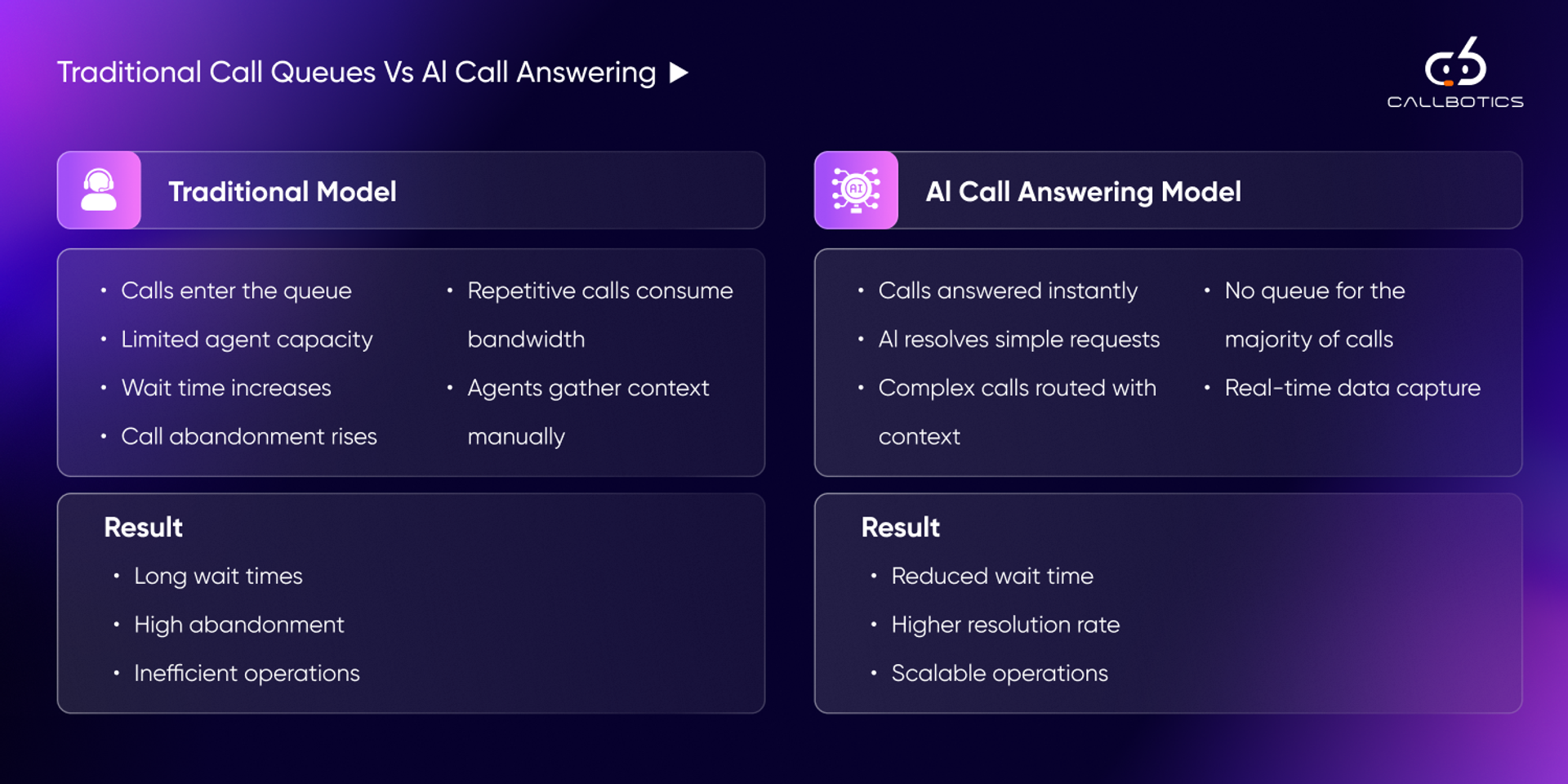
AI call answering changes this model at a structural level. Instead of placing callers into a queue and making them wait for limited human capacity, AI voice agents answer instantly, handle a large share of common requests, and only involve human agents when necessary.
This shifts the operating model from queue management to demand absorption.
The impact is immediate and measurable:
AI call answering is the use of AI-powered voice agents to handle inbound phone calls, understand caller intent, and either resolve the request or route it appropriately in real time.
At a surface level, it may sound similar to IVR or auto attendants. In practice, it is fundamentally different.
Traditional systems rely on predefined flows:
AI call answering replaces this with natural conversation and dynamic decision-making.
Callers can simply say what they need, and the system interprets intent, manages the conversation, and takes action. This removes the friction of menu navigation and significantly improves the speed and quality of interactions.
A modern AI call answering system can:
The most important distinction is that AI call answering is not just a routing layer. It is an execution layer.
Instead of simply directing calls, it can:
This reduces dependency on human agents for routine work and allows teams to focus on interactions that require judgment, empathy, or complex problem-solving.
Modern AI voice agents go far beyond basic routing. They can manage full conversations, understand intent, and complete tasks across systems.
If you want a deeper breakdown of how these systems compare, you can explore our guide on the best AI voice assistants, which covers how leading platforms handle real customer interactions at scale.
Hold queues are often treated as an unavoidable part of customer support. In reality, they are a byproduct of how traditional contact centers are structured.
At their core, queues exist because demand exceeds available human capacity at a given moment.
This creates a backlog of calls waiting to be handled sequentially, which leads directly to delays and customer frustration.
The problem is not just volume. It is the combination of volume, inefficiency, and inflexibility.
Customer demand is highly uneven. It fluctuates based on:
These spikes are often sudden and difficult to predict with perfect accuracy. Even well-forecasted operations struggle to match staffing levels exactly to demand in real time.
During peak periods:
Because human capacity is fixed in the short term, even a temporary surge can create a backlog that takes hours to clear.
Queues are therefore not just a result of high volume. They are a result of the inability to scale instantly.
A large share of inbound calls is repetitive and predictable.
Common examples include:
These interactions typically:
Despite this, they are handled by human agents in most traditional setups.
This creates a capacity bottleneck:
In effect, simple calls crowd out more important ones.
This is one of the biggest inefficiencies in traditional contact center operations.
Traditional IVR systems were designed to reduce load, but they often introduce new friction.
Typical issues include:
As a result:
This creates a compounding effect:
Queues, therefore, are not just caused by demand. They are amplified by inefficient routing and poor self-service design.
AI call answering replaces rigid, menu-based flows with dynamic, real-time conversations that adapt to the caller’s intent.
Instead of forcing customers through predefined paths, the system understands what the caller wants and moves the interaction toward resolution step by step.
The AI answers the call immediately, eliminating the need for hold queues or waiting.
Instead of navigating menus, the caller simply states their request naturally:
“I want to check my order status.”
“I need to reschedule my appointment.”
The system uses natural language understanding to:
This removes the friction of IVR menus and significantly reduces the time it takes to reach the right resolution path.
Once intent is identified, the AI gathers the necessary information to complete the request accurately.
This may include:
The key difference is that these questions are:
This ensures the system collects just enough information to resolve the request or route it correctly without creating unnecessary friction.
For a large percentage of calls, the AI can complete the task within the conversation itself.
Typical examples include:
Because these interactions follow structured logic, they can be handled end-to-end without human involvement.
In many environments, this removes a significant share of total call volume from queues entirely, freeing up agent capacity for more complex issues.
When a request requires human intervention, the AI does not simply transfer the call blindly.
Instead, it passes structured context along with the call:
This means:
This improves both efficiency and customer experience while reducing frustration during escalations.
Every interaction is automatically recorded and structured into usable data.
This includes:
Unlike manual note-taking, this happens consistently across all calls.
This creates a continuous feedback loop where teams can:
To understand how call data turns into actionable insights, see our guide on AI call analysis, which explains how teams use conversation data to improve resolution rates and performance.
The shift is not just about answering calls faster. It fundamentally changes how contact centers handle demand.
Instead of queuing every call behind a limited human capacity, AI absorbs a large portion of interactions instantly and optimizes the rest.
Simple, high-volume calls are handled immediately by AI.
They never enter a queue, which means:
Since these calls often represent a large percentage of total volume, removing them from queues can dramatically reduce overall wait times.
AI captures context before escalation, allowing human agents to start from a position of clarity.
Agents no longer need to:
This can reduce handling time by up to 40%, depending on the use case and implementation.
Shorter calls mean:
AI uses intent detection rather than menu selection to route calls.
This leads to:
Because routing is based on actual intent rather than guesswork, calls reach the correct destination the first time.
AI provides elastic capacity that traditional teams cannot match.
During peak demand:
This prevents queue buildup during:
Instead of reacting to demand, operations become resilient to it.
The fastest and most measurable impact comes from automating high-volume, repeatable call types that follow predictable patterns.
Businesses evaluating vendors for these use cases often compare different providers. Our guide to the best AI answering service breaks down which solutions are best suited for different operational needs.
AI can fully manage scheduling workflows:
This reduces inbound call load and eliminates manual coordination.
“Where is my order?” calls are one of the highest-volume categories in many industries.
AI can:
These calls are resolved instantly without agent involvement, making them one of the biggest contributors to queue reduction.
Common queries such as:
Can be handled entirely by AI using structured knowledge bases.
This removes repetitive workload from agents while maintaining consistent, accurate responses.
AI can handle inbound sales inquiries by:
This ensures faster response times and better conversion potential.
AI provides continuous availability beyond business hours.
It can:
This eliminates missed opportunities and improves customer accessibility.
The key difference lies in capability.
Auto attendants and IVRs route calls. AI call answering can understand, act, and resolve.
Auto attendants remain useful for:
They provide structure but lack flexibility.
AI is significantly more effective in scenarios involving:
Unlike IVR systems, AI does not depend on predefined options. It adapts dynamically to the conversation.
Successful deployment depends on proper setup, not just technology.
AI performance depends on accurate and structured information.
This includes:
Clear inputs reduce incorrect responses and improve resolution accuracy.
To move beyond conversation into execution, AI must connect with:
Without integrations, AI can only answer questions. With integrations, it can complete tasks.
Teams must define:
This ensures smooth collaboration between AI and human agents.
AI systems improve through ongoing optimization.
This includes:
Continuous tuning ensures performance improves over time rather than degrading.
Successful deployment depends on proper setup, integrations, and continuous optimization, not just the technology itself.
For a broader view of how platforms differ in execution, integrations, and scalability, you can review our comparison of the best conversational AI platforms, which outlines what enterprise teams should evaluate before choosing a solution.
To measure impact, teams should track both operational efficiency and customer experience metrics.
Measures the percentage of calls fully resolved by AI without human involvement.
Higher containment directly correlates with reduced queue volume.
These metrics indicate whether queues are shrinking:
They are direct indicators of improved accessibility.
Effective AI handoffs should:
Poor handoffs typically show up as higher repeat-call rates.
CallBotics is built for real-world contact center operations where call volume is unpredictable, workflows are complex, and performance directly impacts customer experience and revenue. Developed by teams with 18+ years of experience in the contact center industry, CallBotics is designed to understand the subtle nuances of a solid contact center workflow.
Unlike generic conversational AI tools, CallBotics is designed specifically for production-grade voice automation, where every interaction must be accurate, fast, and actionable.
The platform enables organizations to:
This approach shifts contact centers away from queue-based handling toward resolution-driven operations.
Instead of managing wait times, teams can:
The result is a more stable, scalable, and efficient support operation that performs reliably even during peak demand.
Hold queues are not a feature of customer support but a symptom of limited capacity, inefficient routing, and over-reliance on human agents for routine tasks. As call volumes rise and customer expectations shift toward instant responses, this model becomes increasingly unsustainable, with hiring more agents offering only temporary and costly relief. AI call answering introduces a fundamentally different approach by resolving high-volume, repetitive calls instantly, absorbing peak demand without additional staffing, improving routing through intent detection, and reducing handling time by providing agents with full context. The impact is structural rather than incremental, leading to shorter wait times, lower abandonment rates, higher first-call resolution, and more efficient use of human agents. As a result, AI call answering is quickly becoming a foundational layer of modern contact center operations, enabling organizations not just to improve efficiency but to fundamentally redefine how customer interactions are managed at scale.

Urza Dey (She/They) is a content/copywriter who has been working in the industry for over 5 years now. They have strategized content for multiple brands in marketing, B2B SaaS, HealthTech, EdTech, and more. They like reading, metal music, watching horror films, and talking about magical occult practices.
See how enterprises automate calls, reduce handle time, and improve CX with CallBotics.
CallBotics is an enterprise-ready conversational AI platform, built on 18+ years of contact center leadership experience and designed to deliver structured resolution, stronger customer experience, and measurable performance.