Customer Effort Score, or CES, measures one simple thing: how easy it was for a customer to get help.
In contact centers, effort usually rises when customers wait too long, repeat the same information, get transferred multiple times, or leave a call without a clear outcome. Even when agents are polite and helpful, the experience can still feel difficult if the process itself is full of friction.
That is why CES matters so much. It captures something many service teams miss when they focus only on satisfaction or friendliness. Customers often stay loyal not because the support felt impressive, but because it felt easy. In contact centers, AI voice agents are becoming one of the most practical ways to reduce that effort. When deployed well, they shorten wait times, improve routing, remove repetitive steps, and make resolution faster and clearer.
This guide explains what CES means, what raises customer effort in real contact center operations, and how AI helps reduce that friction in measurable ways.
The Customer Effort Score measures how easy or difficult it was for a customer to complete a task or receive support. In a contact center, that usually means how much work the customer had to do to get an answer, solve a problem, or move the interaction forward. The lower the effort, the better the CES.
This metric matters because ease often predicts loyalty more reliably than “good service” in the abstract. A customer may not remember a pleasant tone or a polished greeting, but they will remember whether they had to wait, had to repeat themselves, or had to call back. In that sense, CES is one of the clearest indicators of how friction-heavy the support experience really is.
These metrics are often discussed together, but they measure different parts of the customer experience. Using them correctly helps teams determine whether the problem lies in friction, satisfaction, or long-term loyalty.
| Metric | What it measures | Best used for |
|---|---|---|
| CES | How easy it was to get help | Friction, process design, support effort |
| CSAT | How satisfied the customer felt | Interaction quality and short-term experience |
| NPS | Whether the customer would recommend the brand | Loyalty and broader relationship strength |
CES measures friction. It shows how hard the support process felt, regardless of whether the customer liked the agent or the brand. This is the best metric when the goal is to remove effort from the interaction.
CSAT measures customer satisfaction with the support experience or outcome. It is useful for understanding how customers felt, but it does not always explain why the interaction felt difficult.
NPS measures whether a customer is likely to recommend the company over time. It reflects overall brand loyalty more than a single support interaction.
CES drops when support feels easy and rises when customers have to work too hard just to get help. In most contact centers, that effort comes from a few recurring operational issues. These are the areas teams need to fix first if they want real CES improvement.
Waiting is one of the biggest effort drivers in any contact center. If a customer has to spend several minutes in a queue before getting help, the interaction already feels harder than it should. During peak periods, this becomes even more damaging, as patience quickly erodes when there is no visible progress.
Nothing raises effort faster than making a customer explain the same issue multiple times. When context is lost between routing steps or transfers, the process feels broken. Even if the issue eventually gets resolved, the experience still feels difficult.
Misroutes create extra steps. Each transfer adds more delay, more repetition, and more uncertainty. Customers do not care whether the routing logic failed for a technical reason. They just feel that the company made them work harder to get to the right person.
Support feels harder when the answer is delayed or incomplete. If the customer leaves the interaction unsure what happens next, they often need to call again, follow up manually, or continue chasing the issue. That increases effort even when the first interaction sounded successful on paper.
AI improves CES by removing friction where customers usually feel it first. The goal is not just to automate more interactions. It is to make support easier by reducing waiting, unnecessary steps, and confusion. These are the most practical ways AI helps.
AI voice agents can answer calls immediately, which removes one of the biggest sources of customer effort before the interaction even begins. This is especially useful for simple or repetitive calls, and during busy periods when human queues expand quickly.
When customers feel progress immediately, the interaction starts with less friction and lower frustration.
Instead of forcing callers through a fixed menu, AI can identify what the customer actually means and route the call accordingly. That reduces wrong transfers and helps the interaction reach the right path faster.
This is one of the clearest ways AI improves CES because fewer routing mistakes mean fewer steps for the customer.
Many customers call for straightforward reasons such as scheduling, order status, confirmations, FAQs, or account updates. These are high-effort calls when they sit in the human queue, but low-effort when AI handles them quickly and accurately.
The more repetitive tasks AI can resolve directly, the easier the support experience becomes.
When a human handoff is needed, AI can collect account information, issue type, and other relevant details before transferring the call. That reduces the amount of work the customer has to repeat later.
This improves the CES because the handoff feels like a continuation rather than a restart.
AI can also generate summaries and next-step context so the human agent begins the call with useful information already in hand. That shortens the interaction and reduces the number of clarifying questions the customer has to answer.
The result is a smoother support experience with less back-and-forth.
Customers do not always call during business hours. AI helps by providing 24/7 answering, basic support, message capture, and urgency handling even when live teams are offline. That reduces the effort of having to “call back later” or wait until the next day for basic help.
CES improves when customers do not need to call again for the same issue. Better routing, clearer answers, and more structured resolution reduce repeat contacts, lowering effort across the whole support journey, not just a single interaction.
Explore CallBotics if you want AI voice agents that answer instantly, route by intent, and reduce customer effort across high-volume support workflows.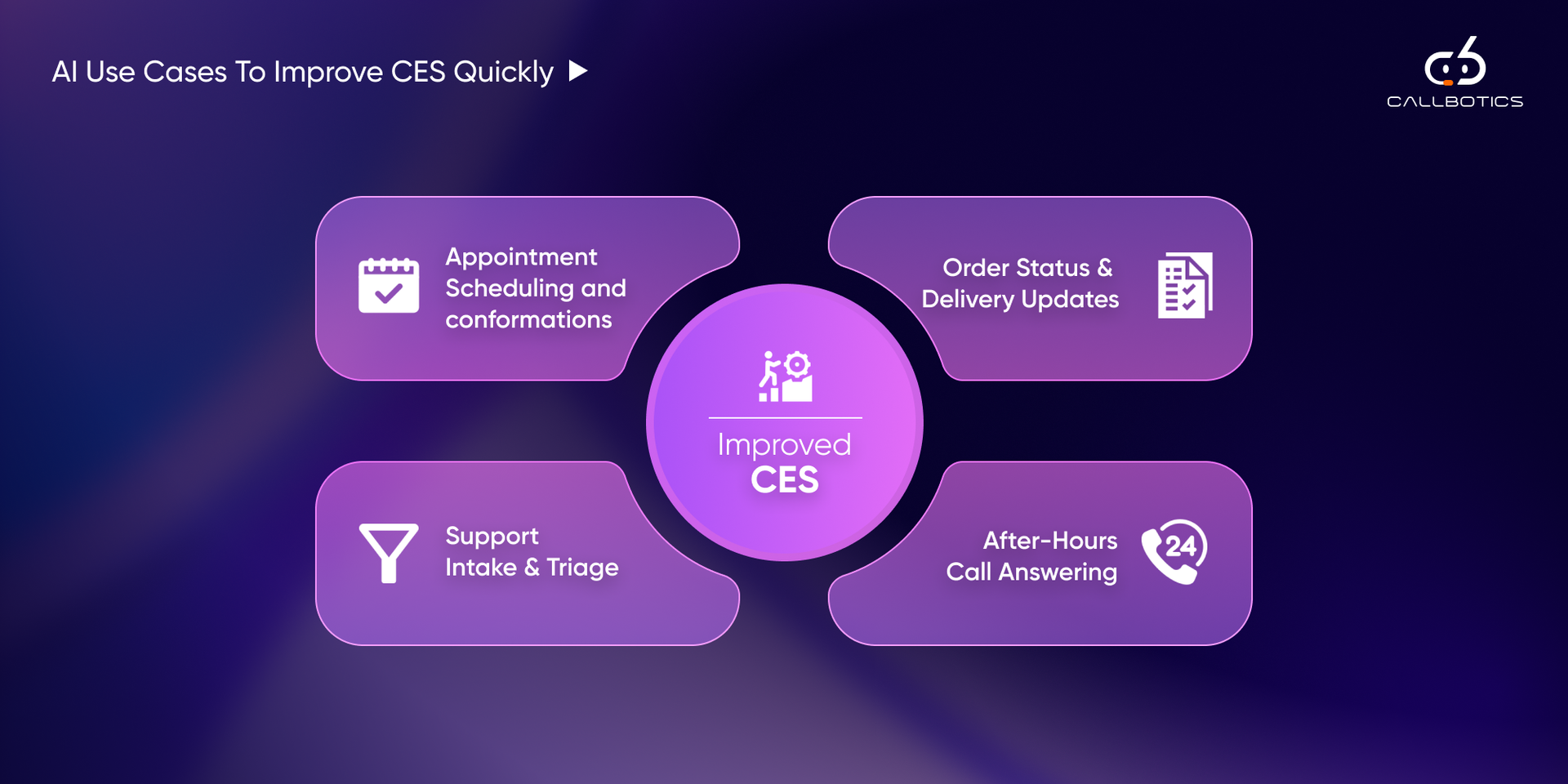
Some workflows improve CES much faster than others. The best starting points are usually high-volume, structured interactions where customer effort is clearly tied to waiting, repetition, or basic task completion.
Scheduling workflows are a strong CES use case because they often involve unnecessary back-and-forth when handled manually. AI can book, confirm, reschedule, or cancel appointments quickly and clearly, reducing friction for customers.
Where-is-my-order calls create unnecessary effort because customers often wait in the queue for information that already exists in the system. AI can surface those updates quickly and reduce the effort of chasing basic order information.
Even when AI does not fully resolve the issue, it can still improve CES by capturing intent and routing the call correctly on the first try. That reduces transfers, lowers confusion, and shortens the path to help.
After-hours availability matters because missed calls and “try again later” experiences create unnecessary customer effort. AI can answer, capture details, and prepare the issue for a cleaner next-step workflow.
CES should not be treated as a vague perception metric. Teams can clearly measure it if they connect survey feedback to the operational signals that typically drive customer effort. That is what makes the metric useful after AI goes live.
CES surveys work best when they are short and immediate. Ask the question right after the interaction, while the experience is still fresh, and keep it focused on ease rather than satisfaction.
Overall, CES can hide which workflows are improving and which are still creating friction. Segmenting by call reason, channel, or workflow makes it much easier to identify where AI is actually reducing effort.
You should not wait for survey responses alone. Teams should also track the operational signals that usually shape effort:
These indicators usually move before CES shifts become obvious in aggregate.
AI does not automatically improve effort. If deployed poorly, it can increase friction rather than reduce it. That usually happens when the conversation is too long, the handoff path is unclear, or the system tries to answer when it should escalate.
Customers should not have to sit through long explanations or answer the same question multiple times. AI works best when the conversation stays short, direct, and relevant to the task.
A clear human handoff reduces frustration because customers do not feel trapped in the automation. An easy escape path often improves CES even when the customer ends up speaking to a person.
Wrong answers create more effort than fast escalations. If the AI is uncertain, it should transfer context rather than improvise. Safe handling is usually better for CES than overconfident automation.
See how CallBotics helps teams reduce transfers, improve handoffs, and make support feel easier with enterprise-ready voice automation built for real contact center operations.CallBotics helps reduce customer effort by removing the friction that usually makes contact center interactions feel hard in the first place. Developed by teams with over 18 years of contact center and BPO experience, the platform is built around the operational realities that affect CES most directly, including queue pressure, routing quality, handoff continuity, and repeat contacts.
What makes CallBotics different:
This makes CallBotics especially well-suited to teams that want to improve ease of support, not just automate more calls.
Customer Effort Score improves when support becomes easier. That usually means fewer steps, less waiting, fewer transfers, better context, and clearer outcomes. In contact centers, those are exactly the areas where AI can create measurable value.
The most effective AI deployments do not improve CES by sounding impressive. They improve it by removing friction from the experience. When AI answers faster, routes correctly, resolves repetitive requests, and hands off cleanly, support feels easier to the customer and more manageable to the business.

Urza Dey (She/They) is a content/copywriter who has been working in the industry for over 5 years now. They have strategized content for multiple brands in marketing, B2B SaaS, HealthTech, EdTech, and more. They like reading, metal music, watching horror films, and talking about magical occult practices.
See how enterprises automate calls, reduce handle time, and improve CX with CallBotics.
CallBotics is an enterprise-ready conversational AI platform, built on 18+ years of contact center leadership experience and designed to deliver structured resolution, stronger customer experience, and measurable performance.