HubSpot has evolved into a powerful system of record for customer data, but for many teams, it still stops short of execution.
Sales and support teams rely on manual calling, inconsistent follow-ups, and fragmented workflows that limit how effectively HubSpot data is used in real time. SDR productivity is capped, response times lag, and valuable context often gets lost between interactions.
At the same time, customer expectations have shifted toward instant, contextual, and multi-channel engagement.
This is where AI voice agents come in.
An AI voice agent integrated with HubSpot transforms the CRM from a passive database into an active execution engine. It enables teams to automate conversations, trigger workflows, and sync every interaction back into HubSpot in real time.
This guide explains how AI voice agents integrate with HubSpot, how they automate calling and CRM workflows, and how enterprises use AI sales and support calling software.
An AI voice agent for HubSpot is a CRM-integrated conversational system that can autonomously handle voice interactions while reading from and writing to HubSpot in real time.
It acts as a live execution layer on top of your CRM, enabling conversations to directly trigger actions, update records, and move deals forward without manual intervention.
Unlike traditional tools, it is not:
Instead, it is a context-aware, task-oriented system that operates inside your HubSpot environment and can:
The key difference is context and execution.
Traditional calling tools operate outside the CRM and require manual updates. AI voice agents operate within the CRM and treat every conversation as a data-driven workflow.
The AI does not operate in isolation. It continuously uses HubSpot data such as:
This allows conversations to be:
Instead of starting from scratch on every call, the AI builds on existing CRM context, creating a seamless, memory-driven interaction experience.
In practice, this transforms HubSpot from a system that stores data into a system that actively executes on it through voice.
HubSpot adoption continues to grow globally, but as teams scale, the limitations of manual execution become increasingly visible.
While HubSpot excels as a system of record, it still relies heavily on human effort to execute outreach, follow-ups, and customer interactions. This gap between data and execution is driving rapid adoption of AI voice automation.
Traditional calling workflows break down as volume increases.
Sales teams are constrained by:
As lead volume grows, teams struggle to maintain consistent outreach, leading to missed opportunities and uneven pipeline coverage.
Even high-performing SDR teams face structural limits.
They can only:
This creates a bottleneck where growth is tied directly to headcount, making scaling both expensive and inefficient.
AI voice agents remove this constraint by enabling parallel, always-on calling capacity.
Manual processes introduce operational friction.
Common issues include:
These gaps reduce the effectiveness of HubSpot as a decision-making system.
AI voice automation eliminates these issues by ensuring that every interaction is automatically logged, structured, and actionable.
Speed has become a critical competitive advantage.
Leads contacted within minutes are significantly more likely to convert than those contacted hours later. However, manual processes often introduce delays due to:
AI voice agents enable instant response, ensuring that every inbound or outbound interaction happens at the optimal moment.
Customer communication is no longer limited to a single channel.
Modern buyers expect:
More importantly, they expect these channels to be connected.
AI voice agents enable this by acting as a unified layer that:
The core reason behind adoption is simple:
HubSpot manages data, but AI voice agents activate it.
Instead of relying on manual workflows, teams can:
This transforms HubSpot into a real-time operational system, where data is not just stored, but continuously acted upon.
AI voice agents integrate deeply with HubSpot by acting as a real-time bridge between conversations and CRM data. Instead of treating calls as isolated events, every interaction becomes part of a structured, continuously updated customer record.
This integration ensures that HubSpot is not just storing information, but actively driving and responding to customer interactions.
AI voice agents continuously sync data between live conversations and HubSpot, ensuring that every interaction is captured and reflected instantly.
This eliminates operational friction across teams.
There is no need for:
As a result, HubSpot becomes a single source of truth that is always up to date, even at scale.
AI voice agents access HubSpot data in real time before and during conversations, allowing them to adapt dynamically based on customer context.
This includes:
This enables conversations that are:
For example, a returning lead does not need to re-explain their requirements. The AI already understands prior interactions and continues the conversation accordingly.
The result is higher engagement, faster resolution, and improved conversion rates.
AI voice agents support both inbound and outbound communication within HubSpot, creating a unified calling layer across the customer lifecycle.
This dual capability ensures that teams can both respond and initiate interactions at scale, without increasing headcount.
HubSpot workflows become significantly more powerful when combined with AI voice automation. Instead of triggering static actions, workflows can now initiate real-time conversations and decision-based execution.
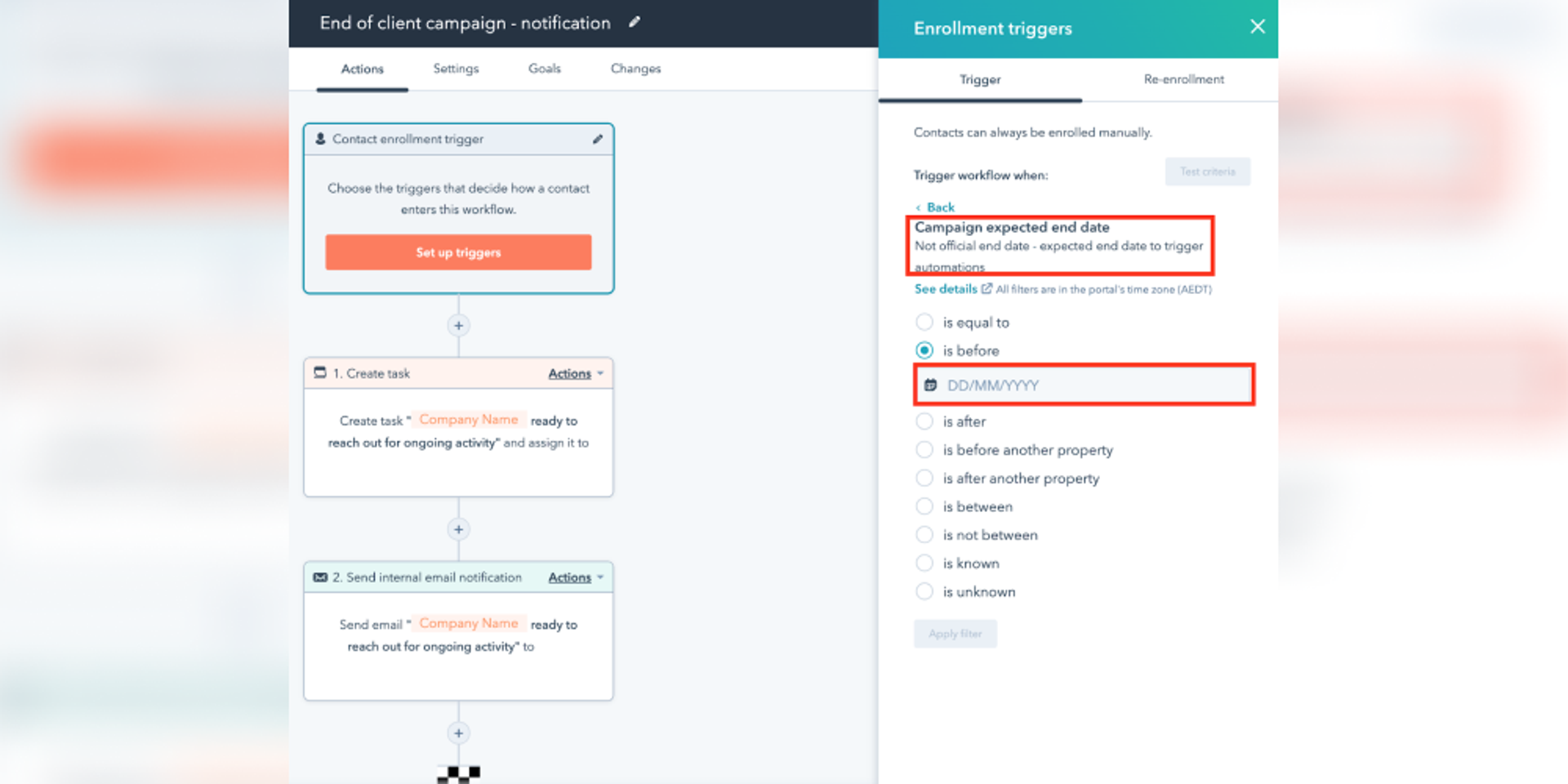
Caption: HubSpot’s Workflow-Based Call Triggers
HubSpot workflows can automatically trigger AI voice calls based on predefined events and conditions.
Common triggers include:
This ensures that every important moment in the customer journey is acted upon instantly, without relying on manual intervention.
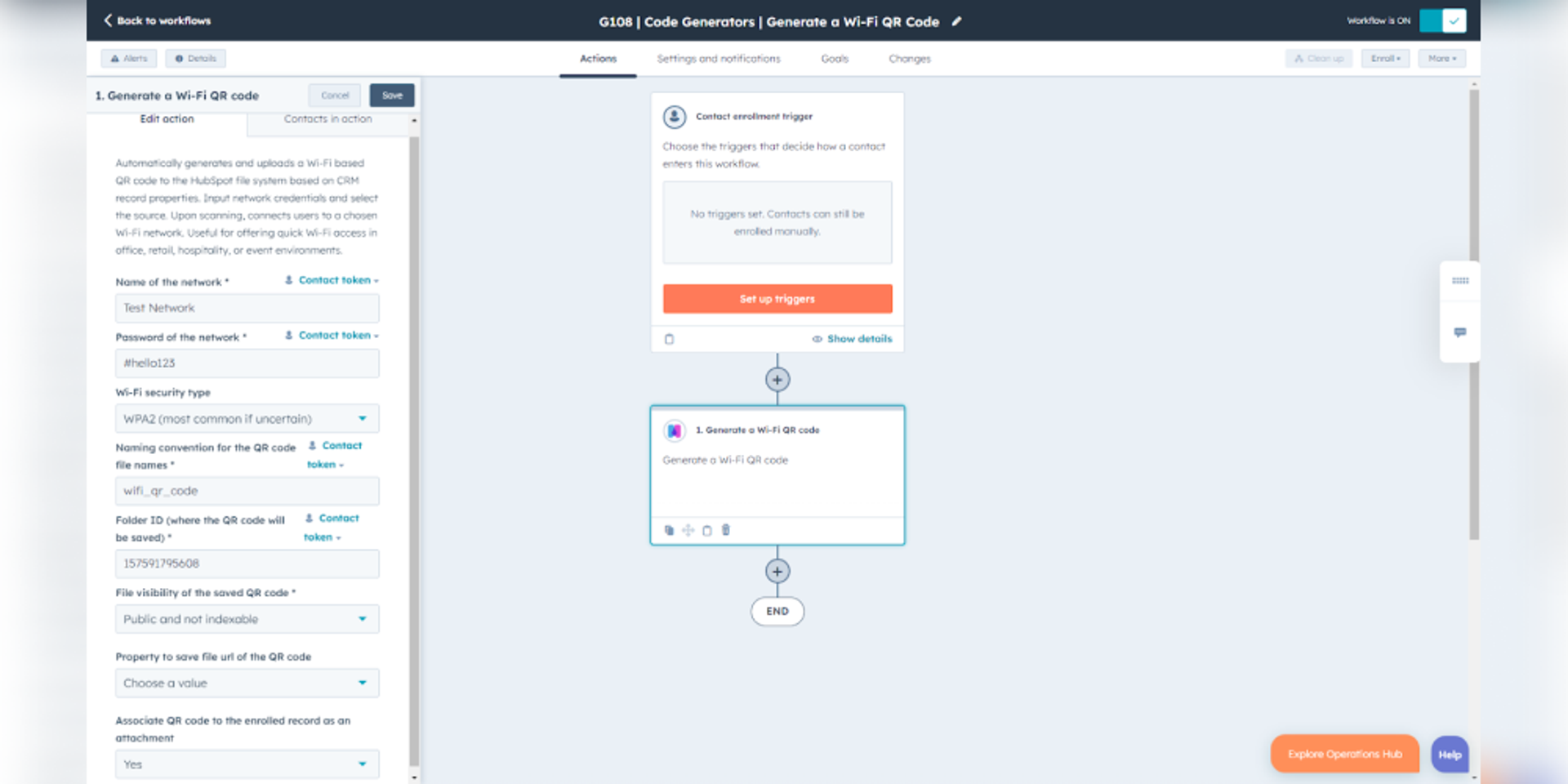
Caption: HubSpot’s Automated Workflow Actions
During or after conversations, AI voice agents can execute workflow actions directly inside HubSpot.
These include:
This creates a closed-loop automation system, where conversations and workflows continuously feed into each other.
For voice automation to be effective, conversations must feel natural and responsive.
Modern AI voice systems are designed to maintain:
This allows the AI to adapt to how users speak, rather than forcing users into rigid scripts.
The result is a human-like conversational experience, even at scale.
AI voice agents enable teams to activate HubSpot data at scale by turning static lists into live outreach campaigns.
Teams can:
This is particularly powerful for:
Advanced controls ensure enterprise readiness, including:
This transforms HubSpot lists into fully automated communication pipelines.
AI voice agents do more than log calls. They transform conversations into structured, actionable CRM data.
Every interaction is captured in detail:
This ensures complete visibility without requiring manual documentation.
AI systems can extract critical business signals from conversations and store them in HubSpot.
This includes:
All extracted data is mapped directly to HubSpot properties, enabling:
Manual data entry is one of the biggest sources of CRM inconsistency.
AI-driven automation:
This improves both data quality and downstream decision-making.
These capabilities position AI voice agents as a core operational layer, not just a communication tool.
AI voice agents extend beyond conversations into full workflow execution.
They can:
Instead of relying on manual follow-ups, every interaction leads to a clear, automated next step.
This transforms HubSpot into a closed-loop execution system, where conversations, data, and actions are fully connected.
AI voice agents escalate conversations when needed based on:
This ensures that high-value or sensitive interactions are handled by human agents.
When escalation occurs:
This eliminates the need for customers to repeat information.
Escalations can be triggered across multiple channels:
This ensures rapid response and accountability across teams.
AI voice agents provide deep visibility into performance and outcomes.
Key insights include:
Unlike traditional QA processes that rely on sampling, AI enables:
100% conversation monitoring and analysis
This allows teams to continuously optimise both performance and workflows.
Enterprise deployments require strong governance and security controls.
AI voice platforms typically support:
These capabilities are critical for industries such as:
Successful implementation requires aligning AI workflows with CRM structure.
Teams must define and map fields for:
This ensures that all insights are stored consistently within HubSpot.
Common implementation templates include:
Predefined templates help accelerate deployment while maintaining consistency.
A structured rollout approach improves adoption and performance.
This reduces risk while enabling continuous optimization.
| Feature | AI Voice Agent | HubSpot Dialer / IVR |
|---|---|---|
| Automation | Full workflow execution | Manual or limited |
| Personalization | CRM-driven dynamic | Agent-dependent |
| Scale | High concurrency | Limited by the team |
| Data capture | Automatic | Manual |
| Availability | 24/7 | Business hours |
AI voice agent pricing for HubSpot integrations typically follows a usage-based model, but the actual cost structure can vary significantly depending on platform capabilities and deployment complexity.
Common pricing components include:
Deployment models generally fall into two categories:
While per-minute pricing is often the most visible cost, it rarely reflects the full picture.
The most important factor is the total cost of ownership (TCO), which includes:
Platforms that reduce manual work, improve data accuracy, and accelerate deal movement often deliver significantly higher ROI, even if their base pricing appears higher.
Choosing the right AI voice agent requires evaluating operational fit, not just feature availability. Many platforms demonstrate strong capabilities in isolation but fall short when integrated into real HubSpot workflows.
The most critical requirement is true bi-directional CRM integration.
A viable solution must:
Basic integrations that only log calls or push limited data are not sufficient for enterprise use.
Voice quality and conversational accuracy directly impact customer experience.
Evaluation should include testing:
The goal is to ensure the system can handle real-world variability, not just ideal conditions.
HubSpot workflows can be complex, and the AI must be able to match that flexibility.
The platform should support:
Rigid systems limit HubSpot’s call automation potential and reduce long-term scalability.
For enterprise deployments, compliance is not optional.
The platform must support:
Enterprises choose CallBotics because it is designed for production-scale contact center execution, not just HubSpot conversational AI experimentation.
Many platforms perform well in controlled demos but struggle in environments where:
CallBotics is built specifically to operate in these conditions.
For broader context and comparisons, you can also explore:
These resources help evaluate how different platforms approach voice automation, CRM integration, and enterprise scalability.
HubSpot is a powerful system of record, but on its own, it does not execute workflows or drive real-time interactions.
AI voice agents bridge this gap by turning CRM data into action.
They enable teams to:
As AI adoption accelerates across HubSpot’s ecosystem, voice automation is moving from an optional capability to a core operational layer in modern CRM systems.
Organizations that adopt early gain a significant advantage in responsiveness, efficiency, and customer experience.

Urza Dey (She/They) is a content/copywriter who has been working in the industry for over 5 years now. They have strategized content for multiple brands in marketing, B2B SaaS, HealthTech, EdTech, and more. They like reading, metal music, watching horror films, and talking about magical occult practices.
See how enterprises automate calls, reduce handle time, and improve CX with CallBotics.
CallBotics is an enterprise-ready conversational AI platform, built on 18+ years of contact center leadership experience and designed to deliver structured resolution, stronger customer experience, and measurable performance.