Insurance claims remain one of the most voice-dependent workflows in the contact center. Even as digital channels mature, policyholders still rely on phone calls when something has gone wrong and clarity matters. They call to report incidents, confirm coverage, check claim status, understand payment timelines, and ensure nothing has been missed.
These calls are rarely complex on their own. The complexity comes from volume, timing, and expectation. Claims spike during weather events, accidents, and seasonal peaks. Customers expect immediate answers. Operations teams must maintain accuracy, compliance, and consistency across thousands of conversations every day.
In 2026, insurers are increasingly using AI voice agents for insurance claims to bring structure and predictability to this environment. Modern voice automation is no longer limited to routing or basic IVR. It now supports full claim conversations, from intake to follow-ups, while preserving clear escalation paths for cases that require human judgment.
This shift reflects a practical reality. Claims operations need systems that perform reliably under real contact center conditions, not ideal scenarios.
Claims operations are shaped by voice behavior, not just systems. Even insurers with mature digital portals see high call volumes because policyholders seek confirmation, reassurance, and explanation. A claim is not a single interaction. It is a sequence of touchpoints spread across days or weeks.
Several structural factors create strain in traditional claim handling.
Inbound calls cluster around the same moments. FNOL surges after incidents. Status calls increase when customers wait for updates. Document follow-ups create repeat contacts. Each interaction consumes agent time, even when the information being shared is straightforward.
Manual handling also introduces variability. Callers receive different explanations depending on timing, agent availability, and experience level. Missed calls lead to callbacks that further inflate volume. Supervisors face growing QA load without clear visibility into root causes.
Automation addresses these issues by standardizing how routine claim conversations are handled.
By consistently managing structured interactions, AI voice agents reduce unnecessary queues and stabilize performance. Claim teams regain time to focus on investigation, negotiation, and resolution. Customers receive timely information without waiting or repeating context across calls.
AI voice agents are automated systems that conduct natural phone conversations, understand intent, and complete predefined workflows using live business data. In insurance environments, they are trained specifically on claim processes, policy structures, and operational rules.
They differ fundamentally from traditional IVR systems.
IVRs rely on menu selection and fixed paths. AI voice agents allow callers to explain their reason for calling in their own words. The system identifies intent, verifies the caller, retrieves relevant data, and completes the interaction when possible.
Within claims operations, AI voice agents are commonly used for:
These conversations are completed using secure verification and direct system access, ensuring accuracy and compliance without manual intervention.
High-performing implementations map AI voice agents directly to the claim lifecycle rather than isolated tasks. This alignment is what allows automation to scale without breaking workflows.
When a policyholder calls to report an incident, the AI voice agent begins by confirming identity using approved verification steps. It then collects structured details such as incident type, date, and basic context. This information is captured consistently and written directly into connected claim systems.
This approach reduces intake delays and ensures claims enter the system with complete, standardized data.
Once a claim is open, policyholders frequently call to understand progress. AI voice agents retrieve live claim status, explain what stage the claim is in, and outline next steps. Clear explanations reduce uncertainty and prevent repeat calls.
By handling these updates automatically, claim teams avoid spending time on informational calls that do not advance resolution.
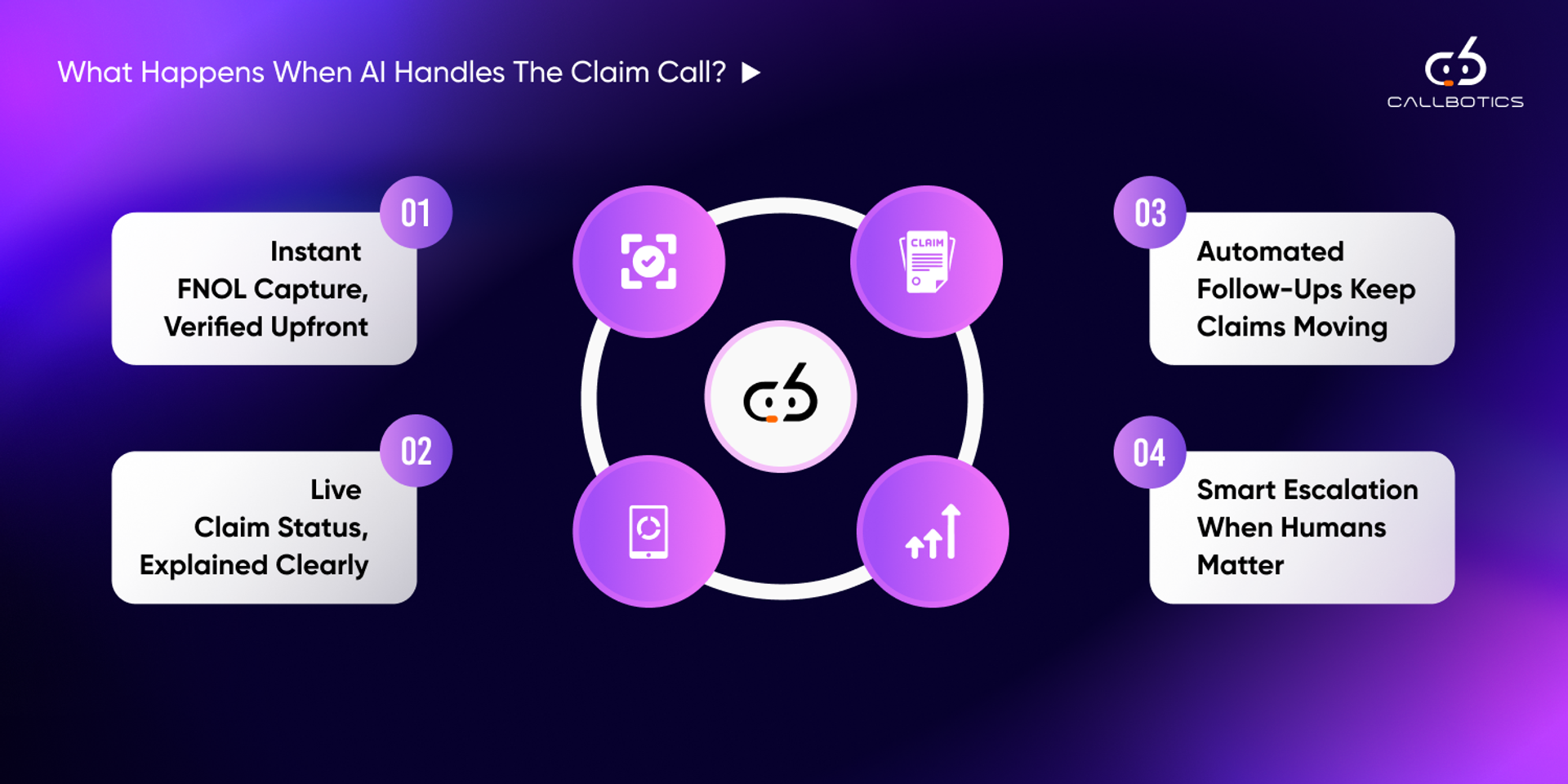
Claims often stall due to missing information. AI voice agents inform policyholders about required documents, confirm what has been received, and trigger follow-up workflows. This keeps claims moving without manual callbacks or email chains.
Not every claim can or should be handled end to end by automation. Disputes, complex coverage questions, and emotionally sensitive situations require human involvement. AI voice agents are designed to recognize these moments and escalate with full context preserved.
This balance allows automation to absorb volume while preserving human judgment where it matters most.
Across top-performing insurers, the same pattern appears. Most claim calls are predictable, structured, and repeatable. The operational risk comes from volume and timing, not complexity.
By using AI voice agents to manage these interactions consistently, insurers gain:
Automation becomes a capacity layer rather than a replacement for expertise.
See how CallBotics handles FNOL, claim status, and coverage inquiries across insurance workflows.
Claims-related calls follow predictable patterns. Policyholders usually want confirmation, clarity, or progress. The value of voice automation comes from handling these moments consistently, at scale, without adding friction to the experience.
Modern voice AI systems automate customer interactions by combining three core capabilities: intent understanding, secure data access, and workflow execution.
Every claim conversation begins with trust. Voice AI systems verify callers early using structured verification flows aligned with compliance requirements. Once verified, the system maintains context across the conversation, eliminating the need for repetition.
This step alone reduces call duration and prevents errors caused by partial information.
After verification, the system pulls live data from connected claim and policy platforms. This allows it to answer questions about claim status, coverage details, deductibles, and payment timelines accurately.
Because responses are based on real-time data, customers receive consistent information regardless of when they call.
Instead of generic updates, voice AI explains what stage the claim is in and what happens next. This guidance reduces uncertainty and prevents follow-up calls driven by confusion.
When additional action is required, such as submitting documents, the system communicates requirements clearly and can trigger follow-up workflows automatically.
| Aspect | Traditional Handling | Voice AI-Assisted Handling |
|---|---|---|
| Call availability | Limited by staffing and shifts | Always available, including after hours |
| Wait times | Increase during peaks | Near-zero due to concurrent handling |
| Claim status calls | Manual, repetitive | Automated with real-time data |
| Data consistency | Varies by agent | Standardized across every call |
| Follow-ups | Manual callbacks | Automated reminders and updates |
| Escalation | Often late or fragmented | Context-aware and immediate |
This comparison reflects why insurers see operational stability improve once structured claim conversations are automated.
Most voice automation tools are designed around ideal conditions. Claims operations rarely operate under ideal conditions. Call volumes fluctuate, customer intent shifts mid-conversation, and escalation must remain reliable.
CallBotics is designed for this reality.
Built from inside the contact center world, CallBotics applies operational nuance directly to how voice automation behaves during live claim conversations. The platform resolves structured interactions end to end instead of stopping at routing, which is critical for claims workflows that involve multiple steps.
CallBotics retrieves and communicates live claim data during the call, reducing repeat contacts and uncertainty.
Verification flows are built into conversations to protect sensitive information without adding friction.
The platform connects directly to existing systems, allowing teams to automate without replacing core infrastructure.
Claims operations often serve diverse policyholder bases. Voice agents adapt to language needs while maintaining consistency.
Every call becomes measurable. Supervisors gain insight into volume drivers, resolution paths, and escalation patterns without manual QA overload.
For customers, this approach means fewer transfers, shorter wait times, and clearer answers.
For operations teams, it means predictable performance, faster deployment, and lower complexity. Agents spend less time repeating information and more time resolving cases that require expertise.
CallBotics strengthens claims operations by removing friction from routine interactions while preserving human judgment where it adds the most value.
CallBotics is well suited for insurance providers that:
Deployment typically happens in about 48 hours, allowing teams to move quickly from documentation to live automation.
The impact of voice automation in claims is best understood through operational outcomes rather than feature lists. When structured conversations are handled consistently, several improvements appear quickly across contact center performance.
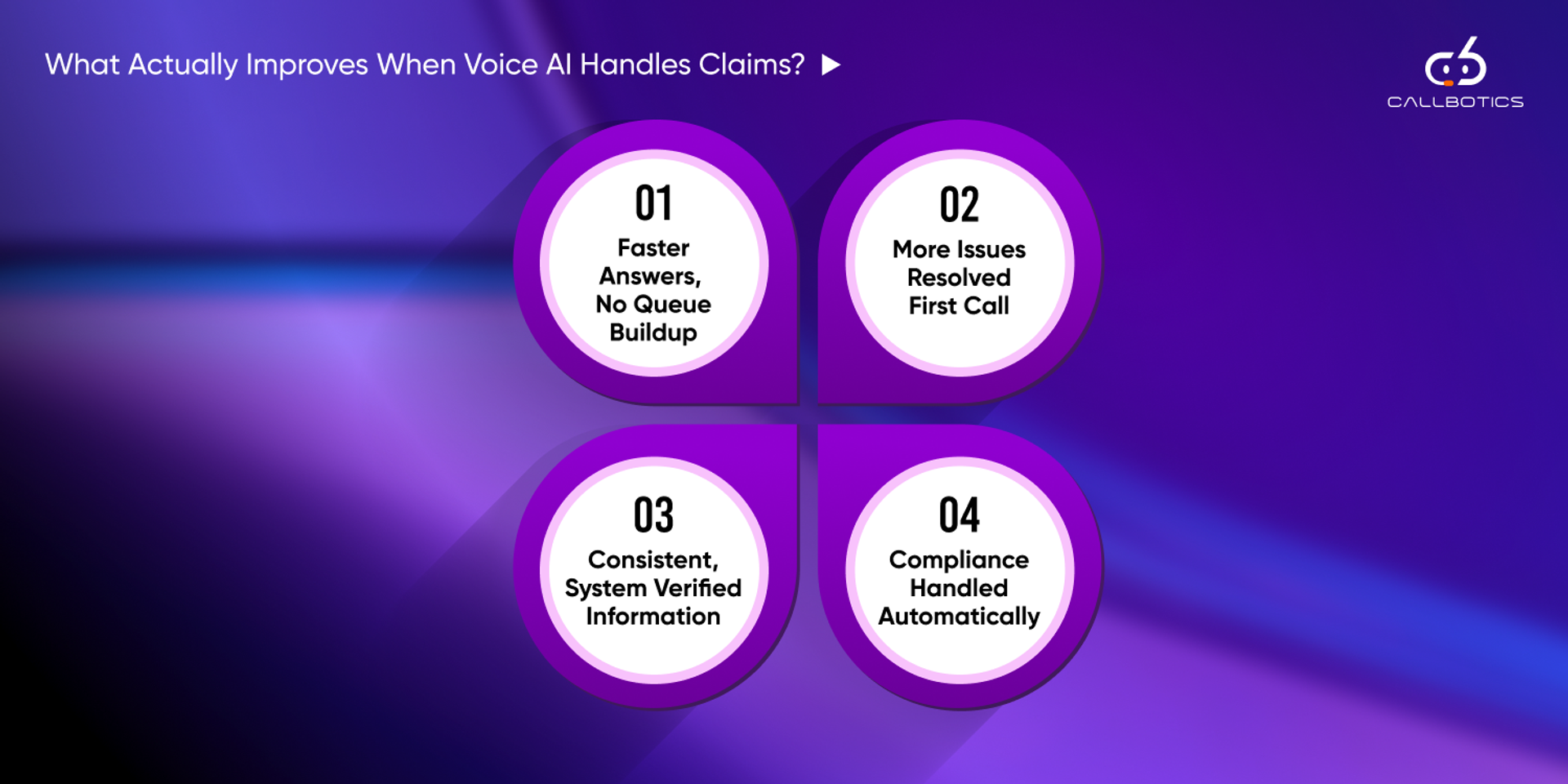
Because voice agents operate concurrently, inbound claim calls no longer stack into queues during peak periods. Customers receive immediate responses for routine inquiries, which reduces abandonment and repeat dialing.
Status checks, coverage explanations, and document confirmations are completed within a single interaction. This reduces unnecessary transfers and follow-ups while improving clarity for the policyholder.
Every call follows the same verified workflows. Claim data is pulled directly from connected systems, reducing the risk of outdated or inconsistent information being shared.
Verification, consent handling, call logging, and audit trails are built into every interaction. This simplifies compliance oversight and reduces the burden on QA teams.
Claims teams gain stability during surges without scrambling to adjust staffing. Automation absorbs volume while preserving clear escalation paths for complex cases.
Successful implementation depends on aligning automation with how claims teams already operate.
Insurers typically begin with FNOL intake, claim status updates, and follow-up calls. These interactions are structured, repeatable, and easy to measure.
Voice automation works best when integrated directly with claim management and CRM platforms. This allows real-time data access without duplicating systems or processes.
Operational SOPs, policy documents, and historical call data provide the foundation for accurate conversations. This ensures the AI reflects real workflows rather than generic scripts.
Teams often go live within days and expand coverage gradually. This approach builds confidence while maintaining operational control.
With CallBotics, this process is streamlined. The platform turns existing documentation into production-ready agents in about 48 hours, supported by white glove deployment and no-code controls for business teams.
Get a practical view on scaling voice operations during volume surges.
Voice automation continues to evolve beyond basic interaction handling.
Systems increasingly identify when customers are likely to call and deliver updates before frustration builds.
Real-time sentiment analysis allows conversations to adapt dynamically, escalating earlier when tone or urgency shifts.
Patterns across thousands of calls help teams identify bottlenecks, missing information, or policy confusion before they impact resolution timelines.
The future is not about removing humans from claims. It is about ensuring they are involved at the right moments, with full context and fewer distractions.
Claims operations succeed when communication is timely, accurate, and predictable. Voice automation provides the structure needed to handle routine interactions at scale while preserving human judgment for complex cases.
CallBotics was built for this reality. Designed around real contact center conditions, the platform resolves structured claim conversations end to end, deploys in about 48 hours, and delivers visibility through built-in analytics and quality monitoring.
For insurers, this means fewer queues, clearer resolution paths, and operational stability during peak demand.Book a demo with CallBotics and experience faster, more predictable claim handling.

See how enterprises automate calls, reduce handle time, and improve CX with CallBotics.
CallBotics is an enterprise-ready conversational AI platform, built on 18+ years of contact center leadership experience and designed to deliver structured resolution, stronger customer experience, and measurable performance.