Utility customer service is harder than many other service environments because demand is uneven, urgency is high, and the reasons people call can vary widely. A customer may be calling about a billing issue, a payment extension, a service request, an outage, or a usage question. During storms, outages, or peak billing cycles, call volumes can spike quickly, putting pressure on queues, service levels, and customer satisfaction simultaneously.
That is where AI voice agents are becoming more important. They help utilities answer requests faster, automate repetitive requests, route calls more accurately, and provide customers with useful support without forcing them to wait in long queues for every basic interaction. When deployed well, they improve both the customer experience and the operational efficiency that supports it.
This guide explains what AI voice agents do in utility customer service, where they create the most value, which use cases utilities should prioritize first, and how platforms like CallBotics can help utilities modernize customer support without making the experience feel impersonal.
What Is An AI Voice Agent In Utility Customer Service?
An AI voice agent in utility customer service is a conversational system that can answer customer calls, understand intent, respond in natural language, and either complete a task or route the caller appropriately. In simple terms, it acts as an intelligent phone-based service layer that handles a large share of routine customer requests without relying entirely on live agents.
In utility environments, this can include answering billing questions, taking outage reports, sharing account information, confirming service requests, capturing meter-related details, and passing along the right context when a human agent needs to step in. Unlike a basic IVR, which mainly pushes callers through menu trees, an AI voice agent can handle more natural interactions and move the call toward resolution more efficiently.
That difference matters because many utility calls are urgent, repetitive, or time-sensitive. The faster the system can understand the request and move toward the right outcome, the better the customer's experience.
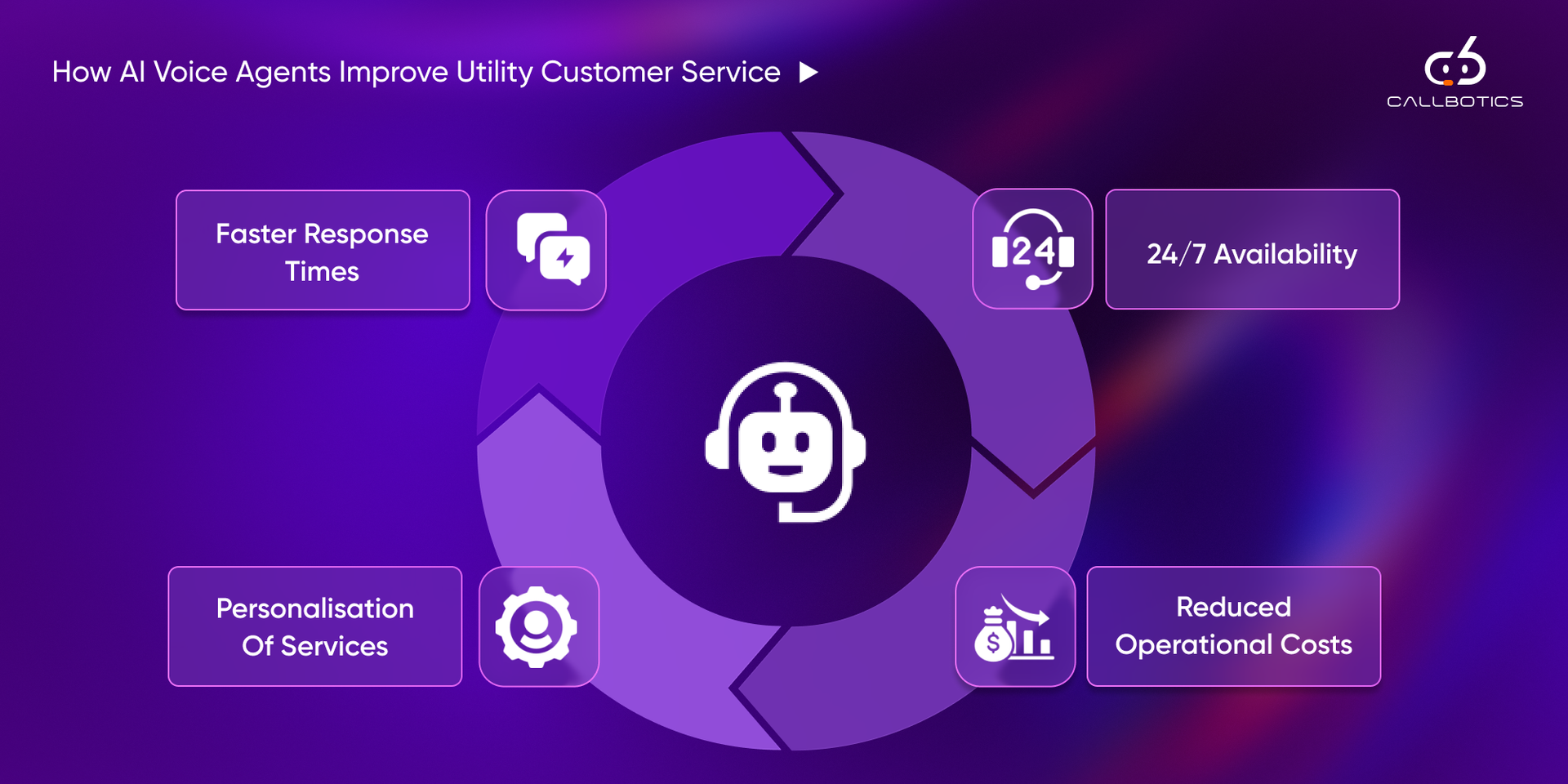
AI voice agents improve utility customer service by reducing the friction that customers usually feel first. That friction often starts with long waits, rigid menus, or difficulty getting simple answers quickly. For utilities, this matters even more because customers often call when something is already wrong or uncertain, such as a billing issue or service interruption.
AI voice agents can answer immediately and handle multiple calls simultaneously, reducing queue buildup and improving accessibility. This is especially useful during peak periods, when utilities may receive a surge of similar questions all at once.
Instead of waiting for a human just to ask about a bill, report an outage, or confirm a request, customers can start the interaction right away. That makes the overall support experience feel more responsive and lowers frustration at the first point of contact.
Utility issues do not happen only during business hours. Customers may need help at night, early in the morning, or during weekends and holidays. AI voice agents make it easier to provide continuous support without matching every coverage need with live staffing.
This is especially useful for outage reporting, payment-related questions, account access, service requests, and status updates. Even when the AI does not fully resolve the issue, it can still capture details and prepare the next step more effectively than a missed call or voicemail-only flow.
AI voice agents can personalize interactions using account context, prior history, service status, and customer details already stored in connected systems. That makes the interaction feel more relevant and reduces the need for customers to repeat basic information at the beginning of every call.
For utilities, personalization can improve everything from payment reminders and account support to usage-related questions and service updates. The result is not just faster support, but support that feels more aware of the customer’s situation.
A large share of utility customer service demand is repetitive. Billing explanations, payment confirmations, outage status, account changes, and common service requests all consume a lot of agent time, even though many follow predictable patterns.
AI voice agents reduce the amount of human handling required for these calls. That helps utilities lower cost per interaction, reduce queue pressure, and allow human teams to focus on the more complex or sensitive conversations that actually require live support.
Explore CallBotics to see how utility teams can automate repetitive service calls, reduce queue pressure, and improve customer support with enterprise-ready AI voice automation.The best utility use cases for AI voice agents are the ones that combine high volume, clear structure, and measurable outcomes. These are the workflows where customers need quick, accurate help and where AI can create immediate value without adding confusion to the experience.
Billing is one of the most common reasons customers call a utility. They may want to understand a charge, confirm a payment, ask about due dates, or explore payment options. AI voice agents can handle a large share of these interactions by answering routine billing questions and helping move customers to the right next step.
They can also support payment-related workflows, provided the system adheres to appropriate security and compliance controls. This reduces repetitive pressure on live agents and shortens the path to resolution for customers.
Outages create some of the highest call spikes in utility environments. Customers want to report a service issue, confirm whether the outage is known, and get some sense of when service may return. These are exactly the kinds of high-volume, structured interactions where AI voice agents are especially useful.
They can capture outage details, provide available status information, and reduce the strain that sudden spikes place on utility contact centers. This helps maintain service accessibility when human teams would otherwise be overwhelmed.
Customers also call about address changes, service transfers, start or stop requests, account updates, and related administrative tasks. Many of these workflows are structured enough for AI to manage either fully or partially.
That allows the utility to process routine service requests more efficiently while giving human teams more time for exceptions, escalations, and edge cases that need deeper review.
Utilities increasingly want to support customers not just reactively, but also proactively. AI voice agents can help by providing simple, personalized energy-saving suggestions based on account context, seasonal trends, or known usage patterns.
This is not the first workflow most utilities should automate, but it can become a useful value-added service once the more operational use cases are stable.
The benefits of AI voice agents go beyond call automation. For utilities, the value shows up across customer experience, cost control, service consistency, and scalability during unpredictable events. This is why AI voice is becoming more than a digital add-on. It is increasingly part of the service infrastructure itself.
Customers generally want utility support to be easy, fast, and clear. AI voice agents help reduce wait times, provide faster answers, and keep the interaction moving without unnecessary steps.
That improves the experience even when the request is simple. Customers do not need a “premium” support experience every time. They need one that feels efficient and easy to navigate.
AI voice agents streamline repetitive processes and reduce the number of simple calls that need live handling. This improves team efficiency by allowing agents to spend more time on high-value interactions rather than repeatedly answering routine questions.
The result is not just labor savings. It is a better use of human capacity.
Utilities need to absorb sudden surges in demand, especially during outages, billing periods, service disruptions, and seasonal events. AI voice agents help utilities scale support more gracefully by handling many interactions simultaneously without waiting for staffing to catch up.
This is one of the strongest practical advantages of AI voice in the utility space.
A live team naturally varies in how it phrases answers, applies rules, and handles certain requests. AI voice agents improve consistency by following the same approved workflows and response logic every time.
For utilities, this consistency is especially important because customer trust is affected not only by speed, but also by clarity and reliability.
See how CallBotics helps utilities improve support with faster answering, better routing, and cleaner handoffs across high-volume service workflows.
The benefits are real, but successful implementation still depends on good workflow design, strong escalation paths, and reliable integration with utility systems. Utilities should approach deployment as an operational program, not just a technology purchase.
Not every utility interaction is simple. Customers may call about disputes, hardship programs, service interruptions with unusual circumstances, emotionally charged outages, or account issues that require judgment. These are areas where AI should support the workflow carefully and escalate early when needed.
The goal is not to force AI into every interaction. It is to automate what can be automated well and hand off the rest cleanly.
Utilities handle sensitive customer data, so privacy and security must be built into the design from the start. Account details, payment information, addresses, and service records all need controlled handling.
That requires proper access controls, secure integrations, controlled recordings, and clear rules about what the system can store, say, or expose during a call.
Utility workflows are often industry-specific. Billing logic, outage terminology, service rules, and account processes must all be accurately reflected in the AI experience. A generic setup is not enough.
That is why training, customization, and ongoing review matter. The more grounded the AI is in actual utility workflows, the better it performs in live operations.
Utilities get the best results when an AI voice is introduced in a structured way. The goal is not just to turn on automation. It is to ensure the system improves the customer journey without introducing new friction or operational risk.
Customers should be able to reach a human without feeling trapped. This is especially important for complex, sensitive, or high-stakes calls. A strong handoff path preserves trust and makes the overall support experience feel safer.
Utility customer service changes over time. Policies change, billing processes change, outage patterns shift, and seasonal behavior affects call demand. AI voice systems need regular review to stay accurate and useful.
Monitoring should focus on where calls fail, where customers escalate, and which workflows create repeat contacts or confusion.
Every AI-handled call can generate useful data. Utilities should use that data to improve scripts, refine routing, fix workflow gaps, and identify where customers still experience friction.
That is where long-term value builds. The more the system learns from real interactions, the stronger its service operations become.
CallBotics helps utilities modernize customer support by combining enterprise voice automation with real workflow execution. Developed by teams with over 18 years of contact center and BPO experience, the platform is built around the realities that matter most in utility service environments: queue pressure, outage-driven spikes, repetitive customer demand, routing quality, and the need for clear operational visibility.
What makes CallBotics different:
This makes CallBotics a strong fit for utilities looking to improve the customer experience, reduce service friction, and manage support demand more efficiently without compromising control.
AI voice agents are transforming utility customer service by making support faster, more accessible, and easier to scale. They help utilities reduce wait times, automate routine requests, improve routing, and maintain more consistent service during both normal operations and high-volume events.
The best results come when utilities focus on the right workflows first and treat AI as part of the service model, not just a front-end experiment. When deployed effectively, AI voice agents improve customer satisfaction, reduce operational strain, and help utilities deliver a more reliable support experience.

Urza Dey (She/They) is a content/copywriter who has been working in the industry for over 5 years now. They have strategized content for multiple brands in marketing, B2B SaaS, HealthTech, EdTech, and more. They like reading, metal music, watching horror films, and talking about magical occult practices.
See how enterprises automate calls, reduce handle time, and improve CX with CallBotics.
CallBotics is an enterprise-ready conversational AI platform, built on 18+ years of contact center leadership experience and designed to deliver structured resolution, stronger customer experience, and measurable performance.