BPOs are under pressure from every direction in 2026. Labor costs are rising, customer expectations are increasing, interaction volumes are becoming less predictable, and clients want more measurable outcomes without paying for linear headcount expansion. The traditional delivery model, which depends on adding people every time demand grows, is becoming harder to sustain.
This is why conversational AI is moving from pilot projects into core operating strategy. For BPOs, it is no longer just a layer for call deflection or a front-end experiment. It is becoming part of the service model itself. Voice and chat AI now sit inside real workflows, handle repetitive interactions, support agents during live calls, and help BPOs deliver more output without scaling labor in the same way.
That shift matters because conversational AI changes more than response speed. It changes cost structure, workforce design, scalability, QA coverage, and the ability to deliver consistent service across clients and channels. This guide breaks down the core conversational AI benefits for BPOs in 2026 and explains why more providers are moving toward AI-first operating models.
Before looking at the benefits, it helps to define what conversational AI means in a BPO environment. The term is often used broadly, but in practice, it refers to voice and chat systems that can understand natural language, respond conversationally, and complete work inside business workflows. That usually includes AI voice agents, chat agents, AI-assisted routing, agent assist tools, and workflow-connected automation across contact center operations.
In the BPO context, conversational AI matters because it goes beyond front-end interaction. It is not just about greeting a customer or routing them to the right queue. It is about helping the business resolve requests end-to-end by connecting the conversation to CRM systems, ticketing tools, scheduling platforms, billing systems, and other operational layers.
Traditional IVR systems are routing-focused. They guide callers through menus and try to direct traffic efficiently. Conversational AI is resolution-focused. It allows customers to speak naturally, captures what they actually need, and then either completes the task or transfers the interaction with the right context already attached. That is a significant shift because it moves AI from a gatekeeper role to an execution layer.

BPO adoption of conversational AI is not being driven by novelty. It is being driven by economic and operational pressure. Providers are expected to deliver faster service, better customer experience, tighter compliance, and stronger cost efficiency, all while handling more channels and more variable demand. That combination makes traditional labor-only scaling harder to defend.
The biggest drivers behind this shift include:
This is the main value section because the benefits of conversational AI for BPOs are not confined to one part of the operation. They show up across economics, scale, service quality, workforce productivity, and performance visibility. The strongest value comes when conversational AI is not treated as a standalone tool, but as part of how service delivery is designed.
One of the clearest benefits is cost reduction through automation of repetitive interactions. Billing questions, appointment confirmations, status checks, FAQs, intake workflows, and similar call types consume a large share of contact center capacity, even though many follow predictable patterns.
Conversational AI reduces the amount of human handling required for these interactions. That lowers cost per resolution, reduces pressure to expand frontline teams for repetitive demand, and creates a more efficient service model. For BPOs, this can improve margin structure while also helping clients see clearer value from automation.
Just as importantly, automation makes costs easier to understand. Instead of addressing every volume increase with additional staffing, BPOs can absorb part of that demand through AI, creating more predictable operating economics over time.
Explore CallBotics to see how BPOs can automate around 80% of calls and reduce per-call cost by 65 to 90% with enterprise-grade AI voice automation.BPOs often support clients across multiple geographies, languages, and service hours. Maintaining round-the-clock coverage entirely through staffing creates cost pressure, operational complexity, and quality variability. Conversational AI helps by providing always-on support without requiring a matching expansion in overnight or off-hours headcount.
This is especially useful for after-hours intake, basic support, appointment requests, order status, account questions, and other structured interactions that customers expect to handle immediately. Even when the AI does not fully resolve every request, it can still collect details, apply urgency logic, and create a cleaner follow-up path.
For BPOs serving global clients, this makes availability more scalable and less dependent on region-specific staffing coverage.
Peak periods are one of the hardest parts of BPO delivery. Client campaigns, billing cycles, open enrollment, outages, order surges, and seasonal demand can create large spikes in interaction volume with very little notice. Traditional models respond with overtime, temporary staffing, or service-level deterioration.
Conversational AI changes that equation by absorbing part of the volume without the same delay in workforce ramp. It can handle high-concurrency demand more consistently, which helps BPOs maintain performance during surges instead of letting queues expand uncontrollably.
This is one of the most practical benefits for BPOs because it reduces the operational fragility that comes with high-volume volatility.
Customers do not evaluate service based on whether a response came from a human or an AI system. They evaluate whether the interaction was fast, useful, and easy. Conversational AI improves customer experience when it reduces wait time, lowers transfer friction, shortens the path to resolution, and provides more consistent responses.
In many BPO environments, this starts with better intake and better routing. Instead of forcing customers through menus or long queue waits, AI can capture intent immediately and move the interaction toward the right workflow faster. For repetitive requests, it can also resolve the issue directly, which improves resolution speed without adding queue pressure.
A major advantage of conversational AI is that it can use CRM data, historical interactions, account context, and workflow rules to tailor the interaction more effectively. That allows BPOs to deliver more personalized service without requiring every agent to manually reconstruct customer history on every call.
This matters because personalization at scale is hard to achieve in labor-heavy environments alone. AI can dynamically adjust responses based on customer status, prior interactions, or service history, which improves relevance and often customer satisfaction as well.
Human-led delivery always includes some variability. Different agents interpret scripts differently, apply process rules with varying levels of precision, and perform differently under pressure. Conversational AI helps reduce that variability by following standardized logic and approved workflows more consistently.
That has a direct effect on SLA adherence. When common workflows are handled in a more repeatable way, response times become easier to stabilize, transfer rates become easier to control, and the operation becomes less exposed to performance swings caused by inconsistency.
For BPOs, consistency is not just a CX issue. It is a client confidence issue. The ability to deliver standard behavior across volume and across teams is a major operational advantage.
Many BPOs still rely heavily on sample-based QA, which means only a small fraction of interactions are reviewed in depth. Conversational AI changes that because every interaction can be transcribed, tagged, analyzed, and scored.
This creates broader operational visibility. Teams can monitor intent trends, sentiment patterns, transfer behavior, compliance adherence, and workflow breakdowns across the full interaction set instead of just a sample. That makes QA more scalable, more actionable, and more useful for both coaching and continuous improvement.
It also gives BPO leaders a stronger way to demonstrate performance value to clients. Full QA coverage and real-time analytics create a clearer operational narrative than a sampled review alone.
Explore how CallBotics helps BPOs reduce interaction cost, improve QA visibility, and scale voice automation across high-volume service workflows.Conversational AI not only changes the customer-facing side of BPO delivery. It also changes how human teams work. This matters because some of the most important benefits appear in workforce productivity, onboarding speed, workload quality, and role evolution, rather than in automation alone.
When AI handles repetitive contacts, human agents can focus more of their time on interactions that require judgment, empathy, escalation handling, or higher-value resolution. That improves workforce efficiency because skilled labor is being used where it matters most.
The effect is not just fewer calls. It is a better allocation of human attention across the queue.
Conversational AI can also shorten training cycles, especially when paired with agent assist, knowledge surfacing, summaries, and workflow guidance. New agents do not need to memorize every process in the same way if the system can support them with more structured context during the call.
This helps BPOs ramp new hires faster while reducing the stress that often comes with early tenure.
After-call work is one of the least visible but most important drains on productivity. Summaries, structured notes, auto-logging, and workflow-connected data entry reduce the amount of manual wrap-up required after each interaction.
This increases active handling capacity and helps agents spend more time resolving issues and less time documenting them.
As conversational AI adoption grows, BPO workforces also begin to change. The model shifts away from relying so heavily on large pools of entry-level repetition handling and toward more specialized roles. AI trainers, conversation analysts, workflow designers, QA specialists, and escalation-focused agents become more important.
That evolution changes not only staffing patterns but also how BPOs think about capability development and career design.
From a business perspective, conversational AI improves more than service quality. It changes the economics of delivery. Lower cost per interaction, better resource utilization, stronger forecasting, and faster ROI all become more attainable when automation is tied to structured workflows.
This matters because many BPOs are moving from pure cost-center delivery models toward more performance-led service models. Conversational AI supports that shift by making service outcomes more measurable and more repeatable. Instead of billing only for labor presence, providers can begin aligning more closely with performance, throughput, and resolution economics.
That creates a more strategic value proposition. The BPO is no longer just selling capacity. It is selling a more scalable operating model.
The best conversational AI use cases in BPOs are not random. They are typically high-volume, structured, and tied to clear business outcomes. These are the workflows where automation improves both service delivery and operating efficiency most quickly.
Common examples include:
The key point is that value comes from end-to-end task completion, not just from conversation. A BPO benefits more when the AI can actually complete a step in the workflow rather than just answering and routing.
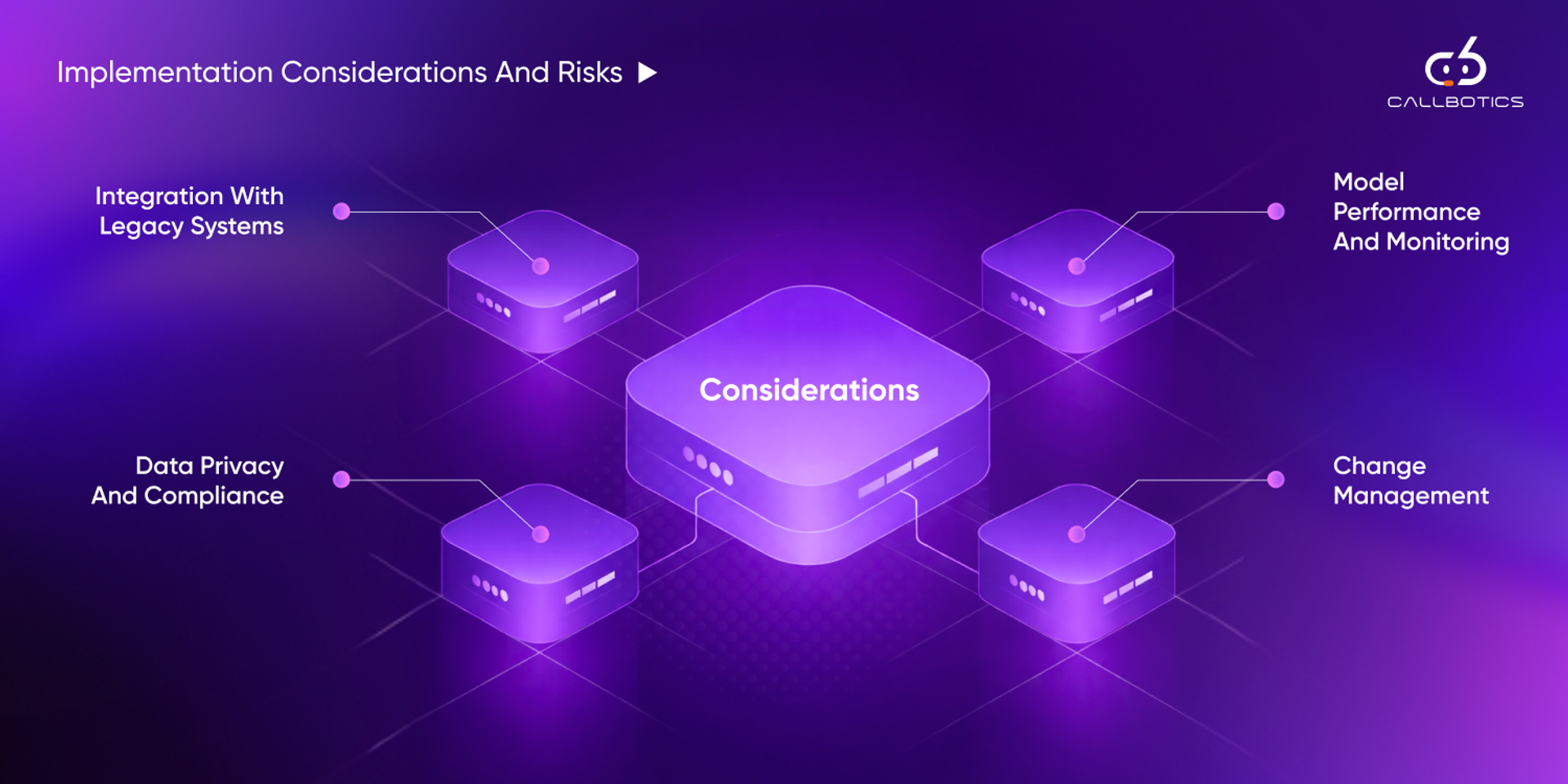
The benefits are strong, but successful adoption still depends on disciplined implementation. Conversational AI creates value fastest when it is introduced into the right workflows with the right controls and expectations.
Many BPO environments still depend on a mix of legacy telephony, CRM, ticketing, and client-specific systems. That means integration design matters early. In some cases, API-first deployment works well. In others, middleware or phased orchestration is the better path.
The key is to plan around the system reality, not around an idealized architecture.
BPOs often operate inside strict compliance requirements such as GDPR, HIPAA, or client-specific governance rules. That means data handling, access controls, retention policies, encryption, and auditability all need to be part of the implementation plan from the start.
Conversational AI performance changes over time. Language patterns shift, workflows change, policies evolve, and client requirements move. Without regular monitoring, drift can reduce quality quietly. That is why governance and ongoing review matter just as much as initial deployment.
Workforce resistance is another important factor. Teams may worry that AI changes role value or removes control. The strongest deployments position AI clearly as workload redesign and support, not just replacement. That requires thoughtful process communication and leadership alignment.
The most effective BPO model is not human-only or AI-only. It is hybrid. AI handles structured volume, repetitive demand, and early intake, while human teams handle complexity, empathy, exceptions, and nuanced decision-making.
This hybrid model produces better outcomes because it plays to the strengths of both. AI improves speed, consistency, and scale. Humans improve judgment, reassurance, and complex resolution. Intelligent escalation based on sentiment, intent, and workflow boundaries is what connects the two.
That combination is increasingly becoming the standard operating model for modern BPOs.
The direction of travel is clear. Conversational AI in BPO is moving toward more capable, more unified, and more workflow-aware systems. Several trends are shaping that shift.
Agentic AI will increasingly handle multi-step workflows instead of just single-turn responses. Proactive engagement will grow, especially for reminders, renewals, and follow-up communication. Voice-first interfaces will become more common because they align naturally with large-volume support operations. And fragmented tool stacks will continue to consolidate into more unified platforms that combine voice, analytics, QA, routing, and workflow execution.
The broader trend is that conversational AI is moving closer to core service infrastructure.
The long-term shift is bigger than tool adoption. BPOs are moving from headcount-based delivery models toward more outcome-oriented service models, and conversational AI is a major part of that transition.
That shift includes per-resolution economics, stronger performance visibility, better forecasting, and more direct links between service design and business outcomes. AI becomes part of the infrastructure that supports that model. It helps standardize performance, absorb variable demand, and give providers more control over both cost and service quality.
This is why AI-first is becoming a structural direction rather than an optional innovation layer.
CallBotics fits into this shift as a voice-first platform built for enterprise BPO environments. It is designed for workflows where call volume, queue pressure, handoff quality, and performance visibility matter, and where AI needs to do more than just route.
It supports the full workflow, not just front-end answering. It also brings together analytics, QA visibility, routing intelligence, and deployment readiness in a way that aligns with how BPO operations actually run.
Where CallBotics stands out:
Conversational AI is changing the economics and operating model of BPO delivery. Its value extends beyond cost reduction into scalability, customer experience, consistency, QA coverage, and workforce design. That is why adoption is moving beyond experimentation and into core service infrastructure.
For BPOs, the most important takeaway is that conversational AI works best when it is tied to real workflows, real outcomes, and a clear operating model. When that happens, it becomes more than a support technology. It becomes a structural advantage in how service is delivered.

Urza Dey (She/They) is a content/copywriter who has been working in the industry for over 5 years now. They have strategized content for multiple brands in marketing, B2B SaaS, HealthTech, EdTech, and more. They like reading, metal music, watching horror films, and talking about magical occult practices.
See how enterprises automate calls, reduce handle time, and improve CX with CallBotics.
CallBotics is an enterprise-ready conversational AI platform, built on 18+ years of contact center leadership experience and designed to deliver structured resolution, stronger customer experience, and measurable performance.