Customer support teams today operate under constant pressure. Call volumes fluctuate without warning. Customer intent shifts mid-conversation. Agents are expected to move faster while maintaining accuracy, empathy, and compliance. In this environment, efficiency alone is not enough. Teams need support that works in real time, inside live conversations, without adding complexity.
AI Agent Assist has emerged as a practical response to these realities. It helps agents handle conversations with greater confidence, speed, and consistency by providing assistance while the interaction is happening. Support teams rely on it because it improves performance without removing human judgment from the process.
When implemented correctly, AI Agent Assist strengthens how teams operate rather than forcing them to change how they work.
AI Agent Assist is a category of technology designed to support human agents during live customer interactions. It operates alongside the agent, providing real-time guidance, information, and workflow support while the conversation is in progress.
Unlike traditional automation tools that operate before or after an interaction, AI Agent Assist focuses on the moment that matters most. It helps agents listen, respond, and resolve issues without breaking focus or switching systems.
In modern contact center ecosystems, AI Agent Assist plays a central role in AI-assisted customer support by improving decision-making and execution without replacing the agent.
AI Agent Assist functions as a real-time support layer embedded into the agent workflow.
During a live call or conversation, the system:
These real-time AI support tools reduce cognitive load on agents. Instead of searching across systems or relying on memory, agents receive timely support that keeps the interaction moving forward.
The result is smoother conversations, faster resolutions, and fewer errors, achieved without disrupting how teams already work.
Support teams adopt AI Agent Assist to address persistent operational challenges that traditional tools struggle to solve.
Common challenges include:
AI Agent Assist addresses these issues directly by supporting agents at the moment. It improves execution without requiring teams to redesign their workflows or sacrifice control.
This practical alignment with real support conditions explains why AI agent assist benefits, resonate strongly with operations leaders focused on stability, scale, and quality.
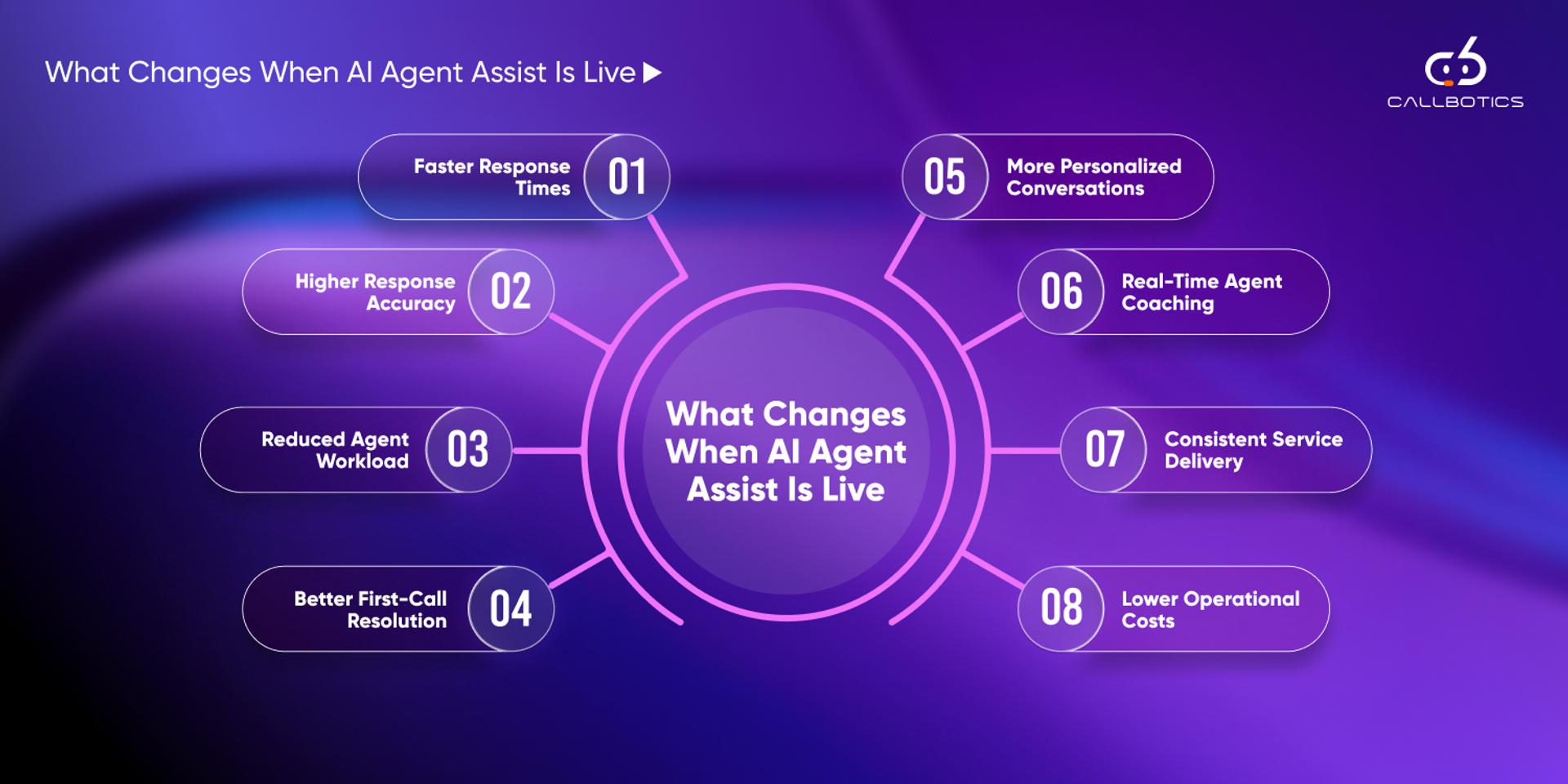
The value of AI Agent Assist becomes clear when viewed through the lens of day-to-day support operations. The following benefits reflect how teams experience measurable improvement once real-time assistance is embedded into live workflows.
Speed matters in customer support, but speed without accuracy creates risk.
AI Agent Assist improves response times by eliminating delays caused by searching, switching tools, or confirming next steps. Relevant information surfaced during the conversation, allowing agents to respond with confidence and momentum.
This capability directly supports productivity enhancement by allowing agents to handle more interactions without increasing stress or compromising quality.
Accuracy in support conversations depends on timely access to correct information.
AI Agent Assist provides agents with workflow-aligned guidance and approved knowledge during live interactions. This reduces reliance on memory and minimizes mistakes caused by outdated or incomplete information.
By improving accuracy at the moment of response, teams reduce rework, escalations, and compliance risk while maintaining consistent service quality.
Much of an agent’s workload comes from tasks that add friction rather than value.
AI Agent Assist automates repetitive actions such as data capture, categorization, and post-call updates. It also reduces the mental effort required to track complex processes during conversations.
This reduction in cognitive load allows agents to focus on listening, problem-solving, and customer engagement. Over time, this leads to healthier teams and more sustainable performance.
First-contact resolution depends on having the right information available at the right time.
AI Agent Assist improves resolution rates by guiding agents through structured workflows while adapting to customer responses in real time. Agents are less likely to miss steps, overlook context, or provide incomplete answers.
Higher first-contact resolution benefits both customers and teams by reducing repeat calls and improving overall efficiency.
Personalization in support is driven by context, not scripts.
AI Agent Assist helps agents tailor responses by incorporating customer history, intent signals, and sentiment insights into live guidance. This allows agents to respond appropriately without slowing down the conversation.
The result is more relevant and respectful interactions that feel informed rather than generic.
Traditional coaching happens after the interaction. AI Agent Assist enables coaching during the interaction.
New and experienced agents alike receive real-time prompts that reinforce best practices, tone, and process adherence. This shortens ramp time for new hires and supports continuous improvement across the team.
Real-time coaching strengthens consistency while preserving the agent’s ability to apply judgment when needed.
Consistency is difficult to maintain across large teams and distributed shifts.
AI Agent Assist standardizes how workflows are executed by guiding agents through approved paths during live interactions. This ensures that customers receive reliable service regardless of who handles the conversation.
Consistency improves trust, reduces variation in outcomes, and simplifies quality management.
Operational efficiency improves when teams resolve more issues in fewer interactions.
AI Agent Assist reduces handle time, lowers repeat contacts, and supports higher resolution without adding headcount. Over time, this translates into meaningful cost control while maintaining service standards.
These savings come from better execution rather than reduced human involvement.
Many support teams still rely on manual processes, static knowledge bases, and post-call quality reviews to manage performance. While these methods worked in lower-volume environments, they struggle under modern contact center conditions.
Without AI Agent Assist, teams experience friction at every stage of the interaction. These challenges directly impact resolution, cost, and agent confidence.
When agents must search across multiple systems during a live conversation, response speed suffers. Even experienced agents lose momentum when information is scattered or outdated.
The result is longer handle times, awkward pauses, and inconsistent answers across agents. Customers feel the delay, and agents feel the pressure.
This is where real-time AI support tools make a measurable difference by keeping responses aligned and timely during the interaction itself.
Support agents spend a significant portion of their day on tasks that add little value to the customer conversation. Manual documentation, repetitive verification steps, and constant context switching increase fatigue.
Over time, this workload leads to burnout, higher attrition, and rising training costs. Without assistance during live calls, even skilled agents struggle to sustain performance at scale.
AI Agent Assist reduces this burden by automating background work and guiding agents through conversations without removing control.
Call volumes rarely arrive evenly. Spikes during peak hours, seasonal events, or unexpected disruptions put immediate strain on support teams.
Without AI assistance, scaling requires adding staff or extending wait times. Neither option is sustainable.
AI Agent Assist allows teams to absorb volume more predictably by improving efficiency per agent. This is a core reason organizations invest in AI agents rather than relying on staffing increases alone.
Traditional quality monitoring happens after the interaction. By the time issues are identified, the customer experience has already suffered.
Without real-time insight into sentiment shifts, agents may miss early signals of frustration or confusion. Escalations occur too late, and opportunities to recover the interaction are lost.
AI Agent Assist brings sentiment awareness into the live conversation, allowing agents to adjust tone and approach while it still matters.
Manual workflows introduce friction at every step. Agents must remember process details, document outcomes, and follow up after the call.
These steps increase handle time and create room for error. They also slow down resolution, leading to repeat contacts and lower satisfaction.
AI Agent Assist streamlines these processes during the interaction, allowing agents to focus on resolution instead of administration.
The table below highlights how support operations change when AI Agent Assist is embedded into live workflows.
| Operational Area | Without AI Agent Assist | With AI Agent Assist |
|---|---|---|
| Response Speed | Dependent on agent memory and manual search | Guided in real time with relevant suggestions |
| Accuracy | Varies by agent experience | Consistent and aligned to approved workflows |
| Agent Workload | High cognitive load and manual effort | Reduced effort through automation and guidance |
| First-Contact Resolution | Lower due to missed context or steps | Higher due to structured, real-time support |
| Onboarding Time | Long ramp periods for new agents | Faster ramp with in-the-moment coaching |
| Sentiment Awareness | Post-call analysis only | Live sentiment visibility during interactions |
| Scalability | Requires additional staffing | Scales through efficiency improvements |
| Cost Control | Driven by headcount changes | Driven by operational efficiency |
This contrast explains why the benefits of AI agent assist extend beyond incremental gains. The technology reshapes how teams handle volume, quality, and consistency without introducing operational complexity.
Support leaders are under pressure to improve resolution and customer experience while controlling cost per interaction. Traditional approaches rely on adding people or tightening scripts. Neither approach addresses the root problem.
AI Agent Assist supports agents where it matters most, during the conversation. It strengthens execution without forcing teams into rigid automation or lengthy transformation projects.
This is why AI-assisted customer support has moved from experimentation to expectation in call-heavy environments.
Many platforms discuss AI Agent Assist as a feature. CallBotics treats it as an operational capability that must work under real contact center conditions.
CallBotics was designed for environments where call volume is high, customer intent changes mid-conversation, and escalation to human agents must remain reliable. It assumes real-world complexity from day one rather than ideal scenarios.
This approach aligns directly with the practical benefits of AI agent assist described earlier.
CallBotics is built by operators who have run large, call-heavy contact centers. That operational depth shows up in how AI Agent Assist behaves during live conversations.
Instead of stopping at routing or surface-level automation, CallBotics supports structured conversations end to end. Agents and AI work together across long, multi-step calls without breaking flow or degrading quality.
This design strengthens AI-assisted customer support by improving execution rather than adding layers of tooling.
CallBotics uses real-time sentiment analysis to guide tone, pacing, and escalation paths while the conversation is happening.
Agents receive support that adjusts as customer emotion and intent shift. This is where real-time AI support tools move from theory to impact. The system responds to what is unfolding in the call, not what was predicted beforehand.
For teams, this means fewer transfers, fewer missed signals, and more controlled outcomes.
One of the most common barriers to adopting AI Agent Assist is time to value.
CallBotics is production ready in about 48 hours. It ingests SOPs, training documents, and call recordings without requiring heavy formatting or engineering dependency. This removes friction from deployment and accelerates results.
Teams see benefits quickly without long pilot cycles or internal resource strain.
CallBotics handles inbound and outbound conversations using the same conversation logic and quality framework.
This consistency matters in environments where teams manage follow-ups, confirmations, and proactive outreach alongside inbound support. Agents and supervisors work with a single operational model instead of fragmented tools.
The result is predictable performance.
CallBotics includes built-in real-time analytics and quality visibility. Every call becomes a data point that can be measured, understood, and improved.
Supervisors gain insight into sentiment trends, resolution outcomes, and workflow performance without relying on separate QA systems. This visibility supports continuous improvement rather than reactive review.
For teams, this means better coaching, faster optimization, and fewer blind spots.
AI Agent Assist has become essential for customer support teams operating in call-heavy environments. It strengthens execution during live interactions, improves consistency, and reduces operational strain without removing human judgment.
The AI agent assist benefits that matter most are not abstract. They show up as faster responses, higher resolution, lower workload, and more predictable performance.
CallBotics connects these benefits to real contact center conditions. By focusing on outcomes, speed to deployment, and live conversation quality, it helps teams improve how they operate today while preparing for scale tomorrow.

See how enterprises automate calls, reduce handle time, and improve CX with CallBotics.
CallBotics is an enterprise-ready conversational AI platform, built on 18+ years of contact center leadership experience and designed to deliver structured resolution, stronger customer experience, and measurable performance.