Bland AI is built for control. It lets teams define how voice agents route calls, trigger APIs, and handle complex logic in real time. That power makes it a favorite among technical teams, and also why it can feel overwhelming for everyone else.
Bland AI is often evaluated by technical teams that want high-volume calling, API-level control, and the ability to connect voice conversations to real systems (CRMs, scheduling tools, internal APIs) so the agent can actually perform actions rather than just talk.
This Bland AI review takes a closer look at the platform’s features, pricing model, real-world pros and cons, and how it compares to CallBotics for production-grade conversational voice AI.
Bland AI is a voice automation platform that helps businesses deploy AI phone agents to handle conversations and take actions during calls. In practice, teams use it for:
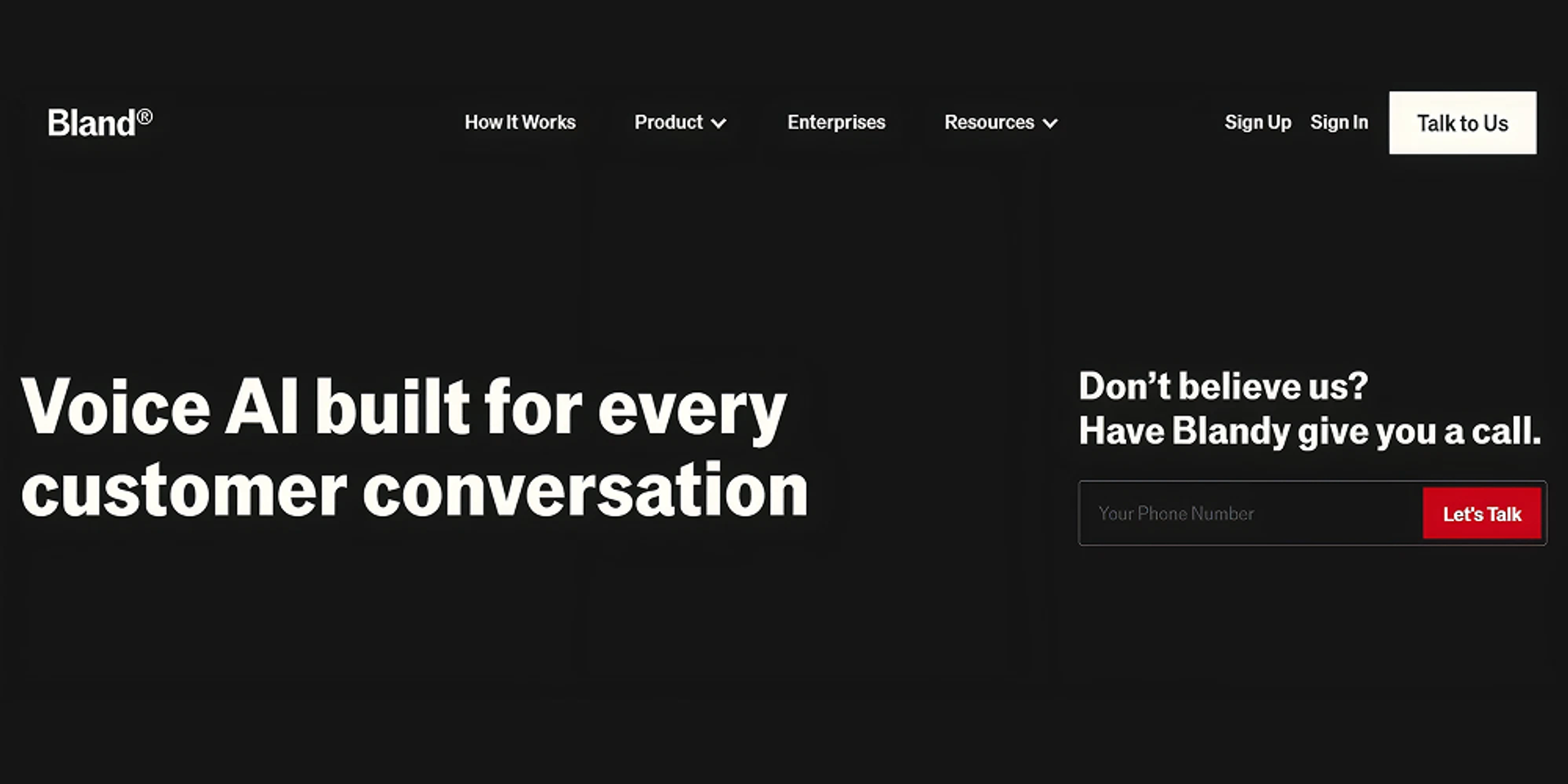
Caption: Bland AI lets you automate phone calls with conversational AI
Bland AI positions itself as an enterprise-ready voice platform, emphasizing control and infrastructure. It also highlights that its system can run on dedicated infrastructure and reduces reliance on third-party model providers (important for teams with privacy or governance requirements).
Bland AI follows a structured setup process that consists of agent configuration, conversation logic, and system integrations. This section of the Bland AI review outlines the core steps teams follow to build, deploy, and operate AI voice agents on the platform.
Bland AI uses Personas to configure agent behavior, voice style, conversation rules, and routing logic. You can tune call behavior, such as waiting for a greeting and interrupt sensitivity (useful for making conversations feel more natural).
Bland AI has Conversational Pathways, which are structured pathways/nodes that help you guide the conversation instead of relying on a single prompt. This is especially useful for multi-step workflows and controlling how the agent responds at different stages of a call.
Bland AI can connect to external systems using tools and integrations so that the agent can do things like:
Once live, teams monitor results and review call outcomes. Based on the outputs, they can refine prompts, flows, and tooling. This iteration loop matters because voice automation quality usually improves through continuous tuning.
Bland AI’s feature set is designed around flexibility and scale. This part of the Bland AI review shows how teams build voice agents, manage conversations, and connect calls to real business systems.
One of Bland AI’s features includes a visual configuration experience through Personas and Pathways. Personas include routing rules and call behavior settings (like interruption thresholds), while Pathways support structured flow control.
That said, Bland AI is still largely developer-led in real deployments. Non-technical teams can adjust high-level behavior, but deeper workflows (tool logic, edge-case handling) usually require technical ownership.
Bland AI runs on a self-hosted model stack designed for enterprises that need tighter control over latency, data, and infrastructure. Instead of sharing resources, Bland provides dedicated servers and GPUs on the client’s own infrastructure, allowing teams to run voice agents in isolation.
This approach helps reduce latency while improving observability and security. All conversation data is encrypted and stored in the customer’s dedicated environment, which is important for regulated industries or teams with strict data governance requirements. The trade-off is that this infrastructure-first model typically aligns better with enterprise deployments than lightweight ones.
Bland AI emphasizes integrations that connect voice to business systems. Its integrations platform highlights connectors with:
These are designed so agents can update records, book meetings, and trigger workflows without manual follow-up.
Bland AI offers a range of voice customization features aimed at teams that want more control over how agents sound and behave during live calls. Its text-to-speech system supports voice cloning from a short MP3 or audio clip, without requiring traditional fine-tuning workflows.
In addition to cloning, teams can control emotion and speaking style dynamically using in-context examples or special markers such as “excited” or “calm”.
Bland AI pricing includes a tiered subscription model combined with usage-based billing.
While the monthly plan sets access limits and features, most of the real-world cost is driven by call usage, especially connected minutes and transfers. This means Bland AI’s total spend increases as call duration, retries, and transfers scale.
Bland AI currently offers four plan tiers: Start, Build, Scale, and Enterprise.
| Plan | Monthly Price | Daily Call Limit | Hourly Call Limit | Concurrent Calls | Voice Clones |
|---|---|---|---|---|---|
| Start | Free | 100 | 100 | 10 | 1 |
| Build | $299 / month | 2,000 | 1,000 | 50 | 5 |
| Scale | $499 / month | 5,000 | 1,000 | 100 | 15 |
| Enterprise | Custom | Unlimited | Unlimited | Unlimited | Unlimited |
Caption: Bland AI pricing tiers
In addition to the monthly subscription, Bland AI’s pricing structure charges for actual usage. These costs are prorated per second and vary by plan.
Connected Call Time (Per Minute): Billed when a call is actively connected and the AI agent is speaking or listening.
Transfer Time Charges: If you use Bland-provided phone numbers, transfer time (when a call is forwarded to a human agent or external number) is billed separately in Bland AI’s pricing structure. However, if you bring your own carrier, transfer time charges may be eliminated.
Outbound & Failed Call Minimums: Bland AI applies minimum charges for outbound call attempts when using its telephony. This applies even if the call is not answered or fails early.
For teams evaluating Bland AI beyond a pilot, total cost is influenced by:
This layered pricing model offers flexibility, but it also makes forecasting more challenging as call volume grows, especially for customer service use cases with variable call lengths and retry logic.
Tired of unpredictable AI voice bills? Discover how CallBotics delivers transparent, predictable pricing at scale.Beyond features, day-to-day usability and call performance play a major role in whether a voice platform succeeds in production. This section evaluates how easy Bland AI is to work with and how reliably it performs during live calls.
Bland AI’s Personas and Pathways make it easier to structure routing and flows than purely code-based systems, and the integration platform reduces friction through connectors for commonly used tools.
But as workflows become more complex, setup increasingly relies on tool logic, exception handling, and quality testing. In practice, this means most production deployments still require technical ownership, especially when integrating with external systems or handling edge cases.
Bland AI emphasizes control and enterprise posture, including dedicated infrastructure, self-hosted models, and guardrails.
But reliability doesn’t mean just uptime. It means ensuring that the agent stays consistent when:
That consistency usually depends on the platform and the QA/monitoring process you run around it.
Security and support are critical considerations for teams deploying voice AI in real customer-facing environments. This section reviews Bland AI’s compliance posture, data handling approach, and the types of support available to users.
Bland AI’s public Trust & Security page lists HIPAA, SOC 2, GDPR, and PCI certifications/compliance via Delve, with a trust portal for review.
Bland AI’s enterprise positioning also emphasizes dedicated servers, encryption, and reduced reliance on third-party model providers.
Bland AI’s docs are extensive, and the platform promotes community support and office hours as part of its support ecosystem. For enterprise buyers, the key question is whether your plan includes:
Read a full breakdown of Bland AI alternatives and explore solutions that fit your needs.
Every voice platform shines in some areas and involves trade-offs in others. This section summarizes Bland AI’s key strengths and limitations based on platform capabilities, operational experience, and common buyer concerns.
While Bland AI and CallBotics both address voice automation, they are optimized for different operating models. This section compares the two platforms across features, pricing, deployment speed, and production readiness.
| Category | Bland AI | CallBotics |
|---|---|---|
| Best fit | Developer-led teams building custom voice workflows | Contact centers/BPOs running repeatable, high-volume call workflows |
| Workflow building | Personas + Pathways for structured flows | Workflow-first approach designed for end-to-end resolution |
| Integrations | Integrations platform (Salesforce, scheduling, Notion, SMS) | Built for real contact center workflows + system integrations |
| Testing | Manual testing + iteration; automated regression usually DIY | Built-in QA + analytics |
| Pricing model | Tier + per-minute billing + additional usage components | Predictable pricing and operational clarity |
| Security posture | HIPAA, SOC 2, GDPR, PCI listed | HIPAA, SOC 2, GDPR |
| Deployment timeline | Enterprise agents in weeks | Go-live in about 48 hours |
CallBotics takes a workflow-first approach to voice automation, with a focus on fast deployment and measurable outcomes. This section explains why CallBotics is often chosen as a Bland AI alternative for customer service teams.
If your goal is customer service automation, three things usually matter most: deployment speed, workflow resolution, and operational visibility. Here’s how CallBotics stands out on these parameters.
If you’re evaluating Bland AI, it comes down to how much control your team actually wants to own in production.
Choose Bland AI if you have strong engineering ownership, are comfortable managing integrations and ongoing QA, and want deep control over how voice agents behave at scale.
If your priority is customer service outcomes, faster time to value, and operational clarity, Callbotics is a safe bet. It’s designed to get teams up and running quickly, resolve a large share of routine calls, and provide built-in analytics and QA without requiring extensive internal build cycles.

Urza Dey (She/They) is a content/copywriter who has been working in the industry for over 5 years now. They have strategized content for multiple brands in marketing, B2B SaaS, HealthTech, EdTech, and more. They like reading, metal music, watching horror films, and talking about magical occult practices.
See how enterprises automate calls, reduce handle time, and improve CX with CallBotics.
CallBotics is an enterprise-ready conversational AI platform, built on 18+ years of contact center leadership experience and designed to deliver structured resolution, stronger customer experience, and measurable performance.