
In a contact center, the staffing plans usually look solid at the start of the day, indicating that the coverage is in good shape. In practice, however, service levels often decline as handle times rise and queues begin to form, forcing teams to spend the day responding to issues instead of running ahead of them. For operations leaders, workforce managers, and supervisors, this misalignment usually traces back to contact center shrinkage. When agents spend time away from live calls, real availability drops. If shrinkage is not tracked closely, forecasts start to drift, and daily operations become harder to manage.
This article focuses on two things:
Contact center shrinkage measures the share of paid agent hours that never reach the phone queue. It accounts for scheduled time, such as coaching sessions, compliance training, and internal meetings, along with unscheduled losses like absenteeism or last-minute schedule changes.
When agents remain on payroll but are unavailable for live interactions, usable capacity drops across the day. Service levels then rely on adding buffer staffing rather than matching demand accurately. Shrinkage quantifies how much call-handling time is lost within each shift and clarifies its direct impact on coverage, forecasting accuracy, and operational control.
| What drives it | How it shows up operationally |
|---|---|
| Coaching and quality reviews | Time deliberately removed from the queue to improve long-term performance |
| Compliance or skills training | Capacity reduction planned into schedules to meet regulatory or enablement needs |
| Internal meetings | Short but frequent pull-aways that reduce effective hourly coverage |
| Breaks, holidays, planned leave | Predictable availability loss that forecasting models can account for |
Planned shrinkage reflects intentional trade-offs. Strong teams schedule it upfront so live demand remains covered.
| What drives it | Why it creates risk |
|---|---|
| Absenteeism or illness | Sudden capacity loss that forecasts cannot absorb in real time |
| Late logins or early logouts | Gradual erosion of coverage across shifts |
| System or facility disruptions | Agents present but unable to take calls |
| Ad-hoc interruptions | Time leakage that compounds during peak periods |
Unplanned shrinkage exposes where staffing models break under real conditions and where operational controls need tightening.
Shrinkage calculations translate staffing plans into usable capacity. They show how many paid hours actually make it into the phone queue and how many are absorbed by non-call activity.
For leadership teams, this metric explains why service levels miss targets even when hiring and schedules appear sufficient.
The standard formula measures the share of scheduled time lost to activities outside call handling:
Shrinkage Rate = (Total Shrinkage Hours ÷ Total Hours Scheduled) × 100
Assume a contact center schedules 1,000 paid hours in a week. If agents spend 700 of those hours handling customer calls, 300 hours never reach live demand. The resulting shrinkage rate comes out to 30 percent.
A 30 percent shrinkage rate means only 70 percent of paid time converts into productive capacity. Forecast accuracy, staffing buffers, and hiring plans depend on this ratio, not total headcount.
At enterprise scale, even a two- or three-point swing in shrinkage can materially affect service levels and cost per contact.
Some workforce teams calculate the same figure starting from productive time:
Shrinkage Rate = (1 − Productive Hours ÷ Scheduled Hours) × 100
Whichever formula is used, the value lies in how leaders apply the result.
Shrinkage clarifies how much staffing is compensating for lost availability, where schedules break down during peak periods, and how much room exists to absorb volume spikes. Operations leaders rely on this metric to validate forecasts, pressure-test staffing models, and prioritize automation or process changes that return time to the queue.
As mentioned earlier, the average industry call center shrinkage rate ranges from 30 to 35%. This rate varies by industry, call center size, and specific workflows.
Service-level commitments such as answering 80 percent of calls within 20 seconds leave little room for error. In these environments, even a one- or two-point reduction in shrinkage can materially improve coverage during peak periods and reduce abandonment without adding headcount.
Hence, contact centers must balance reducing shrinkage to improve productivity with providing agents enough time for rest and training to deliver excellent customer service. As shrinkage decreases, contact center productivity increases.
Shrinkage has a direct and noticeable effect on how well a contact center operates. When fewer agents are available than planned, even small staffing gaps can quickly escalate into broader performance issues across the operation.
Here’s how it impacts call center performance:
One of the most immediate effects of shrinkage is longer customer wait times. When fewer agents are available to handle calls, queues grow, and customers spend more time waiting for support. Recent benchmarks show that the average wait time in contact centers worldwide is around 1 minute and 50 seconds.
However, many customers will abandon calls if they wait more than two minutes without being answered. In fact, nearly 67% of consumers report that they have hung up due to long wait times.
Poor service quality also has lasting consequences, with over 60% of customers saying they are likely to switch brands after experiencing slow support. These delays and abandoned calls not only frustrate customers but also create missed opportunities for businesses to resolve issues and maintain loyalty.
When contact center teams are understaffed, agents must handle higher call volumes with fewer breaks. Over time, this constant pressure can lead to fatigue, stress, and burnout. Recent research indicates that up to 74% of contact center agents are at risk of burnout. Many agents struggle to balance speed and quality, which can prolong call handling times and increase errors.
This added strain also drives high turnover. Some contact centers experience annual attrition rates between 30% and 45%, far above typical levels in other industries. Burned-out agents are more likely to make mistakes, take unscheduled time off, or leave the organization entirely, which further increases shrinkage and creates a difficult cycle to break.
When customers repeatedly face long holds, transfers, or rushed service, satisfaction and loyalty scores fall. Contact centers that struggle with shrinkage also show lower first-contact resolution rates (FCR) and higher abandon rates, directly hurting overall customer experience.
In contrast, operations that invest in agent training, workforce management and planning, and AI-supported tools see improved service consistency, lower attrition, and stronger customer loyalty. In fact, when you improve FCR by 1%, it automatically decreases operating costs by 1%.
📌Read more: A Step-by-Step Guide to AI Voice Agent Implementation in 2026
Contact centers face constant pressure from workforce challenges, high turnover, and operational inefficiencies. When agents are unavailable due to breaks, training, or other factors, shrinkage can quickly affect service levels, increase costs, and frustrate customers.
With AI voice assistants, like CallBotics.ai, you can reduce shrinkage by offloading routine work, assisting agents during live calls, and planning staffing more accurately.
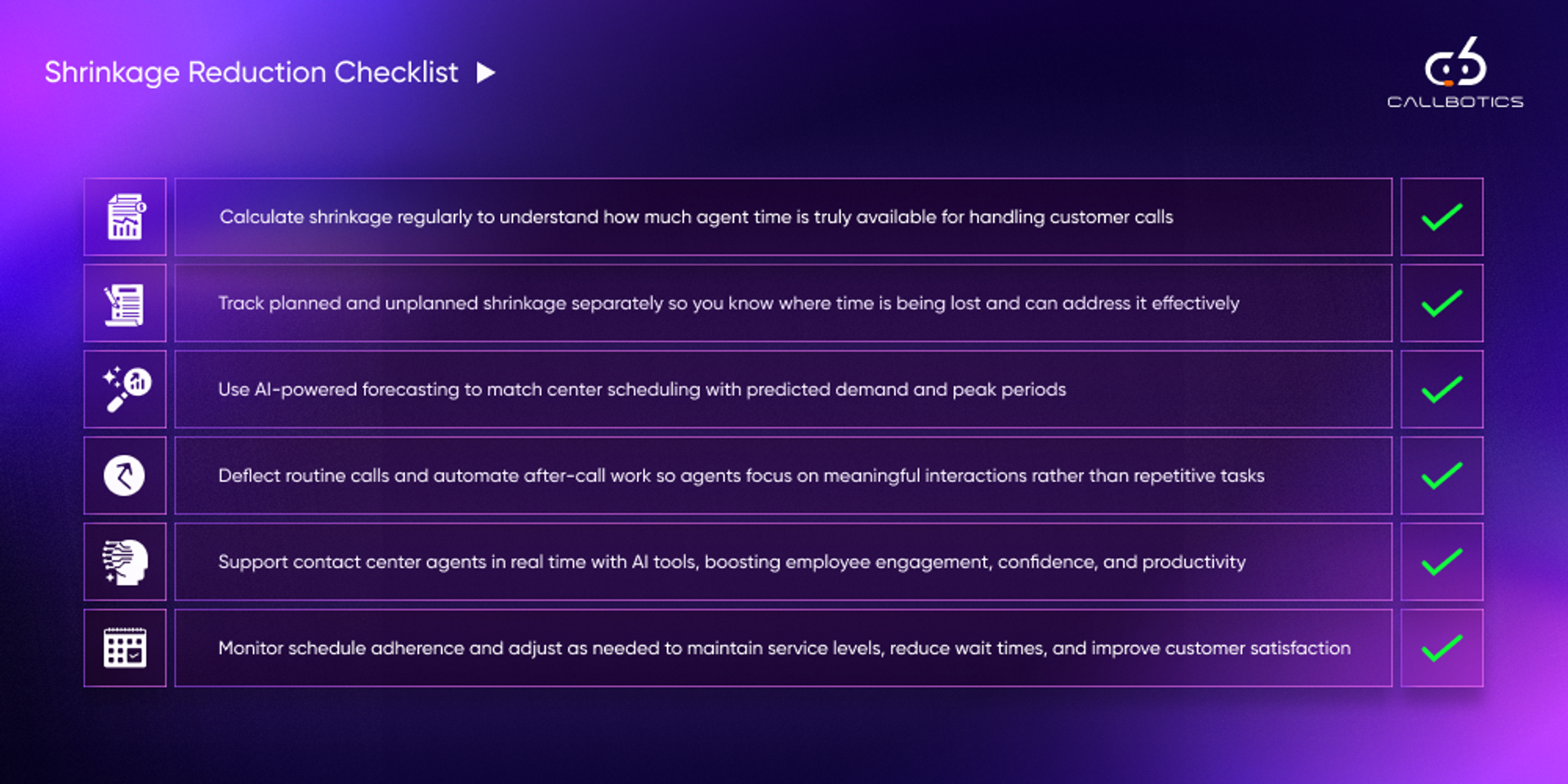
Many of the calls that fill agent schedules involve repetitive inquiries such as FAQs, order status updates, or appointment scheduling. CallBotics’ AI voice agents can handle these routine interactions autonomously, freeing human agents to focus on complex or high-value calls.
For example, real-time sentiment analysis systems can monitor more than 1,000 customer interactions every second. It identifies problems or frustrations right away and allows your team to respond immediately. AI can also predict customer needs and possible issues with around 85% accuracy.
CallBotics’ AI voice agents handle routine calls from start to finish, including caller verification, data retrieval, and task completion within existing contact center systems. Built for contact center workflows, they reduce the volume of repetitive calls routed to human agents, freeing capacity for complex, exception-driven interactions.
In many deployments, these agents autonomously handle about 80% of interactions by performing verification, status checks, data lookups, and task execution through natural, human-like dialogue.
This reduces workload stress on teams, improves availability for challenging cases, and directly lowers shrinkage related to repetitive task overload.
After-call work, such as documenting conversations, updating records, and generating follow-ups, can consume significant agent time and contribute to shrinkage. AI can automate these administrative tasks, freeing agents to return sooner to the queue and handle more calls. Studies show that automating ACW can save 1–2 hours of agent time per day, which translates to a 10-15% increase in call handling capacity.
CallBotics creates call summaries, transcripts, and follow-up actions automatically after each interaction and sends them directly into CRM and reporting systems. Agents stay in one workspace and return to the queue without re-entering information or switching tools.
It boosts agent productivity while ensuring accuracy and compliance in documentation.
Staffing challenges are a major contributor to shrinkage. CallBotics uses live call data from ongoing interactions to inform staffing models in near real time. The added visibility helps leaders adjust coverage, limit idle time during slower periods, and absorb absenteeism without relying on excessive buffer staffing.
In fact, AI-powered scheduling algorithms have increased agent utilization rates by 34% and reduced overtime costs by 28%. These systems can predict staffing needs with 95% accuracy up to six weeks in advance, allowing proactive resource allocation that has generated average annual savings of $2.1 million for large contact centers.
This predictive capability also keeps your workforce ready for spikes or seasonal changes, making sure service levels stay high while labor costs remain under control.
During live calls, teams use AI assistance to pull verified answers, customer data, and next actions directly into the agent’s view. Agents rely on in-call guidance instead of searching knowledge bases or switching between CRM screens, keeping conversations focused on resolution rather than navigation.
With CallBotics, you can listen across active calls and surface context-specific prompts such as required verification steps, policy reminders, or workflow checkpoints, in real-time. Your agents can use these cues to complete tasks accurately and resolve issues in fewer steps, improving consistency across shifts while returning to the queue faster.
High-effort calls place sustained pressure on agents and often lead to fatigue, inconsistent performance, and time away from the queue. You can rely on real-time sentiment signals to identify rising frustration early in a conversation and decide when an interaction needs additional support or escalation.
CallBotics allows you to route demanding calls more deliberately, preventing agents from handling consecutive high-stress interactions. Supervisors spread emotional load across the floor while customers reach the appropriate level of support sooner. Steadier call distribution helps maintain agent availability through the day and reduces shrinkage tied to burnout and execution strain.
High contact center shrinkage becomes visible first in longer wait times, rising operating costs, stretched teams, and inconsistent service quality. Leaders are expected to hit service-level targets while managing both planned and unplanned shrinkage in real time, not after performance has already slipped.
This is where enterprise AI voice platforms like CallBotics, purpose-built for live VoiceOps execution, change the equation. Rather than reacting to shrinkage after the fact, AI absorbs routine demand, stabilizes agent availability, and returns productive time back to the queue during active operations.
CallBotics applies this approach within existing contact center environments through a set of operational differentiators:
Together, these capabilities allow contact center teams to reduce shrinkage while preserving service quality, agent stability, and operational control during periods of fluctuating demand.
Want faster, smarter contact center operations? Book a demo today to see how CallBotics.ai can handle routine calls end-to-end, cut after-call work, enhance agent productivity, and provide real-time insights, with AI voice agents that go live within 48 hours of deployment.

Urza Dey (She/They) is a content/copywriter who has been working in the industry for over 5 years now. They have strategized content for multiple brands in marketing, B2B SaaS, HealthTech, EdTech, and more. They like reading, metal music, watching horror films, and talking about magical occult practices.
See how enterprises automate calls, reduce handle time, and improve CX with CallBotics.
CallBotics is an enterprise-ready conversational AI platform, built on 18+ years of contact center leadership experience and designed to deliver structured resolution, stronger customer experience, and measurable performance.