Both CallBotics and Synthflow help teams automate phone calls using AI voice agents, but the better option depends on what matters most to your team. Some buyers care most about pricing predictability and speed to launch, while others prioritize workflow control, telephony flexibility, or white-label support. CallBotics is positioned more as an enterprise-ready AI voice platform built for faster deployment, stronger operational outcomes, and real contact center use cases, while Synthflow is positioned more as a configurable voice AI platform with builder-led workflows, telephony options, API access, and white-label capabilities.
This comparison focuses on the criteria that most influence real buying decisions: pricing structure, setup effort, workflow depth, integrations, scalability, analytics, and governance. The goal is not to treat one platform as universally right for every team, but to make it easier to see which one aligns better with your deployment model, operating priorities, and time-to-value expectations.
At a high level, CallBotics is positioned more like an enterprise AI voice platform for contact center and BPO-style environments, with messaging around fast deployment, high-volume call automation, and operational outcomes. Synthflow is positioned more like a full-voice AI operating system with configurable workflows, native and bring-your-own telephony options, API access, and white-label support for agencies and enterprise teams.
The biggest practical difference is usually how teams want to deploy. If you want a business-facing platform with clear contact center alignment and a faster path-to-production positioning, CallBotics has the stronger story. If you want more explicit builder control, telephony options, and reseller-style flexibility, Synthflow is more naturally aligned to that motion.
CallBotics is best known for enterprise-ready AI voice agents that automate calls at scale, with messaging focused on fast deployment, human-like voice interactions, and a strong fit for contact center and BPO workflows. Its site highlights 48-hour deployment positioning, enterprise readiness, and AI voice agents designed to reduce costs and improve efficiency in high-volume environments.
It is also framed around operational visibility, workflow-driven automation, and contact center outcomes rather than just voice-agent creation in the abstract. That strengthens its positioning with buyers who care about queue pressure, inbound call automation, triage, and enterprise service delivery.
Explore CallBotics if you want an enterprise-ready voice AI platform with faster deployment, stronger call insights, and workflows built for real contact center operations.Synthflow is best known for its end-to-end voice AI platform, configurable workflows, enterprise telephony options, and high-volume voice automation positioning. Its official site describes it as a voice AI operating system that supports inbound and outbound automation, modular flows, enterprise telephony, and deep analytics.
It is also well known for agency and white-label use cases. Synthflow’s docs explicitly highlight white-label and reseller support, client account management, branded deployments, and the ability to decide which features clients can access. That makes it attractive for agencies, service providers, and teams that want more platform-level control over how AI voice is packaged and deployed.
In practice, both platforms follow a similar deployment path. Teams choose a use case, build the workflow, connect the required systems, test the voice agent, go live, and then improve performance using call outcomes and operational feedback. The difference is less about whether both can automate calls and more about how they support that process. CallBotics is positioned around faster deployment, workflow execution, enterprise voice operations, and 400+ integrations, while Synthflow is positioned more around builder control, API-led customization, telephony flexibility, and platform-level configuration.
That means the real comparison is not capability versus capability. It is operating fit versus platform fit. Buyers should evaluate how each platform packages the setup experience, how much control it exposes, and whether it better matches the kind of team, workflow, and rollout model they are working with.
The biggest differences between CallBotics and Synthflow show up in the areas that most affect deployment success and long-term value. Both platforms support AI voice automation, but they are positioned somewhat differently in how they approach pricing, rollout, workflow control, integrations, scale, and operational visibility. For most buyers, the right choice comes down to which platform fits their deployment model more naturally.
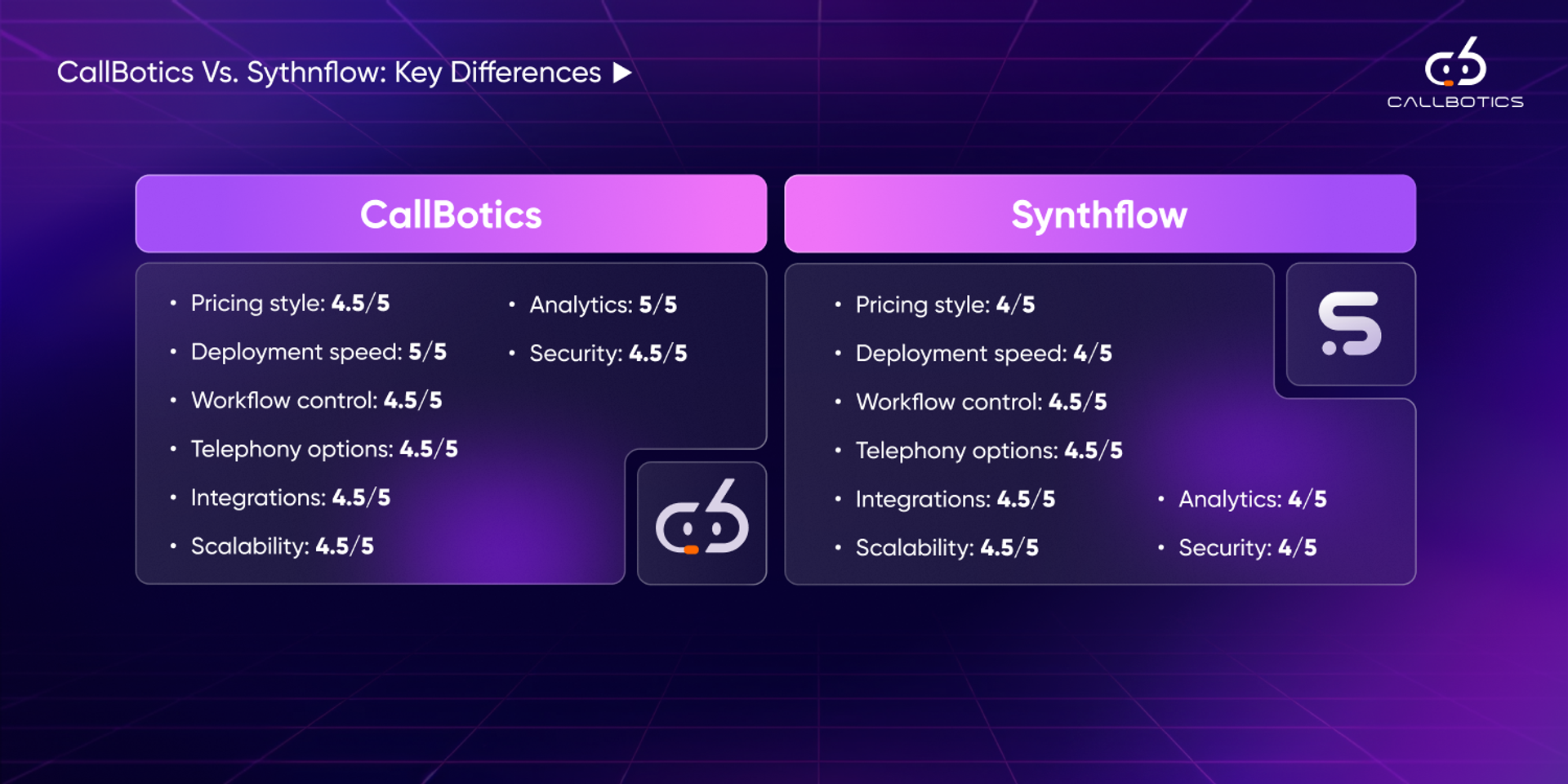
Pricing is one of the clearest differences because it affects budgeting, forecasting, and how costs behave as call volume grows. CallBotics presents pricing in a way that feels more structured around packaged business needs and deployment fit, which can make planning easier for teams that want clearer cost predictability. Synthflow’s pricing is more visibly usage-led, with minute-based estimation, concurrency assumptions, and enterprise scaling tiers expressed more directly.
In practice, that usually means:
Deployment speed matters because it directly affects time-to-value. CallBotics strongly emphasizes fast rollout, including 48-hour deployment positioning for suitable workflows, especially in BPO and contact center contexts. Synthflow gives teams more visible builder-level control, but setup effort can depend more heavily on how much customization, telephony configuration, API work, and integration depth the team wants to take on.
That usually translates into a simple buying signal:
Workflow control is one of the more meaningful differences. Synthflow has a stronger public positioning around builder control, modular workflow design, and API-connected orchestration. CallBotics also supports deep workflows and structured task handling, but its positioning is more outcome-led and operationally oriented than builder-led.
For most buyers, the distinction looks like this:
Telephony flexibility matters because it affects number management, provider choice, and how the voice layer fits into the broader stack. Synthflow is more explicit publicly about telephony model options, including native telephony, Twilio, and bring-your-own provider choices. CallBotics also supports strong telephony flexibility, but its public messaging focuses more on enterprise voice automation outcomes than on exposing telephony architecture details as a core buying narrative.
This creates a practical difference in evaluation:
Both platforms support strong business-tool connectivity, but they communicate it differently. Synthflow emphasizes no-code connectivity, API access, custom integrations, and integration visibility in its public documentation. CallBotics also supports extensive integration coverage, including 400+ integrations, but frames that strength more around applied enterprise workflows, deployment readiness, and operational execution.
That means buyers should look past headline integration counts and ask a more practical question: can the platform connect cleanly to the CRM, scheduling, ticketing, and workflow systems that actually matter in production?
Scalability matters most for teams expecting volume spikes, large inbound programs, or heavy outbound traffic. Synthflow is more explicit publicly about concurrency in its pricing and estimator language. CallBotics emphasizes enterprise-scale automation, BPO fit, and contact center readiness, but it communicates scale more through operational positioning than through visible concurrency-tier detail.
So the difference is not necessarily about whether both can scale. It is more about how each one frames scale publicly.
Analytics matter because voice AI improves through iteration. CallBotics positions performance insights, operational visibility, QA-style monitoring, and business outcomes as core parts of the platform. Synthflow also emphasizes analytics, but its positioning is more centered on platform operations and configurable oversight.
That creates a useful distinction:
Enterprise buyers should be careful not to over-index on homepage language alone in this category. Synthflow publicly mentions enterprise-grade reliability, uptime commitments, and telephony readiness. CallBotics emphasizes enterprise readiness and compliance-oriented positioning more broadly, which aligns well with buyers looking for stronger governance and operational control in customer-facing environments.
The practical takeaway is that both platforms should be validated in a live evaluation. Buyers should confirm:
From a positioning standpoint, CallBotics feels more naturally aligned to enterprise governance conversations, while Synthflow feels more infrastructure-forward in how it presents reliability.
| Category | CallBotics | Synthflow |
|---|---|---|
| Best for | Enterprise voice automation, contact center workflows, and faster rollout | Builder-led voice automation, white-label needs, and telephony control |
| Pricing approach | Transparent, packaged, consultative fit around deployment needs | Usage-led estimator, concurrency-aware, enterprise scaling tiers |
| Setup time | Strong 48-hour deployment positioning for suitable workflows | Strong builder and API flexibility, setup depth depends on workflow complexity |
| Workflow depth | Outcome-led workflow automation and handoff design | Modular workflow builder and multi-agent subflows |
| Integrations | Enterprise workflow fit, applied automation focus | 200+ integrations, API, and custom integrations |
| Telephony | Enterprise AI voice calling positioning | Native telephony, Twilio, or bring your own telephony |
| Analytics | Performance insights and operational visibility | Deep analytics and platform operations visibility |
| Enterprise readiness | Strong public enterprise and BPO contact center positioning | Strong enterprise configuration and white-label infrastructure |
Sources: (CallBotics)
CallBotics appears best suited for teams that want fast value in structured, high-volume voice operations where call quality, handoffs, and queue pressure matter.
CallBotics is a strong fit for high-volume inbound call automation, triage, repetitive support handling, and escalation flows that benefit from summaries and context. Its BPO and contact center positioning make this one of its clearest strengths.
Because the platform is positioned around AI voice automation at scale, it also fits inbound qualification and structured outbound follow-up workflows where clear routing and handoff matter.
Callbotics’ workflow-driven voice positioning also makes it a natural fit for structured flows such as scheduling, reminders, confirmations, and other task-led inbound or outbound interactions.
See how CallBotics helps teams automate high-value voice workflows with intent-based routing, smart handoffs, and enterprise-grade call visibility.Synthflow appears strongest when the buyer wants more direct control over workflow structure, telephony model, and multi-client or white-label deployment.
Synthflow’s modular builder, API surface, and multi-agent flow positioning make it a strong choice for workflow-heavy programs that require more explicit branching and configuration.
This is one of Synthflow’s clearest differentiators. Its docs explicitly support agency white-labeling, client account management, pricing control, and branded deployment options.
With visible concurrency framing, enterprise telephony options, and operating-system-style positioning, Synthflow is well-suited to teams running large call programs that need platform control and reporting depth.
This decision is not about which platform is universally better. It is about which platform fits your team’s operating model better.
Pros
Cons
Pros
Cons
The fastest way to decide is to start from your real constraints, not the vendor marketing language.
Choose Callbotics if you want a stronger contact center fit, a faster rollout, enterprise-grade voice automation, and an operationally guided path to production. It is also the better fit if call insights, triage quality, and service-workflow outcomes matter more than builder-level workflow control.
Choose Synthflow if you want deeper workflow builder control, explicit telephony choice, API-led orchestration, or white-label deployment support. It is especially attractive for agencies, modular builders, and teams that want to shape the architecture more directly.
If the decision still feels unclear, test both platforms on one high-volume, structured use case. That could be inbound triage, appointment scheduling, lead qualification, or status calls. The best pilot should compare setup time, routing quality, human handoff quality, call outcomes, and cost behavior under realistic usage rather than polished demos alone. This is an inference based on the publicly available feature sets and deployment models of both platforms.
Callbotics helps teams upgrade voice AI faster by combining deployment speed with operational depth. Developed by teams with over 18 years of experience in the BPO and contact center industry, the platform is built by people who understand how voice automation performs under real conditions, such as queue pressure, handoff complexity, client SLAs, and high-volume workflows. Instead of treating voice AI as a standalone builder, Callbotics is designed to help teams move from one high-value use case to production quickly, with the routing, workflow execution, summaries, and performance visibility needed to improve outcomes over time.
What makes Callbotics different:
Both platforms are credible voice AI options, but they solve slightly different buying problems. Callbotics is the better fit for teams that want enterprise voice automation with faster deployment, stronger contact center alignment, and a more operationally guided approach. Synthflow is the better fit for teams that want modular workflow control, white-label options, telephony choice, and greater visibility into builder-level flexibility.
The best choice depends on what matters most in your environment: pricing style, workflow depth, telephony architecture, analytics expectations, and time-to-value. If your team is evaluating both seriously, the best next step is usually a narrow pilot focused on one key call intent rather than a broad theoretical comparison. This recommendation is an inference based on the official positioning and public product information reviewed above.

Urza Dey (She/They) is a content/copywriter who has been working in the industry for over 5 years now. They have strategized content for multiple brands in marketing, B2B SaaS, HealthTech, EdTech, and more. They like reading, metal music, watching horror films, and talking about magical occult practices.
See how enterprises automate calls, reduce handle time, and improve CX with CallBotics.
CallBotics is an enterprise-ready conversational AI platform, built on 18+ years of contact center leadership experience and designed to deliver structured resolution, stronger customer experience, and measurable performance.