Both CallBotics and Bland AI help teams automate customer interactions with AI, but the better choice depends on what matters most in the real rollout. Some buyers care most about channel mix, workflow depth, rollout speed, and cost predictability. Others care more about telephony control, API-led customization, and large-scale call infrastructure. CallBotics is positioned as an omnichannel enterprise AI platform across voice, email, SMS, chat, and social workflows, with deeper specialization in voice automation and contact center execution. Bland AI is more commonly evaluated as a telephony-first AI platform for inbound and outbound calling, with strong emphasis on phone automation, APIs, webhooks, SIP, and production-grade calling workflows.
That means this comparison is not about whether both platforms can automate conversations. It is about which platform better matches your operating model. This guide focuses on the factors that usually shape the decision in practice: pricing style, setup effort, workflow control, telephony, integrations, analytics, governance, and whether your team needs broader omnichannel orchestration or deeper voice-led execution.
CallBotics is best known for enterprise AI automation, strong voice specialization, fast deployment, 400+ integrations, and measurable operational outcomes across customer interaction workflows. Its public messaging highlights 18 years of VoiceOps experience, deployment in 48 hours for suitable workflows, and AI agents built to automate around 80 percent of calls.
Bland AI is best known for AI phone automation. Its public materials emphasize inbound and outbound calling, open APIs, SIP support, webhooks, batch calls, telephony-heavy workflows, and enterprise calling infrastructure. Its docs and API references make it especially visible to technical teams that want direct control over how phone workflows behave in production.
So the quick summary is this: CallBotics feels stronger for enterprises that want omnichannel automation with deeper voice-led execution and faster time-to-value, while Bland AI feels stronger for teams that want a more telephony-centric platform with explicit API and call-control flexibility.
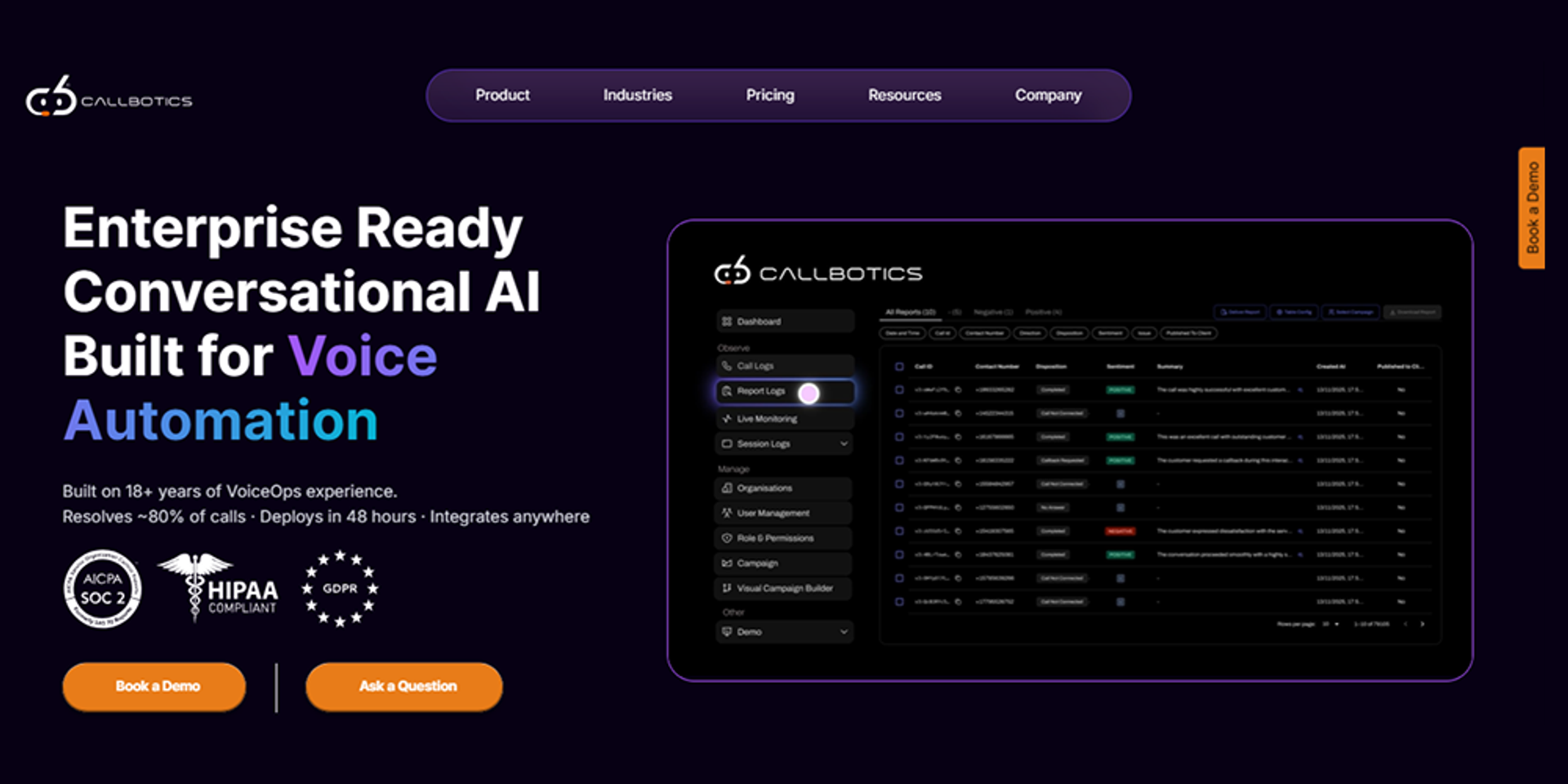
CallBotics is best for enterprises that want to automate customer interactions across channels while keeping voice execution as a core strength. It is built around structured workflows, measurable outcomes, summaries, analytics, and operational visibility, making it especially relevant for contact centers, BPOs, scheduling programs, triage workflows, and voice-heavy service environments.
Because it is built around operational fit rather than just technical voice control, CallBotics is usually the stronger fit for teams that care about routing quality, handoff continuity, queue reduction, and predictable rollout across real business workflows. Its omnichannel positioning also means voice does not have to operate in isolation from the rest of the customer journey.
See how CallBotics helps teams move beyond voice-only automation with omnichannel workflows, stronger summaries, and clearer operational visibility across every customer touchpoint.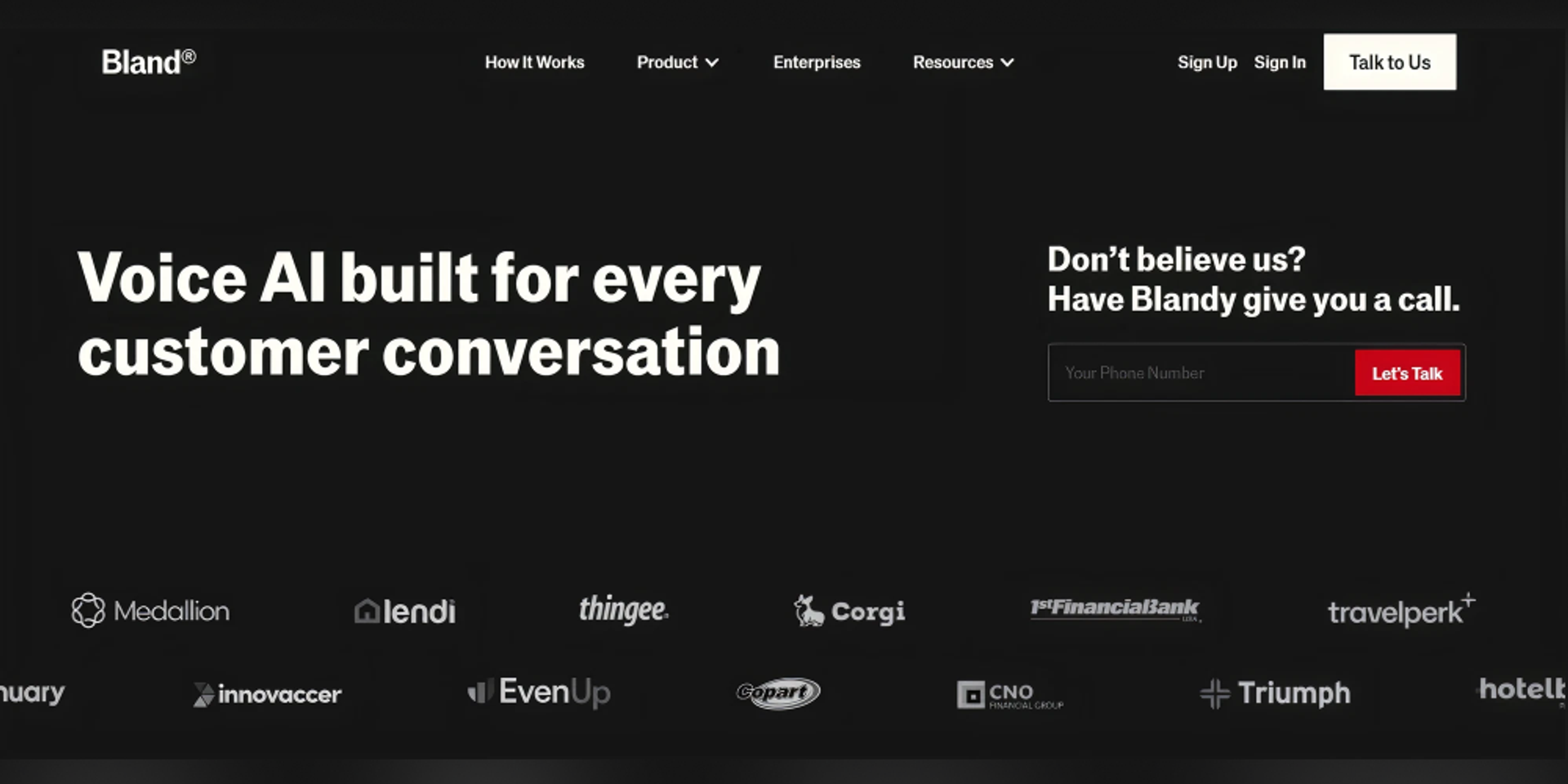
Bland AI is best for teams that want to automate inbound and outbound phone calls with direct control over telephony behavior, API-triggered actions, and developer-accessible workflow logic. Its public product story is centered on calls first, including sending calls, receiving inbound calls, using webhooks during live calls, SIP routing, batch outbound calling, and custom API-driven workflows.
That makes Bland AI especially relevant for telephony-heavy operations, API-led engineering teams, and organizations that want to treat voice automation as a programmable call infrastructure layer. While Bland’s enterprise positioning also references messages and chat sessions, its clearest public strength remains AI phone calls and related enterprise communication control.
In practice, both platforms follow a similar rollout pattern. Teams choose a workflow, design the interaction logic, connect business systems, test edge cases, go live, and then review outcomes weekly to improve the flow. That is true whether the workflow is appointment scheduling, inbound support, collections, lead qualification, or outbound reminders.
The real difference is how each platform expects teams to operate during that rollout. CallBotics frames the process around faster deployment, enterprise execution, and measurable workflow outcomes. Bland frames it more around voice-agent definition, telephony behavior, API, and webhook actions, simulations, regression testing, and gap detection inside phone workflows. So the difference is not capability versus capability. It is more about whether you want a more guided enterprise rollout or a more telephony-driven, developer-controlled implementation path.
The main differences show up in the areas that affect time-to-value, operating fit, and total cost over time. For most buyers, those areas are pricing style, setup effort, workflow control, telephony depth, integrations, analytics, scalability, governance, and omnichannel readiness.
Bland AI is commonly evaluated through a usage-based model. Public and widely referenced pricing content points to per-minute pricing around $0.09 per connected minute, with some Bland-owned content discussing usage-based conversational AI pricing ranges more broadly, and other commentary referencing additional fees tied to transfers or short outbound attempts. That makes it important to verify the exact current billing model, transfer fees, failed-call minimums, telephony charges, and what is bundled at your expected scale.
CallBotics, by contrast, is positioned more around transparent, scalable enterprise pricing and more stable planning for business workflows. For teams that want budgeting clarity and do not want cost driven solely by connected-minute volume, CallBotics is usually the easier model to forecast. The real comparison should not be the minute rate alone, but the total cost against outcomes, support, integrations, and workflow success.
Time-to-launch depends on workflow clarity, integrations, telephony setup, testing, QA, approvals, and how much implementation the buyer needs to own. CallBotics publicly leans into 48-hour deployment for suitable workflows, which gives it a stronger public time-to-value story. Bland promotes production-grade deployment in around 30 days, but that still depends on how much custom call logic, API work, and operational tuning the team needs before scaling.
In practical terms, this means CallBotics is usually better for teams that want faster rollout and more direct movement into production, while Bland is often more appealing to teams that are comfortable taking on more technical implementation work in exchange for deeper call-control flexibility.
Both platforms can support complex workflows, but they frame control differently. Bland’s ecosystem is built around structured call pathways, APIs, webhooks, live actions during calls, simulations, and regression testing. That makes it attractive for teams that want granular control over voice-agent behavior and are comfortable treating the call flow as a more technical system.
CallBotics also supports deep workflow execution, but its positioning is more outcome-led than developer-led. That means it tends to feel stronger for teams that care more about getting structured business workflows into production quickly and measuring business outcomes clearly, rather than maximizing low-level control over every telephony behavior.
Telephony flexibility is one of Bland’s clearest strengths. Its public site explicitly references SIP, guided call routing setup, number porting, telephony provider compatibility, batch calls, inbound support, outbound calls, and API-based call dispatch. This makes telephony depth a real evaluation point in the comparison.
CallBotics also supports enterprise voice execution at scale, but its public story emphasizes the workflow and outcome layers more than it exposes telephony architecture as the product center of gravity. Buyers who want telephony-first control may find Bland easier to evaluate on that axis, while buyers who care more about what the system achieves operationally may find CallBotics more naturally aligned.
Both platforms support strong business-tool connectivity, but they communicate that strength differently. Bland emphasizes open REST APIs, webhooks, and enterprise system integration, which is especially appealing to technical teams building on internal systems or custom architectures.
CallBotics combines broad integration coverage with 400+ integrations and a stronger solution-led story around applied enterprise workflows. That gives it a more operationally useful integration narrative for buyers who want the system to connect to CRM, scheduling, support, and business tools without thinking about everything as an API project first.
Bland’s analytics story is closely tied to its broader testing and optimization loop. Its site highlights regression testing, simulations, knowledge-base gap detection, and platform-level tooling for improving call flows over time. That is valuable for teams that want a more technical optimization workflow around voice automation.
CallBotics, however, places more visible emphasis on transcripts, summaries, call outcomes, QA-style visibility, and intent-level reporting that map directly to contact center and operations use cases. For teams that want reporting to help service managers, QA teams, and operations leaders make weekly decisions, CallBotics is usually the stronger fit.
Explore CallBotics if you want AI automation with stronger summaries, reporting, and cross-channel workflow visibility built for real customer operations.Bland’s enterprise positioning makes very ambitious scale claims around millions of concurrent calls, messages, and chat sessions, along with automatic scaling across channels. That suggests very strong infrastructure ambitions, but buyers should still validate what that means under their own peak-load conditions, transfer logic, and real production traffic.
CallBotics has a stronger public fit for scaling voice-led business workflows in enterprise contact center environments, especially where queue pressure, routing performance, and outcome visibility matter. That makes it easier to assess for teams whose real scaling problem is not generic concurrency, but high-volume service delivery under operational constraints.
Bland’s public materials emphasize self-hosted architecture, enterprise privacy posture, and HIPAA-oriented security in enterprise contexts, which is meaningful for regulated or risk-sensitive environments. Buyers should still confirm how that maps to their own procurement, hosting, and access-control requirements.
CallBotics also positions itself as enterprise-ready, but the distinction is mostly one of emphasis. Bland’s story is more infrastructure and privacy-led. CallBotics balances governance with deployment speed and operational execution, which may feel more useful for teams that need controls without slowing down rollout. Both need live validation, but CallBotics remains highly competitive for enterprise buyers who want governance in a more execution-oriented package.
| Category | CallBotics | Bland AI |
|---|---|---|
| Best for | Enterprise omnichannel automation with stronger voice specialization | Voice-centric automation and telephony-heavy workflows |
| Pricing approach | More transparent, packaging-friendly, outcome-oriented | More usage-based and minute-driven |
| Setup effort | Faster rollout for structured business workflows | More API and telephony-driven setup path |
| Workflow control | Strong workflow execution with business-outcome focus | Granular phone workflow control with APIs and webhooks |
| Telephony depth | Strong enterprise voice execution | Stronger explicit telephony and SIP focus |
| Integrations | 400+ integrations with solution-led workflow fit | Strong API and webhook integration flexibility |
| Analytics and QA | Stronger summaries, reporting, and QA-style visibility | Stronger regression testing and simulation-oriented tooling |
| Scalability | Strong fit for enterprise contact center volume | Strong infrastructure-led scale claims |
| Enterprise controls | Enterprise-ready with execution-oriented fit | Strong privacy and self-hosting posture |
| Omnichannel readiness | Omnichannel platform with deeper voice specialization | Primarily voice-first, with enterprise references to messages and chat |
CallBotics fits best where enterprises want broad customer interaction automation but need voice performance to be especially strong.
CallBotics is a strong fit for high-volume inbound environments where the goal is to answer quickly, reduce hold time, automate repeatable call types, and route exceptions cleanly while preserving operational visibility.
Structured workflows with clear success outcomes, such as booked, rescheduled, confirmed, or canceled, are a natural fit because CallBotics is positioned around execution and measurable outcome reporting.
CallBotics is also a strong fit for teams that want voice, email, text, chat, and social channels coordinated as part of one broader customer interaction workflow rather than treating voice automation in isolation.
Bland AI is strongest where teams are primarily focused on phone automation, telephony-heavy workflows, and technical control over call behavior.
Bland is a strong fit for reminders, confirmations, collections, support calls, and other phone-heavy workflows where AI calls are the main delivery channel.
Bland is especially relevant when the team wants to trigger actions mid-call, connect directly to APIs and webhooks, and keep deeper technical control over how the conversation behaves.
Per-minute pricing can feel attractive for pilots, variable outbound campaigns, and teams that want a direct usage model before moving into larger packaged enterprise commitments. The tradeoff is that the total cost still needs to be validated carefully against retries, transfers, and real call duration.
This decision comes down to channel fit, workflow design preference, and how your team wants to own deployment.
Pros
What to validate in a pilot
Pros
What to validate in a pilot
The fastest way to choose is to start from your operating model, not from the most impressive technical claim.
Choose CallBotics if you need enterprise omnichannel automation, strong voice execution, measurable outcomes, and governance across multiple customer touchpoints. It is usually the better fit when you want faster rollout, clearer reporting, and a platform built around business execution rather than only telephony control.
Choose Bland AI if your first priority is AI phone automation, usage-based voice economics, API-level control, or telephony-heavy workflows where your team wants to shape call behavior in more technical detail.
Test one simpler workflow and one medium-complexity workflow, then compare:
This will usually tell you whether your team needs broader enterprise workflow execution or deeper telephony-first control. This is a practical recommendation based on the platform differences above.
CallBotics helps teams upgrade AI automation faster by combining omnichannel reach with stronger specialization in voice-led workflows. Developed by teams with over 18 years of contact center leadership experience, it is built by people who understand queue pressure, handoff quality, workflow execution, and how to improve customer interactions week by week after launch.
What makes CallBotics different:
Both platforms are credible, but they solve slightly different buying problems. Bland AI is a strong fit for telephony-first automation and teams that want granular API and webhook control over voice behavior. CallBotics is the stronger fit for enterprises that want omnichannel automation with deeper voice specialization, faster rollout, broader workflow execution, and stronger operational reporting.
The best choice depends on your channel mix, workflow complexity, rollout model, governance requirements, and budget predictability. If your team needs more than raw phone automation and wants a platform that can orchestrate customer interactions across channels while still excelling at voice, CallBotics will usually be the better long-term fit.

Urza Dey (She/They) is a content/copywriter who has been working in the industry for over 5 years now. They have strategized content for multiple brands in marketing, B2B SaaS, HealthTech, EdTech, and more. They like reading, metal music, watching horror films, and talking about magical occult practices.
See how enterprises automate calls, reduce handle time, and improve CX with CallBotics.
CallBotics is an enterprise-ready conversational AI platform, built on 18+ years of contact center leadership experience and designed to deliver structured resolution, stronger customer experience, and measurable performance.