Both CallBotics and Vapi help teams automate customer interactions with AI, but the better fit depends on what the buyer actually needs in the rollout. Some teams care most about channel mix, voice workflow depth, pricing predictability, and operational reporting. Others care more about developer control, modular voice-stack choices, telephony configuration, and API-led ownership. CallBotics is positioned as an omnichannel enterprise platform across voice, email, SMS, chat, and social workflows, with strong specialization in voice-led execution. Vapi is positioned more as a developer-focused voice AI platform built for teams that want configurable voice agents and deeper control over the voice stack.
That means this is not just a feature comparison. It is an operating model comparison. The real decision usually comes down to rollout ownership, workflow complexity, channel needs, pricing behavior, telephony depth, integrations, analytics, and enterprise governance. This guide focuses on those criteria rather than on surface-level product claims.
CallBotics is best known for enterprise AI automation with deeper specialization in voice-led workflows, strong contact center fit, and an operating model built around rollout speed, summaries, analytics, and workflow execution. Its broader positioning positions it as an enterprise-ready conversational AI platform with strong voice capabilities within a broader omnichannel strategy.
Vapi is best known for configurable voice AI development. Its docs and public materials frame it as an orchestration layer where teams can choose assistants or workflows, plug in providers, build with APIs, and manage call behavior more directly. That makes it especially appealing to technical teams that want flexibility over the underlying voice stack rather than a more packaged enterprise operating model.
So the quick summary is simple: CallBotics feels stronger for enterprise teams that want faster rollout and measurable workflow outcomes, while Vapi feels stronger for teams that want modular voice infrastructure and are comfortable owning more of the technical setup themselves.
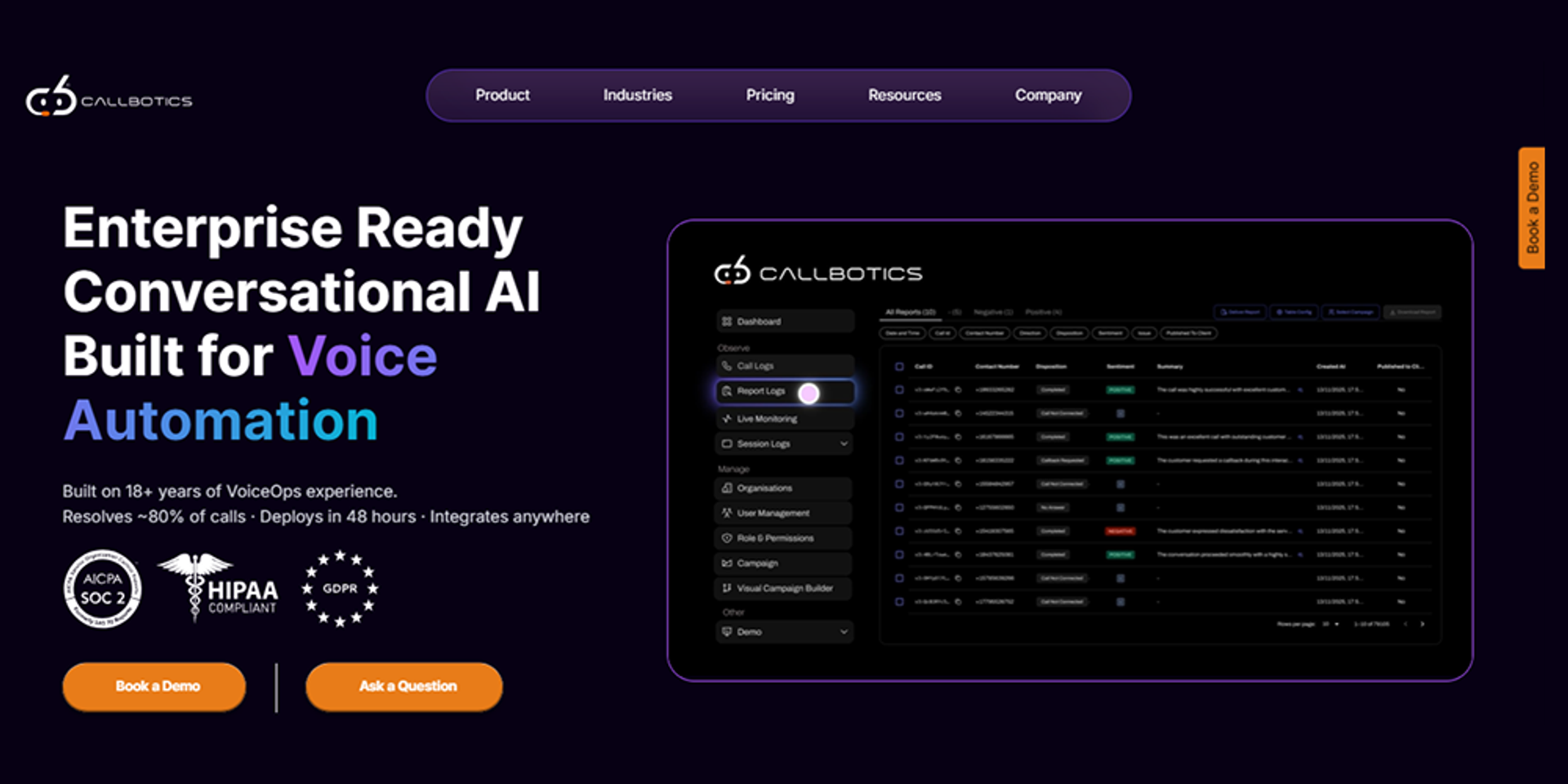
CallBotics is best for enterprises that want to automate customer interactions across voice, email, SMS, chat, and social channels while still prioritizing structured voice execution, workflow outcomes, and operational reporting. Its public positioning leans into business execution, not just on conversation generation, making it a strong fit for contact centers, BPOs, scheduling workflows, support triage, and other high-volume service environments.
That is important because many teams do not just need a voice stack. They need a system that can route correctly, eliminate repetitive work, summarize interactions cleanly, and provide operations leaders with useful visibility into performance. CallBotics appears more aligned to that need than a purely developer-first voice platform.
Vapi is best for teams building and deploying voice AI agents with strong technical control. Its public docs show that calls can be created around assistants, squads, or workflows, and its FAQ emphasizes volume-based per-minute pricing rather than packaged software tiers. That makes it especially relevant for builders who want direct control over telephony, model selection, orchestration, and programmatic call behavior.
In practical terms, Vapi is often a strong fit when voice is the primary channel, the team has engineering resources, and the platform is treated more as a configurable voice layer than a broader enterprise customer interaction system. That does not make it weak. It just means the buyer should be comfortable with a more technical ownership model.
In practice, both platforms follow a similar rollout flow. Teams choose a workflow, define the interaction logic, connect systems, test edge cases, go live, and then review outcomes weekly to improve performance. That setup pattern is common whether the use case is scheduling, support triage, lead qualification, reminders, or inbound service.
The difference is that Vapi usually requires more direct decisions about transcriber, model, voice provider, and orchestration logic. That gives the buyer more flexibility, but it also creates more implementation responsibility. CallBotics, by contrast, is positioned more around faster enterprise rollout and business-use-case execution, which tends to reduce the amount of stack-level ownership the buyer needs to take on up front.
The most important differences are the ones that affect time-to-value, deployment ownership, and total cost over time. For most buyers, those factors are pricing style, workflow control, telephony depth, integrations, analytics, scalability, governance, and omnichannel readiness. Both are credible platforms, but they optimize for different kinds of teams.
Vapi publicly lists usage-style pricing, and its ecosystem is commonly described as charging around $0.05 per-minute for calls, with additional costs for telephony, model usage, concurrency, and hosting-related components. Vapi’s FAQ also confirms that pricing improves with committed monthly volume, which reinforces that it is fundamentally usage-led.
That can be attractive for pilots and variable call programs, but it also means buyers need to look beyond the base rate. The real operating cost may depend on call duration, concurrency, voice provider choice, telephony, and other infrastructure layers. CallBotics, by contrast, is positioned more around packaged enterprise pricing and stable planning, which tends to make budgeting easier for teams that care more about predictable operating cost than about raw minute economics.
Vapi markets fast setup, but actual launch speed still depends on workflow scope, telephony setup, provider choices, testing, and how much configuration the buyer takes on. Because it is more configurable, teams can reduce vendor lock-in, but they also take on more of the implementation burden themselves.
CallBotics has a stronger public positioning around faster production rollout for structured enterprise workflows. That usually makes it the better fit for teams that want to move quickly without building too much orchestration logic internally. In simple terms, Vapi gives more stack control, while CallBotics gives a faster business-ready path for many enterprise use cases.
Vapi emphasizes configurability in code and also supports workflows as a visual orchestration layer for multi-step conversational logic. That makes it attractive for teams that want to own branching, fallbacks, retries, validation, and other interaction rules at a lower level.
CallBotics also supports workflow execution, but its public positioning is more outcome-led than builder-led. That usually makes it a better fit for teams that care less about managing the architecture directly and more about getting business workflows live with strong reporting and operational visibility. Both can support serious automation, but Vapi feels more developer-owned while CallBotics feels more enterprise-operator owned.
Telephony depth is one of Vapi’s clearest strengths. Its platform is centered on voice applications across web, mobile, and network-connected environments, and its docs explicitly support call creation around assistants and workflows. Usage-based pricing and concurrency references also show that telephony is a core part of the product’s design.
CallBotics is also strong in enterprise voice execution, but its public messaging is less about exposing telephony infrastructure details and more about the business outcomes that voice workflows produce. That means Vapi may feel stronger for teams that want deep telephony control, while CallBotics feels stronger for teams that want voice performance inside a broader enterprise automation strategy.
Vapi’s ecosystem supports integration patterns and modular provider connections, and its developer-first posture makes it flexible for API-driven tool actions during or after calls. This is helpful when the team wants to build its own orchestration logic across internal systems.
CallBotics, however, pairs strong workflow execution with a broader public story around business-system connectivity and enterprise automation outcomes. That usually makes it easier for non-developer-heavy teams to evaluate because the question becomes “can it complete the workflow cleanly?” rather than “can we wire everything ourselves?” For enterprise buyers, that difference in framing matters a lot.
Vapi’s analytics story includes transcripts, summaries, structured extraction, and success-style evaluation shortly after the call ends. Its broader tooling supports build-test-deploy cycles, which makes analytics part of a technical optimization loop.
CallBotics places more visible emphasis on operational reporting, summaries, intent-level outcomes, QA-style visibility, and ongoing workflow improvement in real service environments. That makes it a better fit for teams that want analytics to support managers, QA leaders, and service operations, not just developers iterating on prompts and call flows.
Explore CallBotics if you want stronger summaries, reporting, and operational visibility built for enterprise customer interaction workflows, not just voice-stack configuration.Vapi’s pricing page and product ecosystem reference concurrency, including lines, and very large usage figures, including hundreds of millions of calls and millions of assistants launched in broader public materials. That suggests meaningful scale capability, but buyers should still validate real behavior under their own peak-load and overflow conditions rather than relying only on headline scale claims.
CallBotics is easier to evaluate when the scaling problem is operational rather than infrastructural. It is publicly framed around enterprise voice execution, contact center load, queue handling, and structured outcomes, which tends to be more directly useful for operations teams planning high-volume service automation.
Vapi’s public security and privacy docs include HIPAA documentation and broader data-handling guidance, which shows serious attention to regulated deployment scenarios. Buyers should still verify exactly which controls apply to their hosting model, provider choices, and procurement requirements.
CallBotics also positions itself as enterprise-ready, but the public emphasis is more balanced between governance and operational deployment. For many buyers, that makes it feel more usable in a business-led rollout because governance sits inside a more execution-oriented platform story rather than dominating it. Both should be validated in live evaluation, but CallBotics remains highly competitive for enterprises that want strong controls without turning the rollout into a technical integration project first.
| Category | CallBotics | Vapi |
|---|---|---|
| Best for | Enterprise omnichannel automation with stronger voice specialization | Configurable voice AI development and voice-led workflows |
| Pricing approach | More packaged and planning-friendly | More usage-based and minute-led |
| Setup effort | Faster rollout for structured enterprise workflows | More configurable but more technically owned |
| Workflow control | Strong workflow execution with business-outcome focus | Stronger low-level voice-stack and workflow configurability |
| Telephony depth | Strong enterprise voice execution | Stronger explicit telephony and orchestration focus |
| Integrations | Workflow-oriented enterprise connectivity | API-led modular integration flexibility |
| Analytics and QA | Stronger operational reporting and summaries | Stronger technical post-call evaluation loop |
| Scalability | Strong fit for enterprise service operations | Strong public scale posture for voice infrastructure |
| Enterprise controls | Enterprise-ready with execution-oriented fit | Strong compliance-oriented technical documentation |
| Omnichannel readiness | Omnichannel platform with deeper voice specialization | Primarily a voice-first platform |
CallBotics fits best for enterprises that want coordinated customer interaction automation across channels but need voice performance to remain especially strong.
CallBotics is a strong fit for high-volume inbound environments where the goal is to answer faster, reduce hold time, automate repetitive intents, and maintain visibility into call outcomes. Its public positioning around enterprise voice execution and workflow outcomes makes this one of its clearest strengths.
Structured workflows with clear success outcomes, such as booked, rescheduled, canceled, or confirmed, are another natural fit. These are ideal for enterprise teams that want fast automation gains with measurable outcomes.
CallBotics is also well-suited to teams that want voice, email, SMS, chat, and social media coordinated within a single operating model, rather than treating voice automation as a disconnected layer. That matters when the customer journey spans multiple touchpoints, but voice remains the most operationally important one.
See how CallBotics helps teams launch structured AI workflows faster with stronger voice execution, better reporting, and more enterprise-ready operational control.Vapi is strongest for teams building voice-first experiences where configurability, modular architecture, and developer control matter more than packaged enterprise rollout.
Vapi is a strong fit for support, reminders, confirmations, outbound follow-up, lead qualification, and similar phone-based workflows where voice is the primary channel and the team wants a programmable call stack.
Vapi is especially relevant for teams that want to choose their transcriber, model, and voice providers rather than work inside a more pre-shaped enterprise operating model. That modular approach is one of its clearest differentiators.
Teams with in-house engineering resources may prefer Vapi because they can own configuration, orchestration, provider management, integrations, and iterative tuning directly. That can be powerful, but it also assumes technical capacity exists internally.
This is mostly a choice between enterprise operating fit and developer-first flexibility.
Pros
What to validate in a pilot
Pros
What to validate in a pilot
The best decision starts with how your team works, not only what the platform can theoretically do.
Choose CallBotics if you need enterprise omnichannel automation, stronger business-outcome reporting, governance across customer touchpoints, and high-quality voice execution without taking on as much stack ownership internally. It is usually the better fit for teams that want a faster path to production and more visibility into business performance after launch.
Choose Vapi if you want a configurable voice AI platform, have technical resources in-house, value modular provider choice, and prefer to build around a voice-first developer platform.
Test one simple workflow and one medium-complexity workflow, then compare:
That will tell you very quickly whether your team needs a more configurable voice stack or a more packaged enterprise execution model. This is a practical recommendation based on the public positioning of both platforms.
CallBotics helps teams upgrade AI automation faster by combining omnichannel orchestration with stronger visibility into voice-led workflows. Developed by teams with over 18 years of contact center leadership experience, it is built for enterprises that want faster rollout, clearer workflow outcomes, strong summaries, and a continuous improvement loop that service teams can actually use.
What makes CallBotics different:
Both platforms are credible, but they solve different problems. Vapi is a strong fit for technical teams that want configurable voice infrastructure and deeper stack ownership. CallBotics is the stronger fit for enterprises that want omnichannel automation with deeper voice specialization, faster rollout, stronger workflow execution, and clearer operational reporting.
The best choice comes down to your channel mix, workflow complexity, rollout ownership model, governance needs, and budget predictability. If your team wants to move quickly on high-value customer workflows and still keep voice performance as a core strength, CallBotics will usually be the better long-term fit.

Urza Dey (She/They) is a content/copywriter who has been working in the industry for over 5 years now. They have strategized content for multiple brands in marketing, B2B SaaS, HealthTech, EdTech, and more. They like reading, metal music, watching horror films, and talking about magical occult practices.
See how enterprises automate calls, reduce handle time, and improve CX with CallBotics.
CallBotics is an enterprise-ready conversational AI platform, built on 18+ years of contact center leadership experience and designed to deliver structured resolution, stronger customer experience, and measurable performance.