Insurance organizations operate at the intersection of volume, precision, and trust. Every interaction carries implications for compliance, financial accuracy, and customer confidence. Policyholders reach out not only for information but for reassurance that their coverage, claims, and payments are being handled correctly.
Over time, the number of conversations insurers manage has grown steadily. Claims activity fluctuates with weather events. Policy servicing spikes during renewal cycles. Billing inquiries cluster around due dates. Each of these patterns is predictable, yet difficult to manage with human-only models without introducing delays or inconsistency.
This environment has created a clear opportunity for conversational ai for insurance to function as an operational support layer. When designed around real insurance workflows, it strengthens how conversations are handled without altering the fundamentals of insurance service delivery.
Insurance conversations tend to follow structured paths even when the customer’s phrasing varies. A policyholder may begin by asking a simple question, then proceed to a related action once clarity is established. Conversational AI performs best when it mirrors this natural progression.
The interaction typically begins with understanding who the policyholder is and why they are reaching out. Identity context, policy information, and recent activity form the foundation of the conversation. From there, the system identifies intent and determines which workflow applies.
Once intent is established, the AI retrieves relevant data, performs permitted actions, and confirms outcomes. When regulatory, emotional, or complex scenarios arise, the conversation transitions smoothly to a human team member with full context preserved.
Explore how insurance teams automate intake without losing human judgment →
This approach allows AI in insurance to support operational flow rather than interrupt it. Conversations remain purposeful, structured, and aligned with existing processes.
Insurance interactions that preserve context from intake to resolution consistently reduce follow-up calls and rework.
The strongest impact appears in areas where interaction patterns are repeatable and resolution steps are clearly defined.
Claims represent one of the most frequent and sensitive interaction categories in insurance. Policyholders seek confirmation that their claim has been received, clarity on required documentation, and updates on progress.
Conversational AI can guide claim intake by capturing structured information, validating details, and initiating downstream workflows. For existing claims, it can retrieve real-time status, explain next steps, and set expectations clearly. This reduces uncertainty while keeping records synchronized.
Coverage explanations, deductibles, endorsements, and renewal timelines generate consistent inquiry volume. These requests benefit from precise, repeatable responses that reduce variability across agents and channels.
See how insurance operations maintain context from first contact to resolution →
AI-driven interactions ensure that policyholders receive accurate information based on their specific policy context while minimizing manual lookup time for service teams.
Billing inquiries often cluster around predictable dates. Policyholders may ask about premium amounts, payment confirmations, or upcoming due dates. Conversational AI provides immediate clarity while supporting secure transaction workflows where applicable.
This use case contributes directly to reduced inbound volume during billing cycles.
Conversational AI can initiate structured outbound interactions using insurance voice bots to remind policyholders of pending actions, missing documents, or renewal deadlines. These conversations follow the same logic as inbound interactions, ensuring consistency and compliance.
Outbound use cases perform best when they are informational and action-oriented rather than promotional.
While efficiency gains are important, the broader value of conversational AI lies in how it stabilizes operations.
These outcomes become sustainable when AI insurance automation is embedded within operational systems instead of functioning as a disconnected interface.
Conversational AI is most effective when it complements human expertise. It manages structured, repeatable interactions while humans handle scenarios that require judgment, negotiation, or empathy.
By absorbing routine demand, AI allows agents to spend more time on complex cases without increasing workload pressure. This balance improves service consistency and internal satisfaction while maintaining regulatory confidence.
Clear escalation design ensures that automation strengthens trust rather than introducing uncertainty.
Adoption success depends on aligning technology with operational realities rather than theoretical capabilities.
| Operational Area | Value Created |
|---|---|
| Interaction intake | Faster response during demand surges |
| Data capture | Higher accuracy and reduced rework |
| Context continuity | Smoother handoffs across teams |
| Workforce balance | Predictable staffing requirements |
| Service consistency | Repeatable, compliant experiences |
This foundation allows insurance customer service AI to function as a dependable part of daily operations.
Insurance leaders increasingly evaluate technology based on how it improves real outcomes rather than theoretical capability. In service operations, outcomes are measured through experience quality, resolution speed, consistency, and predictability under load.
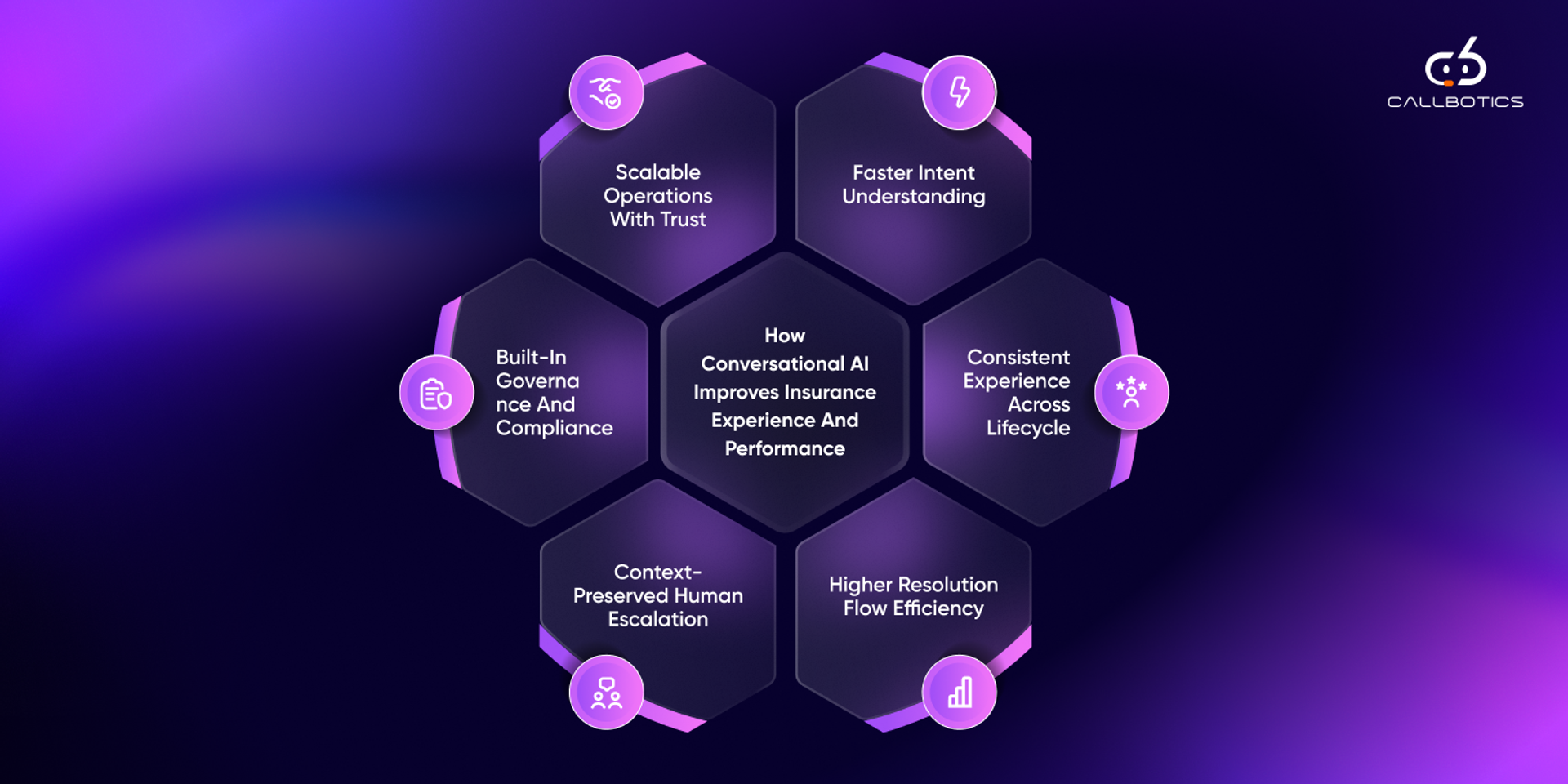
Conversational AI influences these outcomes by shaping how conversations progress, how quickly intent is understood, and how reliably actions are completed. Its impact becomes most visible when applied across the full insurance interaction lifecycle rather than isolated touchpoints.
Insurance conversations tend to cluster around specific moments. Each moment carries different expectations, urgency levels, and emotional context.
During claims related interactions, policyholders seek reassurance and clarity. During policy servicing, they expect accuracy and confidence. During billing inquiries, they value immediacy and transparency. Conversational AI improves experience by adapting to these expectations without requiring customers to change how they communicate.
Key experience improvements include faster acknowledgement of requests, fewer repeated explanations, and clearer guidance on next steps. When conversations flow naturally and resolve efficiently, trust strengthens over time.
Experience consistency matters more to policyholders than channel choice.
Once conversational AI is embedded into daily operations, insurers typically observe changes across several performance indicators.
More conversations are handled concurrently without compromising response quality. This stabilizes operations during renewal cycles and event-driven spikes.
Structured requests move toward completion faster because intent recognition and data retrieval occur early in the interaction.
When conversations move to human teams, context is preserved. Agents receive intent, history, and relevant data upfront, reducing time spent on discovery.
Service teams experience more predictable workloads. Time is redistributed from repetitive inquiries to higher value scenarios that require judgment.
Metrics tied to flow and continuity often improve before cost metrics.
Insurance operations operate within strict regulatory frameworks. Any automation introduced must respect disclosure requirements, data handling standards, and audit expectations.
Conversational AI systems designed for insurance environments include controls that govern what actions can be taken, when escalation is required, and how conversations are recorded. These controls ensure that compliance is embedded into the interaction flow rather than managed after the fact.
Clear governance also supports internal confidence. Teams understand when automation applies and when human involvement is required. This clarity reduces operational risk while enabling scale.
Escalation is not a failure state. It is an intentional design choice that preserves service quality.
Effective escalation occurs when the AI identifies signals such as regulatory boundaries, emotional intensity, or complex exceptions. The handoff includes conversation history, intent classification, and any actions already completed. This continuity allows human agents to step in without restarting the interaction.
When escalation paths are thoughtfully designed, policyholders experience continuity rather than disruption.
Well designed escalation increases confidence in automation across teams.
As insurers mature in their use of conversational AI, adoption often expands into areas that support operational insight and proactive engagement.
These include structured outbound follow-ups tied to claims milestones, proactive reminders during renewals, and internal assistance for agents through real-time prompts and summaries. Each of these use cases builds on the same conversational foundation established for core servicing.
The value of these extensions lies in reuse rather than reinvention. Conversation logic, governance rules, and system integrations remain consistent as new scenarios are added.
Technology adoption succeeds when teams understand how it fits into their roles. Training focuses less on system operation and more on collaboration patterns between AI and humans.
Teams learn when automation applies, how to interpret AI generated context, and how to intervene when judgment is required. This shared understanding ensures that automation supports confidence rather than creating uncertainty.
Insurance environments demand systems that work reliably under pressure. High call volumes, shifting customer intent, peak traffic events, and strict escalation requirements are part of daily operations. Conversational AI delivers value only when it is built to operate within these realities.
CallBotics was designed around real contact center conditions rather than idealized scenarios. Its architecture reflects how insurance conversations actually unfold, including mid-call intent changes, concurrent demand, and the need for seamless collaboration between automation and human teams.
CallBotics strengthens insurance operations by focusing on conversation completion rather than partial automation.
This approach ensures that conversations progress naturally and reliably toward resolution.
Insurance contact centers experience unpredictable surges and sustained concurrency. CallBotics is built to operate consistently under these conditions.
These capabilities allow insurance teams to maintain service quality even during demand spikes.
Operational confidence comes from visibility. CallBotics includes built-in analytics that make performance measurable and actionable.
This visibility supports continuous improvement without adding reporting overhead.
CallBotics is designed to strengthen human teams rather than replace them.
This balance ensures that experience quality and compliance remain aligned.
A practical example of this collaboration model can be seen in CallBotics insurance and regulated workflows.
CallBotics has been deployed in environments where reliability and speed directly affect business outcomes. Across insurance-adjacent use cases, teams report fewer transfers, shorter wait times, and clearer resolution paths.
A detailed case example demonstrating structured conversation handling and backlog reduction is available here.
Conversational AI in insurance delivers the greatest value when it strengthens how conversations already work. Systems that respect workflow reality, preserve context, and support human judgment create stability across operations.
CallBotics brings these principles together by focusing on outcomes rather than surface-level automation. The result is clearer conversations, predictable performance, and insurance operations that scale with confidence.

Alex Penn is a B2B SaaS writer with 3 years of experience turning complex AI topics into clear, practical content for modern businesses. She specializes in AI, automation, and emerging tech, with a knack for making technical ideas accessible without watering them down. Outside of work, Alex bakes cookies for friends and unwinds with a steady diet of indie music.
See how enterprises automate calls, reduce handle time, and improve CX with CallBotics.
CallBotics is an enterprise-ready conversational AI platform, built on 18+ years of contact center leadership experience and designed to deliver structured resolution, stronger customer experience, and measurable performance.