The benefits of conversational AI tend to emerge gradually. They are often first noticed by customers, then by frontline teams, and eventually by leadership as patterns become visible across operations.
One of the earliest shifts customers notice is the feeling that help is always available. When questions are answered immediately, uncertainty is reduced early in the interaction. This creates a calmer starting point for the conversation.
Customers are not left wondering when they will hear back or whether they should try another channel. The conversation begins when the need arises, which helps set a positive tone.
Retail conversations often branch naturally. A customer asking about an order may also want to confirm delivery timing or update contact details. Conversational AI supports this flow by handling related questions within the same interaction.
This continuity helps conversations reach a clear endpoint rather than drifting into follow ups and repeated outreach.
When conversations stay focused, customers feel understood.
As conversational AI handles predictable interactions, human teams find themselves engaging in conversations that feel more meaningful. These are moments where explanation, reassurance, or coordination plays an important role.
This balance supports a more sustainable rhythm for teams and helps preserve energy for interactions where human presence adds genuine value.
See how CallBotics supports retail conversations from first intent to final resolution.
When a system remembers prior context, customers notice. They do not need to restate order numbers or explain their situation again. The conversation continues naturally.
This kind of personalization feels less like targeting and more like attentiveness. It shows respect for the customer’s time and effort.
During product exploration or post-purchase evaluation, customers often look for confirmation rather than persuasion. Conversational guidance helps answer specific questions, clarify options, and remove uncertainty.
This support builds confidence and allows customers to move forward comfortably, knowing they have the information they need.
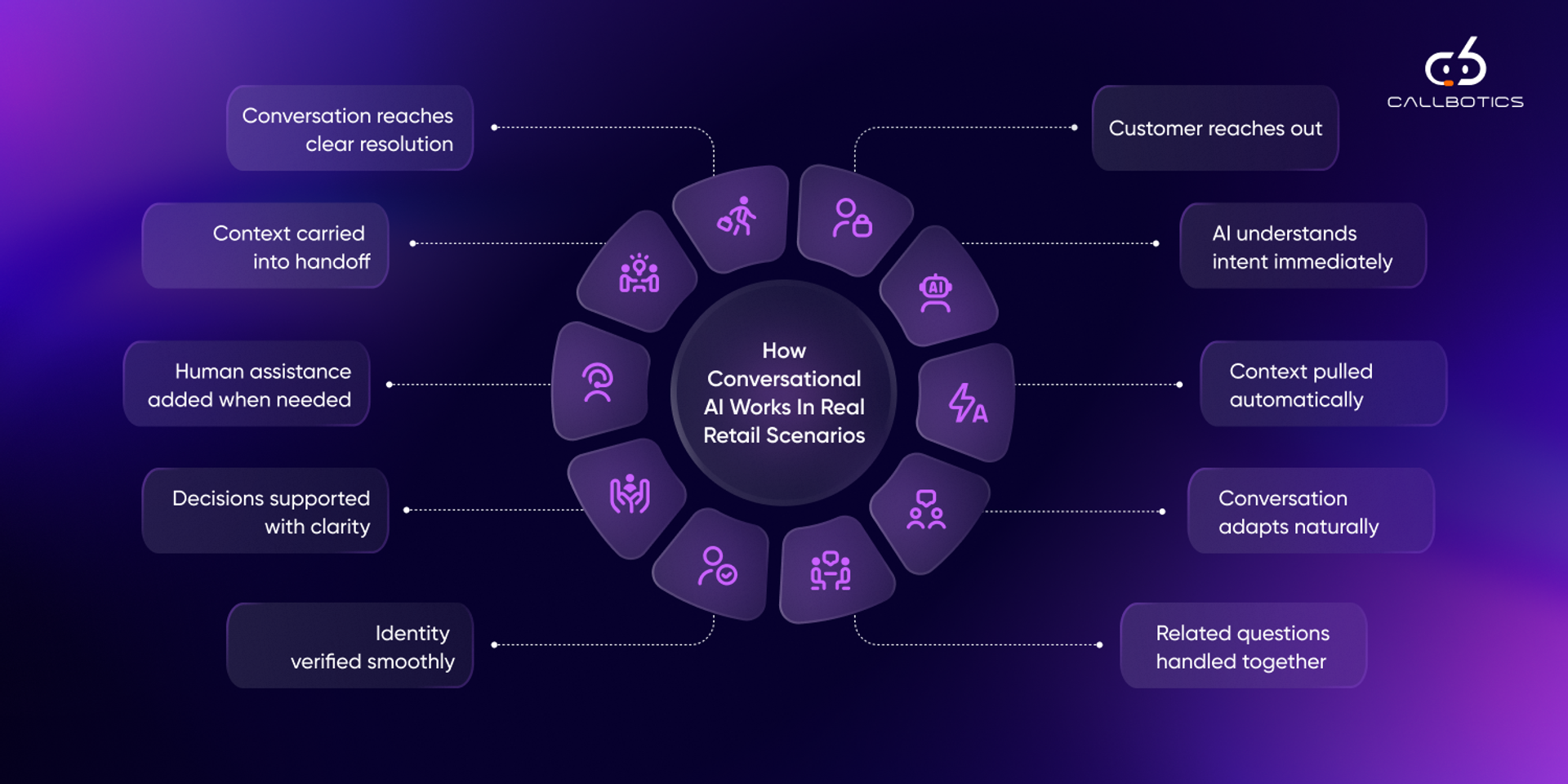
Looking closely at common retail moments helps illustrate how these benefits show up in practice.
A customer checks on an order and receives clear information immediately. If delivery timing needs clarification, that detail is addressed in the same exchange. If a change is required, the conversation adapts.
The interaction concludes with certainty rather than leaving questions open.
When account or order details are involved, identity confirmation happens smoothly within the conversation. Customers feel secure without experiencing unnecessary steps or interruptions.
This balance between security and ease helps preserve trust.
Retail policies and product details can be complex. Conversational AI presents this information clearly and consistently, helping customers make sense of it in their own time.
The conversation adapts to the customer’s questions rather than forcing them into predefined paths.
When a conversation benefits from human involvement, context is carried forward. Agents enter the interaction already informed, allowing them to focus on resolution rather than discovery.
This continuity helps conversations feel seamless and respectful.
Voice remains an important channel, particularly in moments where reassurance or immediacy matters. Customers often choose to speak when clarity feels urgent or when they want confirmation.
Voice interactions supported by shared conversation logic allow these moments to feel like a continuation rather than a restart. Customers are guided through the conversation naturally, with context preserved across channels.
| Retail Moment | Role of Voice |
|---|---|
| Delivery concerns | Immediate clarity |
| Account access | Confident verification |
| Time sensitive updates | Faster understanding |
| Escalations | Smooth progression |
Voice conversations feel most effective when they follow the same narrative as digital ones.
Conversational AI does not transform retail experiences overnight. Its influence accumulates as conversations become easier to resolve and less effort is required from customers and teams.
| Area | Gradual Effect |
|---|---|
| Customer effort | Decreases steadily |
| Resolution speed | Improves naturally |
| Consistency | Becomes dependable |
| Team workload | Feels more balanced |
| Experience | Gains stability |
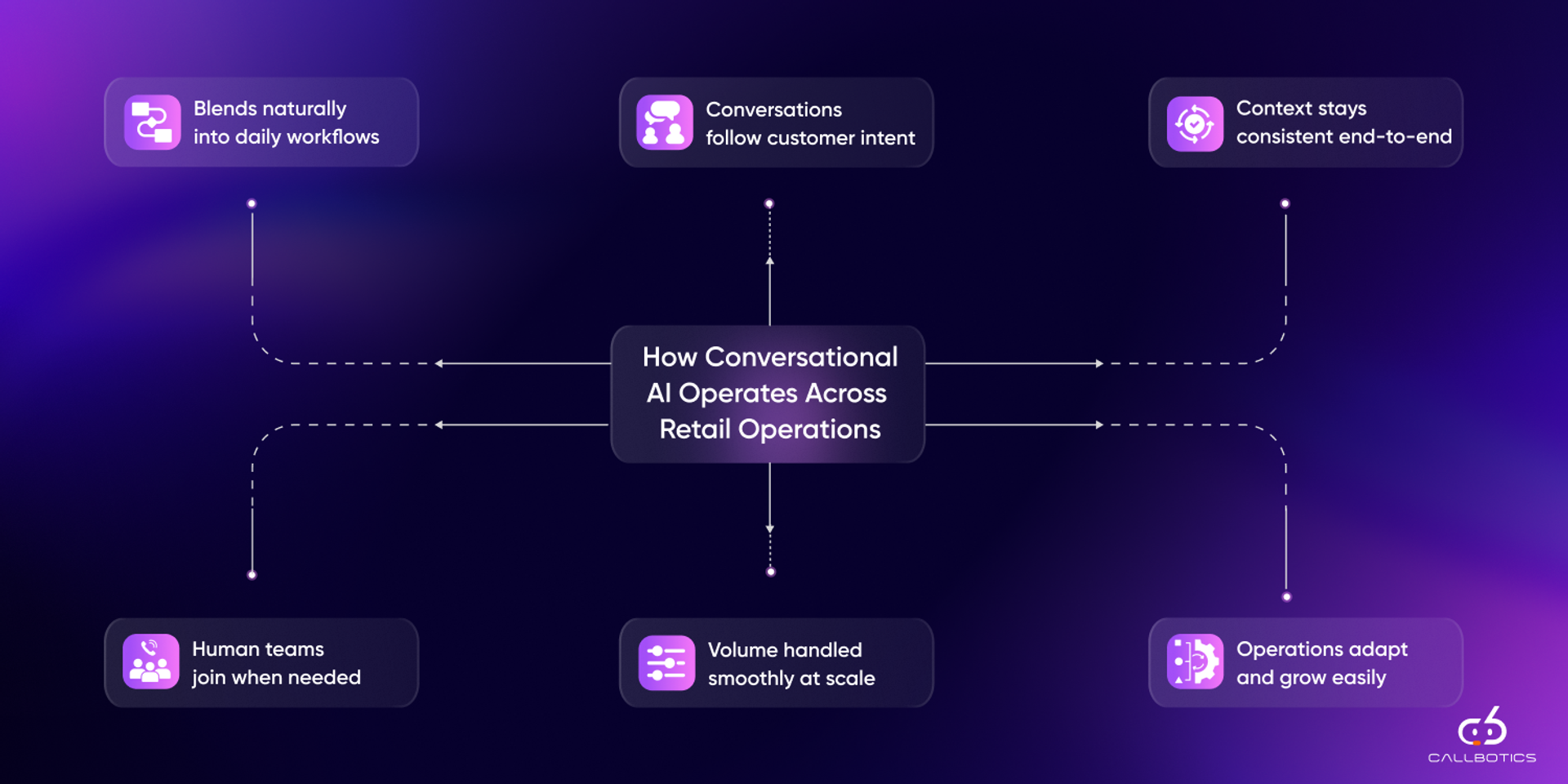
Once conversational AI becomes part of retail operations, it tends to blend in rather than stand out. It does not announce itself. It simply supports conversations in the background, allowing interactions to move forward without interruption.
Retail operations are built around rhythms. Daily order inquiries, periodic delivery questions, promotional spikes, and seasonal demand all create predictable patterns of interaction. Conversational AI works best when it aligns with these rhythms instead of trying to change them.
In practice, this means supporting the conversations that already exist and gently removing friction from them. Teams continue to operate as they always have, but with a steadier flow and fewer interruptions.
The most effective operational changes feel supportive rather than disruptive.
Retail conversations usually begin with a clear purpose. A customer wants to know something, confirm something, or change something. Conversational AI performs best when it is designed around these intentions rather than abstract scenarios.
For example, an order inquiry often leads to related questions about delivery timing or address confirmation. A return request may lead to clarification around eligibility or timelines. These are natural extensions of the same conversation.
When conversation design reflects this reality, interactions feel cohesive. Customers do not experience abrupt stops or forced transitions. The conversation unfolds naturally until resolution is reached.
This approach also makes operations more predictable. Teams know which interactions will be handled automatically and which will naturally progress to human involvement.
One of the quieter benefits of conversational AI is how it supports frontline teams without asking them to relearn their roles.
Agents continue to engage with customers as they always have. The difference is that when they enter a conversation, context is already present. The reason for the interaction is clear. Previous steps are visible. This allows agents to focus on resolution rather than discovery.
Over time, this changes the quality of interactions. Conversations feel more intentional. Agents spend less time gathering information and more time guiding customers forward.
Clarity at the start of an interaction often determines how smoothly it ends.
Retail volume fluctuates. Some days are calm. Others bring unexpected surges driven by campaigns, holidays, or external factors. Conversational AI absorbs these changes quietly by handling predictable interactions consistently.
This creates breathing room across operations. Queues move more steadily. Customers receive timely responses. Teams are not forced into reactive adjustments.
What is especially valuable is that this support is available continuously. Conversations can begin and resolve at any hour without creating additional scheduling complexity.
Customers naturally move between digital and voice channels depending on their needs. Sometimes they prefer typing. Other times, speaking feels more reassuring.
Conversational AI supports this behavior by maintaining continuity across interactions. Context travels with the customer. The conversation feels like one experience, not multiple disconnected moments.
This continuity reduces repetition and builds trust. Customers feel recognized rather than processed.
Retail leaders often look for clear indicators that conversational AI is delivering value. The most useful measurements tend to focus on flow and effort rather than volume alone.
Some teams track how quickly conversations reach resolution. Others look at how often customers return with the same question. Over time, patterns emerge that show whether interactions are becoming simpler and more complete.
These indicators help leaders understand progress without needing to interpret abstract metrics. The experience itself becomes the signal.
When conversations become easier, outcomes usually follow.
As conversational AI becomes embedded in daily operations, it creates flexibility for future expansion. New use cases can be added gradually. Seasonal workflows can be adjusted. Communication strategies can evolve without rebuilding systems from scratch.
This adaptability is particularly valuable in retail, where change is constant. Teams are able to respond thoughtfully rather than reactively.
Retail conversations work best when they feel complete. Customers ask a question, receive clarity, and move forward without friction. Teams operate best when conversations follow predictable paths and escalation happens only when it adds value.
CallBotics was designed around this reality.
Rather than focusing on isolated automation tasks, CallBotics supports structured retail conversations from start to resolution. It assumes real-world conditions like fluctuating call volumes, mixed customer intent, and the need for seamless collaboration between AI and human teams.
Learn how CallBotics applies conversational AI to real retail workflows.
CallBotics is built to handle conversations that have a clear purpose and a defined outcome. Order inquiries, delivery updates, appointment confirmations, and follow-up calls are completed end to end rather than paused midway.
This helps retail conversations conclude with certainty, reducing follow-ups and unnecessary transfers.
Retail environments move fast. CallBotics is designed to be ready for deployment in 48 hours, allowing teams to activate support for high-impact workflows without lengthy setup cycles.
This speed makes it easier to align automation with seasonal demand or immediate operational needs.
Retail conversations are not purely transactional. Tone matters. CallBotics uses real-time sentiment analysis to adjust responses and escalation paths during interactions.
When conversations require a more careful handoff, that transition happens naturally and with context intact.
Retail communication does not happen in one direction. CallBotics handles inbound and outbound calls using the same conversation logic. Order confirmations, delivery reminders, and follow-ups follow the same structured approach as incoming inquiries.
This consistency helps customers experience continuity regardless of who initiates the interaction.
Call volumes fluctuate. CallBotics is designed to scale across concurrent conversations without degrading performance. Whether demand is steady or spiking, conversations remain responsive and predictable.
This reliability is especially valuable during promotions, peak seasons, and unexpected surges.
CallBotics includes built-in real-time analytics that make conversation outcomes visible. Teams can see resolution patterns, escalation behavior, and interaction flow without relying on disconnected reporting systems.
This transparency helps leaders understand what is working and where conversations can be refined.
When these capabilities come together, the impact becomes practical and measurable.
For customers, this means fewer transfers, shorter wait times, and clearer resolution. For teams, it means predictable performance, faster deployment, and lower operational complexity.
CallBotics strengthens retail operations by quietly removing friction from routine interactions while preserving human judgment for moments that benefit from it most.
Retail continues to evolve, but the role of conversation remains constant. Customers want clarity, reassurance, and continuity. Teams want predictability, focus, and confidence in how interactions are handled.
Conversational AI supports these needs quietly and effectively when it is designed around real retail conversations. When paired with a platform like CallBotics, it becomes part of the operational fabric rather than an overlay.
The result is not louder automation. It is calmer conversations that resolve naturally.

See how enterprises automate calls, reduce handle time, and improve CX with CallBotics.
CallBotics is an enterprise-ready conversational AI platform, built on 18+ years of contact center leadership experience and designed to deliver structured resolution, stronger customer experience, and measurable performance.