Many contact center teams use the terms conversational AI and generative AI as if they mean the same thing. They are related, but they solve different parts of the customer interaction problem. One is mainly built to manage conversations through structured flows, intent recognition, and workflow execution. The other is mainly built to generate flexible, human-like responses based on context.
That difference matters because the wrong expectation leads to the wrong deployment. Teams that expect generative AI alone to run every workflow safely often run into control and compliance issues. Teams that rely only on rigid conversational flows can end up with experiences that feel mechanical and frustrating when more flexibility is needed.
This guide explains the difference between conversational AI and generative AI in contact centers, where each one fits best, where they overlap, and why the strongest operating model usually combines both.
Conversational AI is a category of technology designed to understand what a customer wants, guide the interaction toward the right next step, and complete tasks through workflows, integrations, and business rules. In contact centers, it is often the system behind AI call routing, self-service flows, appointment booking, balance checks, support intake, and other structured conversations.
The goal of conversational AI is not just to talk naturally. It is to move the customer through a defined journey with enough control and consistency that the business can trust the outcome.
Conversational AI usually works by identifying intent, extracting key details, and then following a workflow to decide what happens next. If a caller says they want to reschedule an appointment, the system identifies the request, captures the relevant information, checks connected systems, and then either completes the task or routes the interaction correctly.
This approach depends on structured logic. It may feel conversational to the customer, but underneath, it is usually driven by defined paths, decision rules, and task-specific actions.
See how CallBotics helps teams combine workflow control, live integrations, summaries, and smarter automation to improve customer interactions without adding unnecessary complexity.Conversational AI is widely used in contact centers for IVR replacement, call routing, FAQ handling, self-service, appointment scheduling, order status, account updates, and support triage. These are all environments where the customer journey is structured enough that the next step can be clearly defined.
The biggest strengths of conversational AI are reliability, consistency, control, and workflow completion. It works well when the business needs predictable behavior, repeatable service quality, and clean integration with backend systems.
Generative AI is a category of AI that creates new responses based on context rather than relying solely on predefined scripts or fixed decision trees. In contact centers, it is often used to generate summaries, suggest replies, rewrite messages, search knowledge more flexibly, and support agents during live interactions.
The goal of generative AI is not to follow a narrow script to the letter. It is to produce useful language and content that adapts to the situation.
Generative AI typically uses large language models to interpret prompts, understand context, and generate natural language responses. Instead of selecting from a fixed set of answers, it creates a response dynamically based on what it has been given and what it has learned from the model and any connected context.
That is what makes it powerful for less predictable conversations, but it is also why it needs stronger guardrails in customer-facing environments.
Generative AI is commonly used for agent assist, after-call summaries, note generation, knowledge search, personalized reply suggestions, and content creation for support teams. It is also increasingly used inside customer-facing AI systems to make responses feel more natural and context-aware.
The biggest strengths of generative AI are flexibility, speed of content creation, natural language quality, and adaptability in conversations that are less repetitive or more variable. It is especially useful when customers ask the same question in many different ways or when agents need help responding faster.
The simplest way to compare the two is to look at what each one is optimized to do. One is mainly optimized for controlled workflow execution. The other is mainly optimized for flexible language generation and contextual assistance.
| Dimension | Conversational AI | Generative AI |
|---|---|---|
| Primary purpose | Workflow handling and task completion | Flexible response and content generation |
| Best for | Routing, self-service, structured automation | Summaries, agent assist, natural response generation |
| Strength | Control and consistency | Adaptability and natural language |
| Risk | Can feel rigid if over-structured | Can drift without guardrails |
| Typical contact center role | Handles the workflow | Enhances the experience inside the workflow |
Conversational AI is usually more flow-based. It works best when the business can define the next step in advance. Generative AI is more open-ended. It is better at adapting responses when the wording, context, or conversation style varies more widely.
Conversational AI gives the business more control over what is said and what actions can be taken. Generative AI gives more flexibility in how responses are formed, but that flexibility can create inconsistency if it is not managed properly.
Conversational AI is often better for completing tasks such as routing, booking, confirming, updating, or escalating. Generative AI is often better for creating summaries, explanations, suggestions, and more natural conversational support.
Conversational AI is more predictable, which is why it fits regulated or rule-based workflows well. Generative AI is more capable of handling variation, but it may produce responses that need tighter policy controls and stronger review logic.
Conversational AI is usually the better choice when the workflow is structured, high-volume, and easy to define in advance. That is where control, speed, and repeatability matter most.
Routing, scheduling, order status, balance checks, FAQs, and similar requests are ideal for conversational AI because the system can guide the interaction efficiently and complete the task with minimal variation.
When the business needs strict wording, clear verification steps, or precise workflow control, conversational AI is usually safer. It reduces the chance of drifting outside the approved process.
If the next step is easy to define and the workflow has a known outcome, conversational AI is often the most practical choice because it handles structured journeys cleanly and predictably.
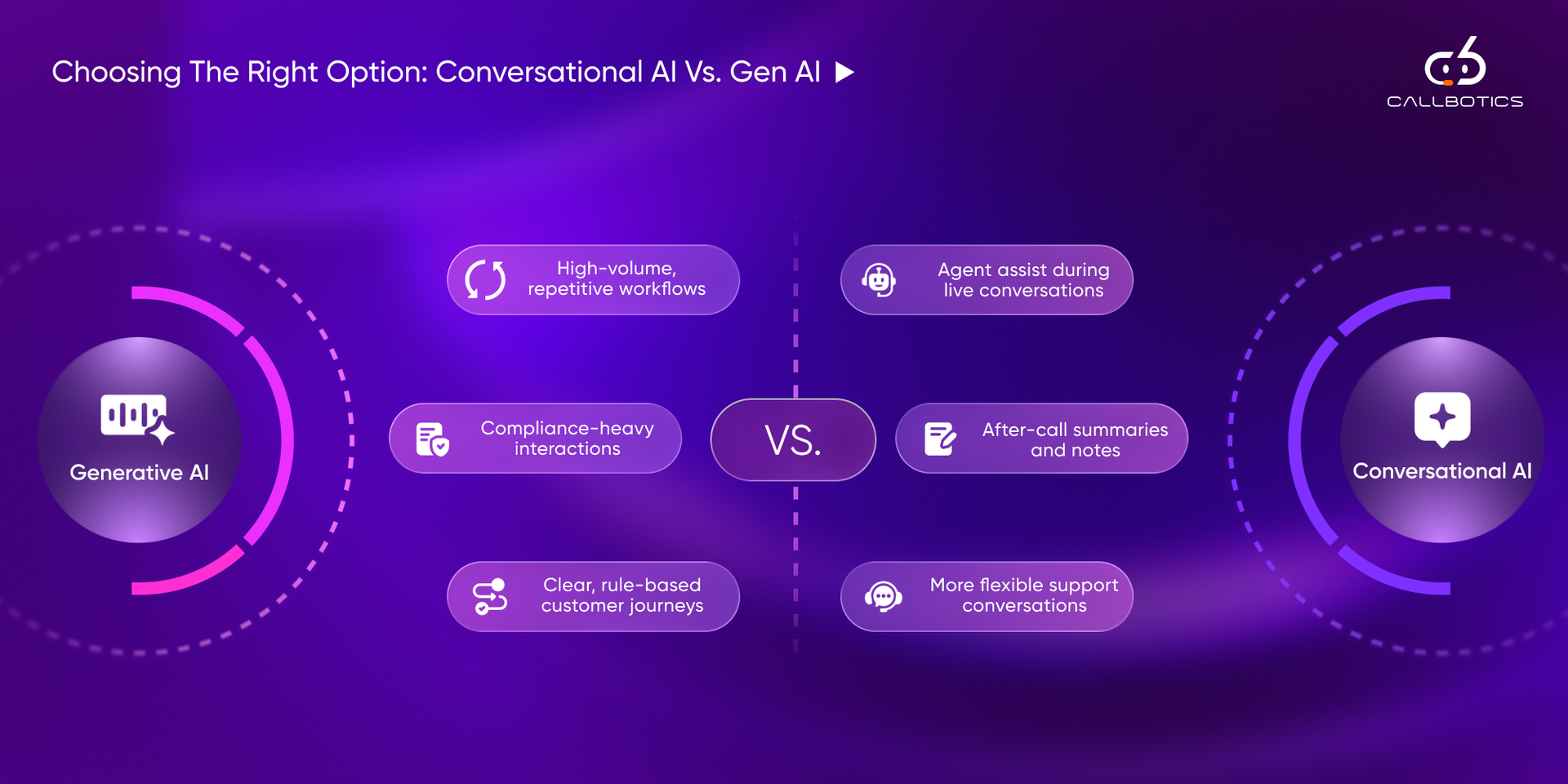
Generative AI adds more value when the interaction needs flexibility, richer language, or intelligent assistance rather than strict workflow progression.
Generative AI is very useful during live calls because it can suggest replies, surface relevant knowledge, recommend next-best actions, and help agents move faster without relying entirely on memory or manual search.
This is one of the strongest contact center use cases for generative AI. It reduces manual note-taking, speeds up wrap-up work, and helps teams capture interaction context more consistently.
When customer questions vary a lot in wording or structure, generative AI can help produce more natural and adaptable responses than a fully scripted system alone.
The real opportunity is not choosing one and rejecting the other. The strongest contact centers combine both in a way that gives them control where they need it and flexibility where it helps the experience.
Conversational AI is best placed at the workflow layer. It handles routing, decision logic, verification, structured task execution, and system-controlled movement through the interaction.
Generative AI can improve the customer and agent experience inside that workflow by making responses sound more natural, improving summaries, personalizing wording, and helping agents with better suggestions.
When both are combined well, the result is better than either one alone. The business gets structured automation and task completion, while customers and agents get a more natural and useful interaction experience.
Explore CallBotics to see how structured automation and smarter response layers can work together to improve routing, summaries, and customer experience across contact center workflows.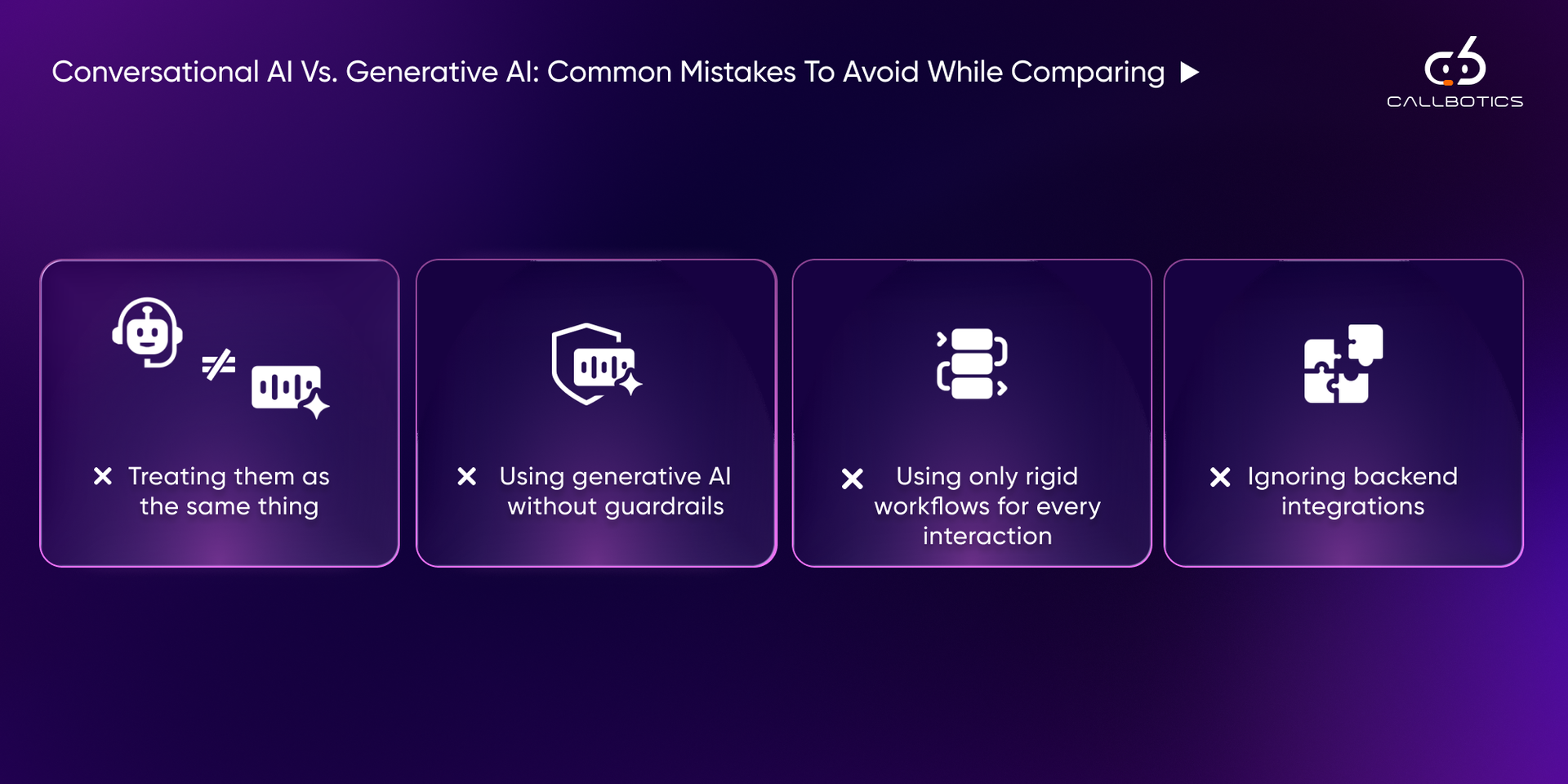
A lot of enterprise confusion comes from comparing conversational AI and generative AI as if they are competing for the same job. In reality, they often work best when they support different parts of the interaction.
This is the most common mistake. If a team thinks both are interchangeable, it will often buy the wrong platform or set the wrong expectations for rollout.
Generative AI can be powerful, but if used without workflow boundaries, policy controls, or escalation rules, it can produce inaccurate or inconsistent responses in customer-facing situations.
The opposite mistake is assuming every customer interaction should stay completely scripted. Over-structured flows can feel frustrating when customers need flexibility or when the conversation doesn't follow the expected path.
Neither conversational AI nor generative AI creates much value if the system cannot connect to the CRM, ticketing, billing, booking, or scheduling tools that actually drive the task.
The right choice depends on the type of support your customers need and what outcomes matter most to the business. The goal is not to sound modern. The goal is to make support faster, clearer, and easier to scale.
Look at the type of interactions customers are actually having. Are they asking repetitive, structured questions, or are they entering more varied, open-ended support situations? That usually tells you which technology should take the lead.
Use conversational AI where the workflow is rule-based and completion matters. Use generative AI where language flexibility, summaries, and agent support create more value. Use both together when you need both control and adaptability.
The best decision comes from asking which setup improves resolution, speed, transfer quality, customer experience, and ROI. The label matters less than the result.
CallBotics combines conversational AI and generative AI in a way that matches how contact centers actually operate. Structured workflows handle routing, task completion, verification, and system-driven actions, while generative capabilities improve summaries, response quality, and smarter interactions inside the workflow.
Developed by teams with over 18 years of contact center and BPO experience, CallBotics is built around real service operations rather than abstract AI categories. That is why it focuses on measurable outcomes such as resolution, routing quality, handoff continuity, and operational visibility instead of just conversation style.
What makes CallBotics different:
Conversational AI and generative AI are not the same, and contact centers get the best results when they stop treating them as if they are. Conversational AI is usually the better choice for control, workflow execution, and task completion. Generative AI is usually the better choice for flexibility, summaries, agent assistance, and more natural language support.
The strongest strategy is not to choose one category blindly. It is to use conversational AI for structure and reliability, and generative AI for flexibility and support inside that structure. When combined well, they improve both automation and customer experience in a way that feels practical, not theoretical.

Urza Dey (She/They) is a content/copywriter who has been working in the industry for over 5 years now. They have strategized content for multiple brands in marketing, B2B SaaS, HealthTech, EdTech, and more. They like reading, metal music, watching horror films, and talking about magical occult practices.
See how enterprises automate calls, reduce handle time, and improve CX with CallBotics.
CallBotics is an enterprise-ready conversational AI platform, built on 18+ years of contact center leadership experience and designed to deliver structured resolution, stronger customer experience, and measurable performance.