Contact center SLAs rarely break because teams do not care about performance. They break because real operations are messy. Demand spikes hit faster than expected, schedules do not fully align with queue pressure, calls get routed poorly, repeat contacts clog capacity, and average handle time stretches longer than planned. In that environment, even a well-managed team can fall behind quickly.
That is why SLA management is not just about reporting after the fact. It is about managing service levels in real time, understanding what is pushing performance off target, and taking action before backlogs and abandonment rates compound. The teams that do this well are not only watching the numbers. They are actively removing the friction that causes those numbers to slip.
This guide explains how contact center SLA management works, which metrics matter most, why SLAs are often missed, and how AI helps teams hit service targets more consistently without burning out agents or increasing headcount at the same pace as demand.
Contact center SLA management is the process of defining service targets, measuring performance against those targets, and taking action to keep service delivery within acceptable levels. In simple terms, it is how teams make sure customers are answered and helped within the timeframes the business has committed to.
That usually includes speed targets, such as answering a percentage of calls within a certain number of seconds, but it also extends beyond speed alone. A strong SLA program considers whether customers are getting timely help across channels, whether queues are stable, whether abandonments are rising, and whether the team is resolving issues efficiently enough to prevent future backlog.
This is why SLA management should be treated as an operating discipline, not just a reporting exercise. It is about maintaining service consistency under real conditions, even when volume shifts, staffing changes, and customer expectations rise.
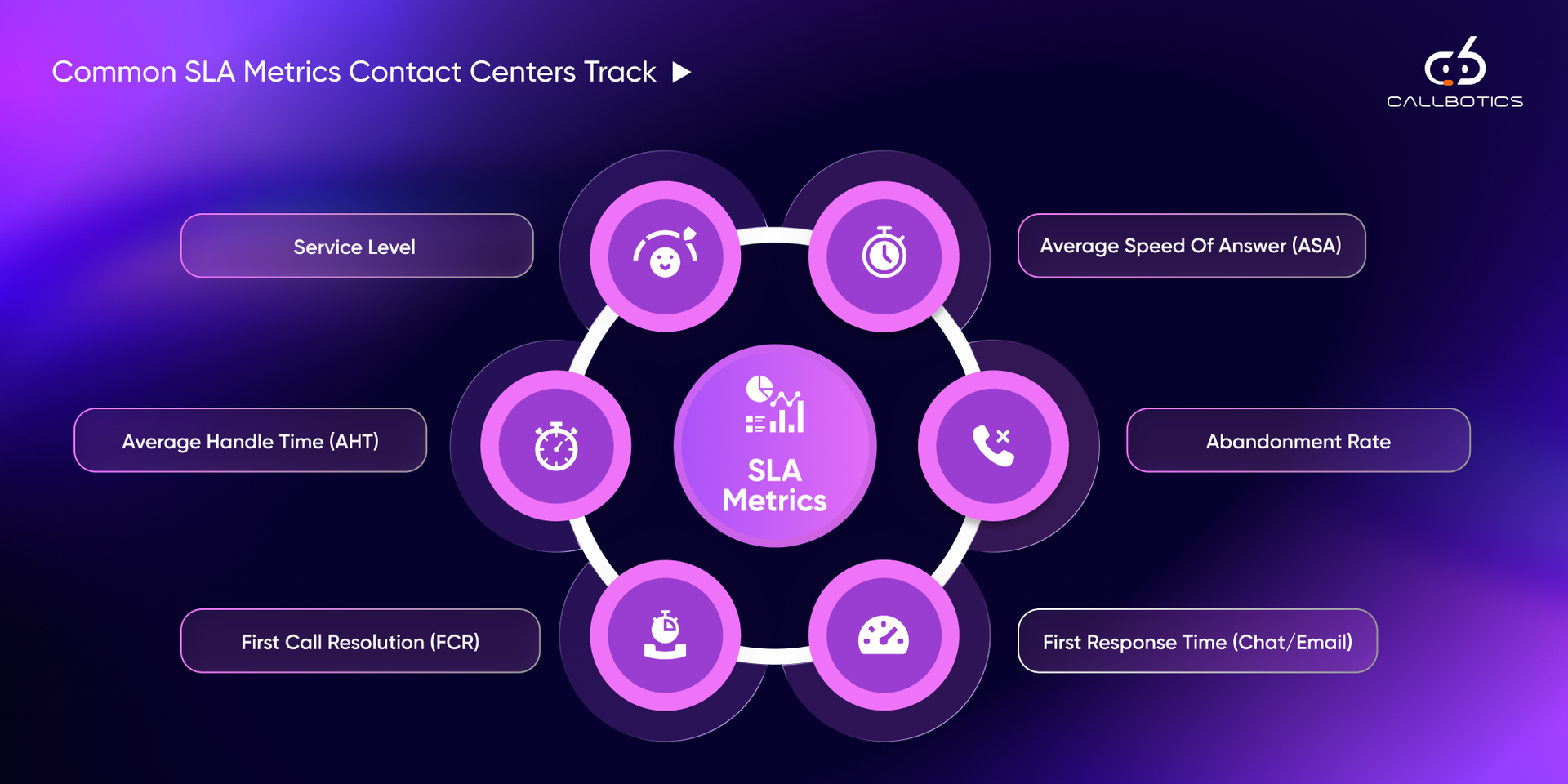
Before improving SLA performance, teams need a clear view of what they are measuring. Most contact centers track a familiar set of service metrics, but those metrics are useful only when leaders understand what each one actually reveals about queue health, capacity, and customer experience. SLA performance is rarely explained by a single number.
Service level is the classic contact center SLA metric. It measures the percentage of calls answered within a target timeframe, such as 80 percent of calls answered within 20 seconds. This is why targets like 80/20 are still widely used.
The reason service level remains important is that it provides a quick snapshot of how well the contact center is keeping up with inbound demand. When service level drops, it usually signals that the queue is under pressure and that customers are waiting longer than the business intends.
Average speed of answer measures how long callers wait before reaching a live person or live support path. While service level shows whether a target is being met, ASA shows what the actual wait experience looks like across the queue.
This metric becomes especially useful during spikes because it reveals how fast the queue is slowing down in real time. A rising ASA is often an early sign that staffing, routing, or demand control needs attention.
Abandonment rate measures how many callers hang up before they get help. This is one of the clearest indicators of queue stress because it reflects customer behavior, not just operational timing.
If abandonment rises, it usually means wait times are too long, the routing experience is poor, or callers are losing confidence that they will get help quickly. That makes abandonment an important SLA health signal, not just a secondary metric.
For non-voice channels, first response time measures how quickly a customer receives an initial reply. This channel-specific equivalent of queue speed is critical for maintaining consistent service expectations across chat, email, and messaging environments.
Teams that manage SLAs across multiple channels need this metric because voice-only visibility can hide service gaps elsewhere in the operation.
SLA success is not only about speed. It is also about whether the issue is solved in the first interaction. First call resolution measures whether a customer’s issue was handled without requiring a repeat contact.
This matters because a fast answer that does not resolve the issue simply creates more demand later. In that sense, FCR is one of the most important support metrics for protecting future SLA performance.
Average handle time measures how long agents spend completing an interaction, including talk time and any related wrap-up work. AHT affects service levels directly because longer calls reduce total capacity and increase queue pressure.
That does not mean lower AHT is always better. Inefficient workflows, repeated explanations, and limited knowledge access can make it harder to hit SLA targets because each call consumes more capacity than it should.
Most missed SLAs are symptoms of broader operational problems. If leaders only react to the service-level number without understanding what drives it, the same problems keep recurring. Strong SLA management starts with identifying the underlying causes that push queues out of balance in the first place.
Volume surges can overwhelm a queue very quickly. Seasonal demand, campaign spikes, billing cycles, outages, and service incidents all create pressure that may not be fully absorbed by the planned schedule.
When this happens, even small forecast misses turn into longer wait times, rising ASA, and higher abandonment. Demand variability is one of the most common reasons contact centers miss service targets.
When calls are routed incorrectly, the customer loses time before they even reach the right support path. That increases average handle time, creates additional queue load, and frustrates the caller before the issue is addressed.
Too many transfers have a similar effect. Each transfer adds time, increases effort, and reduces the chances of quick resolution. Poor routing is often one of the biggest hidden contributors to missed SLAs.
High-volume repetitive calls can overwhelm the queue even when the issues themselves are simple. Common examples include order status, appointment confirmations, account lookups, password resets, and routine billing questions.
These calls are not always difficult to handle, but they consume a large share of capacity and make it harder for the team to protect service levels for more complex requests.
When agents have to search across multiple systems, hunt for answers, or pause to clarify internal processes, handle time rises and the queue slows down. These are not always visible as obvious SLA failures at first, but they steadily reduce service capacity.
The slower an agent can move from question to answer, the harder it becomes to keep service levels stable during busy periods.
SLA performance is heavily shaped by whether staffing coverage actually matches demand. Understaffed intervals, poor forecast alignment, and imbalanced schedules create service gaps that show up immediately in answer speed and abandonment.
This is why workforce planning and intraday coverage decisions have such a direct relationship to SLA attainment.
Teams that manage SLAs well do not rely on a single dashboard and hope for the best. They build a daily operating rhythm around forecasting, monitoring, escalation logic, and follow-up analysis. This is what allows them to respond early instead of reacting only after service levels are already damaged.
Good SLA management starts before the day begins. Teams should use historical demand patterns, known events, seasonality, promotions, and operational changes to forecast likely volume and align staffing accordingly.
The better the forecast, the better the chance of protecting service levels before pressure builds. This is where many avoidable SLA misses can be prevented.
SLA performance needs real-time visibility. Teams should monitor service level, ASA, abandonment, queue length, and channel pressure continuously enough to detect emerging risk early.
The purpose of real-time monitoring is not just awareness. It is an intervention. The sooner teams spot slippage, the sooner they can adjust routing, staffing, or overflow logic before the queue becomes unstable.
When service levels are under pressure, the operation needs a defined plan for handling overflow. That may include routing to backup queues, activating overflow teams, prioritizing urgent interactions, or shifting traffic away from overloaded paths.
Without these rules, queue recovery becomes slower and more inconsistent.
Average handle time improves when workflows are cleaner. Better knowledge access, less tab switching, clearer scripts, and better pre-call context all help reduce unnecessary friction.
The goal is not to rush agents. It is to remove the delays that stretch calls longer than necessary and reduce the center’s available capacity.
Strong teams do not treat missed SLAs as isolated bad days. They review patterns weekly, identify which queues or call types are causing the most service pressure, and then fix the underlying issue.
That might mean improving routing, reducing repeat contacts, changing schedule coverage, or improving knowledge access. The point is to use SLA misses as operational insight, not just performance reporting.
AI helps contact centers hit service levels by changing the shape of demand and improving the way interactions move through the system. Instead of relying only on more staffing or tighter queue discipline, AI gives teams another way to reduce wait times, absorb repetitive volume, and speed up resolution where it matters most.
AI voice agents can answer inbound calls immediately, which reduces the number of customers waiting in the human queue just to begin the interaction. That matters most during high-volume periods, when even a modest amount of queue absorption can improve service levels noticeably.
This helps protect SLA performance because callers do not have to wait for a live agent just to state a simple request.
AI improves routing by identifying what the caller actually needs instead of depending only on static menu choices. That leads to more accurate queue placement, fewer wrong transfers, and less time wasted before the issue reaches the right support path.
Better routing improves both speed and efficiency, which has a direct impact on SLA stability.
One of the biggest ways AI supports SLAs is by resolving repetitive, high-volume requests without sending every call into the human queue. This reduces total demand on agents and creates more capacity for issues that actually require human judgment.
That means better service levels are achieved not just by moving faster, but by reducing the number of interactions human teams need to handle directly.
When AI gathers the right details before a call reaches an agent, the human interaction starts with more context and less repetition. That shortens average handle time and reduces the time lost to re-asking questions.
For SLA management, this matters because even modest improvements in handle time can create meaningful capacity gains across a high-volume operation.
AI can also help teams detect queue pressure and SLA breach risk earlier by surfacing patterns such as rising call volume, route failure trends, or spikes in repeat intents. This gives managers a chance to intervene earlier with routing or coverage decisions.
The value here is not just automation. It is earlier visibility and faster response to emerging SLA pressure.
Want to see how CallBotics helps contact centers reduce queue pressure and protect service levels with AI voice automation? Contact our CallBotics experts.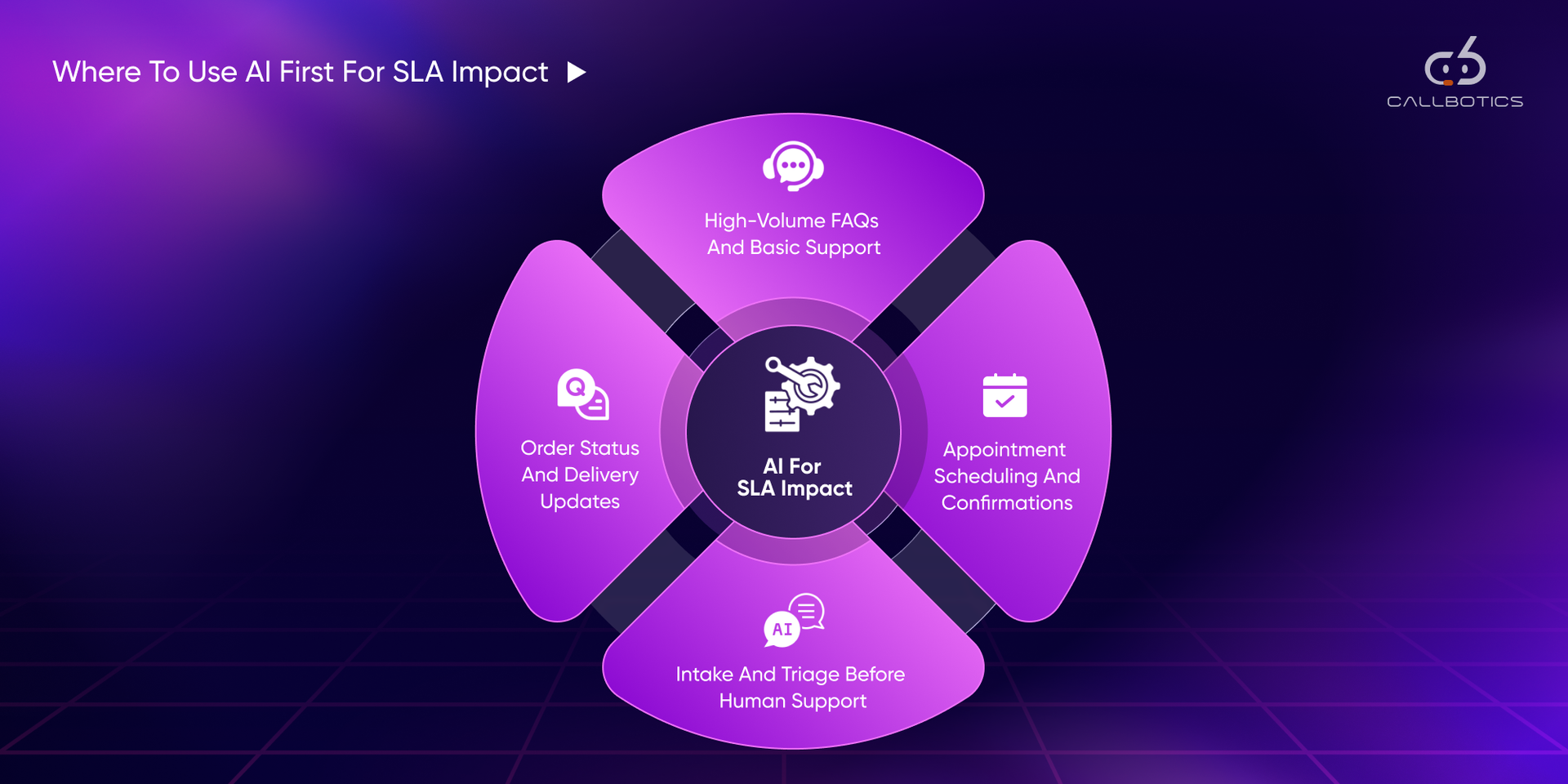
The best first AI use cases for SLA improvement are the ones that reduce pressure quickly without introducing unnecessary complexity. In most contact centers, that means starting with structured, high-volume call types that consume a large share of agent time but do not require heavy judgment.
Simple support questions and common FAQs are often the best place to start because they create a predictable queue load and follow structured response paths. Removing those from the live queue can improve service levels quickly.
Scheduling workflows are highly structured and easy to measure. AI can handle confirmations, rescheduling, reminders, and basic booking flows with clear success outcomes, which makes this a strong early use case.
Where-is-my-order and delivery-update calls can spike heavily and put avoidable strain on support teams. These are ideal for AI because the workflow is usually straightforward and the demand pattern is repetitive.
Even when full resolution is not appropriate, AI can still improve SLA performance by handling intake and triage. If the right details are collected upfront and the call is routed correctly, the human queue becomes more efficient and faster to resolve.
Adding AI should improve measurable service outcomes, not just increase the number of handled interactions. That is why post-launch measurement is essential. The goal is to prove that AI is helping the contact center hit SLAs more consistently, not just changing how calls are distributed.
The first thing to track is whether SLA attainment improves and whether abandonment falls, both during normal hours and peak periods. This gives a direct view of whether queue pressure is improving.
If AI is improving routing and pre-call context, average handle time and transfer rates should begin to improve as well. These metrics show whether AI is making the human part of the interaction more efficient.
Containment and resolution should be measured by call reason, not only in aggregate. This helps teams understand where AI is actually reducing demand and where workflows still need tuning.
Faster service is only useful if it still feels effective to the customer. That is why customer satisfaction signals and repeat-call rates matter. They validate whether SLA improvements are delivering good service, not just quicker service.
Want clearer visibility into containment, routing, queue pressure, and SLA-related call outcomes? See how CallBotics helps teams track and improve live performanceHitting SLAs consistently requires more than faster answering. It requires lower queue pressure, better routing, cleaner handoffs, and operational visibility into what is affecting service levels in real time. CallBotics is designed for that kind of environment. Developed by teams with over 18 years of contact center operator experience, it helps contact centers improve service levels through AI voice agents, intent-based routing, workflow automation, and clearer performance visibility.
What makes CallBotics different:
This helps contact centers strengthen SLA attainment by reducing demand, improving routing quality, and making each human interaction easier to resolve.
SLA management improves when contact centers reduce demand, route correctly, and resolve issues faster. That is the operating reality behind most service-level gains. Teams do not usually achieve better SLAs by pushing agents harder on their own. They hit them by removing the friction that slows the queue down in the first place.
This is where AI creates practical value. It helps answer faster, absorb repetitive contacts, improve routing, shorten human calls, and surface risk earlier. When used in the right workflows, it gives contact centers a more scalable path to better service levels without increasing headcount at the same pace as inbound demand.

Urza Dey (She/They) is a content/copywriter who has been working in the industry for over 5 years now. They have strategized content for multiple brands in marketing, B2B SaaS, HealthTech, EdTech, and more. They like reading, metal music, watching horror films, and talking about magical occult practices.
See how enterprises automate calls, reduce handle time, and improve CX with CallBotics.
CallBotics is an enterprise-ready conversational AI platform, built on 18+ years of contact center leadership experience and designed to deliver structured resolution, stronger customer experience, and measurable performance.