Modern support operations are under constant pressure to do more with fewer resources. Customers expect quick answers, shorter wait times, and fewer interactions to solve their problems. At the same time, support teams are dealing with rising contact volumes, more complex requests, and tighter cost expectations.
One of the most important metrics that connects all of these challenges is First Call Resolution (FCR).
First call resolution refers to the ability to resolve a customer’s issue during the first interaction, without requiring follow-up calls, transfers, or additional support tickets. When teams improve FCR, they reduce repeat contacts, lower operational costs, and deliver a better overall customer experience.
In 2026, when customer expectations are shaped by instant digital services and AI-driven interactions, improving first call resolution has become one of the fastest ways for organizations to strengthen support performance.
First-call resolution measures the percentage of customer issues fully resolved during the first contact with support.
If a customer calls about an issue and the problem is resolved without requiring another call, a follow-up email, escalation, or ticket reopening, that interaction counts as first-call resolution.
The key distinction is between true resolution and temporary handling.
For example:
Many organizations mistakenly assume that answering quickly equals resolution. In reality, speed alone does not improve customer outcomes if the problem remains unresolved.
First-call resolution focuses on the quality and completeness of the interaction, not just on response time.
Looking to improve first call resolution without adding more operational complexity? Book a demo with CallBotics to see how it can help your team resolve more issues in the first conversationCustomer expectations have changed significantly over the past decade. Fast responses are no longer considered exceptional. They are simply the baseline as it is one of the contact center metrics used to measure successful operations.
What customers value most today is resolution without effort.
Customers contact support to have their issues resolved quickly. When they are forced to call again, repeat information, or wait for callbacks, frustration increases.
Repeated interactions also create a perception that the organization lacks clarity, coordination, or competence.
A single unresolved interaction can damage trust even if the initial response was polite or quick.
Improving first call resolution eliminates much of this friction and creates a smoother support experience.
Support centers today handle a much broader range of issues than they did in the past. Customers expect assistance with onboarding, product questions, troubleshooting, billing inquiries, and account management.
At the same time, call volumes fluctuate unpredictably due to product launches, promotions, seasonal spikes, and service disruptions.
When first call resolution rates are low, repeat contacts quickly overwhelm support queues. Agents spend a large portion of their time handling follow-up calls instead of resolving new issues.
Improving FCR reduces repeat interactions and stabilizes queue pressure.
Organizations are under constant pressure to control support costs while maintaining high service standards.
Hiring more agents can temporarily reduce queue times, but it does not address the root cause of repeated interactions.
First-call resolution improves efficiency without sacrificing the customer experience. When issues are solved the first time correctly, teams can serve more customers without expanding headcount.
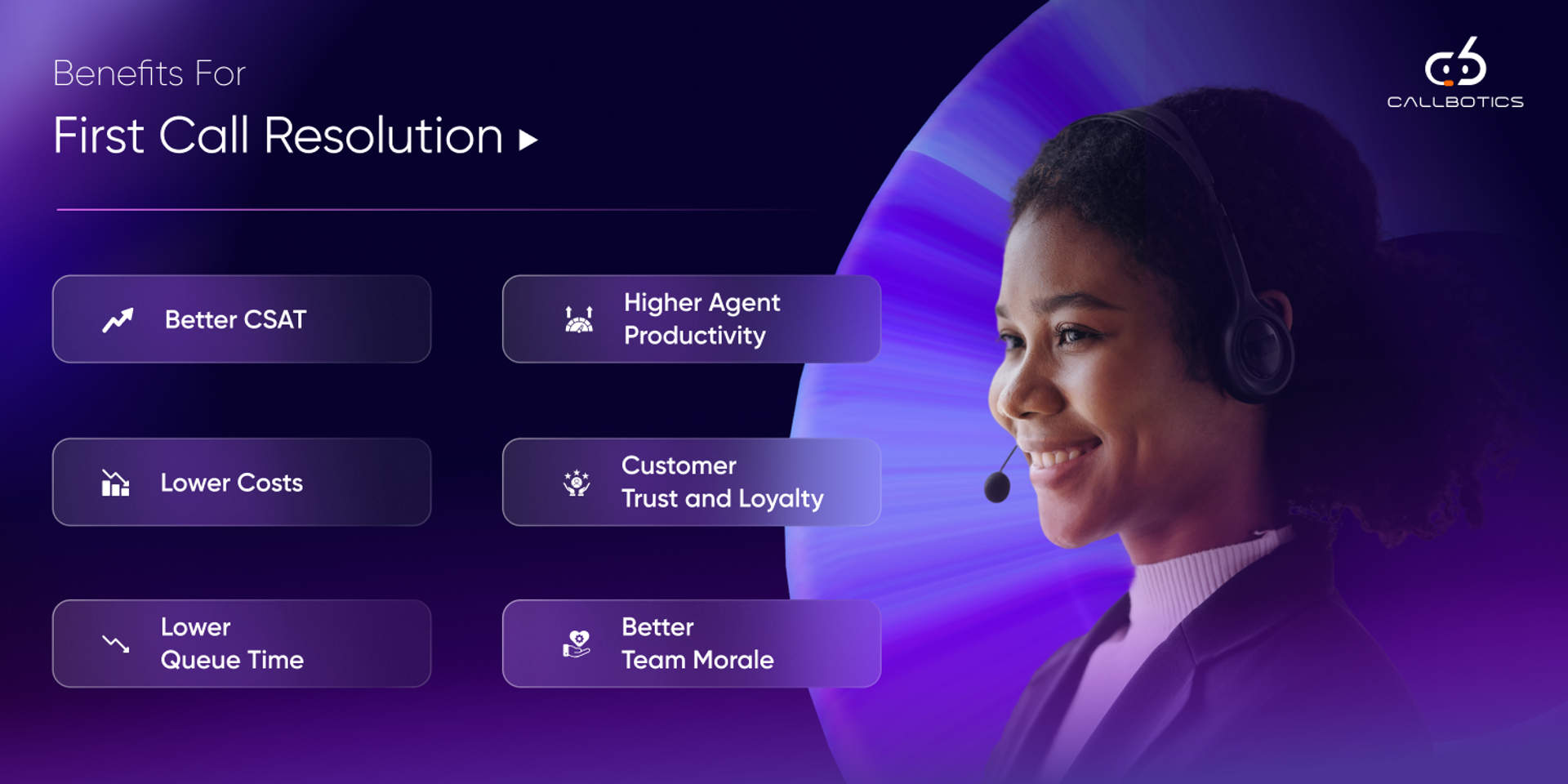
Improving first call resolution has a measurable impact across several areas of support operations.
Customers value solutions more than responses.
When issues are resolved during the first interaction, customers avoid the frustration of repeating details or waiting for follow-ups. This creates a smoother support experience and increases satisfaction scores.
Higher FCR rates often correlate strongly with improved CSAT because customers feel their time is respected and their concerns are handled effectively.
Every repeat call increases operational costs.
Additional interactions consume agent time, increase telecom costs, and extend queue wait times for other customers.
When organizations improve first call resolution, they reduce the number of repeat contacts entering the system. This lowers staffing pressure and reduces the overall cost per interaction.
Even small improvements in FCR can produce meaningful cost savings across large support operations.
Repeat calls create artificial demand within support queues.
A customer who needs to call three times for the same issue generates three separate interactions instead of one.
When issues are resolved during the first call, overall call volume drops. This frees capacity for new callers and reduces wait times across the entire support system.
Lower queue pressure improves both operational stability and customer experience.
Agents are most productive when they can focus on resolving issues rather than managing repeated interactions.
Low FCR rates often force agents to revisit the same problems multiple times. This reduces efficiency and increases frustration within support teams.
Higher first-call resolution allows agents to spend more time solving new issues rather than repeating previous work.
Consistent resolution builds long-term customer trust.
When customers know their issues will be handled correctly during the first interaction, they are more likely to rely on the organization for future support needs.
Reliable service experiences also improve brand perception and increase customer retention over time.
Support work can become stressful when agents feel they are constantly dealing with unresolved issues.
Repeated calls often indicate that processes are unclear, systems are fragmented, or agents lack the information they need to solve problems effectively.
When organizations improve first call resolution, agents gain more confidence in their ability to help customers successfully. This reduces stress and improves overall team morale.
Improving first call resolution does not require massive operational changes. In most cases, the biggest improvements come from fixing a few foundational issues.
Many first-call resolution problems start with incorrect routing.
When calls reach the wrong department or team, agents cannot solve the issue immediately. The call must be transferred or escalated, which increases resolution time.
Improving routing logic ensures that customers reach the right team on the first attempt. This alone can significantly improve FCR rates.
Agents perform better when they have the right information available at the start of the interaction.
Access to CRM records, call history, previous support tickets, and account information helps agents understand the problem faster.
Without context, agents often need to ask customers to repeat details already shared in previous interactions.
Providing structured customer context increases both resolution speed and accuracy.
Support teams frequently encounter the same types of questions and requests.
Creating standardized playbooks or knowledge bases ensures that agents respond consistently and accurately.
Clear guidance for handling common issues reduces hesitation during calls and increases the likelihood of solving problems during the first interaction.
Script-based support often focuses on delivering predefined responses instead of identifying root causes.
Agents need training that helps them diagnose problems quickly, ask the right questions, and determine the best solution for the situation.
Improving diagnostic skills helps agents resolve issues fully rather than providing partial answers that require follow-up.
Analyzing repeat calls can reveal hidden problems within products, processes, or support workflows.
Common repeat-call drivers include unclear billing information, account access issues, or unresolved service requests.
By tracking the reasons behind repeat contacts, organizations can identify patterns and address the underlying issues that reduce FCR.
Explore practical FCR improvement strategies with CallBotics experts and see what stronger first-call performance could look like for your team.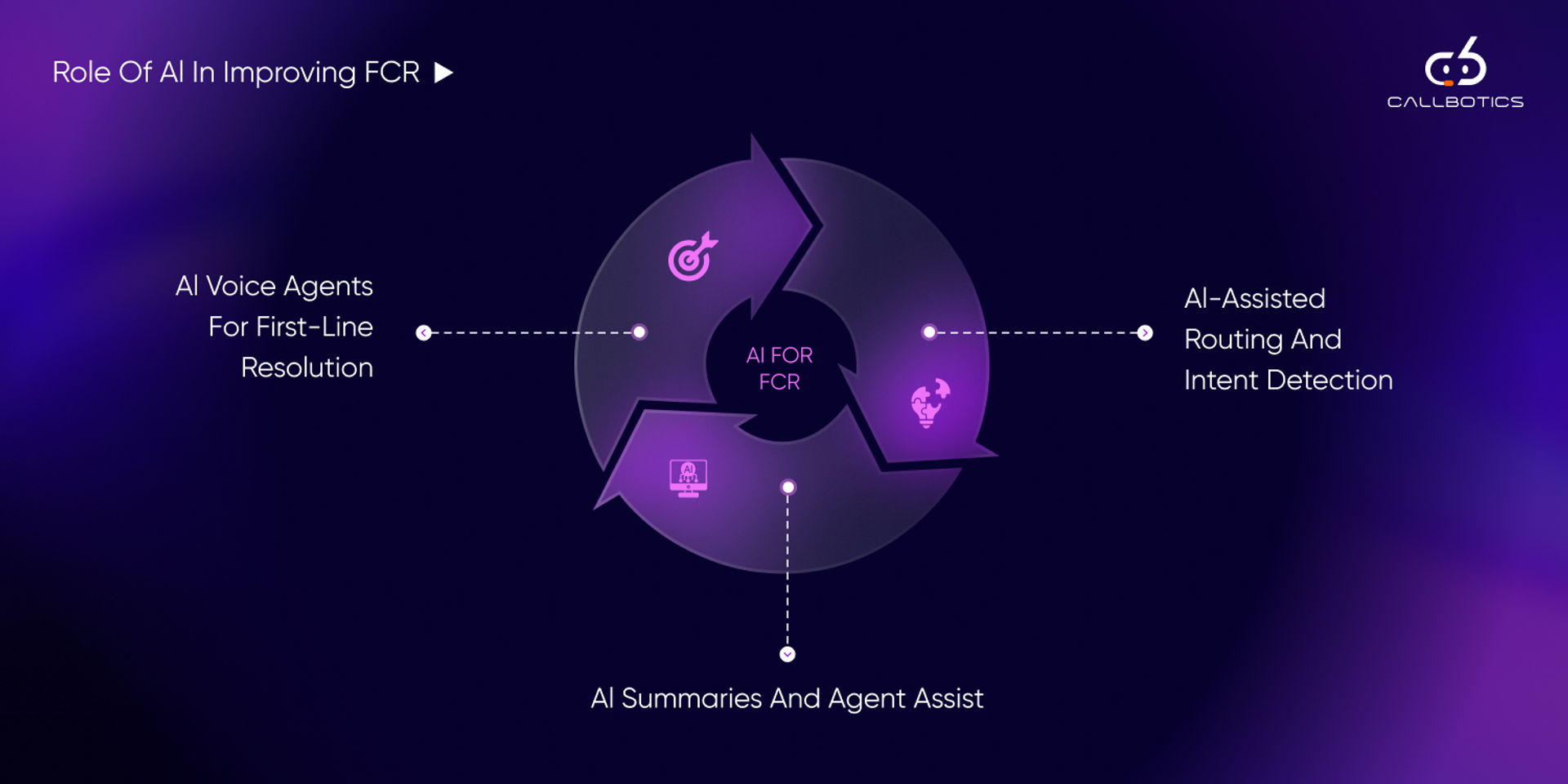
Artificial intelligence is increasingly being used to support first-call resolution in modern contact centers.
AI systems can improve routing accuracy, collect caller details early, and provide agents with relevant context during interactions.
AI voice agents can handle many routine customer requests before they reach live agents.
Common interactions such as appointment scheduling, status updates, account verification, and simple troubleshooting can often be resolved automatically.
By resolving repetitive requests at the first point of contact, AI voice agents increase the overall FCR rate while reducing the workload for human agents.
Traditional IVR systems rely on menu navigation that often forces callers to guess which option matches their issue.
AI-based intent detection analyzes natural language inputs to understand why the customer is calling.
This allows calls to be routed directly to the appropriate team or workflow, reducing transfers and improving resolution speed.
AI systems can automatically generate summaries of previous interactions and highlight key account details.
When agents receive a call, they immediately see relevant information about the customer’s history, previous tickets, and potential solutions.
This reduces repetition during the call and allows agents to resolve the issue more efficiently.
For contact center leaders trying to improve first call resolution, the challenge is rarely just speed. It is about getting every interaction routed correctly, handled with full context, and measured with enough visibility to keep improving over time. CallBotics is built for exactly that, combining AI voice automation, smarter handoffs, and deep operational visibility to resolve more customer issues in the first interaction.
First call resolution is one of the most powerful metrics for improving both customer experience and operational efficiency.
When issues are solved during the first interaction, customers avoid frustration, support teams reduce unnecessary workload, and businesses lower the cost of service operations.
Organizations that focus on routing accuracy, agent context, standardized workflows, and AI-powered assistance typically see the largest improvements in FCR performance.
In an environment where customer expectations continue to rise, improving first call resolution remains one of the fastest and most effective ways to strengthen support outcomes.

Urza Dey (She/They) is a content/copywriter who has been working in the industry for over 5 years now. They have strategized content for multiple brands in marketing, B2B SaaS, HealthTech, EdTech, and more. They like reading, metal music, watching horror films, and talking about magical occult practices.
See how enterprises automate calls, reduce handle time, and improve CX with CallBotics.
CallBotics is an enterprise-ready conversational AI platform, built on 18+ years of contact center leadership experience and designed to deliver structured resolution, stronger customer experience, and measurable performance.