Customer expectations in 2026 are shaped by speed, accuracy, and consistency across every interaction. Customers no longer compare you only to competitors. They compare you to the best experience they’ve had anywhere. That means even a single poor interaction can lead to churn, while a well-handled call can directly influence retention, lifetime value, and brand perception.
This is where live call monitoring plays a critical role.
Live call monitoring allows contact center teams to observe and influence customer conversations as they happen, not after the fact. Instead of relying on post-call reviews that only highlight issues once the damage is done, supervisors can coach agents in real time, prevent escalations before they occur, and ensure compliance during high-risk interactions. In high-volume environments, this ability to intervene at the right moment can be the difference between resolution and escalation.
As call volumes increase and operations become more complex, monitoring is no longer optional or limited to training scenarios. It has become a core operational layer required to maintain service quality, protect revenue, and ensure consistency across thousands of interactions.
At the same time, AI is transforming how monitoring works. What was once limited to manual sampling of a small percentage of calls can now extend to every interaction in real time. AI enables continuous visibility, faster coaching loops, and more objective decision-making, turning live monitoring from a reactive activity into a proactive performance system.
Live call monitoring is the process of observing customer calls in real time so that supervisors or intelligent systems can evaluate and influence the interaction as it happens.
Unlike post-call reviews, which focus on analyzing interactions after completion, live monitoring enables immediate action. Supervisors can guide agents through complex conversations, step in when situations escalate, or ensure compliance requirements are met in the moment rather than corrected later.
This real-time capability is particularly important in high-stakes scenarios where delays in intervention can lead to customer dissatisfaction, lost revenue, or regulatory risk.
In modern contact centers, live monitoring is no longer limited to human supervisors listening in on a handful of calls. It now includes AI-driven systems that continuously analyze every interaction. These systems can:
This combination of human oversight and AI-driven intelligence makes live monitoring more scalable, consistent, and effective across large operations.
Understanding the distinction between different monitoring methods is essential for building an effective quality and performance strategy.
Live monitoring is used during active calls to support agents instantly. It allows supervisors to guide conversations, correct mistakes as they happen, and improve outcomes before the interaction ends. This makes it the most proactive form of quality control.
Call recording captures conversations for later review. It plays a critical role in training, dispute resolution, and compliance audits. However, it does not influence the live interaction and therefore cannot prevent issues in real time.
QA reviews involve analyzing recorded calls to identify trends, score performance, and uncover improvement areas. Traditionally, QA teams review only a small sample of calls due to time constraints, which limits visibility. AI is now transforming this by enabling full coverage, allowing teams to move from partial insight to complete operational visibility.
Together, these methods form a layered approach where live monitoring drives immediate impact, while recording and QA support long-term improvement.
Live monitoring relies on a set of core techniques that provide different levels of visibility and intervention depending on the situation.
Supervisors listen to calls without interrupting the interaction. This method is widely used for quality evaluation, agent training, and performance assessment. It allows supervisors to observe how agents handle real scenarios without influencing the outcome.
Whisper mode allows supervisors to guide the agent in real time without the customer hearing the conversation. This is particularly useful for:
It acts like live coaching, improving outcomes without disrupting the customer experience.
In barge mode, the supervisor joins the call as an active participant. This is typically used when:
This ensures issues are handled quickly and professionally.
In high-risk or sensitive situations, supervisors may take full control of the call. This is used sparingly and typically reserved for:
This level of intervention ensures that important interactions are handled correctly and protects both customer experience and business risk.
Modern contact centers require monitoring tools that go beyond basic listening capabilities and provide real-time operational intelligence.
Supervisors need a unified view of:
This level of visibility allows supervisors to prioritize attention and respond quickly during peak demand.
Effective tools should include:
These features enable immediate intervention and reduce delays in resolving critical situations.
The ability to capture insights during or after calls helps teams:
This turns monitoring into a continuous improvement system rather than a one-off activity.
Access to customer data during monitoring significantly improves both coaching and outcomes. When supervisors and agents can see the full context, they can:
Integration ensures monitoring is connected to actual workflows, not isolated from them.
Monitoring must be controlled and auditable. This includes:
This is especially important in regulated industries where violations can lead to significant penalties.
Live monitoring is most effective when it supports agents rather than creating pressure.
Transparency is critical. Agents should understand:
This builds trust and reduces anxiety associated with being observed.
Not every call requires intervention. Focus on moments where guidance can:
Over-monitoring can reduce agent confidence and disrupt natural conversations.
Whisper is best for development and subtle guidance.
Barge should be reserved for high-risk or high-impact situations where immediate action is required.
Instead of focusing only on individual errors, identify patterns such as:
This allows teams to fix root causes rather than repeatedly addressing symptoms.
High-performing calls provide valuable examples of:
Using these as training material improves consistency across the entire team.
Interactions involving billing issues, cancellations, or complaints benefit significantly from real-time support. Early intervention can prevent churn and improve customer retention.
Live coaching accelerates learning by providing immediate feedback. New agents gain confidence faster and make fewer mistakes during early interactions.
During high call volumes, maintaining quality becomes challenging. Monitoring ensures that service standards remain consistent even under pressure.
In regulated industries, real-time oversight is critical. Monitoring helps ensure required disclosures and processes are followed correctly. This is especially important given that violations such as TCPA breaches can result in penalties of up to $1,500 per call.
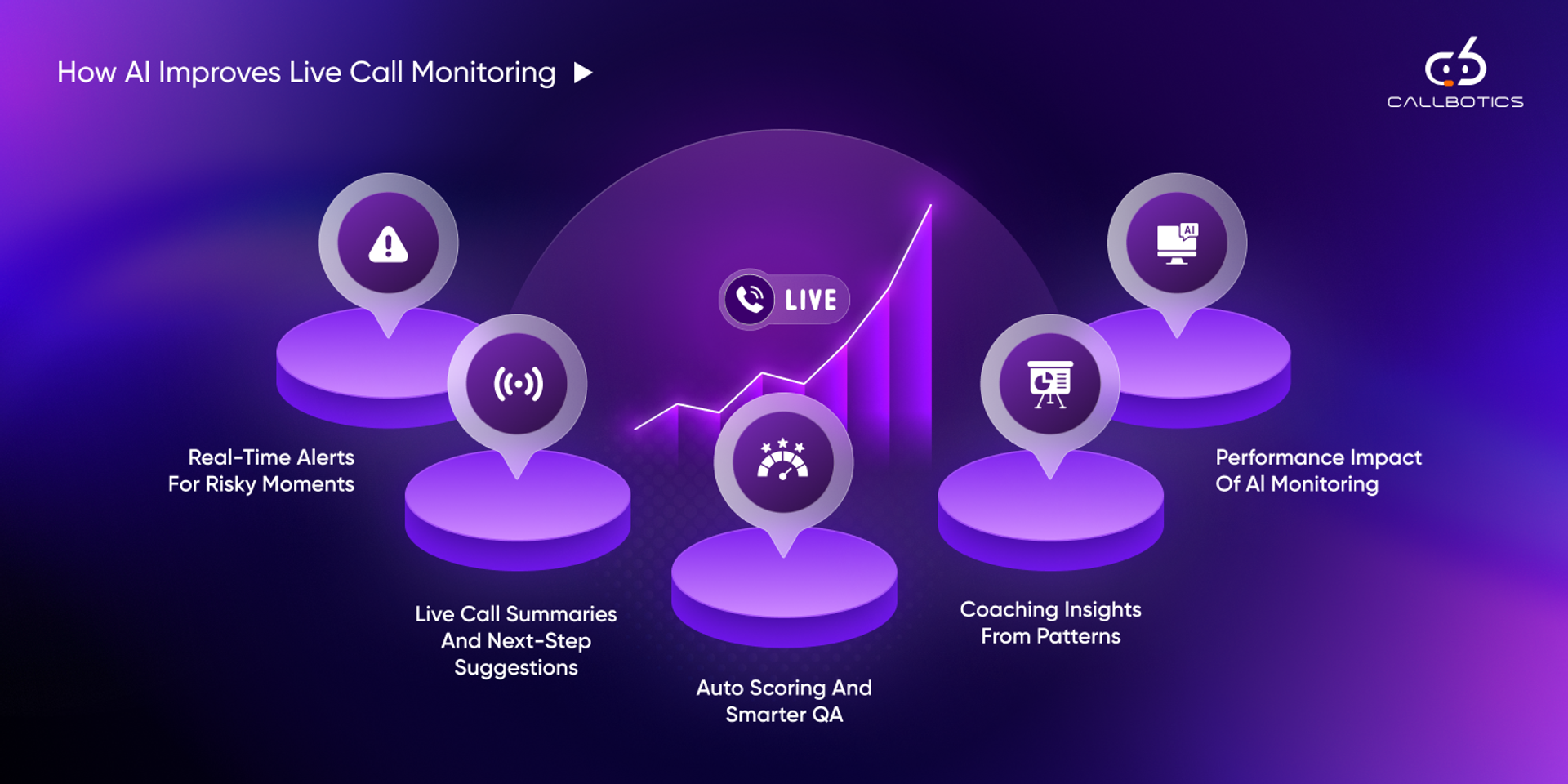
AI transforms live call monitoring from a manual, reactive activity into a continuous, real-time intelligence system. Instead of supervisors needing to listen to individual calls and interpret outcomes after the fact, AI provides instant visibility into every interaction as it unfolds.
This shift is critical at scale. In high-volume contact centers, it is impossible for supervisors to manually monitor enough calls to maintain consistent quality. AI fills this gap by analyzing every conversation in real time, identifying risks, surfacing insights, and enabling faster, more informed decisions.
AI continuously analyses conversations as they happen and flags potential issues.
These include:
Instead of discovering these problems after the call, supervisors are alerted instantly and can intervene at the right moment using whisper or barge. This reduces escalations, improves resolution outcomes, and protects customer experience in high-risk interactions.
AI generates real-time summaries of ongoing conversations, giving both agents and supervisors immediate context without needing to listen to the entire call.
This includes:
In addition, AI can suggest next-best actions, such as:
This reduces cognitive load for agents, speeds up decision-making, and ensures more consistent handling across teams.
Traditional QA models rely on manually reviewing a small sample of calls, typically only 2–5% of total interactions. This creates blind spots and inconsistent evaluation.
AI eliminates this limitation by:
This results in:
QA shifts from periodic sampling to continuous performance management.
Beyond individual calls, AI analyses patterns across thousands of interactions to identify systemic issues.
This includes:
Instead of reacting to isolated incidents, teams can:
This turns monitoring into a strategic tool for continuous improvement, not just performance tracking.
The impact of AI-driven monitoring is both measurable and operationally significant.
Instead of relying on delayed feedback and limited visibility, AI enables contact centers to act on insights in real time. This shifts monitoring from a reactive process to a continuous performance system.
With AI-powered monitoring, organizations can:
Over time, these improvements compound. As workflows are refined and coaching becomes more targeted, contact centers see stronger consistency, better customer outcomes, and more efficient operations at scale.
To measure the effectiveness of live call monitoring, teams need to track metrics that reflect both operational efficiency and customer experience.
This metric indicates whether monitoring and real-time coaching are preventing difficult interactions from escalating.
A reduction in escalation rates typically signals:
Quality scores measure how consistently agents follow processes, scripts, and best practices.
With AI-driven monitoring, this becomes more reliable because:
This is especially critical in regulated industries where errors can lead to financial penalties or legal risk.
First call resolution (FCR) reflects how effectively issues are solved in a single interaction.
Improved monitoring should lead to:
Repeat-call rate is equally important, as it highlights unresolved issues or poor handoffs.
Live monitoring plays a major role in onboarding and long-term agent performance.
Key indicators include:
Effective coaching and real-time support reduce early-stage errors, improve confidence, and increase job satisfaction.
CallBotics enables contact centers to move beyond manual monitoring into a fully AI-driven, real-time performance layer.
Instead of relying on supervisors to listen to individual calls, the platform provides continuous visibility across all interactions, helping teams identify risks, coach agents, and improve outcomes at scale.
The platform helps teams:
By combining automation with analytics, CallBotics shifts the focus from monitoring activity to improving outcomes.
Teams no longer spend time searching for issues. They are alerted to what matters and can act immediately.
This results in:
For deeper insights into contact center optimization, explore:
Live call monitoring is no longer just about listening to calls. It is about improving them in real time.
When used correctly, monitoring helps teams prevent escalations, coach agents effectively, and maintain consistent service quality. With AI, this process becomes faster, more scalable, and more accurate.
The shift is clear. Contact centers are moving from limited, manual oversight to full, real-time visibility across every interaction.
The teams that adopt this approach are not just improving quality. They are building more resilient, scalable, and efficient customer operations.

Urza Dey (She/They) is a content/copywriter who has been working in the industry for over 5 years now. They have strategized content for multiple brands in marketing, B2B SaaS, HealthTech, EdTech, and more. They like reading, metal music, watching horror films, and talking about magical occult practices.
See how enterprises automate calls, reduce handle time, and improve CX with CallBotics.
CallBotics is an enterprise-ready conversational AI platform, built on 18+ years of contact center leadership experience and designed to deliver structured resolution, stronger customer experience, and measurable performance.