

Outbound operations are no longer judged by activity alone. For contact center leaders, performance is defined by resolution, predictability, and economic control. The difference between a scalable outbound program and an expensive one usually comes down to visibility. That visibility starts with outbound call center performance metrics that reflect how work actually gets done across agents, systems, and customer conversations.
When metrics are chosen carefully and reviewed consistently, they move beyond reporting. They become management signals. Signals that show where productivity is being lost, where customer friction is building, and where revenue potential is being left unrealized.
Outbound call center performance metrics are structured indicators that show how outbound operations perform across four dimensions: activity, efficiency, quality, and business impact. They provide leaders with a clear view of how agents engage customers, how conversations progress, and how consistently outcomes are achieved. These metrics help organizations evaluate whether outbound efforts are generating meaningful customer contact, progressing conversations toward defined goals, and producing results that justify the labor, technology, and operational costs involved.
They also separate raw activity from actual performance, which is essential in outbound environments where high call volumes can create the appearance of productivity without delivering measurable business value. Unlike surface-level reporting, these metrics are designed to answer executive questions such as:
When aligned correctly, these metrics form the backbone of disciplined call center performance tracking.
Outbound environments operate under constant pressure. Every call carries cost, opportunity, and brand risk. Tracking the right metrics allows leaders to balance growth, efficiency, and experience without overcorrecting in any one direction. These metrics help leadership teams understand whether outbound capacity is being used effectively, whether customer outreach is producing meaningful results, and whether performance issues are operational, behavioral, or structural.
They also make it easier to identify where performance breaks down across the outbound journey, from low contact rates and weak conversion to poor resolution and rising costs. Without this level of measurement, teams are forced to react based on assumptions rather than evidence, which often leads to wasted effort and inconsistent results.
Metrics reveal how effectively available labor is converted into meaningful conversations. By understanding call distribution, active talk time, and idle periods, leaders can identify whether constraints come from staffing models, dialing strategies, or workflow design rather than individual performance.
This level of insight enables targeted operational improvements instead of broad staffing changes.
Outbound performance is ultimately judged by outcomes. Metrics tied to conversion highlight where conversations succeed or stall. They expose gaps in lead quality, timing, scripting, or handoff logic and provide clear direction for improvement.
For leadership teams, this data helps connect outbound sales metrics directly to revenue planning and forecast confidence.
Outbound efficiency must coexist with trust. Quality and resolution metrics ensure that scale does not degrade experience. They highlight repeat contacts, unresolved intents, and conversation breakdowns that erode long-term value.
Consistent experience metrics protect brand equity while enabling operational scale.
For practical examples of how outbound metrics support scale, see how CallBotics approaches scaling contact center operations without sacrificing visibility or control.The following metrics form the foundation of disciplined outbound measurement. Together, they provide leaders with a balanced view of effort, effectiveness, and economics. They help distinguish between volume that simply keeps agents busy and performance that actually produces measurable outcomes. When reviewed together, these metrics show whether outbound programs are reaching customers efficiently, moving conversations toward resolution, and generating returns that justify operational cost.
They also give leaders a more complete view of where execution is strong, where friction is building, and which parts of the outbound model need correction before performance declines at scale.
Call volume measures the total number of outbound calls placed within a defined period.
For executives, this metric establishes baseline effort and supports capacity planning. On its own, it does not indicate success, but it provides essential context for interpreting downstream performance.
Contact rate measures how often outbound calls successfully reach a live person.
This metric reflects list quality, dialing strategy, and timing discipline. Sustained changes in contact rate often signal data decay or misaligned outreach windows and should trigger corrective action early.
Conversion rate measures the percentage of calls that achieve a defined outcome such as a sale, appointment, or qualified next step.
This metric connects effort to results and is central to evaluating the effectiveness of scripts, agent readiness, and targeting strategy.
Average call duration tracks how long agents spend on each conversation.
Balanced duration indicates efficient, structured conversations. Sharp shifts often reveal script friction, customer confusion, or process gaps that warrant review.
First call resolution measures how often customer needs are fully addressed within a single interaction.
Higher FCR reduces follow-up workload, improves experience, and stabilizes operating costs. For outbound programs, it is a strong indicator of conversation design quality.
Cost per call calculates the average cost of each outbound interaction, including labor and system expenses.
This metric becomes most valuable when evaluated alongside conversion and revenue metrics, enabling leaders to understand true efficiency at scale.
| Metric | What It Indicates | Why Leaders Track It |
|---|---|---|
| Call Volume | Total outbound effort | Capacity and planning context |
| Contact Rate | Reach effectiveness | Data and timing quality |
| Conversion Rate | Outcome efficiency | Revenue impact |
| Average Call Duration | Conversation efficiency | Process health |
| First Call Resolution | Resolution quality | Cost and experience control |
| Cost Per Call | Economic efficiency | ROI visibility |
Agent-level metrics help leadership teams understand how systems, processes, and enablement translate into individual performance. When used correctly, these metrics support coaching and operational design rather than micromanagement. They help leaders see whether performance differences are being driven by skill gaps, workflow friction, uneven workload distribution, or inconsistent process execution.
They also provide a clearer view of how individual effort connects to team-wide efficiency, quality, and outcome consistency. When interpreted in context, agent metrics make it easier to improve performance through better coaching, stronger enablement, and more reliable operating conditions rather than narrow activity pressure.
Calls per agent measure outbound activity per individual over a defined period. This metric helps identify workload balance and operational constraints that may limit throughput or consistency. It also shows whether agent capacity is being used evenly across the team or concentrated unevenly. Over time, this metric can help leaders spot gaps in staffing allocation, dialer efficiency, or campaign structure.
This comparison highlights how much logged time is spent in active conversation versus waiting or inactivity. Sustained imbalance often points to workflow or tooling inefficiencies rather than agent behavior. High idle time may indicate weak list quality, dialing delays, or poor system responsiveness. Excessive talk time without strong outcomes can also suggest conversation inefficiency, weak scripting, or poor qualification flow.
Script adherence measures alignment with approved conversation structures. Strong adherence supports consistency, compliance, and predictable outcomes across teams and campaigns. It helps leadership confirm whether agents are following the intended conversation path closely enough to protect quality and business standards. It also makes it easier to identify whether performance issues are caused by poor execution or by flaws in the script itself.
Quality score reflects conversation accuracy, tone, and resolution effectiveness based on defined criteria. This metric ensures that productivity gains do not compromise experience or long-term trust and keeps performance aligned with business standards. It gives supervisors a more complete view of whether conversations are being handled correctly, not just quickly. Over time, quality scoring also helps connect coaching priorities to measurable improvements in customer experience and resolution outcomes.
Explore how CallBotics helps outbound teams improve contact rates, resolution consistency, and performance measurement at scale.Activity and quality metrics explain how work happens. Sales and revenue metrics explain whether that work creates value. For leadership teams, these metrics are essential because they connect outbound execution to financial outcomes and forecast reliability. They show whether outbound programs are producing enough return to justify labor, technology, and campaign investment. They also help leaders understand whether strong activity levels are translating into revenue efficiency or simply creating more operational effort without meaningful payoff. When tracked consistently, these metrics make it easier to evaluate pipeline health, prioritize higher-value outreach, and improve financial performance without losing control of execution.
Revenue per call measures the average revenue generated from each outbound interaction.
This metric helps executives understand efficiency at scale. Two teams can place the same number of calls and show similar conversion rates, yet deliver very different financial outcomes. Revenue per call exposes whether conversations are targeting the right customers, positioning value effectively, and progressing deals with discipline.
When this metric trends downward, it often points to lead quality issues, pricing friction, or misaligned outreach goals rather than agent effort alone.
Lead conversion rate tracks the percentage of outbound leads that ultimately become customers.
Unlike single call conversion metrics, this measure reflects the full outbound journey. It highlights how well qualification, follow-up discipline, and handoffs work across teams. For leadership, this metric supports pipeline planning and helps identify where prospects stall after initial contact.
Consistent conversion at this level signals operational maturity and alignment between sales, marketing, and contact center execution.
Customer acquisition cost measures the total cost required to acquire a new customer through outbound efforts.
This metric provides a financial lens on outbound operations. Rising CAC without proportional revenue growth indicates inefficiency, often driven by excessive follow-ups, low resolution rates, or overreliance on manual processes.
Leaders use CAC trends to evaluate investment decisions, automation priorities, and channel mix adjustments.
Even well-instrumented contact centers struggle when metrics are misused or misinterpreted. The following patterns are common at scale and often limit the value metrics can deliver. The issue is often not a lack of data, but weak metric selection and poor interpretation. When teams focus on the wrong signals or read them without context, they risk rewarding unproductive behavior, missing operational problems, and making changes that do not improve outcomes. Avoiding these mistakes is essential if outbound metrics are meant to support better decisions rather than simply produce more reporting.
Large dashboards do not guarantee insight. When teams attempt to monitor everything, attention fragments and action stalls. Effective leadership focuses on a small set of metrics that explain outcomes and uses supporting metrics only when investigation is required. Too many tracked metrics make it harder to separate signal from noise and often slow down decision-making. A tighter metric set improves focus, accountability, and the likelihood of timely action.
Metrics rarely operate independently. Call volume without conversion context, or efficiency without quality indicators, leads to incorrect conclusions. Strong performance management evaluates metrics as a connected system. Looking at one metric in isolation can hide the real reason performance is moving in the wrong direction. Leaders need to understand how reach, quality, resolution, and cost interact before deciding what to change.
High call counts can mask declining effectiveness. When activity metrics dominate reviews, teams may increase effort while outcomes stagnate. Outcome-first measurement keeps focus on value creation rather than motion. This helps prevent teams from rewarding busyness that does not produce meaningful business results. It also keeps performance reviews centered on conversion, resolution, and economic impact instead of raw effort alone.
Delayed reviews reduce relevance. Weekly or monthly summaries often arrive too late to correct drift. Timely visibility enables course correction before inefficiencies compound. The longer teams wait to review performance, the more likely small problems are to scale into larger operational issues. Faster review cycles make it easier to spot negative trends early and respond before results deteriorate further.
Metrics create value only when they influence behavior, process, and decision-making. High-performing outbound organizations treat metrics as operational inputs, not reporting artifacts. The goal is not to collect more data, but to use the right signals to improve execution in a measurable way. That means linking metric reviews to coaching priorities, workflow changes, and leadership decisions that directly affect performance. When teams use metrics this way, they can correct issues earlier, improve consistency, and create stronger outbound results without relying on guesswork.
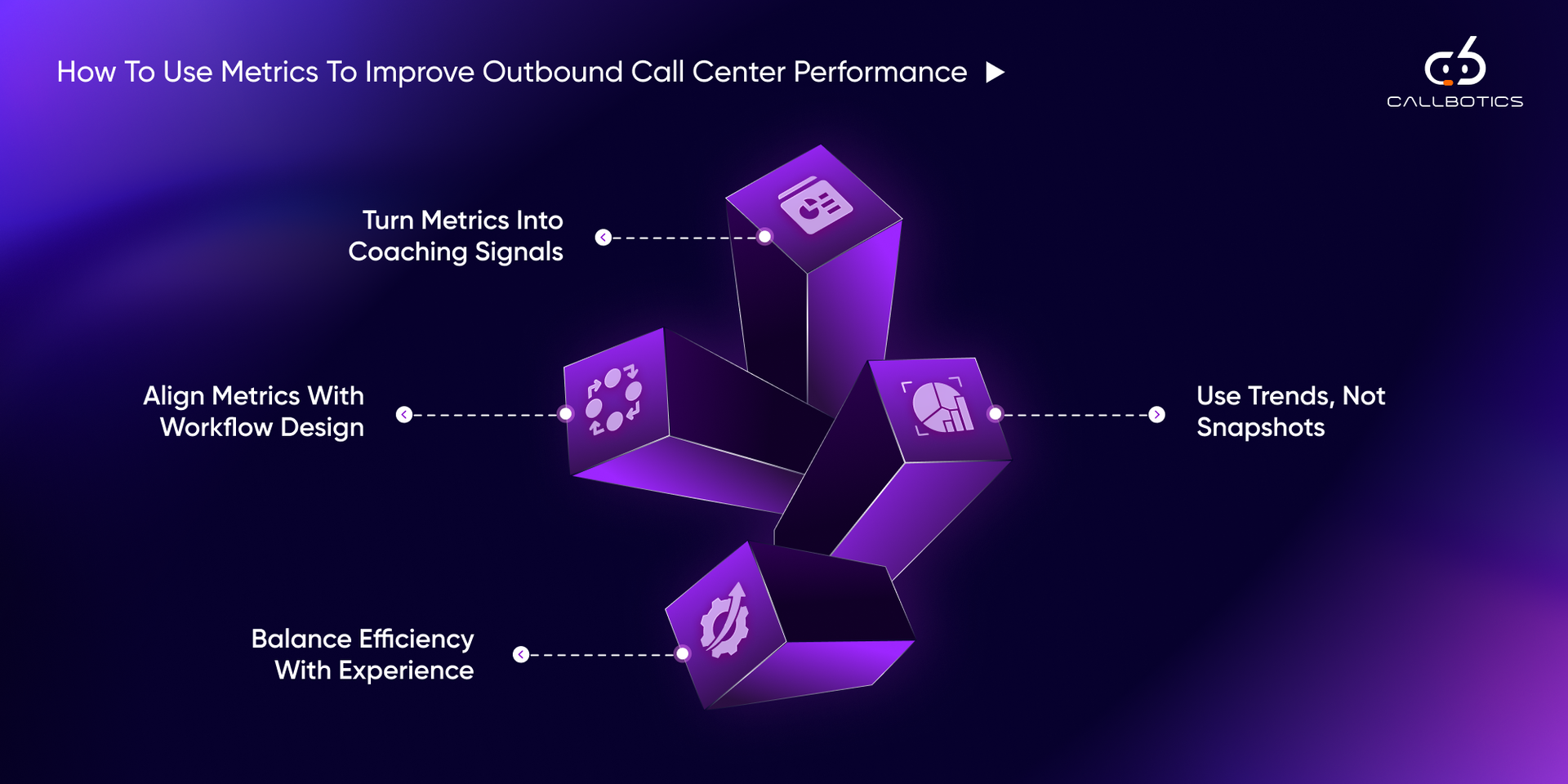
Agent-level trends reveal where targeted coaching delivers the highest return. Leaders should use performance patterns to guide skill development rather than relying on generalized training. This helps managers focus support where it will produce the most meaningful improvement. It also makes coaching more specific, measurable, and aligned with actual performance gaps.
Metrics frequently expose friction rooted in process design. Long call durations, repeated follow-ups, or low resolution often point to unclear conversation paths or missing decision logic. Adjusting workflows based on these signals improves consistency without adding complexity. This allows teams to solve structural problems instead of treating them as isolated agent issues. It also improves repeatability across campaigns, teams, and call types.
Single-period metrics rarely tell the full story. Trend analysis reveals whether performance is stabilizing, improving, or deteriorating over time. Leadership decisions grounded in trends are more resilient and predictable. Looking at trends reduces the risk of overreacting to short-term fluctuations that do not reflect underlying performance. It also helps leaders identify whether corrective actions are actually working over time.
Sustainable outbound performance requires equilibrium. Metrics should guide teams toward faster resolution and lower cost while maintaining conversation quality and trust. Long-term success depends on maintaining this balance. Pushing too hard on speed or volume alone can damage customer experience and reduce overall effectiveness. Strong outbound teams use metrics to improve efficiency without weakening resolution quality or brand perception.
Outbound metrics only become useful when the underlying execution is consistent. In many contact centers, performance data is difficult to act on because conversations break down unpredictably, reporting arrives too late, and quality is often reviewed only after the fact.
Built on 18+ years of contact center operational experience, CallBotics is designed to close those gaps by embedding measurement directly into how outbound conversations are executed. This gives teams stronger visibility, faster decision-making, and more reliable performance improvement at scale.
Outbound operations succeed when effort, quality, and outcomes move in alignment. Metrics provide the framework that keeps those elements connected. When tracked consistently and interpreted correctly, they reveal where performance improves naturally and where intervention is required.
High-performing contact centers rely on disciplined measurement, trend-based analysis, and execution systems that reflect real operating conditions. Together, these elements create predictable performance, controlled costs, and durable customer trust.

See how enterprises automate calls, reduce handle time, and improve CX with CallBotics.
CallBotics is an enterprise-ready conversational AI platform, built on 18+ years of contact center leadership experience and designed to deliver structured resolution, stronger customer experience, and measurable performance.