Contact centers are under more pressure than ever in 2026. Customers expect faster answers, shorter wait times, smoother handoffs, and consistent service across every interaction. At the same time, contact center leaders are dealing with peak volume spikes, rising labor costs, staffing constraints, and constant pressure to improve both efficiency and customer experience.
That combination is forcing many teams to rethink how calls are handled. AI voice agents are becoming part of that shift because they can answer instantly, manage repetitive interactions, support better routing, and reduce operational strain without requiring headcount to scale at the same rate as call volume.
This is why more contact centers are moving beyond basic IVR and adopting AI voice agents as a practical layer in their operation. The goal is not just automation for its own sake. It is to improve queue performance, resolution quality, and service consistency in a way that holds up under real contact center conditions.
Before looking at why contact centers are switching, it helps to define what AI voice agents actually do. Many people still think of voice automation as an upgraded phone menu, but modern AI voice agents do much more than route callers through predefined options.
In a contact center, AI voice agents can answer incoming calls, understand caller intent, ask follow-up questions, handle repetitive requests, collect relevant details, and either complete the task or transfer the call with context attached. Instead of starting every interaction with a menu tree, the system can begin with a natural conversation and move the caller more quickly toward the right outcome.
That matters because many contact center calls are not difficult in principle. They are just high-volume, repetitive, and time-consuming when handled manually at scale. AI voice agents are increasingly being used to reduce that burden while improving the experience for both customers and agents.
The shift to AI voice agents is not happening because the technology sounds impressive. It is happening because contact centers are under pressure to improve measurable outcomes like queue time, first-call resolution, cost per interaction, and customer experience. The reasons below are the ones most often driving that transition.
One of the biggest operational benefits of AI voice agents is speed at the front of the interaction. AI can answer calls immediately, reducing the number of callers waiting for a live agent to begin the conversation. In high-volume environments, that alone can visibly affect queue pressure.
This is especially useful for repetitive or lower-complexity calls that do not require human judgment from the first second. By absorbing part of the inbound load, AI helps keep human queues from backing up as quickly during normal operations and peak periods.
Many contact centers handle large numbers of calls that follow known patterns. Order status requests, appointment confirmations, account lookups, billing questions, password resets, and basic service updates often have clear flows and defined outcomes. AI voice agents are well-suited to these types of requests because they can follow structured logic consistently and complete the task in a single interaction.
When those calls are resolved properly without transfer or follow-up, first-call resolution improves, and repeat contact decreases. That creates value on both sides of the experience. Customers get faster answers, and contact centers reduce avoidable inbound volume.
Traditional call routing often depends on the caller choosing the correct menu option before the system understands what they need. That works only when the caller already knows exactly where they belong. In reality, many callers do not. They describe the issue in their own words and expect the business to resolve it.
AI voice agents improve this by using intent-based routing. They can capture why the person is calling, ask one or two clarifying questions, and send the call to the right queue or workflow with much better context. This reduces wrong transfers, shortens the path to resolution, and lowers frustration early in the interaction.
A large share of contact center effort is often spent on repetitive interactions that are important but operationally draining. When human agents spend too much time on these calls, it becomes harder to maintain quality on more complex, sensitive, or revenue-critical conversations.
AI voice agents help by taking repetitive work out of the human queue. That gives agents more time to focus on cases where empathy, judgment, negotiation, or deeper problem-solving really matter. Over time, that can improve not just productivity but also team sustainability and morale.
Cost reduction matters in every contact center, but lowering cost only works if service quality remains stable or improves. AI voice agents help reduce cost per call by lowering human handling time, improving routing efficiency, reducing repeat calls, and resolving structured requests more quickly.
The key point is that this is not just about replacing minutes. It is about improving the economics of each resolved interaction. When AI handles common requests effectively and transitions appropriately with the right context, contact centers can reduce operational costs without creating additional customer friction.
Want an enterprise AI voice platform built to reduce queues, improve routing, and lower call handling costs? Explore CallBotics.Many contact centers need some level of after-hours coverage, but building and staffing overnight or extended-shift teams is expensive. AI voice agents provide a practical way to maintain availability without matching coverage needs with the same staffing model.
This is useful for after-hours call answering, message capture, appointment requests, lead intake, simple service questions, and urgent triage. Even when a full resolution is not possible outside business hours, AI can still collect clean details, apply urgency logic, and support a better handoff for follow-up.
Peak periods are where many contact centers feel the most operational pain. Seasonal surges, billing cycles, incident-driven spikes, promotions, and service disruptions can quickly overwhelm queues and push abandonment rates higher. Human-only staffing models struggle here because capacity cannot scale instantly.
AI voice agents help absorb that variability. They can handle larger call volumes without the same staffing delay, which gives contact centers a more stable service layer during spikes. This is one of the most practical reasons teams adopt AI voice, especially when queue stability is tied directly to retention, satisfaction, or revenue outcomes.
One of the worst contact center experiences is when a customer explains the issue, gets transferred, and has to start over. AI voice agents can reduce this by passing along summaries, key details, and captured context before a human agent joins the call.
That makes the handoff more efficient and less frustrating. It also shortens live-agent handling time because the conversation begins with useful context rather than rework. In practice, this is one of the clearest ways AI improves both customer experience and operational performance at once.
Calls contain valuable operational information, but many contact centers have historically struggled to use it well. AI voice systems change that by turning calls into transcripts, summaries, tags, trends, and searchable data. That makes it easier to identify recurring issues, spot friction points, improve scripts, monitor routing performance, and coach teams.
This is especially important because the value of AI voice is not limited to automation. It also comes from visibility. When every conversation becomes structured data, leaders can make better decisions about process changes, policy updates, training, and future workflow design.
Many contact center leaders want to modernize, but they do not want a full rip-and-replace project across telephony, routing, support systems, and workforce operations. AI voice agents are appealing because they can often be introduced gradually. Teams can start with one workflow, one call type, or one queue and expand over time.
That makes the path to modernization more manageable. Instead of redesigning everything at once, contact centers can layer AI into existing operations, validate impact, and grow from there. This lowers risk and makes the transition more practical for organizations that need results without major operational disruption.
Not every contact center use case should be automated first. The best early deployments are usually the ones with high volume, clear structure, and measurable outcomes. These use cases create faster wins, lower deployment risk, and make it easier to prove value before expanding into more complex workflows.
Frequently asked questions and repetitive support interactions are often the best place to begin. These calls usually involve known answers, limited variability, and clear resolution paths. That makes them easier to automate well and easier to measure after launch.
Scheduling workflows are another strong starting point because they are structured and outcome-driven. Appointment confirmations, rescheduling, reminders, cancellations, and basic booking flows all map well to voice automation and can reduce both manual effort and missed appointments.
Many contact centers see early value just by improving intake. AI voice agents can identify intent, collect the key details needed for classification, and route with more precision than menu-based systems. Even without full task resolution, this can reduce transfers, lower queue time, and improve first-call outcomes.
The benefits of AI voice are real, but switching successfully still requires discipline. Most deployment problems do not come from the concept of AI voice itself. They come from weak implementation choices such as poor handoffs, missing guardrails, unclear escalation logic, limited integrations, or measuring the wrong outcomes.
Contact centers should be careful not to start too broadly, automate workflows that are too complex too early, or treat launch as the finish line. Success depends on choosing the right first use case, validating performance in real-world conditions, and establishing strong operational oversight of the system once it goes live.
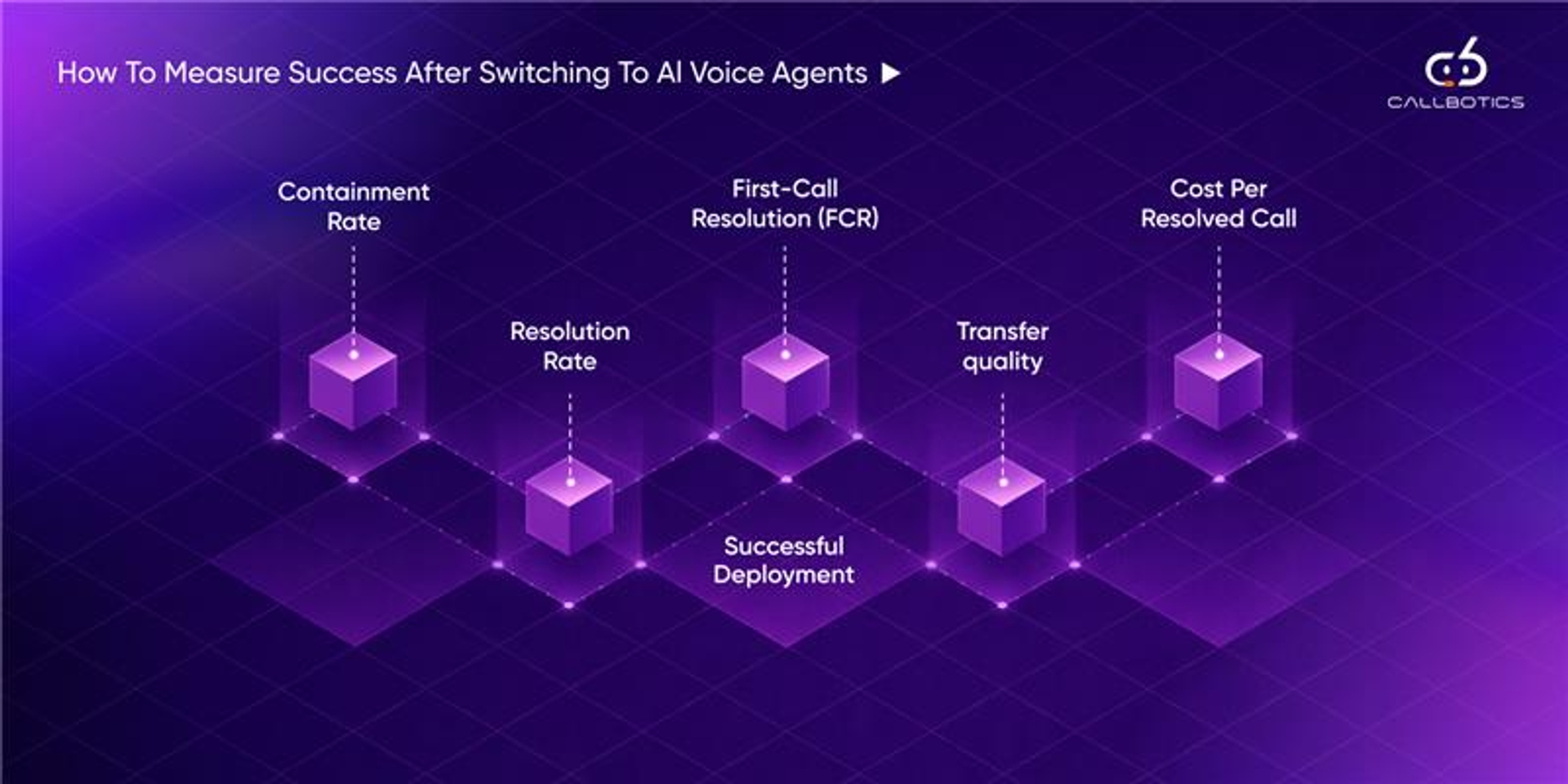
The value of AI voice should be visible in outcomes, not just in demos or surface-level automation numbers. That means contact centers need a clear measurement framework from the start. Otherwise, it becomes difficult to tell whether the system is actually improving operations or just shifting effort from one part of the queue to another.
The most useful KPIs usually include containment rate, resolution rate, abandonment rate, transfer quality, repeat contact rate, average handling time impact, and cost per resolved call. Together, these metrics help teams understand whether AI is improving both customer experience and operational performance in a meaningful way.
Want AI voice agents that deliver measurable contact center outcomes, not just automation claims? See how CallBotics helps teams modernize fasterSwitching to AI voice works best when the platform is built around real contact center operations rather than generic voice demos. CallBotics is designed for exactly that. Developed by teams with over 17 years of contact center experience, it helps contact centers deploy AI voice agents across structured workflows where queue pressure, routing quality, handoffs, and measurable performance all matter.
What makes CallBotics different:
This helps contact centers adopt AI voice agents in a controlled way, prove value quickly, and expand based on real operational results.
Contact centers are switching to AI voice agents because the pressure to do more with less is no longer temporary. Teams need faster answer times, better routing, stronger resolution rates, more flexible coverage, and lower cost per interaction, all without increasing headcount at the same pace as demand. AI voice agents help address that challenge by improving both customer experience and operational efficiency simultaneously.
The strongest reason to switch is not any single feature. It is the combined effect across queues, routing, repetitive workload, handoff quality, and insight generation. For contact centers that start with the right use cases and measure outcomes carefully, AI voice becomes a practical modernization layer that improves how calls are handled from the first hello to the final resolution.

Urza Dey (She/They) is a content/copywriter who has been working in the industry for over 5 years now. They have strategized content for multiple brands in marketing, B2B SaaS, HealthTech, EdTech, and more. They like reading, metal music, watching horror films, and talking about magical occult practices.
See how enterprises automate calls, reduce handle time, and improve CX with CallBotics.
CallBotics is an enterprise-ready conversational AI platform, built on 18+ years of contact center leadership experience and designed to deliver structured resolution, stronger customer experience, and measurable performance.