High call transfer rates are rarely caused by a single failure. They are the visible result of broken routing logic, missing context, and systems that force agents to escalate instead of resolve. Every transfer adds friction, increases handle time, and erodes customer confidence. Over time, this compounds into higher operational costs and inconsistent service quality.
Modern contact centers are addressing this problem by using AI systems designed for real-world call behavior. When implemented correctly, AI does more than route calls. It creates clarity early in the interaction, preserves context throughout the conversation, and supports resolution without unnecessary handoffs. This is how organizations begin to reduce call transfer rate with AI in a way that is measurable and sustainable.
Call transfer rate measures how often a customer interaction is handed from one agent or system to another before resolution. While some transfers are unavoidable, a high transfer rate usually indicates structural inefficiencies in routing, knowledge access, or agent enablement.
From a customer perspective, transfers signal uncertainty. Customers interpret multiple handoffs as a lack of ownership, even when agents are well-intentioned. From an operational perspective, transfers inflate average handle time, increase repeat contact risk, and concentrate workload on senior staff.
Reducing transfers improves more than a single metric. It stabilizes service delivery and allows teams to scale without constantly adding headcount.
Most transfers fall into a few predictable categories:
These issues are not solved through training alone. They require systems that can interpret intent, surface context, and guide resolution during the call itself.
AI reduces call transfers by improving decision quality at every stage of the interaction. Instead of reacting after a call breaks down, AI reshapes how calls are handled from the first second through resolution. In production environments, this approach combines intent detection, structured workflows, real-time guidance, and unified context to keep interactions on the right resolution path. It enables contact centers to reduce avoidable handoffs by resolving more requests within a single flow rather than passing them between systems or teams. The result is fewer transfers, faster resolution, and more consistent outcomes across high-volume operations.
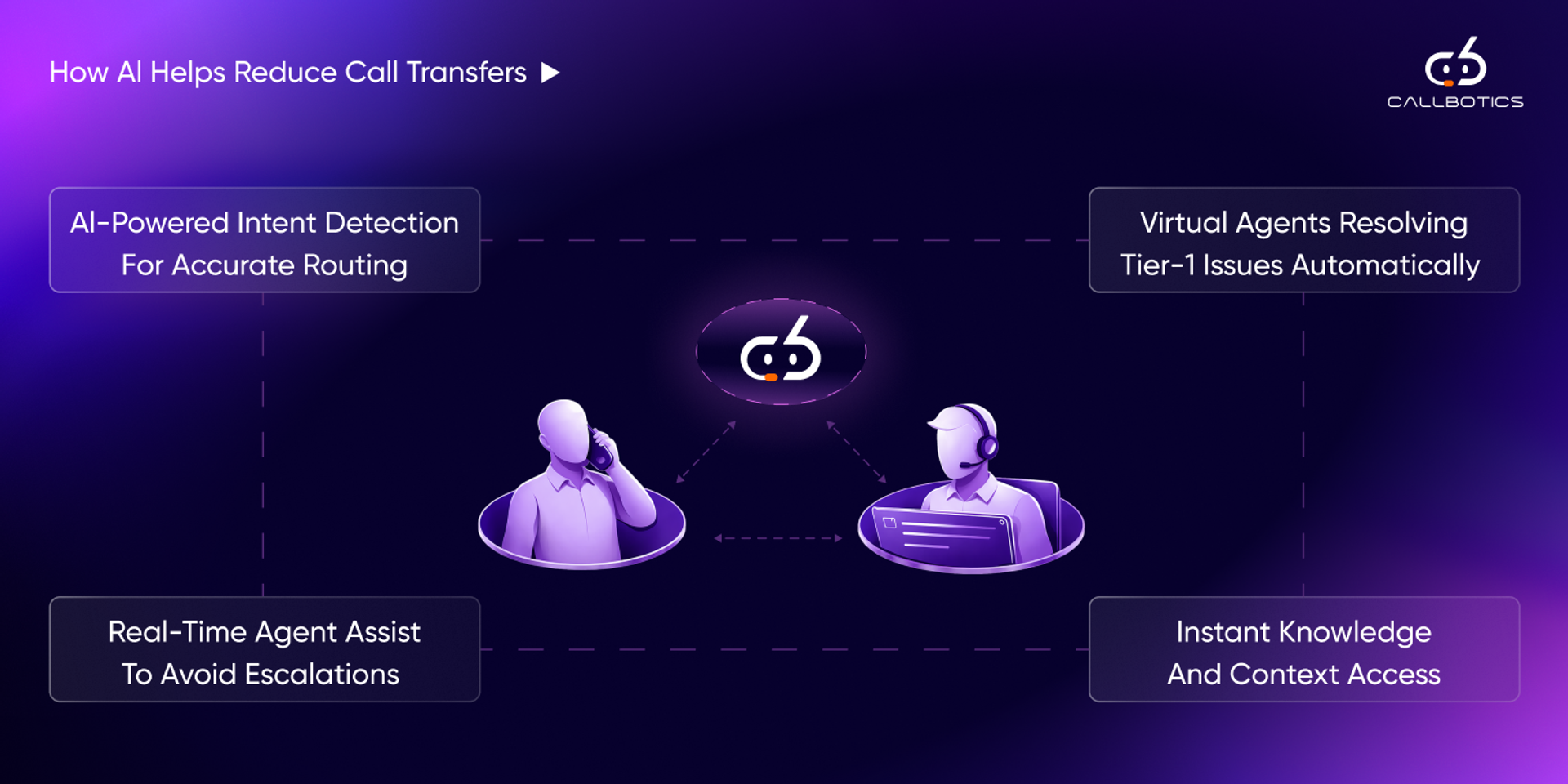
Accurate routing depends on understanding why the customer is calling, not just what menu option they selected. Modern AI call routing analyzes natural language, historical interaction patterns, and real-time signals to determine intent before routing decisions are made.
This allows calls to reach the right destination immediately, reducing misroutes that often lead to multiple transfers early in the interaction.
A large share of call volume consists of structured, repeatable requests. When these interactions are handled by AI virtual agents, customers receive faster answers, and agents are protected from unnecessary interruptions.
Resolving routine inquiries end-to-end, virtual agents can prevent transfers that would otherwise occur simply to move the call to the correct queue or department.
Not every escalation is required. Many occur because agents lack confidence or clarity mid-conversation. AI-driven guidance supports agents during the call by surfacing next steps, relevant policy details, and resolution paths in real time.
This support helps reduce call escalations by enabling agents to complete the interaction without involving supervisors or specialists.
Transfers often happen when expertise is siloed. AI systems that unify customer history, policy data, and prior interactions eliminate the need to move calls for basic information access.
When agents and systems share a complete view of the interaction, resolution becomes a single continuous experience rather than a chain of handoffs.
See how CallBotics helps contact centers reduce transfers with enterprise-ready AI voice agents built for faster routing, structured resolution, and live operational visibility.Reducing transfers is not about adding more technology layers. It is about removing friction from how calls flow through the contact center. Teams that succeed treat AI as part of the operating model, not a side experiment.
The following framework reflects how high-performing contact centers deploy AI without disrupting existing operations.
The first opportunity to prevent transfers happens before the call reaches an agent. Intent models must work with natural language, not menu trees. Customers rarely describe their issue in neat categories, and forcing them to do so creates routing errors that cascade into transfers.
Effective intent models analyze what the caller says, how they say it, and how similar issues have been resolved in the past. This allows the system to route based on the likelihood of resolution rather than static rules. When routing accuracy improves, downstream transfers decline naturally.
Virtual agents are most effective when deployed with clear boundaries. They should handle structured conversations that follow predictable paths and escalate only when judgment or exception handling is required.
When designed for call-heavy workflows, these agents complete entire interactions instead of stopping midway. This removes a large portion of calls that would otherwise enter the agent queue only to be transferred later.
The operational benefit is immediate. Agents receive fewer interruptions, and customers avoid unnecessary handoffs before reaching resolution.
Even with better routing and containment, some calls will always require a human. This is where real-time assistance matters most.
During live conversations, AI can surface verified information, recommended actions, and compliance-aligned guidance at the moment it is needed. This support helps agents stay in control of the call and resolve issues confidently.
This is where AI for first-contact resolution becomes tangible. Instead of measuring success after the call ends, resolution is actively supported while the call is still in progress.
Transfer reduction is not a one-time optimization. Call patterns change with seasonality, policy updates, and customer behavior. AI systems that learn from conversation outcomes allow routing logic to evolve without manual reconfiguration.
Analyzing where transfers still occur and why, teams can refine intent models, expand containment safely, and improve guidance accuracy. Over time, this creates a feedback loop that stabilizes performance even as volume fluctuates.
Call transfers do not happen randomly. They appear in predictable moments where systems lack clarity or agents lack support. The following scenarios reflect where AI delivers the most consistent impact. CallBotics is built to reduce these breakdowns by improving routing accuracy, preserving context, and supporting resolution across live contact center workflows. It helps teams contain structured requests, guide agents in real time, and escalate with context only when necessary. In practice, that means fewer avoidable handoffs, faster resolution paths, and more consistent customer experiences across high-volume environments.
| Industry Scenario | Common Transfer Trigger | How AI Changes the Outcome |
|---|---|---|
| Telecom support | Misrouted troubleshooting calls | Intent detection routes directly to the correct resolution path |
| Insurance claims | Status inquiries escalated to specialists | Guided workflows provide accurate updates without transfer |
| Ecommerce | Order lookup handled across teams | Automated retrieval resolves the request immediately |
| Banking | Verification steps causing handoffs | Structured flows complete verification in one interaction |
Telecom support calls often involve layered issues that span billing, service status, and device troubleshooting. Transfers occur when the initial agent cannot confirm context or determine the next step quickly.
AI-driven intent detection identifies the root issue early. Virtual workflows guide diagnostics step by step. Real-time assistance ensures agents stay aligned with approved resolution paths. As a result, most issues are resolved in one interaction without escalation.
Claims-related calls are structured but sensitive. Transfers happen when agents lack immediate visibility into claim status or coverage details.
AI systems retrieve verified claim data, guide conversations in real time, and adapt responses based on customer sentiment. This keeps the interaction contained and reduces handoffs to specialists unless genuinely required.
Order-related inquiries represent high volume and low complexity, yet they frequently generate transfers due to fragmented systems.
AI workflows unify order status, delivery updates, and return policies into a single interaction. Customers receive clear answers quickly, and agents are not pulled into calls that can be resolved automatically.
Verification steps often trigger transfers when processes are rigid or unclear.
AI-led flows complete verification securely within the same interaction, using structured logic that adapts to customer responses. This eliminates the need to move calls between teams simply to complete identity checks.
Explore CallBotics to see how enterprise teams reduce transfer rates through better routing, faster workflow activation, and AI built on real contact center experience.Most AI voice tools are designed around ideal conversations, but CallBotics is designed around reality, where contact centers face high call volumes, shifting intent, interruptions, and the need for reliable escalation when human judgment matters.
Reducing call transfers is not about forcing conversations into automation. It is about creating clarity, preserving context, and supporting resolution at every stage of the interaction. AI systems designed for real contact center workflows improve routing accuracy, contain structured demand, and guide agents through complex moments. When implemented thoughtfully, AI transforms a persistent problem into a manageable exception.
This shift creates measurable operational value over time. Contact centers that invest in this approach see improvements in resolution quality, customer satisfaction, and operational stability, while also reducing friction for both customers and agents. Customers experience fewer unnecessary handoffs and clearer paths to resolution, while teams gain better visibility into where transfers happen and how workflows can be improved. The goal is not to remove human involvement, but to build a system where automation and human support work together more effectively.

See how enterprises automate calls, reduce handle time, and improve CX with CallBotics.
CallBotics is an enterprise-ready conversational AI platform, built on 18+ years of contact center leadership experience and designed to deliver structured resolution, stronger customer experience, and measurable performance.