A shopper stumbles onto your eCommerce site at 2 a.m. They like a product, but have questions: Will this charger work with my laptop? Can I get this delivered by this weekend?
They look for a chat widget, maybe an FAQ section. Nothing answers their question. By morning, they’ve forgotten about you or found an alternative.
This is revenue leakage, but not from weak demand or poor product-market fit. It’s due to response latency at the moment of purchase. The bottleneck today is operational: conversion infrastructure. It’s about your ability to answer questions, resolve hesitation, and move shoppers to checkout at any hour, in any volume, without adding headcount.
To solve this, top brands are using AI in the buyer journey. McKinsey's November 2025 State of AI report found that organizations using AI to drive growth and innovation improved customer satisfaction, competitive differentiation, profitability, and revenue growth.
According to the Salesforce 2025 Connected Shoppers Report, 39 percent of consumers and more than half of Gen Z shoppers are already using AI for product discovery.
Shoppers are already engaging with AI during their purchase journey. The infrastructure question for leadership: Can your operation respond at that speed and scale? This guide will nudge you toward the right path.
This guide covers:
An AI voice agent is software that speaks with customers via voice channels and completes tasks during the conversation.
An AI voice agent for eCommerce sales can typically handle tasks such as abandoned-cart follow-ups, order status inquiries, delivery updates, and post-purchase feedback. For example, an AI voice agent can call a shopper who left items in their cart, answer questions about sizing or shipping, and process the order.
The system understands customer intent, responds in real time, and works directly with your CRM and other internal tools.
AI voice agents operate through a sequential workflow that ensures no information gaps.
If you’d like to see an AI voice agent handling eCommerce sales and support in real time, you can explore a live example on this page.
As an eCommerce leader, you’re painfully aware of the problems plaguing the industry: abandoned carts, response latency, and the difficulty of delivering personalized service at scale.
What has changed is that it has become easier to tackle these challenges. AI voice agents interact with customers through natural, spoken dialogue. Unlike text-based bots, they handle complete conversations in real time, understand intent, ask clarifying questions, and take action.
This matters because e-commerce buying intent is highly time-bound. When customers are ready to buy, delays in answering a question about pricing, delivery, returns, or compatibility directly reduce conversion. Text-first channels often plateau at this moment. Typing slows the interaction, back-and-forth messages introduce friction, and customers drop off when reassurance doesn’t come fast enough.
AI voice agents remove these decision blockers in a single, continuous interaction. Customers can ask follow-up questions naturally, get immediate clarification, and move forward without switching channels or waiting for a human agent.
According to IBM's 2026 Consumer Research Study, which surveyed over 18,000 consumers globally, 41% now use AI assistants to research products, 33% to find reviews, and 31% to search for deals and promotions.
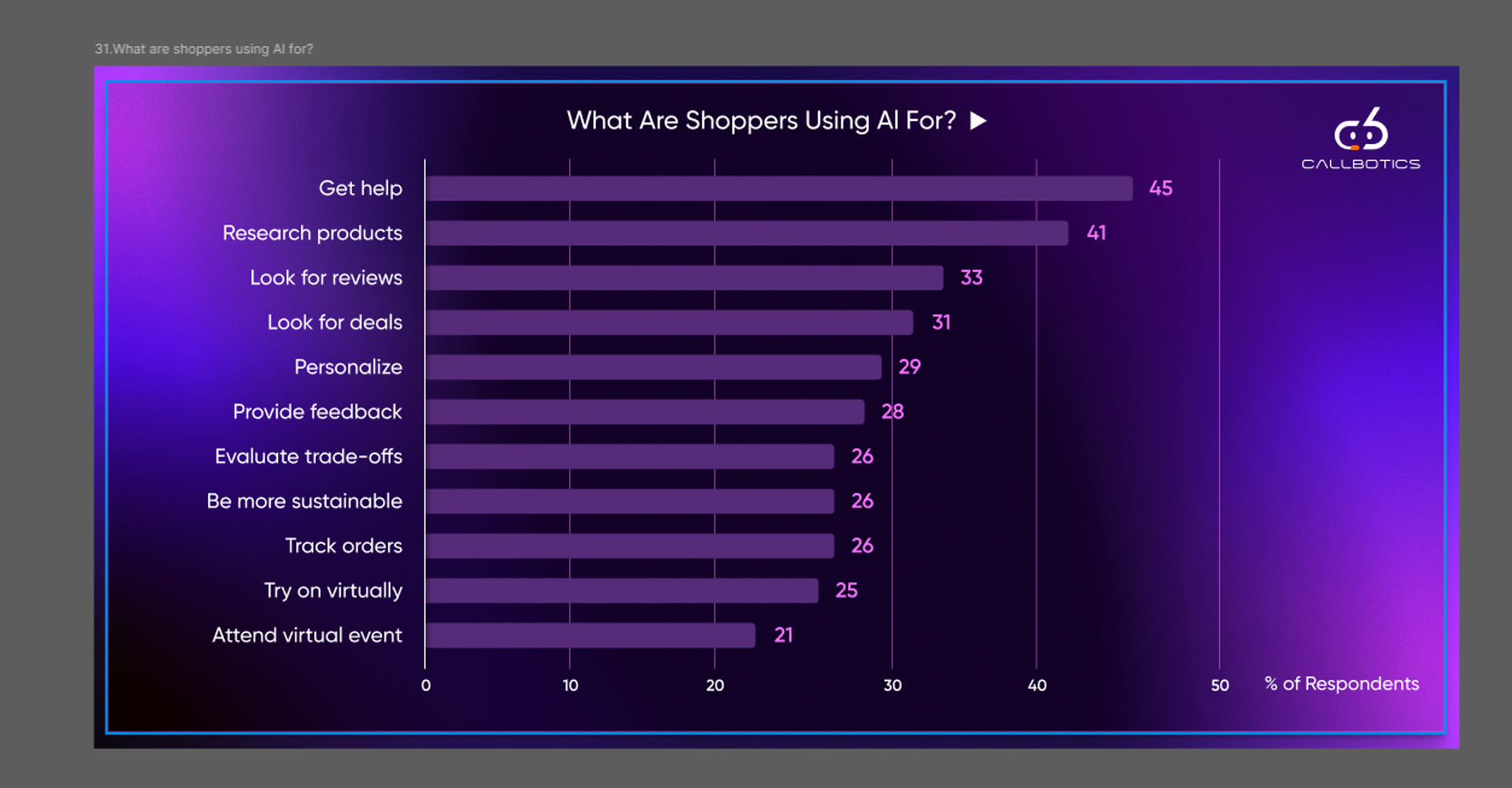
Caption: What shoppers use AI for (IBM 2026 Consumer Research Study)
IBM's study found that 48% report stronger customer engagement through conversational AI. This is particularly true in the discovery phase, where consumers increasingly interact with AI through chat, voice, or messaging to research and evaluate products before buying.
Voice also enables real-time handling of high-friction moments that typically stall purchases. AI voice agents can address delivery timelines, resolve edge cases, guide payments, and manage exceptions instantly. When done well, this directly impacts revenue.
On average, 80% of consumers who have shopped using their voice assistant are satisfied
— — PwC's Consumer Intelligence Series
PwC's Consumer Intelligence Series research found that 8 out of 10 consumers who shopped with a voice assistant were satisfied with the experience. Of those, one in three consumers shared their positive experiences with friends and family, while 39% shopped again with the same retailer, and 24% spent more money with that retailer. It’s clear that conversational voice AI, when done well, delivers results.
For businesses, the advantage compounds. AI voice agents can instantly handle traffic spikes during campaigns, product launches, or seasonal peaks without adding headcount or degrading response quality.
Instead of turning browsing sessions into missed opportunities, voice-led conversational AI converts them into guided buying experiences, powered by a channel consumers are already growing comfortable with.
Drive sales round the clock with always-on customer engagement
Voice AI delivers the most value when it's tied to revenue and operational outcomes. The use cases below walk through how eCommerce brands can deploy AI voice agents across the customer journey.
A shopper adds items to their cart at 10 PM, gets distracted, and leaves. Your cart abandonment email lands in a crowded inbox the next morning. The SMS goes unread.
What conversational voice AI changes: An hour after cart abandonment, an AI voice agent calls: "Hi, this is [Brand]. You left a few items in your cart. Can I help you complete your order or answer any questions?" The shopper asks about a particular feature and shipping. The agent answers both, offers a discount, and processes the order on the spot.
Outcome: Automated cart recovery that reaches shoppers while purchase intent is still warm, without manual outreach or follow-up delays. Better customer experience.
A customer wants to order running shoes, but abandons their cart because they also want socks and a water bottle. These are products you sell, but the customer wasn’t aware of them.
What conversational voice AI changes: During a cart recovery call, an AI voice agent says: "A lot of customers grab socks with this order. They're 10% off when bundled. Want me to add them?"
Or during a post-purchase follow-up call, after confirming the delivery went smoothly and collecting feedback, the agent mentions: "By the way, the pair of shoes goes well with running socks and a water bottle. Want me to send you a link?"
Outcomes: Higher Average Order Value (AOV) and repeat purchases through timely, personalized recommendations. Boost in customer loyalty.
A customer wants to return an item. They try the chat feature, but entering the details is too slow. They call support, but the queue is ten minutes long. They’re frustrated before speaking to anyone.
What conversational voice AI changes: The customer calls, and an AI voice agent answers immediately, whether it’s 2 p.m. or 2 a.m., and processes the return. The agent resolves the issue and sends a confirmation within 90 seconds.
Outcome: Instant resolution round the clock without queues, tickets, or escalations, even during peak volumes. Boosts customer satisfaction
The use cases discussed above for AI voice agents for e-commerce sales are representative. You can gradually expand the scope of AI voice agents to handle back-in-stock notifications, subscription renewals, loyalty program updates, and seasonal promotion outreach. The common thread: high-volume, time-sensitive interactions where speed and personalization matter.
The use cases above show where AI voice agents deliver value, but impact depends on how well they're integrated into your existing operations.
Deploying an AI voice agent for eCommerce sales is simpler than most teams expect. The key is to connect the right systems, train the AI on relevant scenarios, and set up triggers that align with your customer journey. Here's how to do it.
Connect the conversational voice agent to your existing stack: Shopify, WooCommerce, Magento, or your CRM. This ensures the voice agent has access to customer data, order history, and product information from day one. Most platforms support API-based integrations, so setup typically takes hours or days.
When a customer calls about an order, the agent should already know what they purchased, when it shipped, and whether there are any issues. Without this connection, the conversation starts from scratch, and that defeats the purpose of the voice agent.
Input your FAQs, common objections from customers, data from past orders, and sales prompts. The more context the agent has, the better it handles real conversations without escalating unnecessarily.
Think through scenarios like:
The more context the agent has, the better it handles real conversations without unnecessary escalations. Start with the 10-15 most common queries. These typically cover 70-80% of inbound calls.
Set rules for when outbound calls go out. For example:
Timing matters too. A cart recovery call at 2 a.m. may not land well, so set rules to ensure reasonable calling hours. Also, automate second or third call attempts a few days after the initial call, in case you couldn’t get through to the customer right away.
Use the analytics dashboard to track conversion rates, call duration, resolution rates, and customer sentiment. Look for patterns:
Refine scripts based on what's working, and cut what's not. AI voice agents improve over time, but only if you're feeding performance data back into the system. Plan for a periodic review cycle.
If you’d like to dive deeper into how to implement conversational AI, take a look at our blog on this topic.
The implementation steps above may be straightforward, but execution depends on the platform you choose. CallBotics AI voice agents for eCommerce sales are built to accelerate the process, with production-ready agents deployed in about 48 hours.
Built by operators with over 17 years of contact center experience, CallBotics automates eCommerce voice interactions without sacrificing operational nuance or control.
If you’re an eCommerce store looking to automate cart recovery, sales calls, and post-purchase support without hiring extra agents or waiting months to go live, CallBotics ticks all your boxes.
Salesforce data shows that 39% of shoppers, including over half of Gen Z shoppers, are using AI for product discovery. Will customers who call at 2 a.m. have the same experience as those who call at 2 p.m.?
Here’s the opportunity:

Alex Penn is a B2B SaaS writer with 3 years of experience turning complex AI topics into clear, practical content for modern businesses. She specializes in AI, automation, and emerging tech, with a knack for making technical ideas accessible without watering them down. Outside of work, Alex bakes cookies for friends and unwinds with a steady diet of indie music.
See how enterprises automate calls, reduce handle time, and improve CX with CallBotics.
CallBotics is an enterprise-ready conversational AI platform, built on 18+ years of contact center leadership experience and designed to deliver structured resolution, stronger customer experience, and measurable performance.