
Conversational AI has become a foundational capability for modern businesses handling customer interactions at scale. Organizations now rely on automated conversations to manage inbound support, outbound follow-ups, appointment scheduling, lead qualification, and status inquiries across voice and digital channels.
However, deploying conversational AI is not a plug-and-play exercise. Many initiatives stall after launch because they are designed for ideal conditions rather than real operational environments. High call volumes, unpredictable customer behavior, incomplete data, and peak traffic periods expose weaknesses in poorly planned deployments.
Understanding how to deploy conversational AI effectively requires a structured approach that balances strategic intent, operational discipline, and technical execution. When deployed correctly, conversational AI reduces wait times, improves resolution consistency, and allows teams to handle demand without increasing complexity or cost.
This guide provides a practical, step-by-step framework for deploying conversational AI in production environments. It focuses on decisions that determine long-term performance, scalability, and business impact.
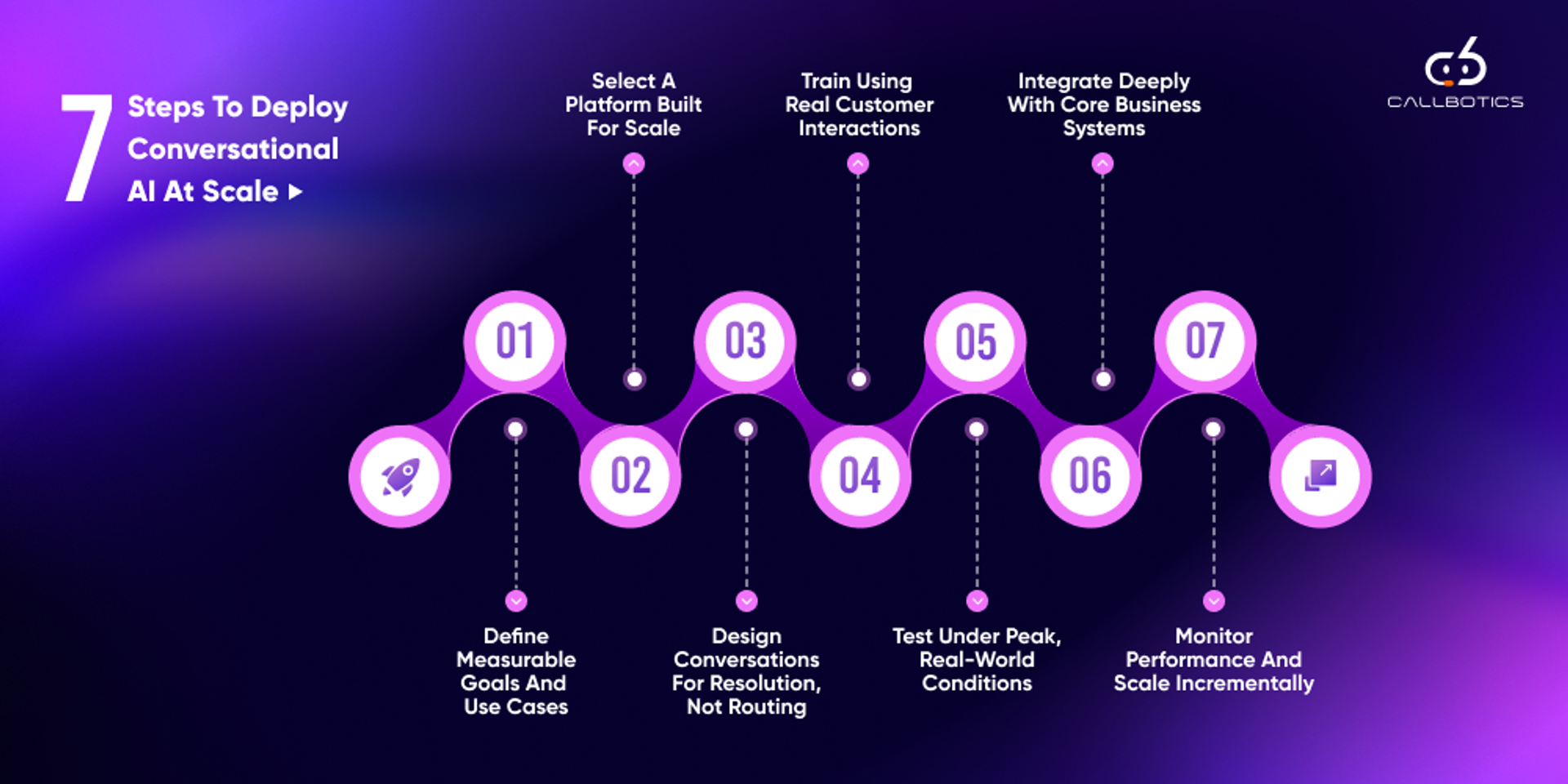
Successful conversational AI deployment follows a clear sequence. Each step builds on the previous one and directly influences system reliability, customer experience, and operational outcomes.
Deployment begins with clarity. Without clearly defined goals and use cases, conversational AI initiatives lack direction and become difficult to evaluate.
Conversational AI goals should be tied to measurable business and operational outcomes. Effective objectives typically focus on:
These objectives provide a concrete benchmark for deployment success and guide design, training, and platform decisions.
Not all customer interactions should be automated. Conversational AI performs best when applied to interactions that are:
Examples include appointment scheduling, order or case status checks, account verification, outbound reminders, and follow-up calls.
Equally important is documenting which interactions should not be automated. Scenarios involving complex judgment, negotiation, or sensitive interpretation should remain outside automated resolution. Clear scope definition prevents misuse and protects customer trust.
Platform selection determines whether conversational AI can operate reliably under real-world conditions.
When selecting a conversational AI platform, organizations should prioritize:
Platforms should be evaluated based on how they behave during peak traffic, not just during demonstrations or pilots.
Organizations typically choose between three approaches:
The decision should align with internal capabilities, deployment urgency, and tolerance for operational risk.
Step 3: Design Effective Conversational Flows
Conversation design is one of the most critical factors in deployment success. Well-designed flows enable resolution. Poorly designed flows increase confusion and escalation.
Each conversational flow should be built around a clearly defined goal. This includes:
Flows without clear completion criteria often lead to unresolved interactions and poor user experience.
Users rarely follow scripts. They interrupt, rephrase, provide partial answers, or change intent mid-conversation. Effective conversational flows include:
Designing for recovery is essential for maintaining performance at scale.
Multi-turn conversations require the system to retain and apply context consistently. Remembering previously collected information prevents repetition, shortens interactions, and improves resolution rates.
Training is where conversational AI moves from theoretical capability to practical usefulness. The quality of training directly impacts accuracy, stability, and user trust.
High-performing conversational AI systems are trained on real customer interactions rather than hypothetical examples. Historical call transcripts, chat logs, and recorded conversations provide realistic phrasing, incomplete requests, and natural variations in language.
Effective training datasets should include:
Training exclusively on idealized examples results in brittle systems that fail under real usage.
Adding too many intents early increases confusion and reduces accuracy. It is more effective to start with a limited set of well-defined intents that align directly with chosen use cases.
Each intent should have:
This approach improves intent recognition and simplifies ongoing optimization.
Training does not end at launch. Conversational AI must be refined continuously using live interaction data.
Ongoing fine-tuning should include:
Continuous training ensures the system adapts to evolving customer behavior and business changes.
Testing conversational AI requires more than validating correct responses. It must reflect production conditions.
Before launch, conversational AI should be tested for:
Testing limited to scripted scenarios does not expose real-world weaknesses.
Internal teams often unconsciously adapt to system behavior. Testing should include users unfamiliar with the system to surface natural interaction patterns.
This approach helps identify:
Testing must produce measurable outcomes. Core performance indicators include:
These metrics establish a baseline for post-launch monitoring and optimization.
Conversational AI delivers limited value without access to business data. Integration transforms automated conversations into resolution-capable interactions.
Conversational AI typically needs access to:
Without real-time data access, conversational AI can only provide generic responses and deflection.
Integrations must be:
Fallback logic should be defined for cases where systems are unavailable, ensuring conversations do not stall or degrade user experience.
When conversational AI escalates to a human agent, all collected information should be passed forward seamlessly. Context preservation reduces repetition, shortens resolution time, and improves agent efficiency.
Deployment does not end at launch. Conversational AI must be actively monitored and adjusted as usage patterns, volumes, and business requirements change.
Conversational AI should be monitored with the same rigor as other operational systems. Key performance indicators should be visible in real time and reviewed regularly.
Critical metrics include:
Monitoring these metrics allows teams to identify degradation early and make corrective adjustments before customer experience is affected.
Live interaction data provides clear signals about where conversational AI succeeds and where it struggles. Optimization efforts should focus on:
Optimization should follow a structured cadence rather than ad hoc changes.
Scaling conversational AI should be incremental. New use cases, channels, or languages should be introduced only after existing flows demonstrate consistent performance.
This approach minimizes risk and preserves stability as deployment scope grows.
Even well-planned deployments encounter challenges. Addressing them proactively is critical to maintaining reliability.
Conversational AI often handles sensitive customer data. Deployments must comply with applicable security and privacy requirements, including data access controls, encryption, and auditability.
Best practices include:
Security and compliance considerations should be addressed early, not retrofitted after launch.
Customers rarely interact in predictable ways. Conversational AI must be designed to handle:
Robust recovery logic and sentiment-aware escalation are essential for managing unpredictability at scale.
Conversational AI must integrate into existing operational workflows rather than forcing teams to adapt around it. Clear ownership, escalation rules, and handoff procedures prevent confusion and duplication of effort.
Scaling conversational AI successfully requires discipline and consistency.
New use cases should be added only after existing ones demonstrate stable resolution rates and acceptable escalation behavior. This prevents compounding errors across the system.
Multi-channel and multilingual expansion increases reach but also complexity. Each channel and language should be treated as a separate deployment phase, with dedicated testing and performance monitoring.
Scaling requires defined ownership for:
Clear governance ensures conversational AI remains aligned with business objectives over time.
Most AI voice assistants focus on automation. CallBotics is designed around operational outcomes.
CallBotics was built for real contact center conditions rather than ideal scenarios. It assumes fluctuating call volumes, shifting customer intent, and the need for dependable escalation.
CallBotics supports deploying conversational AI effectively by:
For customers, this results in fewer transfers, shorter wait times, and clearer resolution. For teams, it delivers predictable performance, faster deployment, and reduced operational complexity.
CallBotics strengthens operations by removing friction from routine interactions while preserving human judgment where it matters most.
Deploying conversational AI successfully requires more than selecting a model or launching a bot. It requires disciplined planning, realistic design, continuous optimization, and operational accountability.
Organizations that understand how to deploy conversational AI effectively focus on:
When deployed with these principles, conversational AI becomes a dependable component of customer operations rather than an experimental layer.

See how enterprises automate calls, reduce handle time, and improve CX with CallBotics.
CallBotics is an enterprise-ready conversational AI platform, built on 18+ years of contact center leadership experience and designed to deliver structured resolution, stronger customer experience, and measurable performance.