Healthcare contact centers handle a large share of calls related to member enrollment, eligibility checks, benefits questions, appointment readiness, and billing clarification. These calls are often repetitive, but they still require accuracy, speed, and careful handling of sensitive information. Patients and members expect quick answers because delays in enrollment or verification can directly affect access to care.
The challenge is that many of these workflows still depend on manual lookup, multiple systems, and live staff availability. That slows response times, increases administrative workload, and creates more room for inconsistency. In high-volume environments, even simple verification requests can create long queues and operational friction.
This is where AI voice agents are becoming more useful in healthcare. They help automate structured enrollment and benefits workflows, verify information in real time, collect the right details before escalation, and make patient access smoother without putting the full burden on live teams.
Enrollment and benefits verification look simple from the outside, but they create a lot of operational pressure inside healthcare contact centers. Patients call with urgent questions about eligibility, covered services, copays, plan status, and whether they can move forward with care. These questions often sound repetitive, but they sit inside workflows where mistakes can delay treatment, create confusion, or lead to billing disputes later.
That is why these calls are difficult to handle at scale. Healthcare teams need speed, but they also need accuracy, compliance, and access to multiple systems before they can give the right answer.
A large share of inbound healthcare support demand comes from common questions such as “Am I covered?” “Is this service included?” “What plan am I on?” “What is my deductible?” and “Can I schedule this appointment?” These are repetitive enough to automate, but important enough that patients expect a clear and reliable answer.
Healthcare is not an environment where vague or inconsistent answers are acceptable. Enrollment details, coverage rules, and eligibility status must be handled carefully because the information affects real care decisions and financial expectations. A fast answer is only useful if it is correct.
Enrollment and verification often depend on multiple data sources. A contact center may need access to the EHR, payer systems, benefit data, member records, scheduling systems, or internal policy logic. That makes the workflow harder than a simple FAQ response.
Many calls happen because the patient needs to act quickly. They may be trying to confirm coverage before scheduling, resolve a benefits question before treatment, or understand whether a service is eligible right now. That urgency makes long wait times especially frustrating.
Explore CallBotics to see how healthcare teams can automate enrollment and verification workflows with faster answering, stronger routing, and enterprise-ready AI voice automation.AI voice agents in this context act as structured support systems that can answer calls, understand intent, collect the right information, and help move the patient toward the right next step. That may include guiding a new member through enrollment steps, checking eligibility, confirming plan information, sharing approved benefits details, or preparing the interaction for a human specialist when the issue becomes more complex.
The key difference from a basic phone tree is that the system can handle natural language and workflow execution together. Instead of forcing the caller through rigid menu options, it can identify what the patient is actually trying to do, ask the needed follow-up questions, and either complete the task or hand the call off with context already attached.
That makes healthcare support feel less fragmented and more efficient, especially for the high-volume, structured interactions that contact centers handle every day.
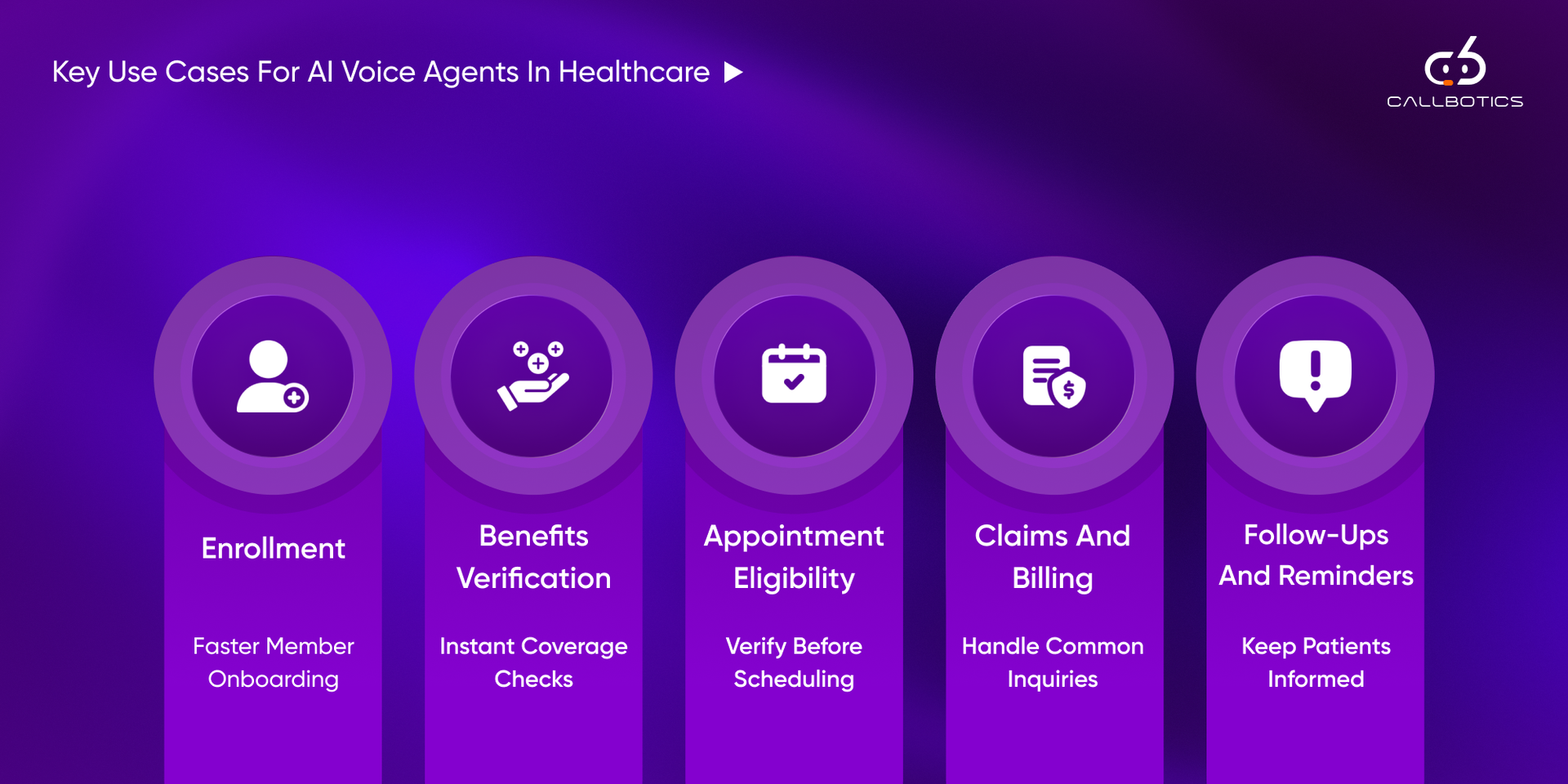
The best healthcare use cases for AI voice agents are the ones that combine high volume, clear structure, and measurable outcomes. Enrollment and verification workflows fit that pattern especially well because they require consistency, speed, and system access more than open-ended conversation.
AI voice agents can guide patients or members through enrollment workflows by collecting required details, confirming information, and moving them through the next steps in a structured way. This helps reduce manual workload while still giving patients a clearer and faster entry into the system.
One of the strongest use cases is real-time verification of eligibility, coverage, and plan details. When connected to the right systems, the AI can confirm whether coverage is active, which plan rules apply, and whether the patient should proceed or escalate for a more detailed review.
Before an appointment is scheduled or confirmed, many healthcare providers need to know whether the patient is eligible and whether the visit is covered. AI voice agents can help confirm readiness before the appointment process moves forward, reducing preventable issues later.
Patients often call with questions about what is covered, why a claim was handled a certain way, or what their out-of-pocket responsibility may be. AI can support the early part of these calls by giving approved information, collecting account context, and routing more complex billing discussions appropriately.
After enrollment or verification, AI voice agents can also handle reminders, follow-ups, and next-step communication. That includes confirming documents, reminding patients of required actions, or reinforcing what happens next in the process.
The benefit of AI in healthcare enrollment and verification is not just that it answers calls. It changes how the operation handles repetitive demand, how consistently information is delivered, and how quickly patients can move through administrative steps that affect access to care.
AI voice agents can answer immediately and handle many repetitive requests without queue delay. That reduces waiting and helps patients get answers faster when they need to confirm eligibility or enrollment details before taking action.
Healthcare teams spend a large amount of time on repetitive administrative calls that do not always require human judgment. AI reduces that burden by handling common verification and onboarding steps, which gives specialists more time for exceptions and higher-complexity cases.
Structured automation improves consistency because the system follows the same approved workflow every time. That reduces the variation that often appears when different agents interpret rules or processes differently under pressure.
Patients usually judge support by how easy it was to get help. When enrollment and verification become faster, clearer, and less repetitive, the experience improves even if the workflow is still administrative in nature.
See how CallBotics helps healthcare teams improve enrollment access, reduce administrative call pressure, and deliver more consistent verification support with enterprise-ready AI voice workflows.Healthcare automation only works when it is paired with strong privacy and governance controls. Enrollment and benefits workflows often involve sensitive personal and health-related information, which means AI voice agents need to be designed with data protection, access controls, and escalation logic in mind from the start.
Any healthcare voice workflow should be designed around the secure handling of protected information. That includes how data is collected, stored, accessed, and shared during and after the interaction. The automation should never be treated as separate from the compliance model.
Before sensitive benefits or member details are discussed, the system should confirm identity using the right verification logic. This reduces the risk of giving protected information to the wrong caller and creates a more defensible workflow overall.
Healthcare teams need visibility into what happened during the interaction. That means maintaining transcripts, decision records, verification steps, and escalation outcomes in a way that supports oversight and accountability without exposing data too broadly.
Healthcare teams get the best results when they start with structured workflows, connect the right systems, and avoid overcomplicating the patient experience. The goal is not to automate everything at once. It is to improve access and efficiency in the areas where AI can be most reliable.
These are good starting points because they are repetitive, measurable, and important to patient access. They also create value quickly by reducing queue pressure and administrative workload.
The voice agent should have real-time access to the systems that hold the truth about patient status, coverage, and workflow state. Without these integrations, the AI is often limited to message capture or generic responses.
Patients usually want clarity, not complexity. Prompts should be short, direct, and easy to follow. Healthcare workflows are already complicated enough, so the voice experience should reduce friction, not add to it.
Some cases will always need human review. The handoff should include the member's context, what has already been verified, and what the patient is trying to accomplish, so the call does not start over from zero.
Healthcare teams should evaluate AI voice performance using both operational and patient-facing metrics. That is the best way to prove whether the system is improving access, efficiency, and consistency rather than just moving calls around differently.
| KPI | What it measures | Why it matters |
|---|---|---|
| Enrollment completion rate | How many onboarding calls end successfully | Shows whether the workflow helps patients move forward |
| Verification accuracy rate | Correctness of eligibility and benefits responses | Reflects reliability and risk control |
| Call resolution rate | How many calls are handled without further escalation | Shows practical automation value |
| Patient satisfaction (CSAT) | How easy and helpful the experience felt | Validates patient experience impact |
| Average handle time | How efficiently structured administrative calls are managed | Reflects workload reduction |
This shows how often the AI successfully helps the patient complete the enrollment or onboarding path. It is one of the clearest indicators that the workflow is usable and effective.
This measures how often the information given during benefits and eligibility checks is correct. In healthcare, this is especially important because inaccuracies create downstream operational and patient risks.
This shows how many enrollment or verification calls can be completed without a live agent taking over. It helps the team understand where AI is reducing administrative burden most effectively.
Patients may not care that the workflow was automated, but they do care whether it felt easy and clear. CSAT helps validate that the process is improving the experience, not just speeding it up internally.
CallBotics helps healthcare organizations automate enrollment and benefits verification with AI voice agents built for high-volume, structured customer interaction workflows. Developed by teams with over 18 years of contact center and BPO experience, the platform is designed by operators who understand how queue pressure, workflow complexity, and sensitive information handling affect real service environments.
What makes CallBotics different:
This makes CallBotics especially useful for providers and healthcare support teams that want to streamline patient access and reduce manual administrative burden without losing control of the workflow.
AI voice agents help healthcare organizations improve enrollment and benefits verification by making these workflows faster, more consistent, and easier to scale. When patients need quick answers about eligibility, onboarding, and coverage, faster support can directly improve access to care and reduce frustration.
The strongest results come when healthcare teams start with structured workflows, connect the right systems, and use AI to remove administrative friction rather than trying to automate every possible interaction at once. Done well, this creates a more efficient support operation and a better patient experience at the same time.

Urza Dey (She/They) is a content/copywriter who has been working in the industry for over 5 years now. They have strategized content for multiple brands in marketing, B2B SaaS, HealthTech, EdTech, and more. They like reading, metal music, watching horror films, and talking about magical occult practices.
See how enterprises automate calls, reduce handle time, and improve CX with CallBotics.
CallBotics is an enterprise-ready conversational AI platform, built on 18+ years of contact center leadership experience and designed to deliver structured resolution, stronger customer experience, and measurable performance.