Billing and collections calls create steady pressure on contact center teams because they are high-volume, time-sensitive, and often sensitive for customers. A missed payment does not always mean someone is unwilling to pay. Sometimes they forgot the due date, missed the invoice, need a payment link, want to confirm a charge, or need help understanding the bill.
Customers also expect payment experiences to be fast and low-friction. JPMorgan notes that 65% of consumers expect frictionless payments, which makes long queues, repeated explanations, and slow payment support harder to justify.
AI voice agents can support common billing workflows such as payment reminders, balance explanations, payment link delivery, confirmation calls, retry reminders, and basic billing questions without making customers wait. The value is not just automation. It is helping customers act sooner, reducing avoidable inbound calls, and giving teams clearer visibility into who paid, who needs follow-up, and where payment conversations are getting stuck.
AI voice agents help contact centers handle billing calls that follow a clear process. They can call customers to send payment reminders, confirm basic account details, explain the amount due, share due dates, and guide customers to the next step.
For payment processing, the AI voice agent can help customers choose an available payment option, send a secure payment link, confirm whether a payment was completed, and update the connected system once the action is done. This reduces the need for agents to manually repeat the same instructions across hundreds or thousands of calls.
They can also support follow-ups. For example, if a payment fails, the AI voice agent can trigger a retry reminder. If a customer has already paid, it can confirm the update and avoid another unnecessary call. If the customer has a billing dispute, hardship request, or complex account issue, the call can be transferred to a human agent with the conversation context included.
Billing and collections calls are difficult to scale because they combine volume, urgency, accuracy, and customer sensitivity. Even when the task looks simple, the conversation needs to be handled carefully. These calls also affect cash flow, customer trust, and operational workload at the same time. If reminders are delayed or records are not updated correctly, teams may face more inbound calls, disputes, and follow-ups. That is why payment and billing workflows need consistency, timing, and clear visibility across every interaction.
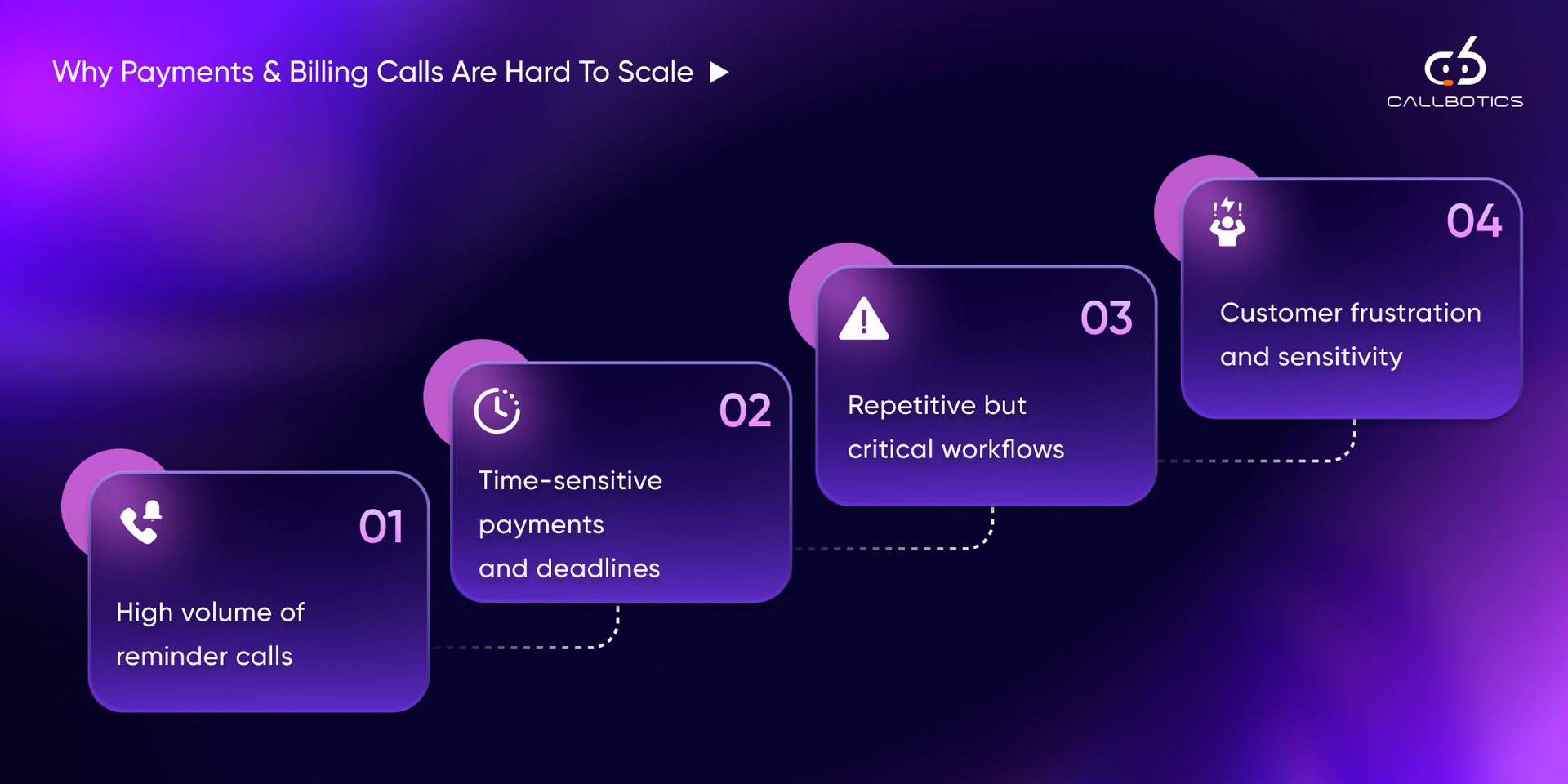
Payment reminders occur every cycle, so the same call types keep recurring across large customer bases. This can quickly consume agent capacity. The pressure increases when teams need to make multiple follow-ups before and after the due date. During peak billing periods, agents may spend most of their time on reminders instead of handling higher-value conversations. Without automation, reminder volume can become difficult to manage consistently.
Billing calls often occur near due dates, late-fee windows, or potential service interruptions. That makes timing critical. If the customer receives the reminder too late, they may not have enough time to act. Delays can also increase frustration when customers are trying to avoid penalties or service disruption. Teams need a reliable way to reach customers at the right moment.
Many billing calls follow a clear process, but they still need to be accurate. A wrong balance, due date, or payment instruction can create bigger issues. Customers rely on these details to make the right payment decision. Agents also need to capture the outcome correctly so finance and support teams have the latest status. When the process is repeated manually, small errors can appear at scale.
Payment-related calls can feel stressful for customers. Some may be confused, worried, or upset before the conversation even begins. The tone of the call matters because customers may already feel pressure around money, fees, or service access. If the experience feels rushed or unclear, frustration can increase quickly. Teams need to balance firmness, clarity, and empathy in every billing conversation.
AI voice agents can automate billing workflows that put the most pressure on contact center teams. These are usually high-volume calls that follow a clear process and require quick action from the customer. The goal is to make payment-related conversations faster, clearer, and easier to manage without pushing every interaction to a human agent. This gives teams more control over billing demand without complicating the customer experience.
They are especially useful for workflows where timing, accuracy, and consistency matter. AI can handle reminders, payment guidance, billing questions, confirmations, and failed payment follow-ups, while keeping records up to date. Human agents can then focus on disputes, exceptions, and sensitive cases that need judgment.
AI voice agents can make outbound calls to remind customers about upcoming or overdue payments. They can share the due date, pending amount, and next step in a clear and consistent way. This helps teams avoid missed reminders during peak billing periods. It also ensures customers receive the same accurate information across every reminder call.
These reminders are useful because many missed payments happen due to delay, confusion, or a lack of timely communication. A well-timed call can help customers act before late fees, penalties, or service issues begin. It also reduces the manual effort required from agents.
AI voice agents can guide customers through secure payment steps during the call. They can explain available payment options, send a secure payment link, and confirm what the customer needs to do next. This keeps the process simple without exposing sensitive payment details inside the conversation. It also helps customers move from reminder to payment without needing another call.
For teams, this reduces the time agents spend repeating payment instructions. For customers, it creates a faster path from reminder to action. The result is a smoother payment experience with fewer abandoned calls and fewer follow-ups.
Customers often call because they do not understand a charge, billing cycle, fee, or balance update. AI voice agents can answer common billing questions, explain invoice breakdowns, and guide customers through basic account details. This helps reduce avoidable inbound call volume. It also prevents simple billing confusion from turning into longer support conversations.
The value is clarity. When customers understand what they are being charged for, they are less likely to unnecessarily escalate the issue. If the question becomes complex or sensitive, the AI voice agent can transfer the call to a human agent, including the context.
After making a payment, customers often want to know whether it was successful. AI voice agents can confirm payment status, explain whether it is posted or pending, and share the next step if needed. This gives customers confidence without making them wait for an agent. It also reduces uncertainty for customers trying to avoid late fees or service disruptions.
These calls also reduce repeat contacts. If customers receive a clear confirmation or receipt update, they are less likely to call again to verify the same payment. This helps support teams keep queues clear for more complex billing issues.
Failed payments require prompt follow-up, as delays can lead to late fees, service interruptions, or repeated collection attempts. AI voice agents can notify customers when a payment fails and, where available, explain the reason, such as an expired card, a declined transaction, or incorrect payment details. This helps customers understand the issue before it becomes more stressful.
They can also guide the customer toward a retry option or send a secure link to update payment information. This helps teams recover failed payments more quickly while giving customers a clear way to resolve the issue. If the customer has a dispute or cannot pay immediately, the call can be routed to a human agent for support.
AI voice agents improve billing operations by enabling faster reminders, more consistent follow-ups, and easier access to basic payment support. This helps teams reduce delays, recover payments sooner, and use human agents where they are needed most. They also help supervisors see which payment conversations are completed, pending, or escalated. That visibility matters when teams are managing large account volumes. Instead of relying only on manual call attempts, billing teams get a more structured way to move customers toward resolution.
Timely reminders make it easier for customers to act before a payment becomes overdue. AI voice agents can reach customers at the right point in the billing cycle and guide them toward the next step. They can also send payment links or instructions while the customer is still engaged. This reduces the gap between reminder and action. When the process feels simple, more customers are likely to complete payment without needing another call.
Missed payments often happen because customers forget, miss the invoice, or do not receive a clear reminder. Proactive AI voice calls help reduce these gaps before they turn into late payments. The system can follow a defined reminder schedule without depending on agent availability. This helps teams stay consistent even during busy billing periods. Customers also get more time to act before fees, penalties, or service issues become a concern.
Many billing calls are about simple questions, such as the amount due, the due date, invoice details, or payment status. AI voice agents can answer these instantly without making customers wait in a queue. This gives customers quick clarity when they are trying to understand or complete a payment. It also prevents small questions from becoming repeat calls. When a query needs human support, the agent can receive the call with the right context.
Manual outbound calling takes time, especially when agents repeat the same reminder or payment instruction across many accounts. AI voice agents reduce this workload by handling predictable collection calls at scale. This reduces the time the agent spends on calls that follow a standard process. It also helps teams manage spikes without adding temporary staff for every billing cycle. Human agents can then focus on disputes, account exceptions, and conversations that need empathy or judgment.
Payment calls need more than speed because they involve sensitive customer data, account details, and financial actions. If the process feels unclear or unsafe, customers may hesitate to complete the payment. Contact centers also need workflows that protect information while keeping the experience simple. This is why secure, compliant, and transparent payment handling matters in every billing conversation. These controls also reduce risk for supervisors, finance teams, and compliance teams. The stronger the payment workflow, the easier it is to protect customers while still advancing the payment.
Payment conversations must be designed to protect sensitive information throughout the call. AI voice agents can support secure workflows by using tokenization, masking, and approved payment links, rather than exposing full card or account details. This reduces the risk of agents or systems handling unnecessary sensitive data. It also helps customers complete payments through safer, controlled steps. Teams can also limit what is stored in transcripts, notes, and reports. This helps maintain useful records without keeping unnecessary payment data.
Data protection also matters after the call ends. Payment status, call notes, and customer actions should be updated without storing sensitive payment information in the wrong place. This gives teams the visibility they need without increasing security risk. For customers, it creates a safer payment experience that feels professional and controlled. It also helps reduce internal handling of sensitive information across support teams. That matters when billing workflows run across multiple systems, agents, and departments.
Before any payment action, the customer’s identity should be verified using the appropriate steps. AI voice agents can confirm approved account details before sharing balances, due dates, or payment options. This helps prevent payment information from being shared with the wrong person. It also protects the business from errors that can lead to disputes or compliance issues. Verification creates a clear checkpoint before the conversation moves into financial action. This is especially important when the call involves overdue balances, account changes, or payment updates.
Verification should be clear but not frustrating. Customers should understand why they are being asked to confirm certain details. A simple verification flow helps protect the account while keeping the conversation moving. If verification fails or the request appears sensitive, the call should be transferred to a human agent. This protects the customer without forcing the AI voice agent to handle every edge case. It also gives human teams control when judgment, exception handling, or additional review is needed.
Customers are more likely to complete a payment when they understand what is happening at every step. AI voice agents should clearly explain the amount due, available payment options, the secure link, confirmation status, and the next action. This avoids confusion and reduces the chance of repeat calls. Clear communication is especially important when customers are worried about fees, failed payments, or service interruptions. The call should never make the customer feel rushed or unsure. Simple language helps customers trust the process and take the right action.
Trust also depends on confirmation. After a payment step is completed, customers should know whether the payment was successful, is pending, or requires further action. A clear confirmation helps customers feel secure and reduces uncertainty. It also reduces the number of follow-up calls from support teams about the same payment. Confirmation should also be reflected in the connected billing or CRM system. That way, customers and agents both see the same updated status if there is a later conversation.
AI voice agents work best when billing workflows are designed around customer ease, not just automation. The goal is to help customers understand the issue, take action quickly, and reach a human agent when judgment is needed. Many billing failures happen not because customers refuse to pay, but because the process feels unclear or delayed. A well-designed workflow reduces friction at each step of the conversation. It also ensures that payment-related interactions move forward instead of getting stuck midway.
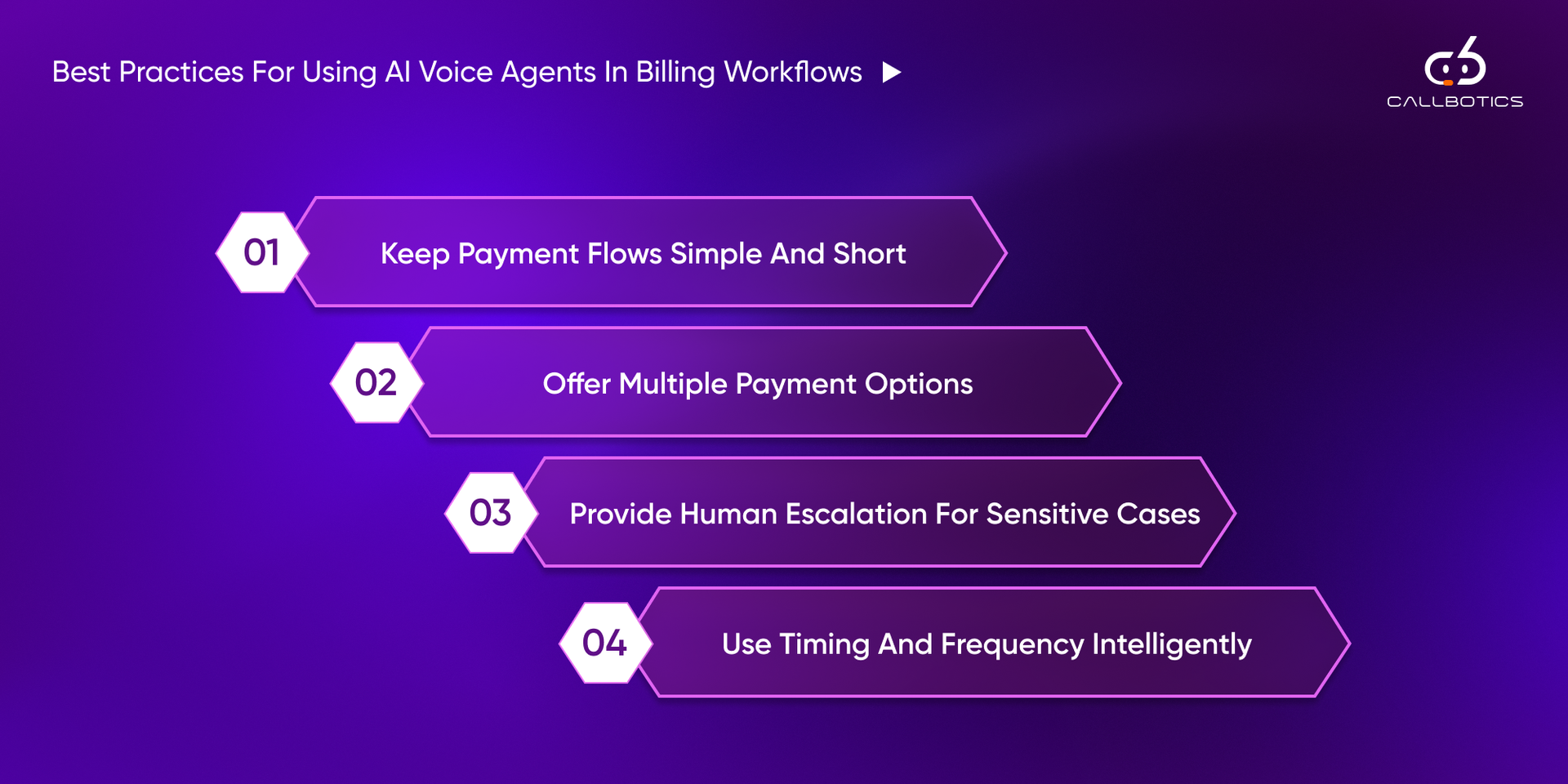
Payment calls should not feel complicated. If the customer has to answer too many questions, wait too long, or follow unclear steps, they may drop off before completing the payment. Each extra step increases the chance of confusion or disengagement. A shorter flow keeps the customer focused on completing the payment. It also reduces the need for repeat calls or follow-ups.
Customers are more likely to complete payment when they can choose the option that works best for them. AI voice agents should guide them toward approved options without making the process feel rigid. Not every customer prefers the same payment method or timing. Flexibility helps reduce hesitation during the call. It also allows customers to complete payment in a way that feels comfortable and familiar.
Some billing calls need empathy, review, or exception handling. Disputes, hardship requests, incorrect charges, and account-specific concerns should not be forced through a fixed automation path. Customers in these situations often need reassurance and clear answers. A smooth handoff helps avoid frustration and repeated explanations. It also ensures the issue is handled with the right level of care.
Reminder timing affects how customers respond. Too few reminders can lead to missed payments, while too many can feel aggressive or frustrating. The timing of the first reminder and follow-ups plays a big role in payment completion. Consistent scheduling helps teams avoid gaps in outreach. It also ensures customers are contacted at the right moment in their payment cycle.
AI voice agents should be measured by how well they improve billing outcomes, not just by how many calls they handle. The right KPIs show whether reminders are leading to payments, whether customers are getting clear answers, and whether overdue accounts are reducing. They also help teams understand where customers drop off during the payment journey. This makes it easier to improve scripts, timing, escalation rules, and follow-up workflows.
Payment completion rate shows the percentage of customers who successfully complete payment after interacting with the AI voice agent. This is one of the most important KPIs because it directly links the call to a billing outcome. If completion is low, the issue may be unclear instructions, limited payment options, poor timing, or too many steps. Tracking this helps teams improve the payment flow rather than just increasing call volume.
A strong completion rate means the AI voice agent is not just reminding customers, but helping them take action. It also shows whether customers can move from conversation to payment without unnecessary friction.
Call-to-payment conversion rate measures the percentage of outbound reminder calls that result in a payment action. This helps teams understand whether their reminder strategy is actually working. A call may be answered, but that does not always mean the customer completed payment. Tracking conversion shows the difference between outreach activity and real payment progress.
This KPI is useful for testing reminder timing, message clarity, and placement of the payment link. It also helps teams identify which customer segments, due-date windows, or follow-up attempts lead to better results.
Reductions in overdue accounts indicate that AI voice agents are helping customers pay before their accounts move further into delinquency. This KPI matters because the goal is not only to make calls, but to reduce payment delays. If overdue accounts are not decreasing, teams may need to adjust reminder timing, retry logic, or escalation rules. Tracking this helps collections teams see whether proactive communication is improving recovery.
A lower overdue account count can also reduce pressure on agents and finance teams. It means fewer urgent follow-ups, fewer late-stage collection calls, and less customer frustration.
CSAT helps measure whether customers had a clear and respectful experience during the payment interaction. Payment conversations can be sensitive, so the experience matters as much as the outcome. Customers should understand the amount due, the next step, and whether their payment was successful or pending. If CSAT is low, the call may feel rushed, confusing, or too difficult to complete.
Tracking CSAT helps teams balance collection performance with customer trust. It also shows whether automation is improving the experience or simply adding another layer of friction.
Billing workflows need to be simple, consistent, and secure for both customers and teams. CallBotics automates payment-related conversations so customers get clear guidance and teams can manage reminders, follow-ups, and support without relying on manual calling. It integrates with existing contact center systems without requiring major changes to those systems. This makes it easier for teams to start with key billing workflows and expand over time.
AI voice agents can make payment and billing operations easier to manage by handling everyday workflows, such as reminders, payment follow-ups, confirmations, and basic billing questions. They help teams reach customers on time, reduce manual calling, and keep payment conversations clear and consistent. This also gives billing and support teams better control during peak collection periods. Instead of manually chasing every follow-up, teams can focus on cases that require human attention.
The real value is not just automation. It is helping customers take action faster while keeping the experience simple, secure, and respectful. When used well, AI voice agents can improve collections, reduce avoidable call volume, and give human agents more time for sensitive billing issues that need care and judgment. This creates a better balance between operational efficiency and customer trust. For payment workflows, that balance is what makes automation useful in real contact center environments.

Anindita Majumder is a content and copywriter with about four years of experience across content writing, copywriting, and journalism. Her work has involved building and shaping content for global brands in B2B SaaS tech, healthcare, travel tech, edtech, and more. Her love for reading often spills into the way she ideates. Outside of work, she is a vocalist, which keeps her creativity flowing.
See how enterprises automate calls, reduce handle time, and improve CX with CallBotics.
CallBotics is an enterprise-ready conversational AI platform, built on 18+ years of contact center leadership experience and designed to deliver structured resolution, stronger customer experience, and measurable performance.