
Workforce management, or WFM, is what helps a contact center stay properly staffed throughout the day. It covers forecasting demand, building schedules, planning staffing levels, and tracking adherence so the right people are available at the right time. When WFM works well, service levels stay steady. When it does not, queues build up, agents get stretched, and customers feel the impact quickly.
That pressure is harder to manage in 2026. Demand moves faster, customer conversations span more channels, and even a small forecasting miss can lead to long wait times, missed service levels, and frustrated teams. The pressure is also customer-facing. SurveyMonkey reports that 84% of consumers say a positive customer support experience greatly impacts how they view a company, which means staffing and service decisions carry real business weight.
AI is changing WFM by helping teams forecast demand faster, adjust schedules more accurately, and respond earlier when volumes shift. Instead of spending the day reacting to staffing gaps after they show up, contact centers can use AI to plan with more confidence, make quicker decisions, and run WFM with more flexibility.
Workforce management, or WFM, is the process of making sure a contact center has the right number of agents available at the right time. Its job is to balance customer demand, agent availability, and service goals so the operation runs smoothly without overstaffing or leaving teams stretched.
WFM is responsible for four core things:
In simple terms, WFM helps contact centers stay prepared. When it is done well, teams can handle demand more consistently, agents are better supported, and customers are less likely to face long waits or poor service.
Workforce management usually looks clean on a spreadsheet. You forecast demand, assign shifts, and expect service levels to stay on track. But real contact centers do not run in neat patterns. Demand changes, agent availability shifts, and customer needs rarely stay within the plan.
That is where WFM starts to break. The problem is not that teams do not plan. It is that the plan can become outdated very quickly. When that happens, the pressure shows up everywhere at once, in queues, service levels, agent fatigue, and customer experience.
One of the hardest parts of WFM is that contact volume can change faster than teams can respond. Seasonal peaks, open enrollment periods, billing cycles, outages, product issues, or marketing campaigns can all drive sudden spikes. A center that looked properly staffed in the morning can be overwhelmed by midday, with queues rising before managers have time to react.
The pain point is not just more contacts coming in. It is how little room there is for error when demand moves unexpectedly. A small miss in the forecast can quickly turn into long wait times, missed SLAs, overloaded agents, and supervisors scrambling to recover service levels in real time.
Not every customer interaction takes the same amount of time, and that creates a major WFM problem. A quick balance check or order update may take a minute or two, while a benefits question, billing dispute, or claims-related call can take much longer. When teams rely on one blended average handle time, they treat very different types of work as if they are the same.
That is where staffing plans start to fall apart. The volume forecast may look correct on paper, but if the mix of intents shifts toward more complex interactions, the real workload becomes heavier than expected. The result is slower queues, longer calls, more pressure on agents, and a staffing model that no longer reflects what customers actually need.
A schedule only works if the planned staffing shows up the way it was designed. In real operations, that rarely happens. Break overruns, late logins, unplanned time off, coaching sessions, meetings, system issues, and day-to-day absenteeism all reduce the amount of time agents are actually available to handle contacts.
This is where WFM feels especially frustrating for operations teams. On paper, coverage may look fine, but live adherence tells a very different story. Even small gaps across the day can leave teams understaffed, push occupancy too high, and force supervisors to manage service risk hour by hour instead of following the original plan.
WFM has also become much harder because contact centers are no longer managing one channel at a time. Voice, chat, email, and social all compete for staffing, but they do not behave the same way. Voice needs immediate coverage, chat can scale differently, email builds backlog quietly, and social often carries public pressure that teams cannot ignore.
The real pain is that everything feels urgent at once. A team may move people to protect the voice queue, only to see chat response times slip and email backlog grow. WFM teams are constantly forced to make trade-offs across competing priorities, often without enough visibility or flexibility to rebalance staffing before service starts to suffer.
See how CallBotics helps contact centers reduce repetitive call volume and make WFM planning easier.WFM teams are under pressure to plan more accurately, react faster, and keep service levels stable even when conditions change during the day. AI is changing WFM by helping teams move beyond static planning and make better decisions across forecasting, scheduling, adherence, and daily operations.
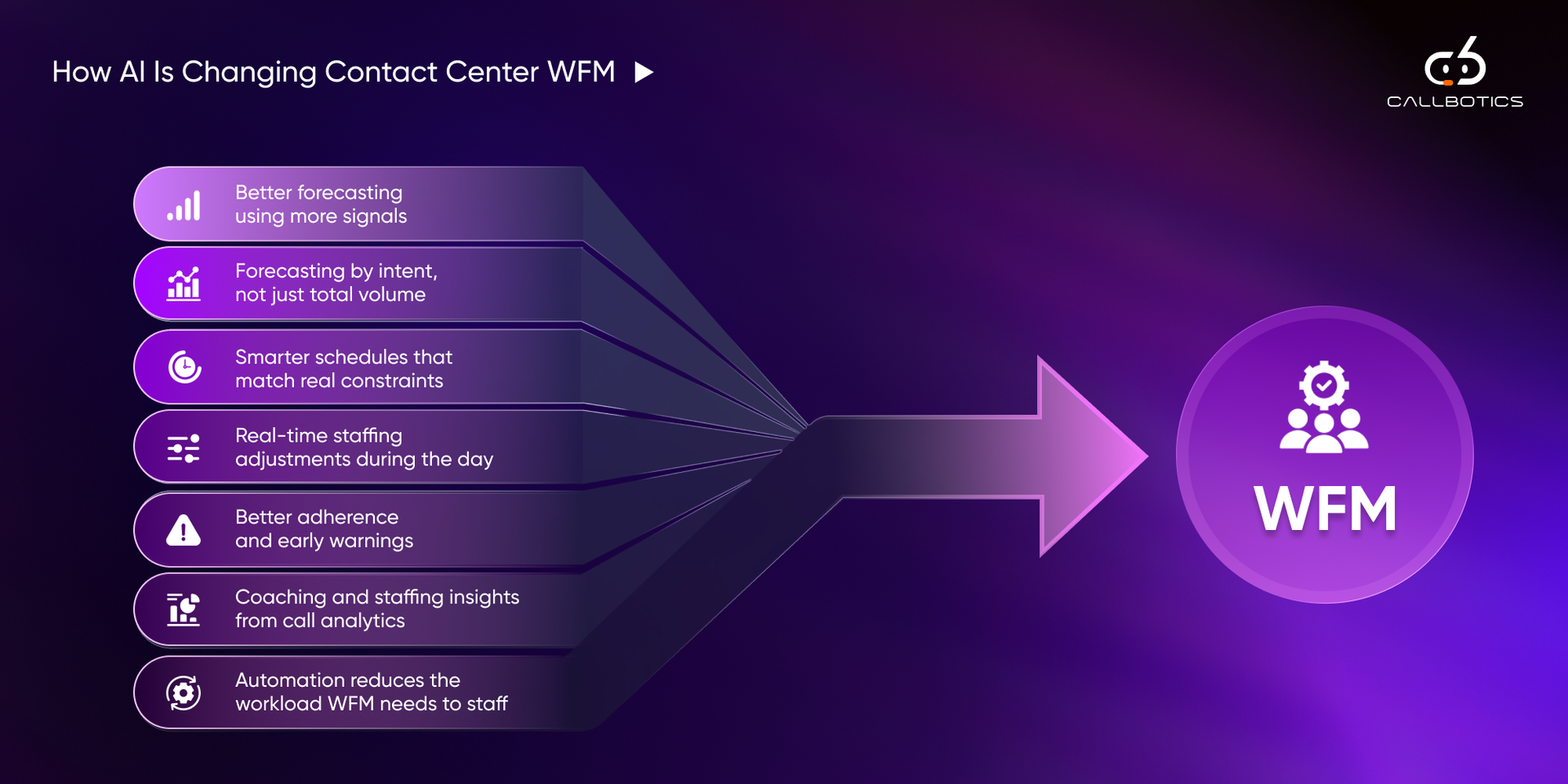
Traditional forecasting often relies too heavily on historical volume. That becomes a problem when customer demand is shaped by more than past patterns, such as billing cycles, outages, campaigns, seasonal peaks, or changes in contact reasons. AI helps WFM teams forecast more accurately by looking at more signals together, not just yesterday’s numbers.
One of the biggest WFM pain points is that total contact volume does not tell the full story. Two days may have the same number of calls, but the workload can look very different if one day is filled with simple requests and the other is filled with more complex issues. AI helps teams forecast by intent so staffing plans reflect the real effort behind the volume.
Building schedules is not just about filling seats. WFM teams have to balance service coverage, agent skills, fairness, shift preferences, labor rules, breaks, and operational priorities at the same time. AI helps build schedules that are more practical because it works within these constraints instead of relying on broad assumptions or manual trade-offs.
Even a good schedule can start to break once the day begins. Demand spikes, absenteeism, longer handle times, or sudden channel pressure can push service levels off track quickly. AI helps with intraday management by giving WFM teams a faster way to see what is changing and make adjustments before the impact spreads.
A schedule on paper does not always match what happens in real operations. Late logins, break overruns, unplanned unavailability, and schedule drift can slowly weaken coverage until service levels start slipping. AI helps by spotting these patterns earlier so supervisors can step in before small issues become larger performance problems.
WFM problems are not always caused by volume alone. Sometimes the issue is that certain call types take too long, repeat contacts stay high, or agents need more support with specific interactions. AI-powered call analytics help surface these patterns so teams can improve performance at the source, not just keep adjusting the staffing plan around it.
One of the most practical ways AI changes WFM is by reducing the amount of repetitive work that needs human coverage in the first place. AI voice agents can handle routine interactions, give customers immediate responses, and absorb volume that would otherwise sit in the queue. That makes staffing plans easier to manage and lowers the pressure on live teams.
WFM teams spend a lot of time reacting to changes, fixing gaps, and updating plans that go out of date too quickly. AI helps reduce manual work in WFM areas that require constant monitoring, quick decision-making, and frequent adjustments.
The value is practical. Instead of waiting for queues to build or service levels to slip, AI can help teams spot issues earlier, update plans faster, and make everyday WFM decisions with less guesswork.
One of the biggest WFM pain points is that forecasts can become outdated very quickly. A normal day can change fast because of an outage, a billing issue, a campaign launch, or an unexpected spike in customer demand. By the time teams notice the shift manually, queues may already be growing and service levels may already be under pressure.
AI helps by spotting unusual patterns earlier and updating forecasts faster. Instead of relying only on scheduled reviews, WFM teams can catch abnormal volume changes sooner and respond before the impact spreads across the day. That makes forecasting more useful in live operations, not just in planning meetings.
Building schedules manually is difficult because WFM teams are trying to balance coverage, fairness, agent availability, skills, labor rules, and changing demand at the same time. Even when the schedule looks fine on paper, gaps often emerge later because the plan cannot fully account for real operating constraints.
AI can help build better schedules by working through those constraints more quickly and suggesting practical changes when coverage starts to slip. That can include recommending shift swaps, overtime options, or schedule adjustments that help close gaps without forcing managers to work everything out by hand.
A schedule is only the starting point. Once the day begins, queues can rise quickly because of higher volume, longer handle times, absenteeism, or pressure on a specific channel. In many contact centers, teams end up reacting late because they do not see the risk clearly enough until service levels have already dropped.
AI helps with intraday management by showing where coverage needs to move in real time. That makes it easier to adjust breaks, shift staffing toward the right queue, and take action earlier to protect SLAs before a short-term issue turns into a larger service problem.
Staffing problems are not always caused by volume alone. Sometimes the real issue is that calls are taking longer, transfers are increasing, or repeat contacts are quietly adding more work back into the queue. When those patterns are missed, WFM teams may keep adjusting staffing without fixing the reason demand feels heavier than expected.
AI helps by linking performance signals such as repeat calls, transfers, and AHT changes back to staffing planning. That gives teams a better view of what is driving workload, so they can plan more accurately and make smarter decisions instead of treating every service problem as just a volume problem.
AI voice automation does not just change how calls are handled. It changes the amount of work WFM has to plan for, the type of demand that reaches live agents, and how stable service levels are during the day. That is why voice automation has a direct impact on WFM outcomes, not just customer experience.
One of the biggest WFM pain points is having to staff large volumes of repetitive contacts that do not always need a human agent. When those routine calls keep filling the queue, they add pressure to staffing plans, increase wait times, and make it harder for teams to stay focused on more complex work. AI voice agents help by containing simple intents before they reach the live queue.
AHT often rises when human agents spend the first part of the call collecting basic details, confirming information, and figuring out why the customer is calling. That slows down the queue and makes staffing harder because agents spend time on steps that could have been completed earlier. AI voice agents help by gathering information before a transfer, so the live conversation can start with context already in place.
WFM becomes more difficult when calls reach the wrong team, bounce between agents, or return because the issue wasn't handled properly the first time. Transfers and repeat contacts make demand less predictable and create an extra workload that staffing plans often fail to account for. AI voice agents improve routing by identifying intent earlier and directing customers to the right path from the start.
Adding AI to WFM only matters if it improves planning, staffing, and service outcomes in a measurable way. The goal is not to track whether a new tool is active. The goal is to see whether the operation is becoming more accurate, more stable, and easier to manage.
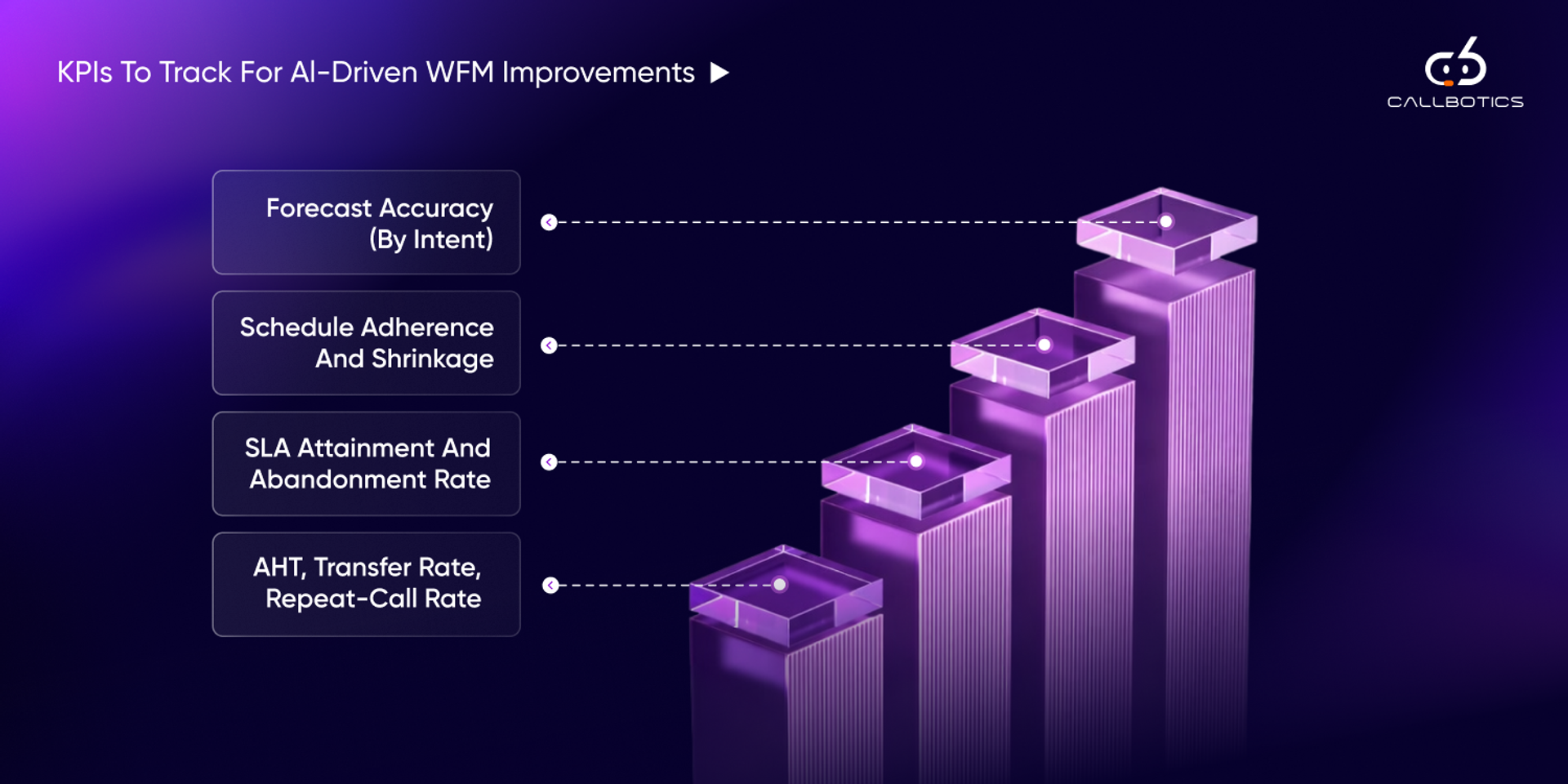
Forecast accuracy is one of the clearest ways to tell whether AI is improving WFM. But looking only at total contact volume is not enough. A forecast can look accurate overall and still miss what really happened if the mix of call reasons changed or if some intents took much longer to handle than expected.
That is why forecast accuracy should be tracked by intent. Compare forecasted volume to actual volume for each major call reason, and compare expected handle time to actual handle time for those same intents. This shows whether AI is helping the team plan for the real workload, not just the total number of contacts.
A staffing plan is only useful if live operations stay close to it. Many WFM teams deal with a daily gap between the schedule on paper and what actually happens because of late logins, break overruns, meetings, coaching time, absenteeism, or unplanned offline time. That is where service pressure often starts.
To measure improvement, track whether schedule adherence gets stronger and whether shrinkage becomes easier to predict over time. If AI is helping WFM, teams should see fewer surprises during the day, more stable staffing coverage, and less last-minute scrambling to recover service levels.
WFM decisions have a direct effect on service levels. When staffing misses demand, queues build, wait times rise, and more customers hang up before they get help. That is why SLA attainment and abandonment rate are two of the most important ways to judge whether AI-driven WFM is working.
Look at whether staffing changes are helping the team hit service targets more consistently and whether fewer customers are dropping out of the queue. If AI is improving WFM in a practical way, the result should not just be better planning screens. It should show up in steadier SLAs and lower abandonment during real operating conditions.
Some of the most important WFM signals sit inside call performance. If AHT rises, transfers increase, or repeat calls stay high, staffing pressure gets worse even when volumes look manageable. These metrics often reveal why the workload feels heavier than the forecast suggested.
That is why AHT, transfer rate, and repeat-call rate should be tracked alongside core WFM measures. They help explain whether AI is improving the operation at the source, not just helping teams react after the fact. When these metrics move in the right direction, WFM plans usually become more stable, customer effort goes down, and service outcomes improve.
AI can improve WFM, but it does not fix weak planning on its own. Many teams still run into problems because they apply AI on top of the same old assumptions. The result is better-looking forecasts on paper, but the same staffing pressure on the floor.
Total volume and blended AHT can hide what is really happening. Two days may look similar in the forecast, but the workload can be very different if the call types change.
Staffing plans become less reliable when teams forecast only the number of contacts and not the reasons behind them. Simple intents and complex intents do not create the same workload.
Forecasts can break quickly during outages, campaigns, billing cycles, product issues, or seasonal spikes. If the plan is not updated fast enough, queues rise before teams can react.
WFM conditions change constantly. AI works best when forecasts, schedules, and intraday decisions are reviewed and adjusted as new patterns appear.
The goal is not to add more dashboards or models. The real test is whether staffing becomes more accurate, service levels improve, and teams spend less time reacting to avoidable gaps.
AI can surface risks early, but supervisors still need to act on them. If alerts and insights do not connect to daily decisions, the value stays limited.
Explore how CallBotics connects AI voice automation to real WFM outcomes across forecasting, staffing, and SLAs.
How CallBotics Supports Better WFM Outcomes
WFM gets harder when teams have to staff repetitive calls, manage avoidable transfers, and plan around demand that feels more unpredictable than it should. CallBotics helps reduce that pressure by using AI voice agents to handle routine intents, improve routing and handoffs, and surface call insights that make forecasting and staffing decisions easier.
WFM has always been hard because the plan rarely holds for long. Volumes change, handle times shift, people go off schedule, and small gaps turn into service problems very quickly. AI helps contact centers deal with that reality in a better way by making forecasting more accurate, helping teams respond faster, and reducing some of the workload that creates pressure in the first place.
That matters because better WFM is not just about cleaner schedules. It means fewer surprises during the day, stronger SLA performance, less pressure on agents and supervisors, and a lower risk of burnout across the team. When AI is used well, it helps contact centers run with more stability and a lot less firefighting.

Anindita Majumder is a content and copywriter with about four years of experience across content writing, copywriting, and journalism. Her work has involved building and shaping content for global brands in B2B SaaS tech, healthcare, travel tech, edtech, and more. Her love for reading often spills into the way she ideates. Outside of work, she is a vocalist, which keeps her creativity flowing.
See how enterprises automate calls, reduce handle time, and improve CX with CallBotics.
CallBotics is an enterprise-ready conversational AI platform, built on 18+ years of contact center leadership experience and designed to deliver structured resolution, stronger customer experience, and measurable performance.