Call escalation is one of the most under-managed parts of contact center operations because it often sits between teams, systems, policies, and customer expectations. A customer may start with a simple question, but the interaction can quickly become complex when the issue needs supervisor approval, technical support, account verification, billing review, or a specialist decision. When escalation is not clearly designed, customers repeat information, agents lose context, queues build up, and resolution becomes harder than it needs to be.
Recent contact center data shows why escalation design now matters more. Puzzel’s State of Contact Centres 2026 survey, based on 1,505 CX leaders and contact center professionals, found that 94% of leaders say consolidating multiple systems is critical to improving performance and cutting costs, while 85% say they are ready to implement AI, but only one-third feel fully prepared. For escalation workflows, this matters because fragmented systems and uneven readiness often create the exact handoff gaps that frustrate customers and slow down resolution.
This guide explains what call escalation means, why it happens, the main types of escalation, and how a complete escalation process should flow from first contact to final resolution. It also shows how contact centers can reduce unnecessary escalations, preserve context during handoffs, and use clear escalation rules to improve customer experience, agent consistency, and operational visibility.
Call escalation means moving a customer’s call to someone who can handle the issue better when the first agent cannot resolve it. The call may go to a supervisor, technical expert, billing specialist, compliance team, or another support layer. The purpose is not just to pass the customer around. The real goal is to help the customer get a clear answer, a confirmed next step, or the right resolution without unnecessary frustration.
A call usually gets escalated when the issue needs more authority, deeper knowledge, special system access, or careful judgment. A refund exception, disputed charge, account security concern, service outage, or claim update may need support from a more specialized team. Poor escalation makes customers wait longer and explain the same problem again. A well-managed escalation helps agents know exactly when to hand off the call, who should receive it, and what context must move with the customer.
Call escalation happens when the first level of support cannot safely or completely resolve the customer’s issue. Sometimes the agent may not have the right system access, product knowledge, approval authority, or policy clarity to move the interaction forward. Other times, the customer may already be frustrated and needs a supervisor or specialist to restore confidence. A good escalation process gives agents a clear path instead of leaving them to guess what to do next.
Customer requests also become harder to handle when they involve billing disputes, account security, legal concerns, healthcare information, service failures, or compliance-sensitive steps. These situations need careful handling because one wrong answer can create risk for the customer and the business. Complex requests may also require multiple teams, deeper investigation, or approval before the final answer can be given. A well-designed call escalation process makes sure the customer reaches the right person with the right context, without feeling like they are being pushed from one queue to another.
See how CallBotics helps contact centers reduce unnecessary escalations with AI voice agents that resolve more customer interactions before a handoff is needed.Call escalation can happen in different ways depending on the issue, the customer’s condition, and the level of support needed. Most contact centers use four common types: hierarchical, functional, automatic, and customer-initiated escalation. Each type solves a different problem, so agents need to know when to use each one. Clear escalation rules help customers reach the right support layer without feeling bounced around.
Hierarchical escalation happens when a call moves to someone with more authority, usually a supervisor, manager, or senior support lead. This type is used when the first agent understands the issue but does not have the approval power to resolve it. A common example is a refund request that exceeds the agent’s allowed limit. The customer gets moved up the support chain so the decision can be reviewed and approved properly.
Functional escalation happens when a call moves to a person or team with a specific skill set. This is different from hierarchical escalation because the call is not moving upward in authority, but sideways to the right specialist. For example, a billing agent may escalate a technical activation issue to a product support team. The goal is to match the customer’s problem with the team that can actually solve it.
Automatic escalation happens when a system sends the call to a higher support level based on rules, risk signals, or AI-driven triggers. The agent does not need to manually decide because the system identifies when escalation is needed. For example, a call may be escalated automatically if the customer shows high frustration, repeats the same issue, fails verification, or mentions a compliance-sensitive concern. This helps contact centers respond faster when the interaction becomes risky, urgent, or too complex for the current path.
Customer-initiated escalation happens when the customer directly asks to speak with a supervisor, manager, or higher-tier support team. This often happens when the customer feels unheard, frustrated, confused, or unsure that the current agent can solve the issue. The agent should not treat this as a personal failure. A calm response, clear context capture, and smooth handoff can turn a tense moment into a better service experience.
A strong call escalation process gives agents a clear path from the first warning sign to the final resolution. Without that flow, escalations become messy, customers repeat themselves, and supervisors receive calls without enough context. The six steps below show how a contact center can handle escalation in a more controlled and customer-friendly way.
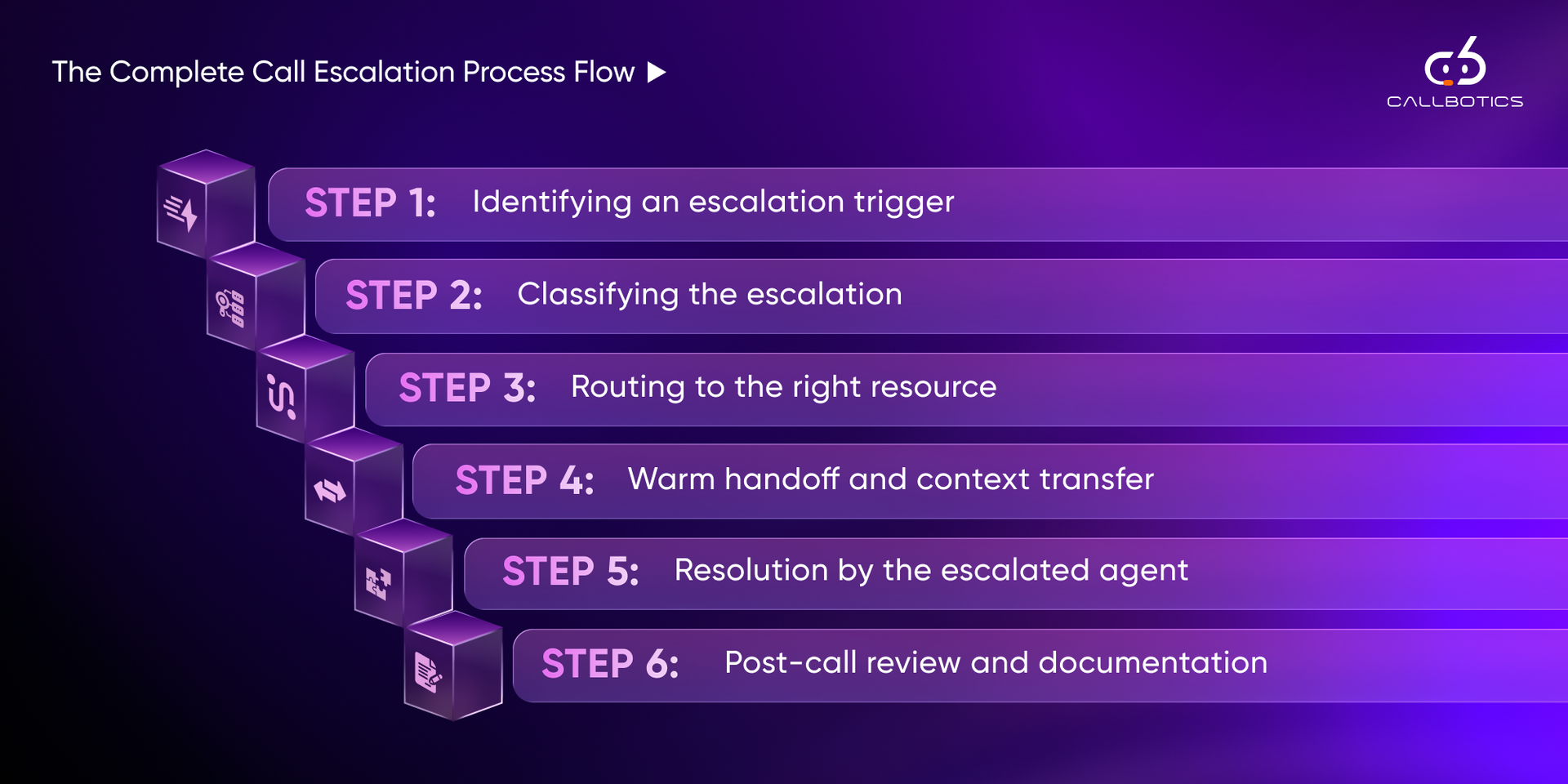
An escalation starts when the agent, system, or AI tool detects that the call needs a higher level of support. The trigger may come from certain keywords, a sharp change in customer sentiment, a repeated contact about the same issue, or a compliance-related flag. Early detection matters because it prevents the call from becoming more frustrating before help arrives.
Agents should be trained to notice signs like anger, confusion, long silence, repeated objections, or phrases such as “I already called about this” or “I want to speak to someone else.” Systems can also flag issues when verification fails, wait time crosses a limit, or the customer mentions a sensitive topic. A clear trigger list helps agents act quickly without guessing.
After the trigger is spotted, the next step is to classify what kind of escalation it is. The team needs to know whether the call needs supervisor approval, specialist help, compliance review, technical support, or urgent intervention. Classification keeps the escalation from going to the wrong person and creating another delay.
Urgency also needs to be judged at this stage. A billing clarification may not need the same response speed as a fraud concern, service outage, medical access issue, or angry customer at risk of churn. Clear categories help agents decide whether the call is low, medium, high, or critical priority.
Once the escalation is classified, the call should be routed to the person or team best equipped to handle it. That may be a supervisor, senior agent, billing specialist, technical expert, claims team, compliance lead, or account manager. Good routing is about matching the customer’s issue to the right capability, not just moving the call somewhere else.
Poor routing is one of the biggest reasons customers feel bounced around. A customer with a technical issue should not land with a billing supervisor just because the first agent needed help. Smart routing reduces hold time, protects customer patience, and gives the receiving agent a better chance of resolving the issue on the next step.
A warm handoff means the first agent does not simply transfer the customer and disappear. The agent passes the key context to the next person before or during the transfer, so the customer does not have to start from the beginning. This step can make the difference between a smooth escalation and a frustrating one.
The handoff should include the customer’s identity, call reason, issue summary, steps already taken, system notes, customer mood, and any promised next action. Call history, account details, verification status, and previous contacts should also move with the interaction where available. Strong context transfer helps the escalated agent sound prepared, confident, and respectful of the customer’s time.
The escalated agent’s job is to close the loop, not just continue the conversation. They should quickly confirm the issue, acknowledge what has already happened, and explain what they can do next. A simple recap helps the customer feel heard and shows that the handoff was not just another transfer.
The receiving agent may approve an exception, complete a system action, investigate the issue, provide a final answer, or set a clear follow-up path. When full resolution is not possible during the same call, the agent should still confirm the next step, owner, timeline, and communication method. Customers are usually more patient when they know exactly what will happen next.
Every escalated call should be documented because escalations reveal where the service process is under pressure. The record should capture the reason for escalation, the team involved, time spent, outcome, customer sentiment, and whether the issue was resolved. Without this documentation, leaders only see that escalations happened, not why they happened.
Post-call review helps teams identify patterns such as unclear policies, missing agent access, weak knowledge articles, broken routing, or product issues. It also helps supervisors coach agents and reduce unnecessary escalations over time. A good review process turns escalated calls into useful operational insight instead of treating them as isolated problems.
Explore how CallBotics supports smoother escalation handling by passing full conversation context to human agents when a call needs specialist support.Calls usually get escalated when the issue moves beyond what the first agent can safely or completely resolve. The most common reasons include refund or billing disputes, technical complexity, compliance concerns, repeat issues, and emotionally charged customers. These situations need more authority, deeper knowledge, clearer judgment, or stronger context handling. A good escalation process helps agents move the call forward without making the customer feel ignored or transferred without purpose.
Refunds and billing disputes often get escalated because they involve money, customer trust, and approval limits. A frontline agent may understand the issue but may not have the authority to approve a refund, waive a charge, or correct a billing exception. Customers are usually sensitive in these situations because they feel something has gone wrong financially. Clear escalation rules help the agent know when to involve a supervisor or billing specialist before the conversation becomes more tense.
Technical issues get escalated when the first agent cannot diagnose the problem with the tools or knowledge available to them. The customer may need help with activation, service failure, account access, system errors, or troubleshooting that requires specialist support. Poor handling here can make the customer feel like the agent is guessing. Routing the call to the right technical team helps protect time, accuracy, and customer confidence.
Compliance-related calls need careful handling because the wrong answer can create risk for the customer and the business. These may include identity verification, account security, healthcare information, legal concerns, claims details, or privacy-related requests. Agents should not be forced to make judgment calls when the issue needs a controlled process. Escalation helps make sure sensitive interactions are handled by the right team with the right authority.
Repeat issues get escalated when the customer has already contacted support and still does not have a clear resolution. These calls are often frustrating because the customer feels their time has already been wasted. The agent needs to quickly understand what happened before, what was promised, and why the issue is still open. A smooth escalation can prevent another failed follow-up and help the customer feel that someone is finally taking ownership.
Emotional customers may ask for escalation because they feel unheard, rushed, or disappointed by the previous support experience. Anger, stress, confusion, or urgency can make a normal issue harder to manage. The agent’s job is to stay calm, acknowledge the concern, and avoid treating the request as a confrontation. A supervisor or senior agent can often reset the conversation by listening clearly, confirming the next step, and rebuilding trust.
Call escalations work best when agents know exactly when to escalate, what information to pass forward, and who should take ownership next. Without clear rules, customers wait longer, agents feel stuck, and supervisors receive calls without enough background. Strong escalation handling keeps the customer experience calm, even when the issue is complex or sensitive. These four practices help contact centers make escalation smoother, faster, and easier to manage.
Clear escalation criteria help agents understand when a call should stay with them and when it needs higher support. This removes guesswork and prevents agents from holding on to issues they cannot resolve. The criteria should cover approval limits, risk signals, customer frustration, technical complexity, and compliance-sensitive situations.
A customer should not have to explain the same issue again after a call is escalated. Full context transfer means the receiving agent gets the call reason, customer details, steps already taken, current status, and promised next action. This makes the handoff feel professional and helps the next agent move straight toward resolution.
Escalation breaks down when supervisors or senior agents are not available at the moment the customer needs help. Long holds can make an already frustrated customer feel ignored. A practical escalation model should make sure the right people are reachable during peak hours, sensitive cases, and high-volume periods.
Every escalated call should teach the contact center something useful. Post-call analysis helps leaders understand why the escalation happened, whether it was handled well, and what could prevent the same issue from happening again. Over time, this improves training, policies, routing, knowledge content, and customer experience.
Escalation can protect the customer experience, but only when it is handled with care. The biggest mistakes usually happen when agents escalate too quickly, transfer calls without context, or fail to review what happened afterward. These gaps make customers feel passed around instead of supported. Avoiding these mistakes helps contact centers keep escalation useful, controlled, and focused on resolution.
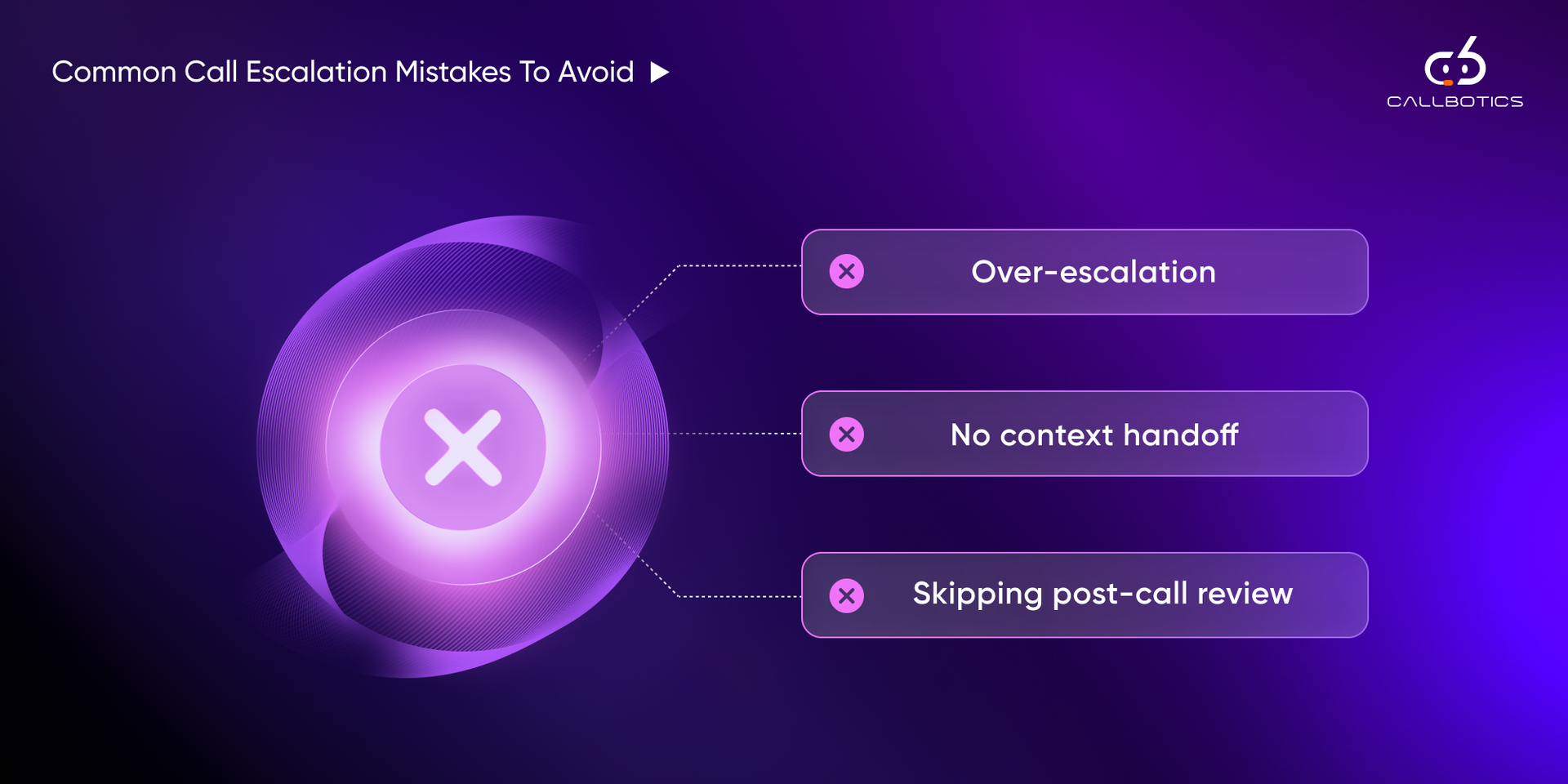
Over-escalation happens when agents move calls to supervisors or specialists before trying the right first-level steps. This can overload senior teams and make customers wait longer than necessary. It also weakens agent confidence because they start depending on escalation instead of using approved guidance. Clear decision rules, better training, and stronger knowledge support can help agents handle more issues at the right level.
A weak handoff is one of the fastest ways to frustrate a customer during escalation. When the receiving agent does not know the issue, the customer has to repeat details, explain the problem again, and rebuild trust from the beginning. The first agent should pass the issue summary, account details, verification status, previous steps, and customer mood before the transfer. A good context handoff makes the next agent sound prepared and helps the customer feel respected.
Skipping post-call review means the contact center loses the chance to learn from the escalation. Leaders may know that the call was escalated, but they will not know whether the cause was unclear policy, missing access, poor routing, or a training gap. Escalated calls should be reviewed for patterns, outcomes, sentiment, handle time, and repeat contact risk. This helps teams improve the process instead of dealing with the same issues again and again.
AI voice agents are changing call escalation by resolving supported customer requests before a human agent is needed. They can verify the customer, understand the issue, follow approved service logic, answer questions, collect required details, update connected systems where integrated, and confirm the next step. This helps reduce escalation volume because many calls do not need to move to a supervisor or specialist when the process is clear. Human agents can then focus on sensitive, complex, or high-judgment cases where their support adds the most value.
A strong AI voice agent does not escalate just because a call becomes slightly difficult. It escalates when there is a real reason, such as failed verification, customer frustration, policy exception, compliance risk, unclear intent, or a request outside the approved workflow. The best systems also pass the full context during handoff, including the issue summary, customer details, steps completed, sentiment signals, and reason for escalation. This makes the human agent more prepared and helps the customer feel like the conversation is continuing, not starting over.
CallBotics helps contact centers reduce unnecessary escalation by resolving around 80% of suitable calls without human handoff, depending on the workflow and use case. When a call does need a human agent, CallBotics passes the full conversation context so the customer does not have to start again. The goal is simple: resolve more calls through AI voice agents and make every required escalation smoother, faster, and easier for agents to handle.
Call escalation should not be treated as a failure or something contact centers must avoid at all costs. It is a process that needs to be designed with clear triggers, smart routing, full context transfer, and proper review. When escalation is handled well, customers feel supported instead of passed around. Agents also get a clearer path for when to resolve, when to ask for help, and when to hand off with confidence.
Teams that want to reduce unnecessary escalations need more than better scripts or longer training sessions. They need AI voice automation that can resolve suitable calls, detect when human support is truly needed, and pass the full conversation context when escalation happens. CallBotics helps contact centers cut escalation volume by resolving more customer interactions through AI voice agents while keeping agents prepared for the calls that still need a human touch. For teams under pressure to improve resolution, reduce queue load, and protect customer experience, that is where escalation starts becoming a controlled process instead of a daily fire drill.

Anindita Majumder is a content and copywriter with about four years of experience across content writing, copywriting, and journalism. Her work has involved building and shaping content for global brands in B2B SaaS tech, healthcare, travel tech, edtech, and more. Her love for reading often spills into the way she ideates. Outside of work, she is a vocalist, which keeps her creativity flowing.
See how enterprises automate calls, reduce handle time, and improve CX with CallBotics.
CallBotics is an enterprise-ready conversational AI platform, built on 18+ years of contact center leadership experience and designed to deliver structured resolution, stronger customer experience, and measurable performance.