Both CallBotics and PolyAI help contact centers automate calls with AI voice agents, but they are often chosen for different reasons. Some teams prioritize launch time and a predictable rollout. Others care more about natural conversation quality, enterprise governance, or how deeply the platform fits into an existing customer service stack. CallBotics positions itself around fast deployment, enterprise-ready voice automation, and measurable call outcomes, while PolyAI positions itself around lifelike enterprise customer service conversations, governance, and large-scale voice automation for major brands.
This comparison focuses on what real buyers usually care about most: deployment speed, automation depth, integrations, analytics, governance, and how pricing is likely to behave over time. The goal is not to repeat marketing claims, but to help teams decide which platform better matches their workflow complexity, rollout timeline, and operational priorities.
At a high level, CallBotics is positioned as an enterprise AI voice platform built for fast deployment, workflow execution, and contact center operations. Its public messaging emphasizes 48-hour deployment, automation of around 80 percent of calls, enterprise readiness, and 18 years of VoiceOps experience behind the platform.
PolyAI is positioned as an enterprise customer service voice AI platform built around highly natural conversations, strong enterprise governance, and large-scale deployments for well-known brands. Its public material emphasizes lifelike voice assistants, enterprise deployment, customer-led interactions, and large production implementations, with setup commonly framed in weeks rather than days.
So the quickest summary is this: CallBotics looks stronger for teams that want faster operational rollout and clearer contact center outcomes, while PolyAI looks stronger for enterprises that want a premium customer service voice assistant motion with heavier emphasis on enterprise conversation quality and governance.
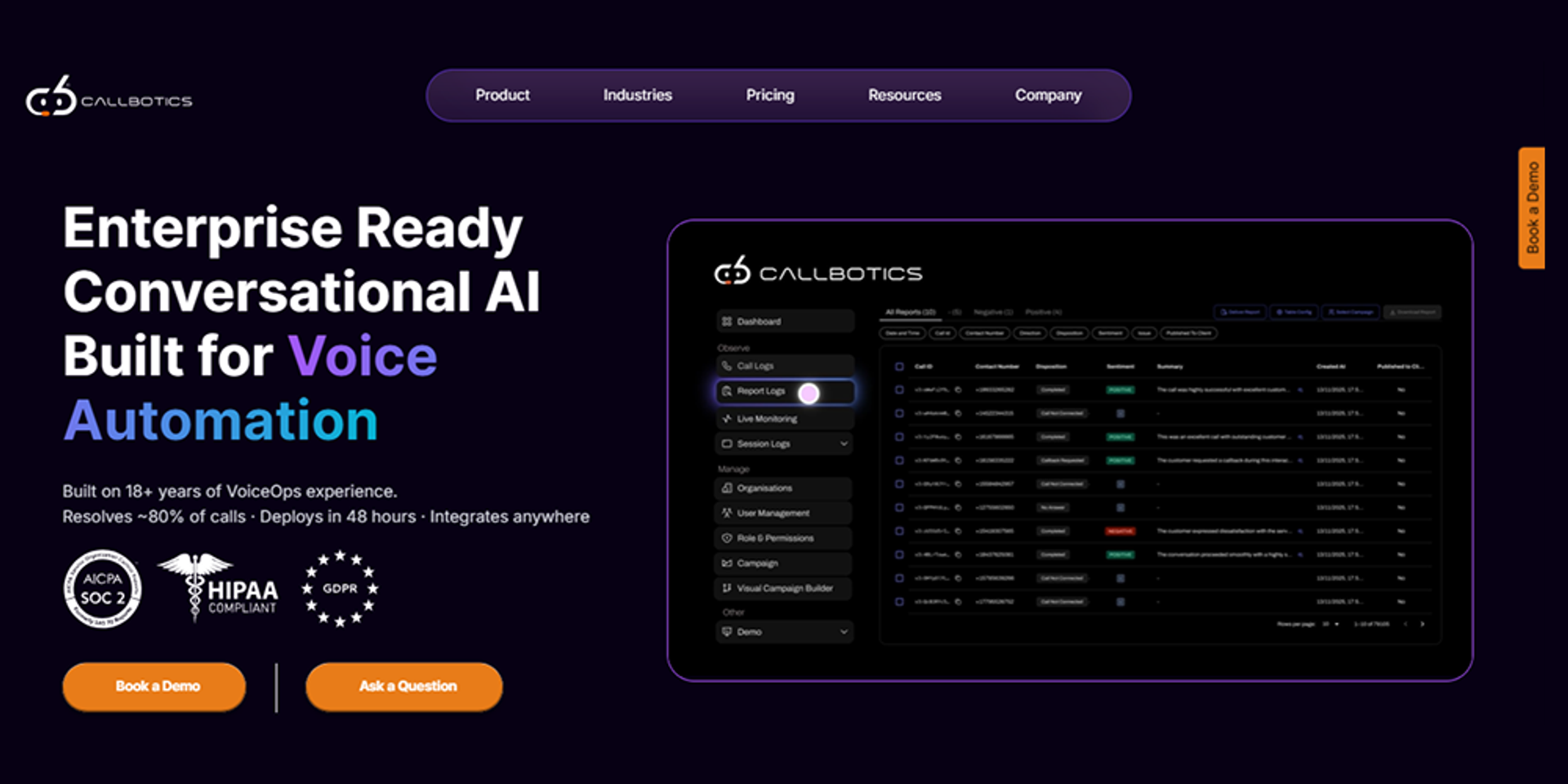
CallBotics is a voice-first AI platform for enterprises that want to automate inbound and outbound calls across structured workflows. It is positioned around enterprise voice automation, faster deployment, call routing and resolution, summaries, analytics, and high-volume contact center use cases. Its messaging consistently centers on outcomes such as cost reduction, queue relief, and operational speed rather than just voice-agent creation.
A major part of that positioning is operator credibility. CallBotics states that it was built on 18 years of VoiceOps experience, which is important because the platform is framed as being developed by teams that understand how real BPO and contact center environments behave under pressure. That makes it especially relevant for businesses that care about deployment speed, workflow reliability, handoffs, and operational visibility.
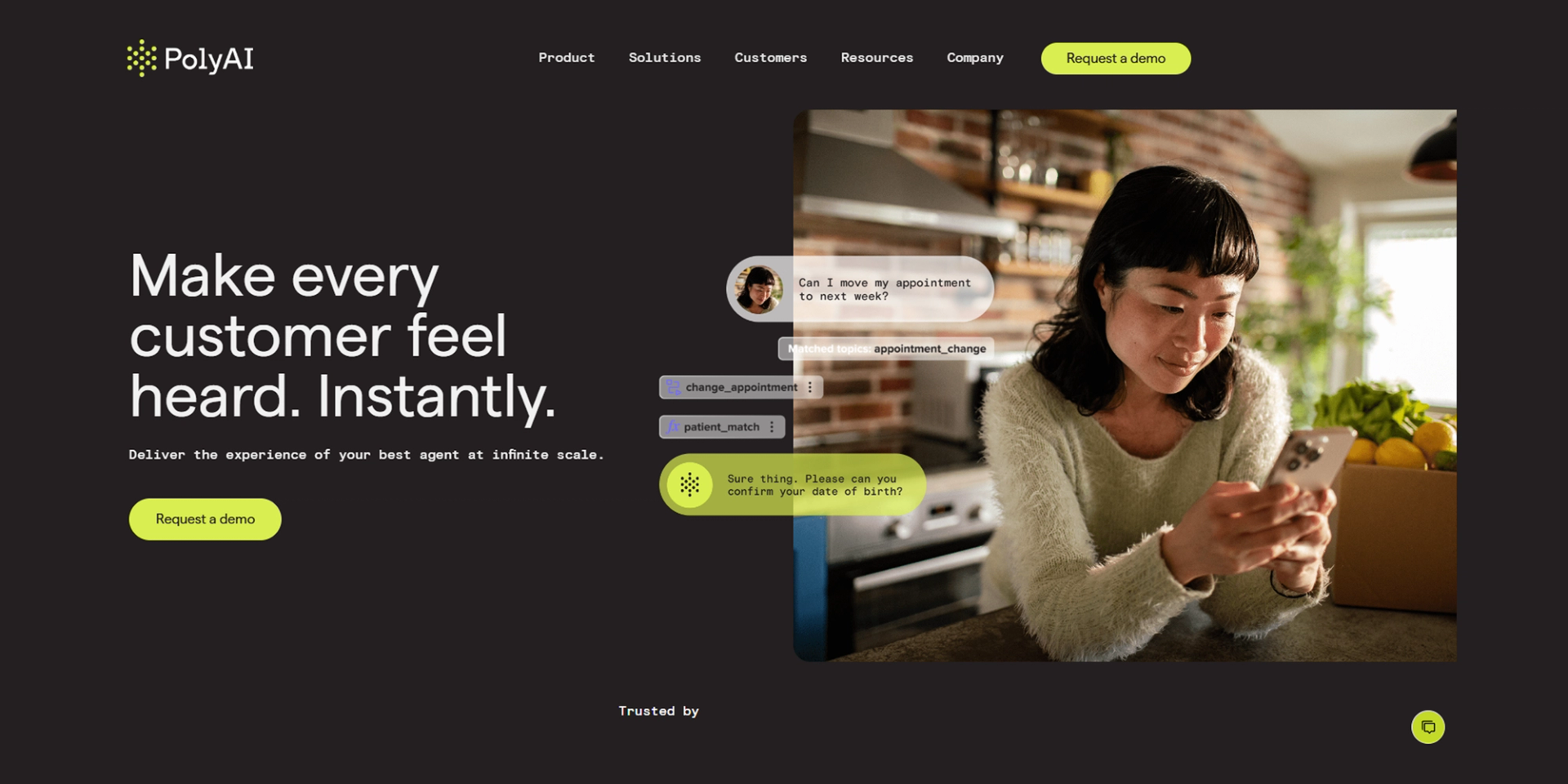
PolyAI is an enterprise voice AI platform focused on customer service automation. Its public positioning is built around highly natural voice conversations, enterprise-grade reliability, and customer-led interactions that sound more human and brand-consistent than traditional IVR or rigid automation systems. It is particularly well known for serving large enterprise brands and for emphasizing voice quality and conversation quality as core strengths.
PolyAI also presents itself as an enterprise platform with strong governance and deployment support. Its materials emphasize enterprise implementation, integrations into contact center environments, SLA-backed reliability in enterprise contexts, and more managed rollout expectations. That makes it a natural fit for buyers who want a mature enterprise vendor motion and are comfortable with a more formal deployment process.
In practice, both platforms follow a similar deployment path. Teams choose a use case, design the workflow, connect the required systems, test the voice agent, go live, and then improve performance using call outcomes and operational feedback. That similarity matters because the real decision is not whether both platforms can automate calls. It is how they support that process and what kind of team they are optimized for.
CallBotics frames this process around speed, workflow execution, and enterprise voice operations. PolyAI frames it more around enterprise voice assistant design, integration into the customer service stack, and production-quality deployment supported by experts. So the difference is less about capability in theory and more about the operating model, deployment tempo, and the level of structure the buyer wants around rollout.
The biggest differences show up in the areas that affect long-term operational value: rollout speed, conversation quality, automation depth, integrations, analytics, governance, and pricing style. Both are credible enterprise platforms, but they optimize for somewhat different strengths.
Time to deployment is one of the clearest differences. CallBotics strongly emphasizes 48-hour deployment for suitable workflows, especially in contact center and BPO contexts. PolyAI, by contrast, publicly frames its setup more as an enterprise implementation motion, with public references to about 6 weeks to build, integrate, and deploy a customer-led voice assistant.
That does not mean one is universally easier than the other. It means the buyer experience is different. CallBotics appears better suited to teams that want faster time-to-value and a more operationally direct rollout. PolyAI appears better suited to enterprises that are comfortable with a longer implementation cycle in exchange for a more managed enterprise deployment process.
Conversation quality is one of PolyAI’s most visible strengths. Its public messaging repeatedly emphasizes lifelike voice conversations, adaptive dialogue, and brand-level conversational experience. This is a real advantage for enterprises that care deeply about how the assistant sounds and how natural the interaction feels to the customer.
CallBotics also positions itself around fast, natural, and reliable conversations, but its public messaging leans more toward operational usefulness than premium conversational branding. That means Callotics feels stronger when the buyer cares most about outcomes like reduced queues, faster routing, and workflow execution, while PolyAI feels stronger when the buyer is heavily optimizing for highly natural conversation quality as a strategic brand experience.
Both platforms go beyond simple routing, but they emphasize that value in different ways. Callbotics’ public positioning emphasizes end-to-end resolution, workflow execution, and handling 80 percent of calls with AI agents trained for business workflows. PolyAI also supports transactions such as reservations, order tracking, troubleshooting, and payments, but its public narrative is more centered on customer-led conversation and enterprise customer service transformation.
In practical terms, that means CallBotics comes across as the stronger choice when the buyer is measuring success around containment, routing, task completion, and operational efficiency. PolyAI comes across as strong where natural CX automation and enterprise service design matter most.
Integrations matter because voice AI becomes operationally useful only when it can do more than just talk. CallBotics publicly highlights 400+ integrations and positions those integrations around enterprise workflow execution and existing systems. PolyAI’s public materials emphasize integration into the existing tech stack through SIP or PSTN connectivity and contact center workflow integration, but its public-facing integration details are less expansive in the sources we surfaced than Callbotics’ broader connectivity story.
This gives CallBotics a meaningful edge in public positioning around broad business-system connectivity. Buyers should still validate which CRM, helpdesk, calendar, scheduling, and ticketing tools matter most for their deployment, but CallBotics appears stronger in explicitly framing integrations as part of fast workflow execution.
CallBotics positions performance insights, summaries, QA-style visibility, and operational outcomes as a core part of its value. That makes it especially attractive for teams that want strong measurement around intent-level performance, handoff quality, and call improvement loops.
PolyAI also supports enterprise analytics and operational insight, but its public narrative leans more toward conversation quality, enterprise CX value, and business opportunity discovery than explicit QA-style oversight. That does not mean the platform lacks depth of insight. It means the public framing is different. For teams that care deeply about contact center reporting and operational visibility, CallBotics appears more closely aligned.
Explore CallBotics if you want AI voice automation with stronger call insights, summaries, and performance visibility built for real contact center operations.PolyAI clearly emphasizes enterprise reliability, governance, and controlled deployment in its public materials. That is one of its strongest trust signals for large enterprises. CallBotics also positions itself as enterprise-grade and compliance-oriented, with public messaging around enterprise readiness and controlled voice automation.
The practical takeaway is that both need live validation. Buyers should confirm access controls, audit logs, escalation rules, retention settings, and policy enforcement in a real evaluation. Still, CallBotics remains competitive here because it combines enterprise-readiness with a more deployment-oriented contact-center story, while PolyAI feels stronger in an enterprise-governance-first positioning.
Pricing style is another major difference. PolyAI is commonly positioned as an enterprise, quote-based platform rather than a public self-serve or packaging-led offer. Callbotics, by contrast, publicly leans into transparent, scalable pricing discussions, and its pricing content highlights comparisons on predictability, flat per-agent structures, and better visibility into cost drivers.
That means CallBotics usually looks better for buyers who care about budgeting visibility and predictable scaling economics, while PolyAI may be more natural for enterprises already operating inside larger quote-based procurement models. The real cost drivers for both will still include volume, integrations, implementation complexity, and support scope.
| Category | CallBotics | PolyAI |
|---|---|---|
| Best for | Fast enterprise rollout, contact center workflows, measurable call outcomes | Large enterprise customer service programs, premium conversation quality |
| Deployment speed | Strong 48-hour deployment positioning | More formal enterprise rollout, public references within weeks |
| Automation depth | Strong workflow execution and resolution focus | Strong enterprise customer service automation with a premium conversational focus |
| Integrations | 400+ integrations and workflow execution emphasis | Strong enterprise stack integration, less publicly broad integration detail |
| Analytics | Stronger public emphasis on summaries, call insights, and QA-style visibility | Strong enterprise insight framing, less operationally explicit in public positioning |
| Governance | Enterprise-ready and workflow-oriented | Strong enterprise governance and reliability posture |
| Pricing style | More transparent and scalable public pricing posture | Commonly enterprise quote-based |
Sources: (CallBotics)
CallBotics appears strongest in use cases where structured workflows, faster deployment, and operational call outcomes matter most.
CallBotics is a strong fit for contact centers looking to reduce misroutes and unnecessary transfers by capturing intent early and routing calls with richer context. This aligns closely with its broader enterprise contact center and BPO positioning.
Structured workflows such as booking, confirmations, rescheduling, and reminders are a natural fit for CallBotics because success is clear and workflow execution matters more than open-ended conversation depth alone.
CallBotics is also a good fit for outbound qualification and follow-up programs where the goal is to capture details, summarize outcomes, and pass clean context to human teams. That aligns with its positioning around enterprise voice workflows and measurable operational improvement.
PolyAI appears strongest in enterprise customer service environments where highly natural voice experience and governance are central buying criteria.
PolyAI is strongly positioned for large-scale inbound service environments where enterprises want natural customer-led conversations and strong escalation rules. This is one of its clearest public strengths.
PolyAI publicly references bookings, payments, order tracking, and troubleshooting as examples of what its voice assistants can handle. That makes it a strong fit for enterprises automating structured but customer-facing service flows.
PolyAI also fits enterprises that prioritize policy control, governance, and broader customer service modernization across channels, especially where the voice assistant is part of a larger enterprise CX strategy rather than a narrow workflow rollout.
The decision is not about which platform is good and which is not. It is about fit.
Pros
What to validate
Pros
What to validate
The simplest way to decide is to start from your real constraints, not the broadest feature claims.
Choose CallBotics if faster rollout matters, if you want stronger intent-level measurement, if you care about structured workflow execution, or if you want a platform built by teams with deep contact center operating experience. It is usually the better fit for teams that want enterprise-grade voice automation with clearer time-to-value and stronger operational control over day-to-day outcomes.
Choose PolyAI if your team is running a large enterprise CX program, cares deeply about premium conversational experience, and is comfortable with a more traditional enterprise rollout and procurement model. It is a strong fit when natural conversation quality and enterprise customer service positioning are central buying priorities.
If the answer is not obvious, compare both on two structured, high-volume intents such as scheduling and FAQs. Measure containment, transfer quality, summary usefulness, CSAT signals, and setup time. That will tell you more than a polished demo ever will. This is an inference based on the differences surfaced above and is a practical buying recommendation rather than a direct vendor claim.
CallBotics helps teams upgrade voice AI faster by combining deployment speed with operational depth. Developed by teams with over 18 years of experience in the BPO and contact center industry, the platform is built by people who understand how voice automation performs under real conditions, such as queue pressure, handoff complexity, QA expectations, and client service targets. Instead of treating voice AI as a standalone conversation layer, CallBotics is designed to help teams move from one high-value workflow to production quickly, then improve it through summaries, analytics, and weekly optimization loops.
What makes CallBotics different:
Both platforms are credible enterprise voice AI options, but they solve slightly different buying problems. PolyAI is a strong fit for enterprises prioritizing highly natural customer service conversations and governance-heavy rollout models. CallBotics is the stronger fit for teams that want faster rollout, broader workflow execution, clearer operational visibility, and a more practical path from first use case to scaled deployment.
The best decision depends on your call intents, rollout timeline, governance needs, and budget predictability. If your team values time-to-value, contact center fit, and measurable operational outcomes, CallBotics will usually be the better choice. If your team values premium conversational enterprise CX positioning above all else, PolyAI may be the more natural fit.

Urza Dey (She/They) is a content/copywriter who has been working in the industry for over 5 years now. They have strategized content for multiple brands in marketing, B2B SaaS, HealthTech, EdTech, and more. They like reading, metal music, watching horror films, and talking about magical occult practices.
See how enterprises automate calls, reduce handle time, and improve CX with CallBotics.
CallBotics is an enterprise-ready conversational AI platform, built on 18+ years of contact center leadership experience and designed to deliver structured resolution, stronger customer experience, and measurable performance.