Customer service phone calls are undergoing a quiet but profound transformation.
For decades, contact centers relied on IVR menus, long wait queues, and scripted interactions that prioritized call routing over real conversation. These systems improved efficiency but often introduced friction, frustration, and a sense of impersonality, eroding customer trust.
Voice AI promised to solve this. Early systems automated workflows but sounded robotic. Later solutions improved speech quality yet struggled to sustain natural dialogue. Many platforms performed impressively in demos but struggled in real call environments.
The urgency behind this shift is growing. Gartner predicts that by 2029, AI will autonomously resolve 80% of common customer service issues, underscoring how rapidly service delivery models are evolving.
PolyAI represents a different direction.
Instead of recreating phone trees, it focuses on building voice assistants capable of natural, contextual conversations. The goal is not automation alone, but interaction quality at scale.
This PolyAI review explores how the platform performs in real contact center environments, where it excels, where organizations may face challenges, and how it compares with alternatives such as CallBotics.
By the end, you’ll understand:
To understand PolyAI’s role, it helps to see how voice automation has evolved and why many organizations now evaluate conversational platforms:
PolyAI belongs to this category, focusing on natural interaction and conversational continuity. As organizations modernize customer service, they often compare PolyAI with emerging PolyAI alternatives to balance experience quality and operational efficiency.
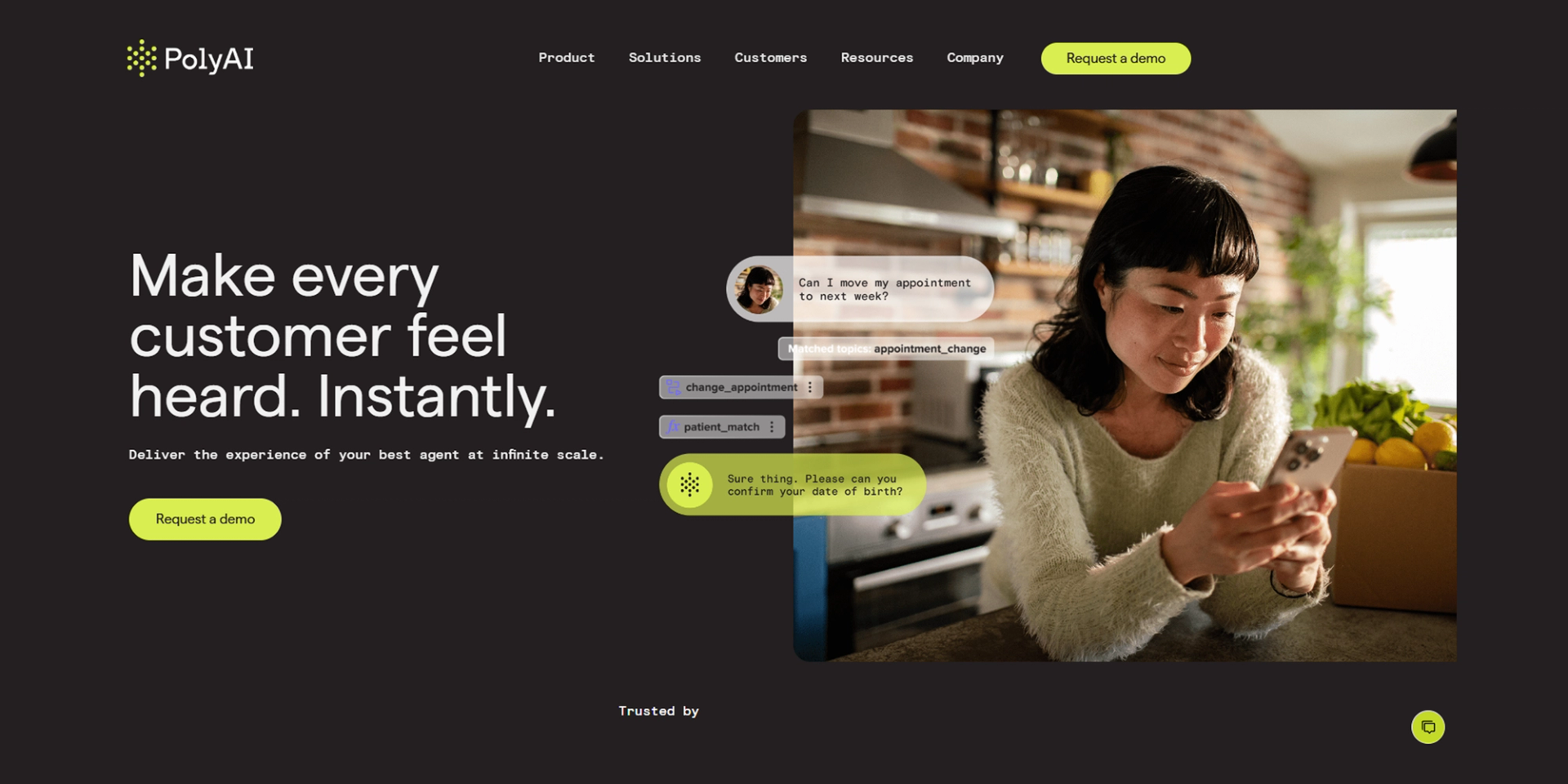
PolyAI is an enterprise conversational voice AI platform designed to handle customer phone calls using natural language understanding and human-like speech.
Instead of forcing callers through predefined paths, PolyAI features allow customers to speak naturally. The assistant interprets meaning, maintains context, and completes tasks while preserving a fluid conversational experience.
PolyAI voice assistants can:
Its roots in conversational linguistics and AI research are reflected in its dialogue modeling and linguistic realism.
Learn how AI voice agents improve first call resolution →
The voice AI landscape includes several categories:
Focus on task completion and cost reduction.
Focus on natural dialogue and customer satisfaction.
Combine automation with analytics, QA tools, and workflow orchestration.
PolyAI sits firmly in the conversational experience category. It is designed to improve interaction quality rather than simply reduce call duration.
This positioning makes it particularly relevant for organizations where customer experience is a competitive differentiator.
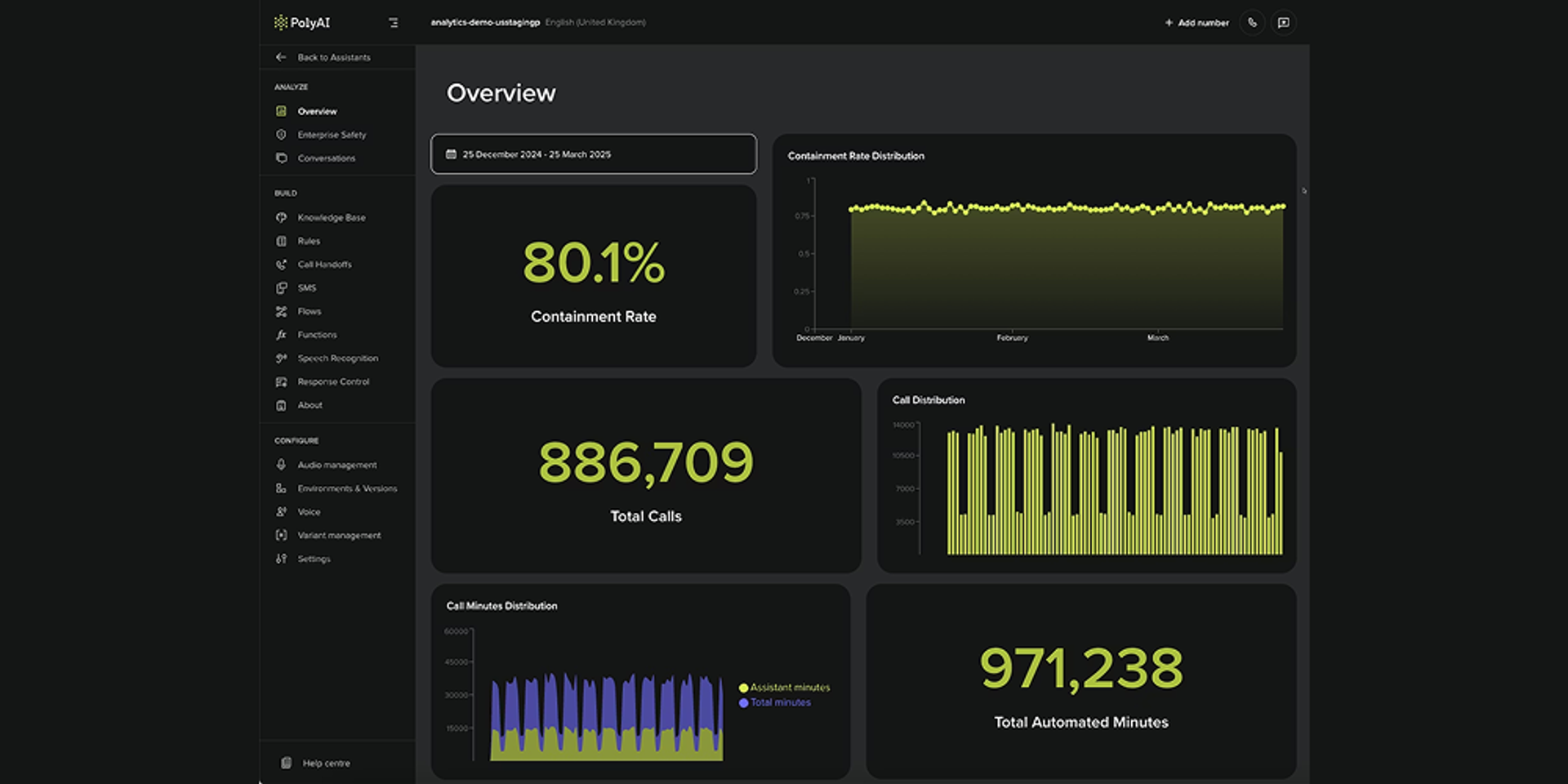
Caption: PolyAI analytics dashboard showing conversation metrics and containment performance.
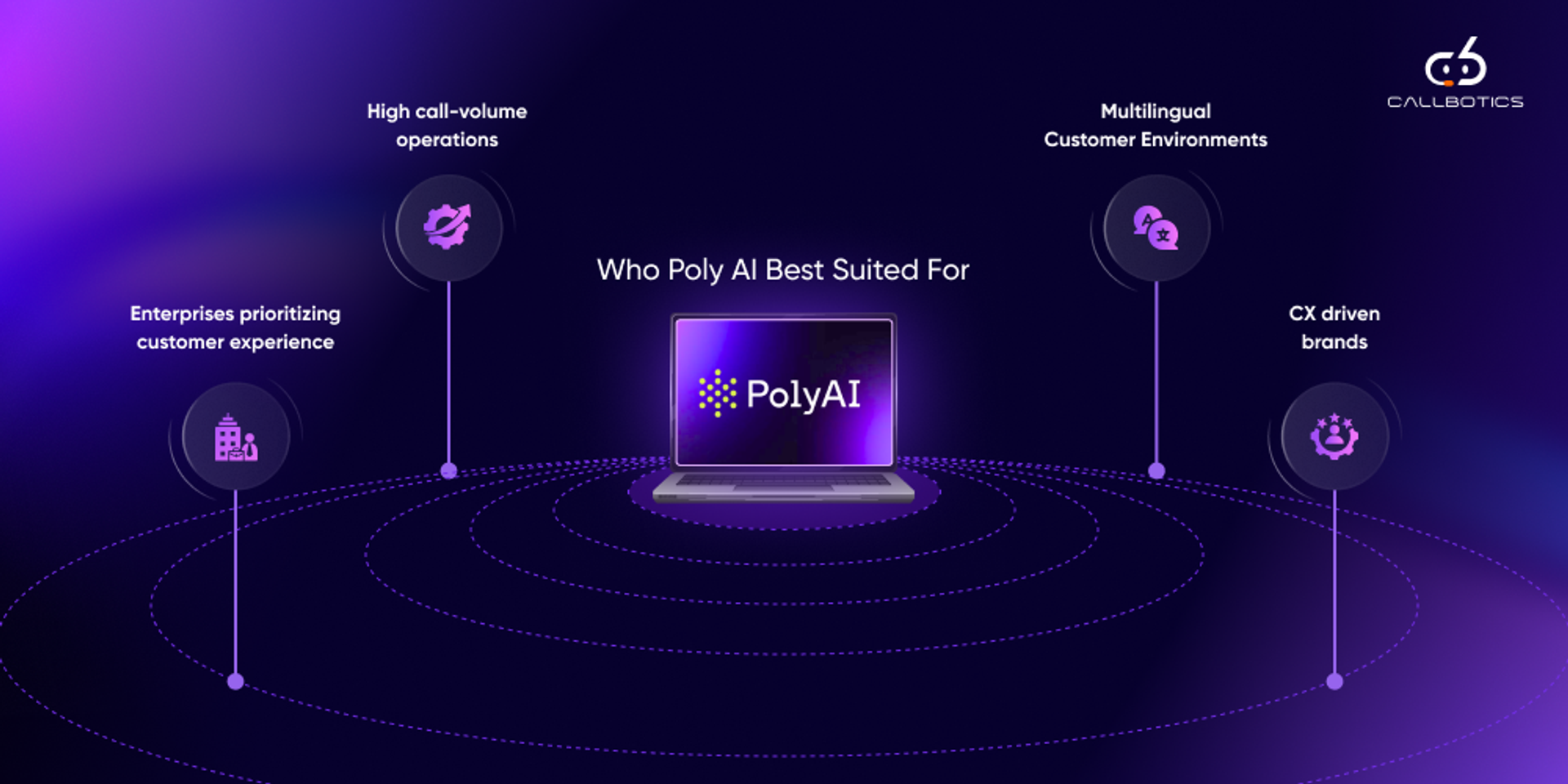
PolyAI is not a one-size-fits-all solution. Its strengths are most visible where conversation quality directly influences customer perception.
Organizations seeking to reduce friction and deliver premium service experiences benefit from conversational realism.
Businesses managing large volumes can automate routine interactions without degrading service quality.
PolyAI supports multiple languages and accent variations, enabling global accessibility.
Brands competing on service experience and loyalty.
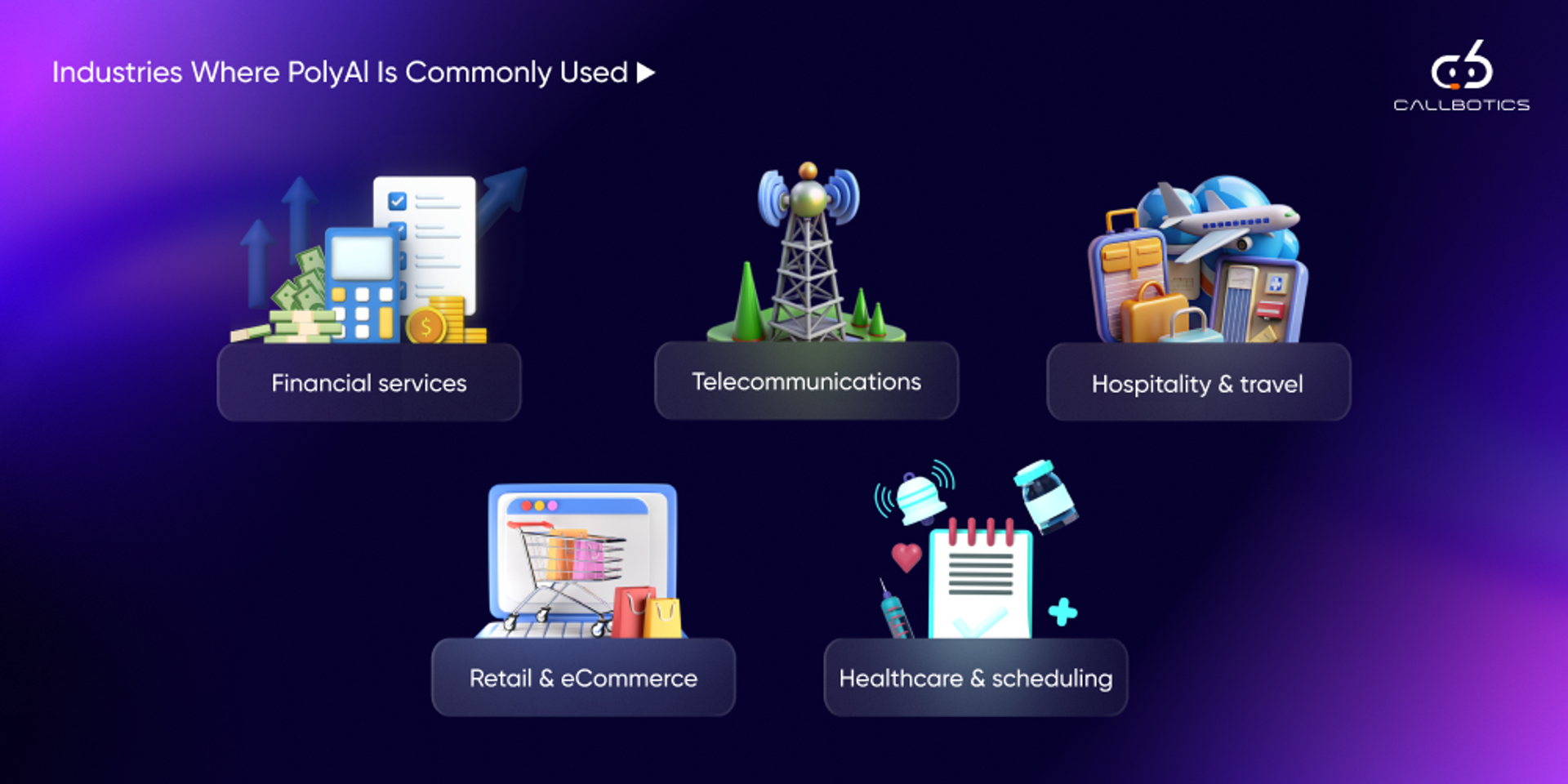
PolyAI is deployed across sectors where interaction quality matters.
Balance inquiries, fraud alerts, payments, and account support.
Reservations, modifications, cancellations, and loyalty support.
Billing questions, troubleshooting, and plan changes.
Order tracking, returns, and customer inquiries.
Appointments, reminders, and routing.
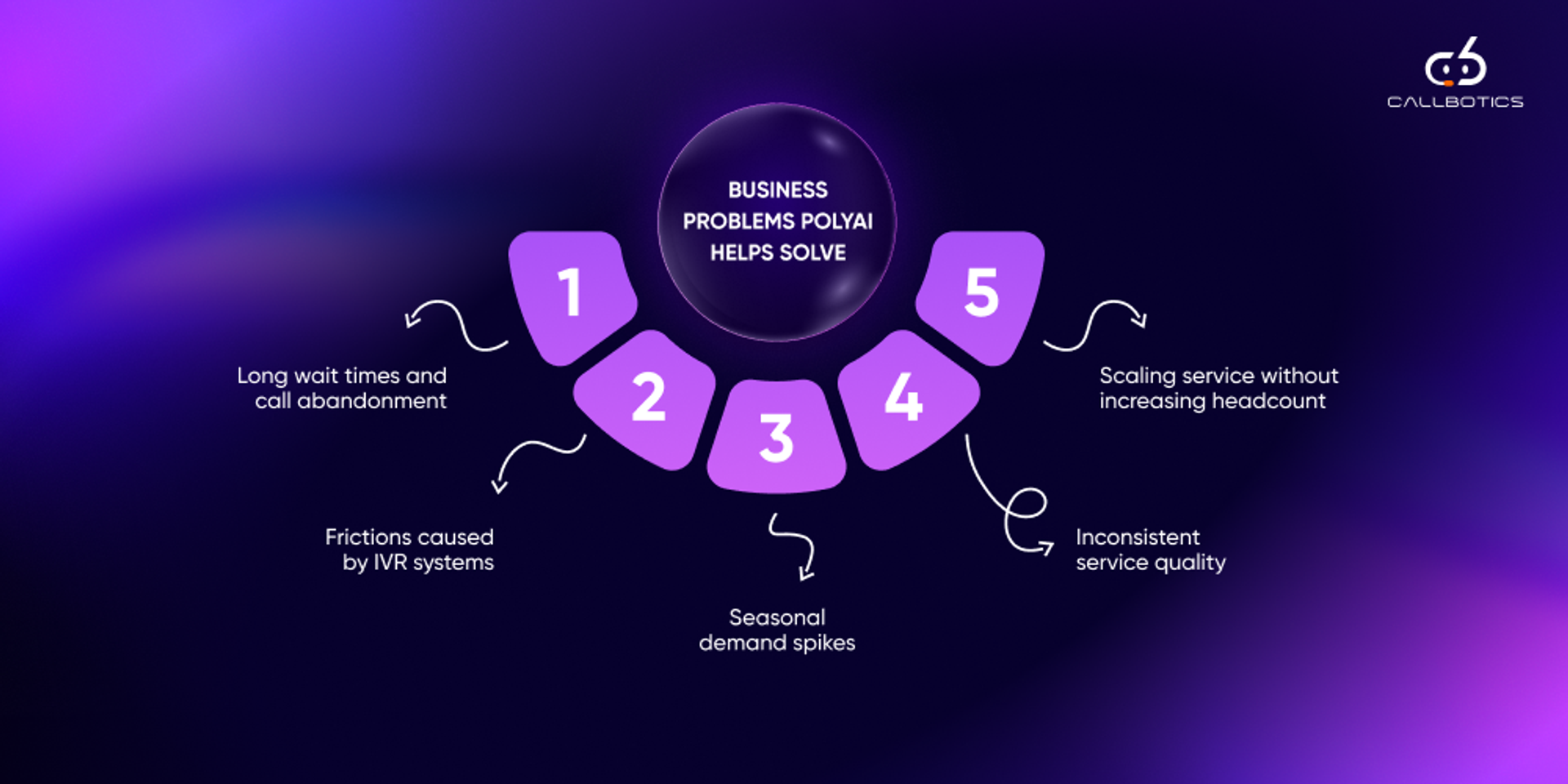
Organizations adopt conversational voice AI to address systemic service challenges.
PolyAI answers instantly and resolves routine requests without queue delays.
Natural conversation replaces menu navigation.
PolyAI scales to absorb volume surges.
Delivers consistent responses across interactions.
Expands capacity while controlling operational costs.
Automation is increasingly part of the solution. McKinsey reports that leading organizations are already automating up to 70% of customer contacts, allowing human agents to focus on complex and high-value interactions.
Read more about how contact center automation improves operational efficiency →
To understand PolyAI’s real-world value, it helps to look at how the platform operates once deployed in live customer environments. Rather than focusing only on conversational design, PolyAI combines language understanding, enterprise integrations, and telephony infrastructure to manage complete voice interactions from greeting to resolution.
Assistants are designed to handle interruptions, clarifications, and conversational repair.
The platform interprets meaning and context rather than matching keywords.
PolyAI connects with CRM systems, booking platforms, payment systems, and authentication tools to complete real tasks.
Supports inbound and outbound calls, routing, queue overflow, and escalation.
Teams monitor containment rates, escalation triggers, and resolution success to refine performance.
Instead of navigating menus, callers speak naturally:
“I want to check my last bill and make a payment.”
The assistant retrieves information and completes the task conversationally.
This reduces friction, shortens resolution time, and improves satisfaction.
Customer expectations have shifted. Speed and accuracy alone are no longer sufficient. Interaction quality now shapes brand perception.
Industry forecasts reinforce this shift. Gartner notes that AI and evolving customer expectations are reshaping service delivery, pushing organizations toward more intelligent and automated support models.
Poor phone experiences increase churn. Frictions weaken trust. Impersonal systems erode brand connection.
Conversational voice AI aims to close the gap between automation efficiency and human service quality.
Long wait times don’t have to define support, see how CallBotics resolves calls instantly →
At the core of PolyAI is its conversational intelligence engine. Unlike rule-based systems that follow rigid scripts, PolyAI models dialogue as a dynamic exchange.
Customers rarely express their needs in a single sentence. They clarify, correct themselves, and change direction mid-conversation.
PolyAI is designed to:
Why this matters:Without context retention, callers repeat information, increasing frustration and escalation rates.
Read more about reducing average handle time and queue delays →
Real conversations shift direction.
For example:
“I want to pay my bill… actually, can you tell me the amount first?”
PolyAI recognizes pivots and adjusts the conversation instead of resetting the interaction.
This ability separates conversational AI from script-driven bots.
Many voice bots rely heavily on keyword matching. PolyAI interprets intent contextually.
It can understand variations like:
All maps serve the same intent.
PolyAI is designed to make automated conversations feel natural rather than mechanical.
It mirrors human pacing, pauses, and tone, helping interactions feel fluid and reducing caller confusion. Organizations can also tune the voice and communication style to match their brand personality, ensuring consistency across every interaction.
Because callers can speak naturally without adapting to system language, effort is reduced, and completion rates improve.
PolyAI supports multiple languages, regional dialects, and diverse accents. This improves accessibility and resolution accuracy for global and multicultural customer bases.
PolyAI combines conversational dialogue with task automation. It can handle routine requests such as scheduling, billing inquiries, order status, authentication, and subscription changes by retrieving and updating data in connected systems.
Calls can be routed based on intent, escalated when needed, and passed to agents with conversation summaries, reducing repetition and speeding resolution.
PolyAI integrates with CRM platforms, payment systems, scheduling tools, and contact center software, enabling real-time transaction completion rather than simple query handling.
Its conversational intelligence can also extend across voice, chat, and messaging channels, maintaining consistency across touchpoints.
Successful deployments involve continuous refinement through monitoring and performance tuning. Teams typically track containment rates, resolution success, escalation triggers, and customer experience indicators.
When implemented effectively, PolyAI can reduce wait times, improve first-call resolution, lower cost per interaction, and allow agents to focus on complex issues.
Performance outcomes depend on integration depth, conversation design, and ongoing optimization.
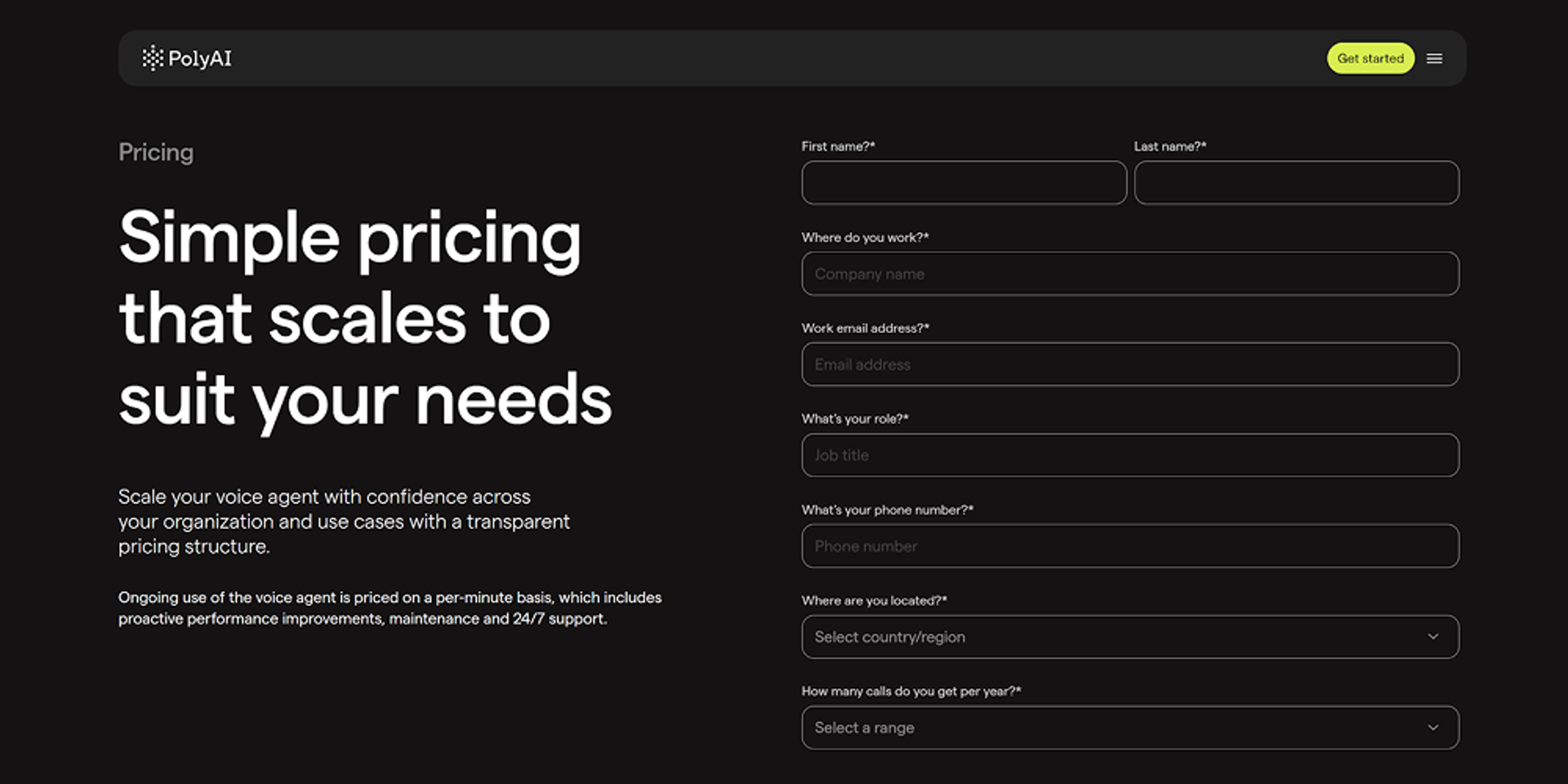
Caption: PolyAI pricing structure typically varies based on enterprise requirements and usage volume.
PolyAI does not publish standard pricing tiers.
PolyAI pricing is customized based on deployment scope and enterprise requirements, which is typical for enterprise CX platforms and requires careful cost modeling.
Costs usually vary based on:
Most deployments follow a usage-based model tied to call minutes or interactions.
Organizations should plan for:
Organizations often justify investment through reduced staffing pressure, faster call resolution, improved customer satisfaction, and better handling of demand spikes.
A platform’s strengths and limitations become clearer once deployed in real-world contact center operations. Here are some pros and cons to note:
Both PolyAI and CallBotics automate customer phone interactions, but they address different priorities within contact center environments.
PolyAI emphasizes conversational realism and interaction quality. CallBotics emphasizes automation efficiency and operational performance.
| Dimension | PolyAI | CallBotics |
|---|---|---|
| Primary focus | Conversational voice AI | Contact center automation |
| Design philosophy | Natural dialogue & interaction realism | Resolution speed & workflow efficiency |
| Interaction style | Dialogue-first & contextual | Workflow-first & task completion |
| CX emphasis | Conversational comfort & flow | Speed, accuracy & routing |
| Operational goal | Improve interaction quality | Improve throughput & resolution |
| Capability | PolyAI | CallBotics |
|---|---|---|
| Conversation model | Multi-turn, context-aware dialogue | Structured workflows for resolution |
| Handling interruptions | Adapts to conversational pivots | Managed via workflow logic |
| Task completion | Completed within dialogue | End-to-end workflow automation |
| Experience style | Natural conversational flow | Clear & structured resolution |
| Ideal strengths | CX interactions & inquiries | Scheduling, routing & compliance workflows |
| Dimension | PolyAI | CallBotics |
|---|---|---|
| Deployment approach | Enterprise rollout with conversation design | Guided onboarding with workflow templates |
| Time to production | Varies by scope & integrations | Often live quickly for core workflows |
| Setup complexity | Conversation modeling & integrations | Accelerated setup using templates |
| Best suited for | CX transformation initiatives | Rapid operational deployment |
| Dimension | PolyAI | CallBotics |
|---|---|---|
| Pricing model | Usage-based enterprise pricing | Fixed per-agent pricing |
| Predictability | Variable with usage | Predictable monthly costs |
| Budget planning | Requires usage modeling | Easier forecasting |
| Cost scaling | Scales with usage volume | Scales with deployment size |
| Dimension | PolyAI | CallBotics |
|---|---|---|
| Monitoring focus | Conversation performance | Operational performance metrics |
| Analytics | Deployment dependent | Built-in dashboards & automation metrics |
| QA capabilities | May require integrations | Integrated QA & monitoring |
| Optimization | Conversational refinement | Workflow performance tracking |
For organizations evaluating PolyAI alternatives, CallBotics takes a fundamentally different approach to enterprise voice AI. Rather than focusing primarily on conversational experience alone, CallBotics is built for real contact center environments where operational reliability, visibility, and measurable outcomes are critical.
The platform is designed to support production-grade call handling from day one, making it well suited for teams managing high-volume, customer-facing operations that cannot tolerate inconsistent performance or long deployment cycles.
Here’s what makes CallBotics stand out:
Unlike experimental AI tools designed primarily for demonstrations, CallBotics focuses on delivering dependable automation that improves resolution rates, reduces agent workload, and provides full transparency into system performance.
The decision is less about which platform is better and more about aligning technology with operational priorities.
Organizations seeking more natural conversational experiences may find PolyAI aligned with their CX goals.
Organizations prioritizing automation efficiency and scalable resolution may find CallBotics aligned with operational objectives.
Some enterprises adopt layered strategies, using conversational AI for customer-facing interactions while leveraging workflow automation to streamline resolution.
CallBotics may be a strong fit when organizations prioritize:
PolyAI may align well when organizations prioritize:
The right approach depends on whether the goal is interaction quality, operational performance, or both.
Voice automation is no longer a question of whether to adopt, but how to adopt intelligently.
PolyAI represents a significant step forward in conversational voice technology, enabling context-aware interactions at enterprise scale.
Successful adoption requires thoughtful planning, integration, alignment, cost modeling, and ongoing optimization.
For teams focused on rapid deployment, operational visibility, and predictable automation outcomes, platforms such as CallBotics may better align with operational priorities.
Ultimately, the right decision depends on where your organization wants intelligence to operate:
A clear understanding of business priorities and customer expectations will guide the most effective path forward.

Urza Dey (She/They) is a content/copywriter who has been working in the industry for over 5 years now. They have strategized content for multiple brands in marketing, B2B SaaS, HealthTech, EdTech, and more. They like reading, metal music, watching horror films, and talking about magical occult practices.
See how enterprises automate calls, reduce handle time, and improve CX with CallBotics.
CallBotics is an enterprise-ready conversational AI platform, built on 18+ years of contact center leadership experience and designed to deliver structured resolution, stronger customer experience, and measurable performance.