Voice automation is no longer confined to pilots or internal demos.
It is increasingly being deployed to handle real customer conversations across sales, support, and operational workflows. As phone channels remain critical to customer engagement, businesses are under pressure to automate call handling without compromising responsiveness, call quality, or control. Platforms like Synthflow AI have gained attention by lowering the barrier to building and deploying AI voice agents, particularly for teams looking to move quickly.
This Synthflow review takes a practical, buyer-focused look at what Synthflow AI actually delivers in real-world use. It examines how the platform works, what features and limitations matter in production environments, how pricing scales with usage, and where Synthflow fits best. The review also compares Synthflow with more enterprise-oriented platforms like Callbotics, helping your team evaluate which option aligns with your operational requirements rather than just initial setup speed.
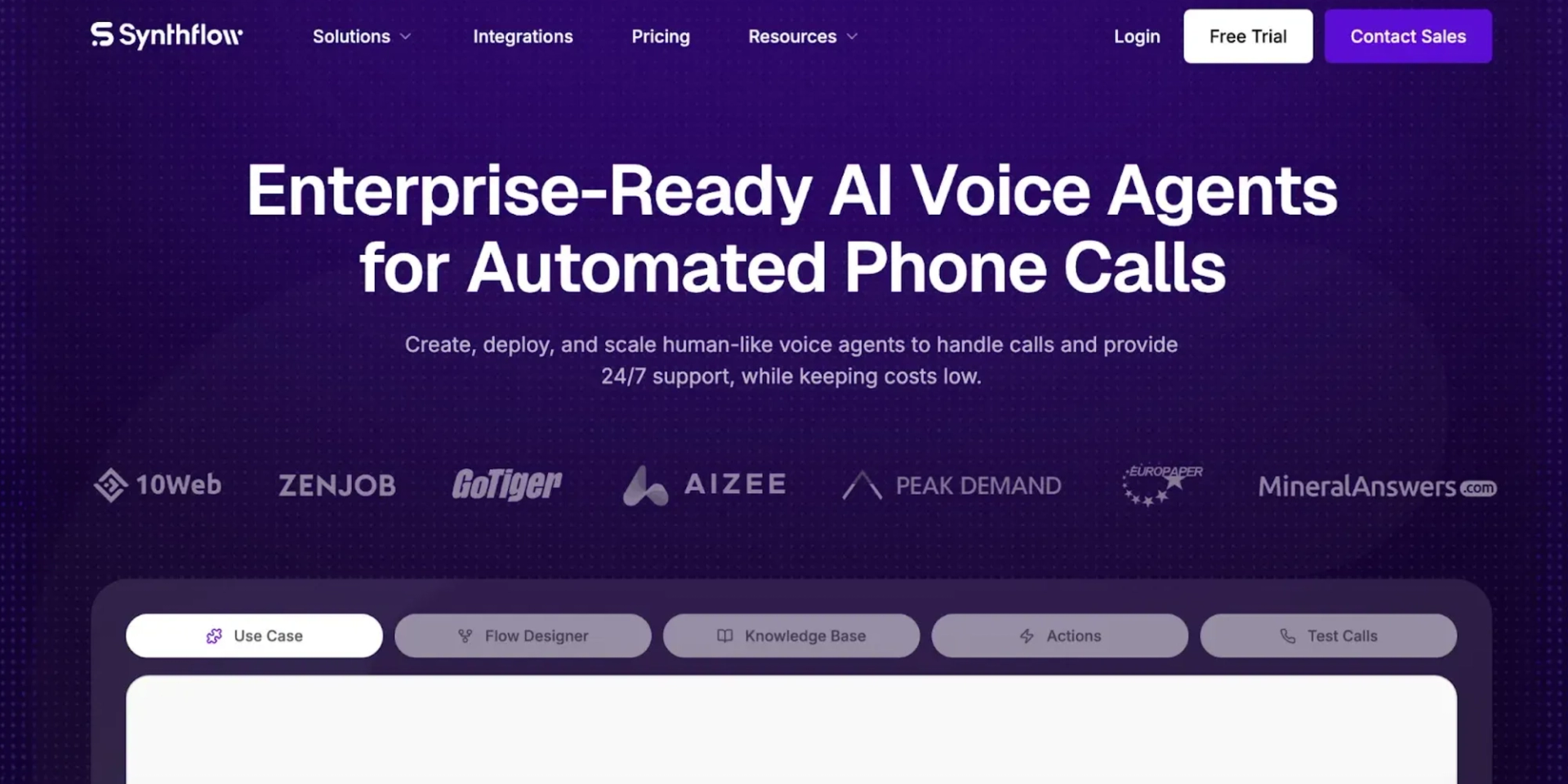
Source: SynthFlow Homepage
Synthflow AI is a platform designed to help businesses build, deploy, and manage AI voice agents for handling phone calls. It enables teams to automate both inbound and outbound voice interactions using a no-code approach, making voice automation accessible to users without deep technical expertise.
Through this Synthflow review, it becomes clear that Synthflow focuses on speed and flexibility rather than deep operational control. The platform is particularly appealing to startups, agencies, and small teams that want to experiment with AI-driven call handling, validate use cases, or deploy voice agents quickly without heavy upfront investment.
Synthflow helps address common early-stage voice automation challenges such as missed calls, basic lead qualification, and repetitive call workflows. It is most effective in environments where rapid prototyping, customization, and iteration matter more than enterprise-grade governance, compliance frameworks, or large-scale operational oversight.
Synthflow AI is commonly used for:
Overall, this Synthflow review positions Synthflow AI as a practical entry point into voice automation. It works best for teams prioritizing speed, experimentation, and flexibility, while more complex or regulated environments may require platforms built specifically for long-term, high-volume operations.
Synthflow AI allows users to create voice agents using a visual, no-code interface where teams can design call flows, define responses, and connect agents to phone numbers and supported integrations. The setup process is straightforward and optimized for fast deployment.
Once deployed, the AI agent answers calls, follows the configured logic, and interacts with callers via natural-language responses. However, call handling is primarily governed by user-defined rules and scripted flows rather than adaptive, operational intelligence. This distinction is important in this Synthflow review, as it affects how well the platform performs in complex or high-volume call environments.
In practice, Synthflow voice agents typically:
The platform includes several tools designed to make voice automation accessible and fast to deploy, especially for teams experimenting with AI-driven calling workflows. These Synthflow AI features emphasize flexibility, ease of use, and speed over deep operational control, an important distinction when evaluating long-term fit.
Synthflow provides a visual, drag-and-drop builder that allows non-technical users to design call flows without writing code. Teams can define prompts, responses, branching logic, and basic routing rules through a graphical interface. This lowers the barrier to entry and makes it easy to prototype voice agents quickly, even for users with limited technical experience. However, managing highly complex or dynamic call scenarios may require careful planning within these visual constraints.
The platform emphasizes fast response times to reduce latency during live calls. This helps conversations feel more natural and prevents awkward pauses that can disrupt the caller experience. While performance is generally smooth for simple workflows, response consistency can vary with call volume, integrations, and overall system load, which becomes more pronounced at scale.
Synthflow integrates with popular CRMs and business tools to enable basic data exchange during calls. These integrations support common use cases such as capturing lead information, logging call outcomes, and triggering simple workflows. While useful for foundational automation, integrations typically focus on lightweight data syncing rather than deep, bidirectional operational workflows.
One of the more distinctive Synthflow AI features is its white-labeling capability. Agencies and partners can brand voice agents with their own names, visual identities, and voice experiences. This makes Synthflow particularly attractive for reselling, client-facing deployments, or building branded AI voice solutions without exposing the underlying platform.
Understanding Synthflow AI pricing is critical before committing because Synthflow’s costs are primarily usage-based and can change materially depending on the LLM and telephony options you choose. On the pricing page, Synthflow positions two paths: Pay as you go for pilots and smaller deployments, and Enterprise for teams running high monthly call minutes and needing enterprise-grade scale and support.
The Pay-as-you-go model starts at $0 to create an account and build agents, then charges based on actual usage once you start running calls. Synthflow notes that most PAYG setups fall within a per-minute range, depending on your configuration.
Enterprise is positioned for scaling teams handling 10,000+ minutes per month and includes enterprise-grade reliability and support. This plan is custom-priced and includes features like guaranteed uptime with an SLA, advanced compliance options, and higher scale capabilities.
Synthflow’s calculator and plan comparison show that your effective per-minute cost is made up of multiple components, and the biggest variable is the LLM you pick.
Note: See Synthflow’s official pricing page for the latest details.
An evaluation of how Synthflow AI performs across usability, call reliability, security considerations, and ongoing support.
| Evaluation Area | Assessment (Condensed) | Rating (out of 5) |
|---|---|---|
| Interface & Setup Experience | Clean and intuitive interface that enables fast setup for basic voice agents, with added effort required for complex or large-scale deployments. | 4.0 / 5 |
| Call Quality & Reliability | Clear, natural-sounding calls in most scenarios, though reliability varies with traffic, integrations, and configuration at scale. | 3.5 / 5 |
| Day-to-Day Usability | Easy to manage for simple workflows, but requires more manual oversight as call volume and complexity grow. | 3.5 / 5 |
| Security & Compliance | Baseline security controls are present, but limited visibility into enterprise-grade compliance may concern regulated teams. | 3.0 / 5 |
| Customer Support Availability | Support relies mainly on documentation and standard channels, with responsiveness varying by usage level. | 3.0 / 5 |
| Documentation & Self-Serve Resources | Adequate for core setup and usage, but less comprehensive for advanced or edge-case scenarios. | 3.5 / 5 |
A thoughtful Synthflow AI pros and cons assessment helps clarify where the platform delivers strong value and where teams may encounter constraints as usage grows. Synthflow is designed to prioritize speed, flexibility, and ease of entry into voice automation, which makes it appealing for experimentation and early-stage deployments. At the same time, its design choices introduce trade-offs that become more visible in high-volume, regulated, or operationally complex environments. Understanding both sides is essential before committing to the platform for long-term use.
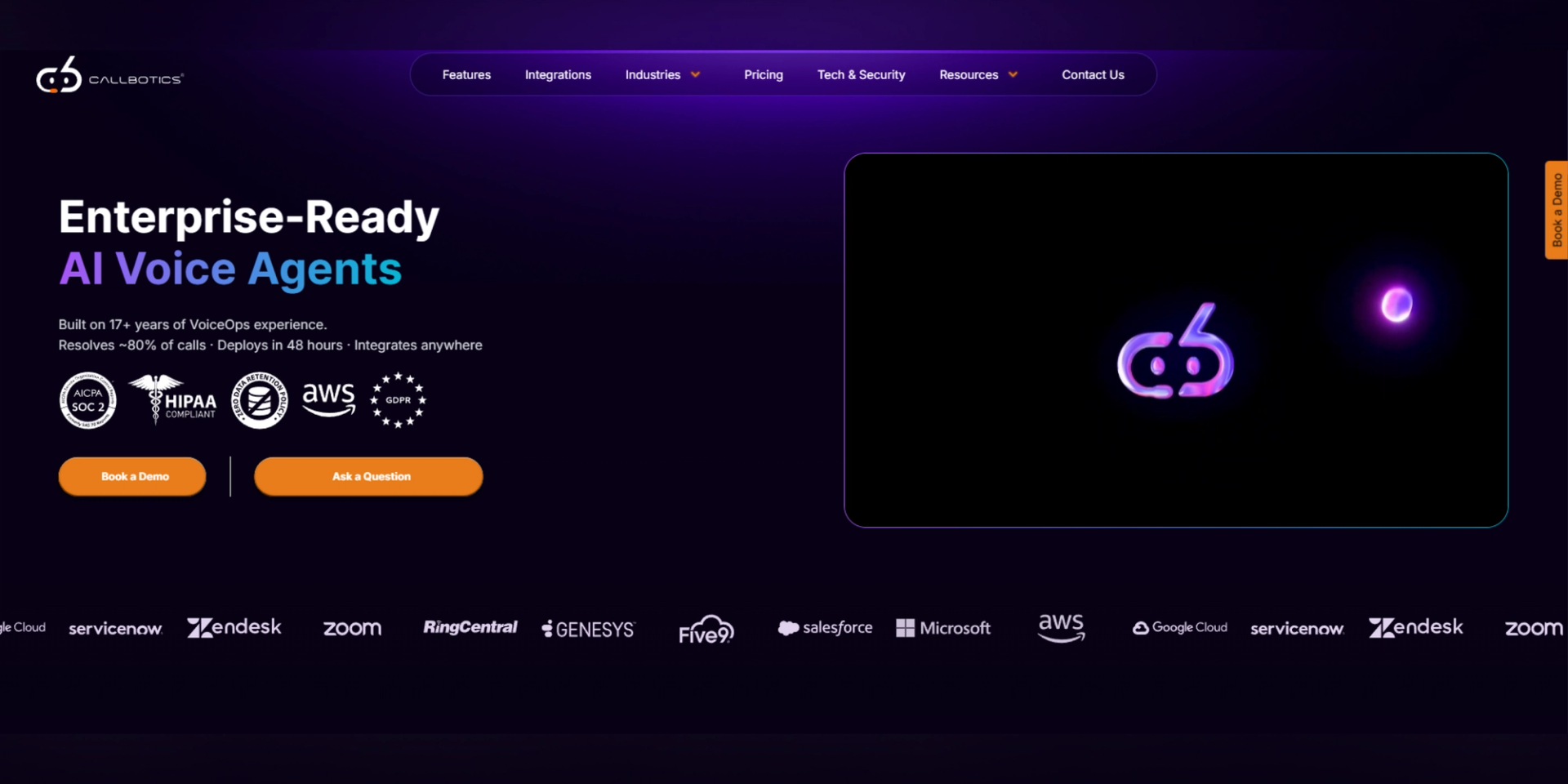
Source: CallBotics Homepage
Synthflow and CallBotics approach voice automation from different starting points. The feature differences largely reflect whether a team is optimizing for speed of setup and experimentation or for long-term, production-grade voice operations.
Pricing models play a major role in determining how well a platform scales as call volumes increase. The differences here are most visible once voice automation moves beyond pilots into sustained usage.
Deployment speed and support depth become increasingly important as voice automation moves into customer-facing and mission-critical workflows.
| Area | Synthflow | CallBotics |
|---|---|---|
| Primary Focus | No-code experimentation | Production-grade voice automation |
| Best Fit | Pilots, startups, agencies | High-volume, enterprise operations |
| Pricing Model | Usage-based, variable | Predictable, scale-friendly |
| Scalability | Low to moderate volume | Built for sustained volume |
| Deployment | Fast setup, more tuning later | Faster production rollout |
| Support | Mostly self-serve | Hands-on, operational support |
For businesses evaluating Synthflow alternatives, CallBotics takes a fundamentally different approach to voice AI. Instead of prioritizing rapid experimentation alone, CallBotics is built for real customer service environments where reliability, visibility, and consistency matter. The platform is designed to support production-grade call handling from day one, making it better suited for teams running high-volume, customer-facing operations.
Here’s what makes CallBotics stand out:
Both platforms serve different operational needs. The right choice depends on whether your priority is rapid experimentation or production-grade reliability at scale.
When Synthflow is the better choice:
When CallBotics wins:

Bryan is a B2B SaaS writer with a technical background who shifted into writing about technology and AI four years ago. With hands-on tech experience, he brings depth, clarity, and practical context to complex AI and SaaS topics. He’s a firm believer in an AI-driven future and focuses on content that explains not just how technology works, but why it matters. Outside of writing, Bryan enjoys watching films, listening to tech podcasts, and nurturing an unusual rookie-level interest in marine biology.
See how enterprises automate calls, reduce handle time, and improve CX with CallBotics.
CallBotics is an enterprise-ready conversational AI platform, built on 18+ years of contact center leadership experience and designed to deliver structured resolution, stronger customer experience, and measurable performance.