Voice AI platforms such as Synthflow AI and Vapi are reshaping how businesses manage customer interactions. These tools enable companies to deploy AI-powered phone assistants that handle appointment scheduling, inbound support, and lead qualification quickly and consistently.
Both platforms reveal clear differences when compared directly:
Many organizations also evaluate AI voice agents such as CallBotics as an alternative when comparing performance, pricing stability, and workflow control, making it a frequent contender alongside these platforms.
Below is a detailed, practical, and data-driven Synthflow comparison with Vapi and CallBotics to help you decide which platform best fits your use case, technical maturity, and budget.
The table below compares Synthflow AI, Vapi, and CallBotics across core dimensions, including features, setup effort, pricing, and real-world call performance. It highlights how each platform is positioned for different teams, from developer-led experimentation to fully managed, enterprise-scale deployments.
| Category | Synthflow AI | Vapi | CallBotics |
|---|---|---|---|
| Features | Site widget embeds, bulk outbound campaigns, visual workflow builder, agency white labeling | Custom voice models, a wide selection of AI models | Enterprise-grade AI voice agents, multi-step automation, built-in quality, and analytics |
| Ease of Use | No-code setup for non-technical users; outbound assistant intros can be tricky | More complex setup, better for developers; no-code UI available | No-code, fully assisted deployment; live in about 48 hours |
| Pricing | Starts at $370/mo with 2,000 minutes; $0.13 per extra minute | $0.05+ per minute depending on components; | Professional: $500/AI Agent; Growth: $450/AI Agent; Enterprise: custom. Fixed pricing, no per-minute penalties |
| Performance | Longer response times with noticeable pauses; cannot interrupt mid-sentence | Optimized for low latency (500–700ms); supports interruptions | Enterprise-trained AI for natural conversation; minimal wait times; high accuracy |
| Phone Support | U.S., Canada, Australia; Twilio for international | U.S. only natively; Twilio/Vonage for international; limited outbound | U.S.-based with international integrations; full enterprise support and onboarding |
| Integrations | Cal.com, ClickFunnels, Make, Zapier, GoHighLevel, HubSpot, Salesforce, Freshworks, Stripe | Webhooks for APIs, external AI models, Google Sheets, and Google Calendar | Seamless CRM, helpdesk, and workflow integrations; API access for custom automation |
| Language Support | 90+ languages | 100+ languages with multiple AI model options | Multilingual support with enterprise-grade conversational capabilities |
| Best For | Traditional industries, high call volume, non-technical teams, white-label solutions | Developer-focused teams needing customization, low-latency natural conversations | Professional: mid-sized teams starting with AI voice agents; Growth: scaling enterprises with multiple workflows; Enterprise: top-tier scalability, compliance, high-volume operations |
Table Caption: Side-by-side comparison of Synthflow AI, Vapi, and CallBotics for features, pricing, and usability
Below is a clear overview of each platform, showing their core capabilities and the types of teams that benefit most from Synthflow, Vapi, and CallBotics.
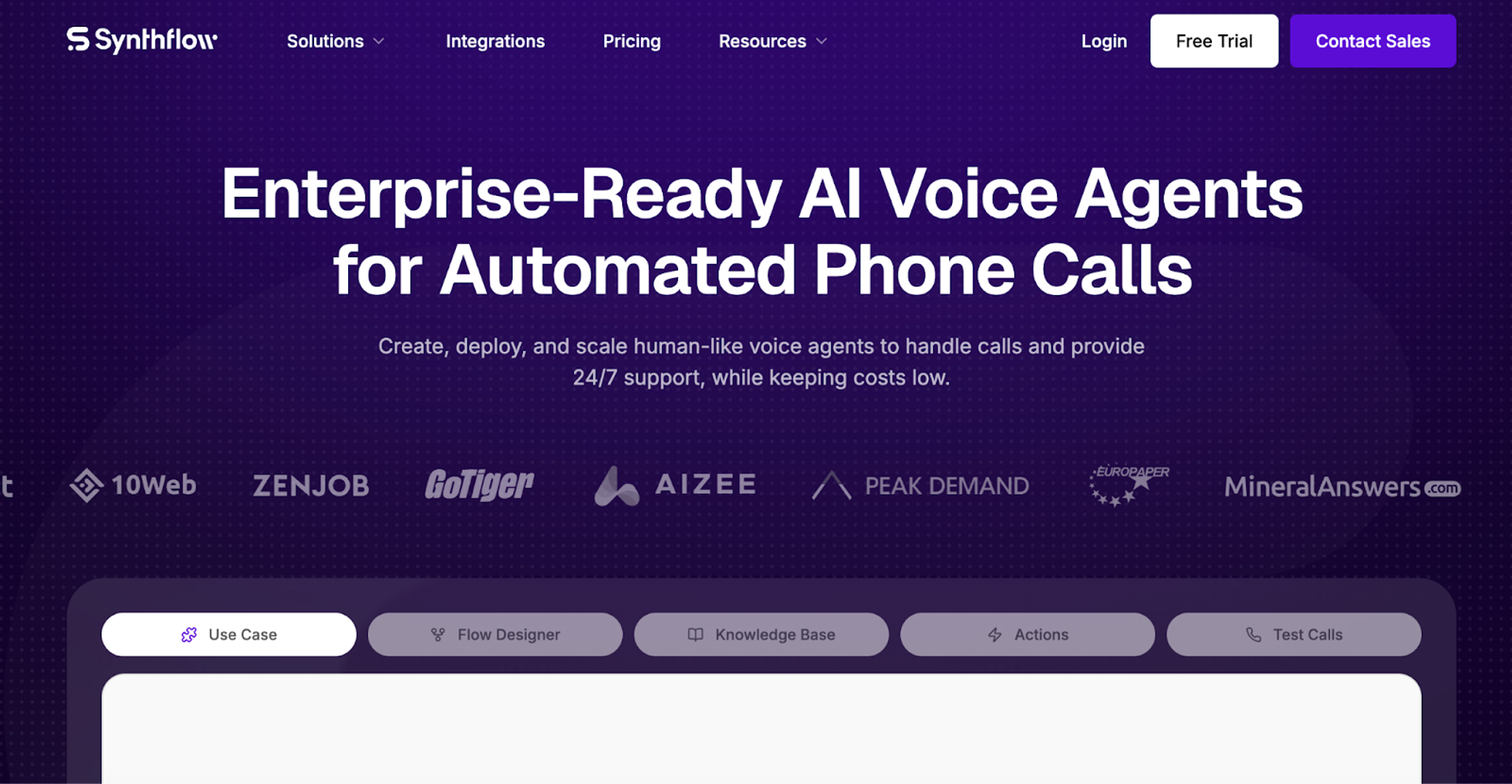
Caption: Deploy Enterprise-Ready Voice AI for automated calls
Synthflow AI is a no-code voice AI platform that enables teams to build voice agents without heavy technical effort. It focuses on conversational call flows, branching logic, and integrations with common business tools such as CRMs. Its drag-and-drop approach lets teams deploy automations such as appointment reminders, FAQ responses, lead qualification, and support tasks with minimal fuss.
Here’s what it offers:
The platform caters to small businesses and teams seeking to move beyond basic IVR systems while avoiding significant engineering investment.
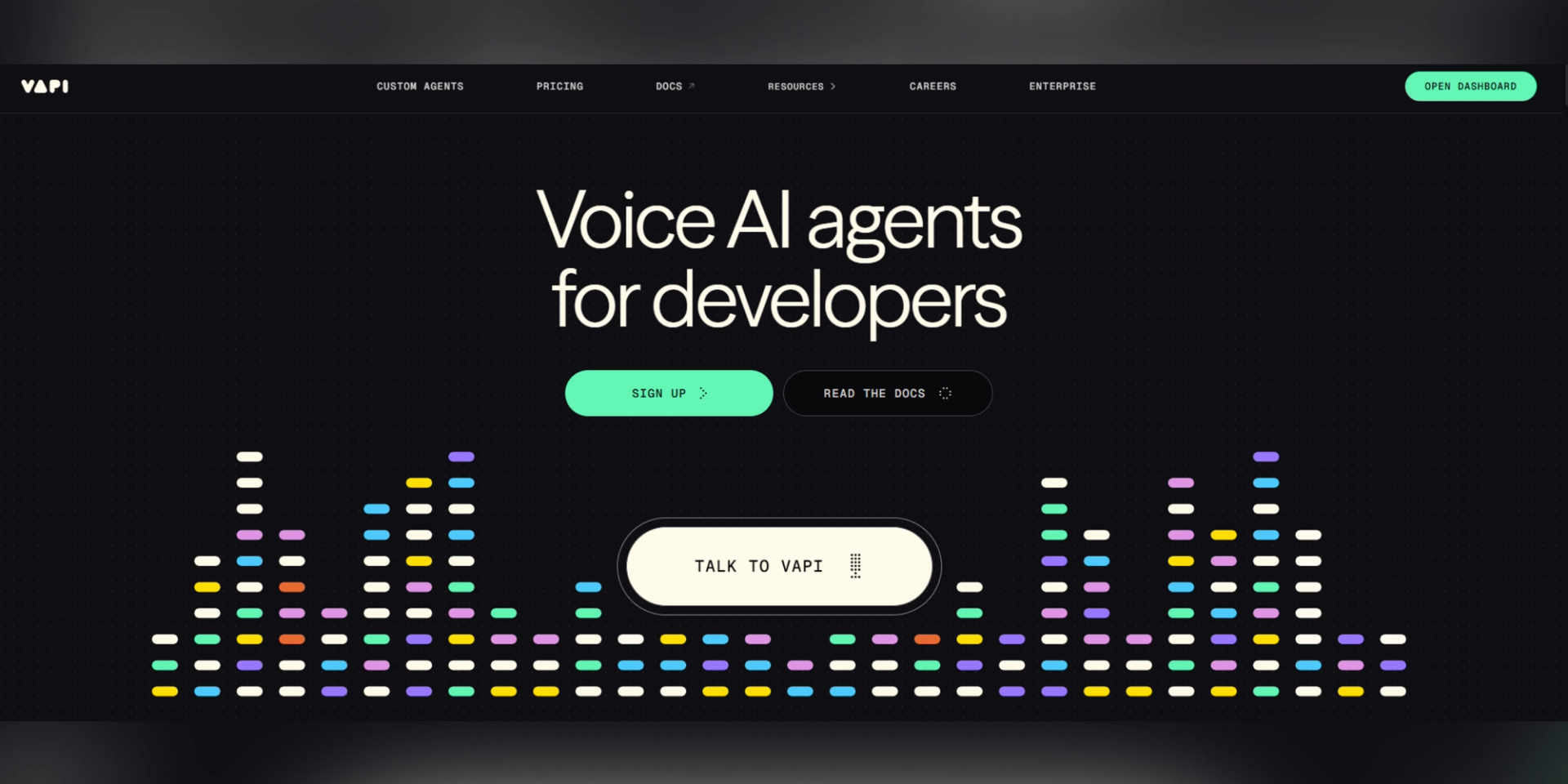
Caption: Deploy Voice AI agents designed specifically for developers
Vapi is an API-first voice automation platform that emphasizes developer flexibility and integration into production environments. Compared to Synthflow, Vapi is more technical and suited for teams that need custom workflows inside their existing systems. It emphasizes control over every piece of the stack. That includes speech-to-text, large language models, text-to-speech, telephony routing, and API integrations.
It offers the following features:
It works well where voice agents must integrate deeply with backend infrastructure, custom logic, and existing telephony providers. It’s ideal for engineering teams that want to control pricing, components, and calling behavior at a granular level.
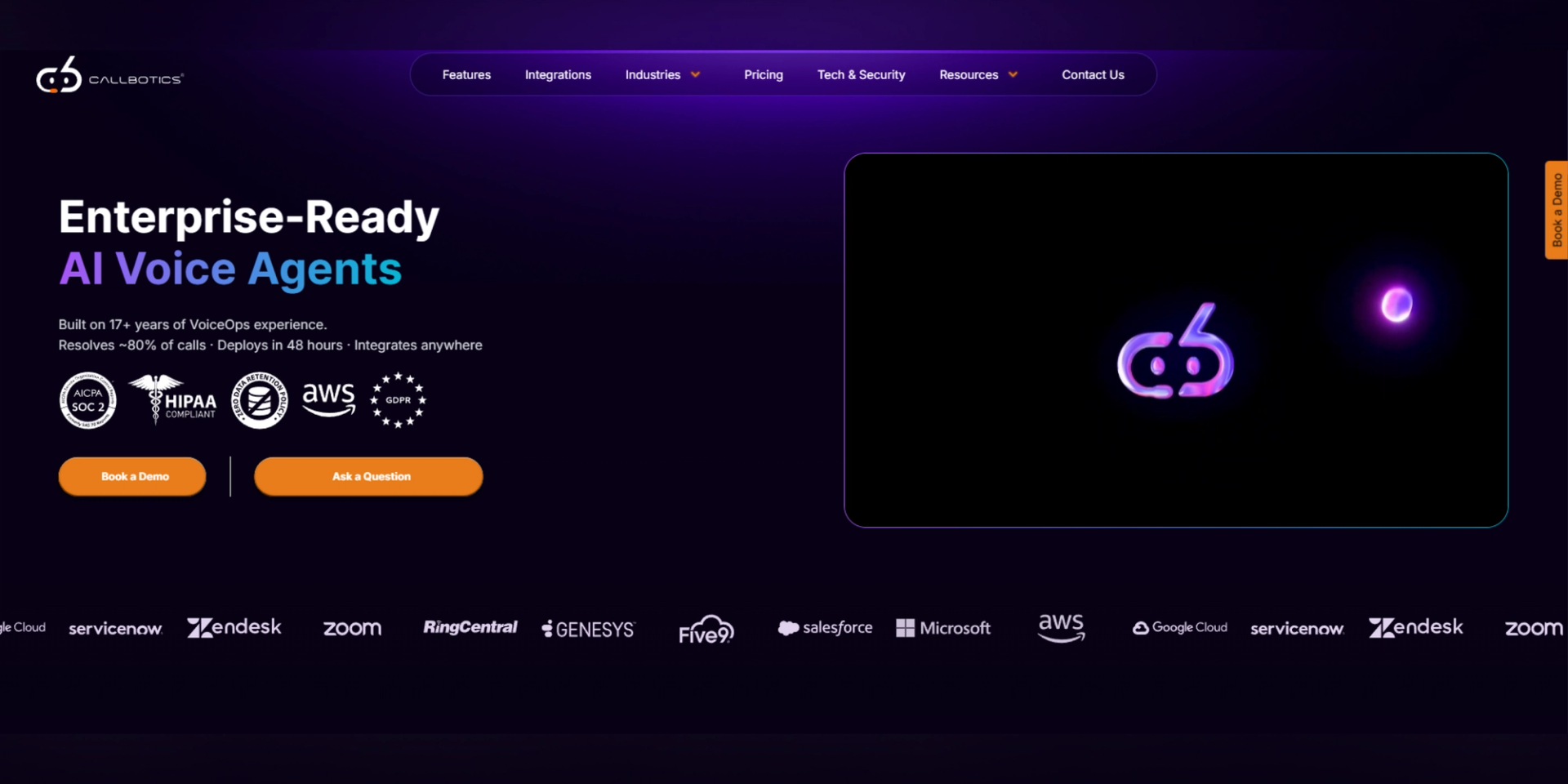
Caption: Automate calls with agents built on 17+ years of experience
CallBotics positions itself as a scalable, workflow-flexible platform for mid-to-large teams needing a balance between usability and complex call logic execution. It delivers enterprise-grade AI voice agents capable of multi-step automation, high concurrency, and built-in quality and analytics.
Some of its key features include:
Unlike Synthflow or Vapi, this platform is ideal for high-volume AI contact centers, BPOs, and regulated industries wanting predictable pricing, rapid deployment, and reliable performance for heavy call workloads.
📌Also read: AI Contact Centers vs Traditional Contact Centers: Which Model Wins on ROI?
When evaluating Synthflow vs Vapi, it’s crucial to look beyond pricing. These features define how well a platform can handle your workflows, scale with your business, and deliver consistent results.
We’ll also highlight where CallBotics serves as a modern, enterprise-ready alternative.
Automation logic determines how well your AI agents can handle sequential, conditional, and multi-step interactions. This is a critical differentiator for teams choosing between Synthflow, Vapi, and CallBotics.
Synthflow:
Let’s say a small gym uses Synthflow to automate membership reminders. The AI calls members, asks if they want to renew, and updates a spreadsheet. While functional, adding a secondary branching workflow (e.g., different questions for new vs. returning members) is cumbersome.
Vapi:
If a fintech startup uses Vapi to handle loan application calls, the bot dynamically checks credit history via an API, routes applicants based on eligibility, and triggers follow-ups. Developers can fine-tune each step programmatically.
CallBotics:
The visual workflow builder is easy for non-technical users, but the system also supports advanced customizations for developers. This combination ensures high-resolution automation across complex call scenarios.
High-quality voice output and response accuracy are critical for maintaining professionalism and reducing escalations.
Synthflow:
Vapi:
CallBotics:
For example, during a multi-step insurance verification call, Synthflow might repeat questions if the caller changes answers. Similarly, Vapi requires developer updates to maintain conversational context. In contrast, CallBotics handles multi-turn logic seamlessly, delivering human-like, accurate responses without manual intervention.
For businesses prioritizing professional call handling and customer experience, CallBotics provides the highest quality, followed by Vapi (with developer effort) and Synthflow (for basic tasks).
Integration capabilities determine how well the AI voice platform fits into your existing workflows.
Synthflow:
Synthflow integrates with popular business tools like HubSpot, Salesforce, Zapier, Make, ClickFunnels, and GoHighLevel. Webhooks and pre-built templates simplify connection setup, but advanced API customization is limited.
Vapi:
Vapi offers extensive API support and flexibility. Developers can connect to custom CRMs, analytics dashboards, scheduling tools, or external AI models.
While setup is more technical, the platform supports complex system architectures and automated data flows for organizations that require full control over integration.
CallBotics:
CallBotics balances integration depth with ease of use. The platform provides native CRM and helpdesk integrations, seamless API access, and pre-configured connectors.
Teams can quickly link dashboards, reporting tools, or workflow systems, while developers retain flexibility in custom workflows. White-glove deployment ensures integrations are production-ready within 48 hours.
Performance visibility is critical for monitoring AI agent effectiveness, quality assurance, and operational improvement.
Synthflow:
It provides basic reporting with call summaries, transcripts, and simple analytics dashboards. While sufficient for small teams, visibility into complex workflows or multi-agent performance is limited.
Advanced data export or sentiment analysis may require add-ons.
Vapi:
Vapi allows detailed analytics and supports custom dashboards through APIs. Developers can track call flows, performance metrics, and conversation analytics in real time.
This flexibility is valuable for technical teams optimizing AI behavior across multiple channels.
CallBotics:
CallBotics delivers a built-in quality and analytics module with sentiment analysis, call transcripts, call scoring, and workflow KPIs. It provides actionable insights without extra cost or setup.
Data export is straightforward, supporting compliance reporting, team monitoring, and continuous workflow optimization.
By comparing workflows, voice quality, integrations, and reporting, teams can select the platform that best suits their needs.
| Feature Area | Synthflow | Vapi | CallBotics |
|---|---|---|---|
| Automation Depth | Simple flows, single-step | Highly customizable, API-controlled | Multi-step, multi-turn, enterprise-grade |
| Workflow Flexibility | Limited branching | Full developer control | Complex conditional and adaptive logic |
| Voice Accuracy | Basic, good for short calls | Depends on configuration | Human-like, contextual, domain-trained |
| Integration Support | Standard pre-built | Developer-led, extensive | Enterprise-grade connectors and API |
| Reporting & Analytics | Basic, add-ons required | Developer-built | Built-in, actionable, real-time |
| Ideal User | Small teams, low volume | Developers, technical teams | Mid-market & enterprise contact centers |
Table Caption: Feature comparison of Synthflow, Vapi, and CallBotics across automation, voice quality, integrations, and reporting
Synthflow, Vapi, and CallBotics each take different approaches to billing, which can affect long-term budgets as call volumes increase or workflows grow more complex.
Below, we’ll break down each platform’s pricing, highlight hidden costs or benefits, and show which models make sense for different teams.
Synthflow offers tiered plans with usage-based charges. While feature-rich, Synthflow’s pricing model can become unpredictable for businesses with high call volume or complex workflows.
| Plan | Monthly Cost | Included Minutes | Concurrent Calls | Custom Workflows | Ideal Users | Notes |
|---|---|---|---|---|---|---|
| Pro Plan | $370 | 2,000 | 25 | 8,000 | Solo users/ small teams | Extra minutes $0.13/min; minimal concurrency; limited customization |
| Growth Plan | $750 | 4,000 | 50 | 42,000 | Small to mid-sized teams | Extra minutes $0.12/min; increased workflows and team access; limited outbound capacity |
| Agency Plan | $1,250 | 6,000 | 80 | 100,000 | Agencies/ resellers | White-label platform, custom voices, custom actions, onboarding support; per-minute charges still apply |
| Custom Enterprise | Contact Sales | Higher | Custom | Unlimited | Large enterprises | Advanced integrations, SIP trunk, REST API, priority support; usage-based minutes create cost unpredictability |
Table Caption: Synthflow pricing, features, and ideal users at a glance
However, per-minute charges can rise quickly at high call volumes. Concurrency upgrades and advanced features such as sentiment analysis, premium voices, and additional workflows often come at an additional cost.
Exceeding plan limits can lead to unpredictable overage fees, making long-term budgeting challenging.
Vapi follows a usage-based, developer-focused model, giving flexibility but requiring careful cost management.
| Pricing Component | Cost | Notes |
|---|---|---|
| Call Minutes | $0.05/ min | Pay-as-you-go; enterprise contracts available for high-volume usage |
| Call Concurrency | 10 included + $10/ line/ month | Scales with usage; additional lines increase cost |
| SMS/ Chat | $0.005/ msg | Volume-based |
| Model Provider Costs | At cost | STT, LLM, TTS billed separately |
| Data Retention | 14–30 days | Customization available for enterprise contracts |
| Security & Compliance | Add-on $1,000/ month | Optional SOC2/HIPAA zero-data retention compliance |
| Support | Community support by default; private Slack/email support for enterprise | Named engineer/ account manager available |
Table Caption: Vapi pricing breakdown, pay-as-you-go costs, and optional enterprise add-ons
Vapi’s pay-as-you-go pricing model offers flexibility but can create variable costs as usage grows. TTS, STT, and LLM costs are often additional, depending on the provider and usage.
On the other hand, enterprise contracts can offer more predictable costs, but require negotiation.
CallBotics is designed for predictable, enterprise-friendly pricing, emphasizing high levels of automation, concurrency, and workflow depth, with no hidden fees.
| Plan | Monthly Cost | Features | Ideal Users |
|---|---|---|---|
| Professional | $500/ agent | Handles routine & complex workflows, appointment booking, analytics, seamless integrations, no-code builder, white-glove onboarding, and no overage fees | Mid-sized teams starting AI voice deployment |
| Growth | $450/ agent | Higher concurrency, multi-step workflows, industry routing, sentiment analysis, real-time booking, predictable monthly cost, 48-hour deployment | Scaling enterprises handling high volumes and complex workflows |
| Custom Enterprise | Contact Sales | Full AI voice automation, unlimited complex workflows, enterprise compliance, hundreds of concurrent calls, custom integrations, 24/7 support, white-labeling, and predictable enterprise billing | Large enterprises in compliance-heavy industries (healthcare, insurance, legal) |
Table Caption: CallBotics pricing, features, and ideal users for mid-market and enterprise teams
The platform’s pricing is based on agents and concurrency, making costs predictable. This means that no per-minute charges are applicable.
It supports rapid deployment (48 hours) with full onboarding and QA, and includes enterprise-grade compliance (SOC2 Type 2, HIPAA, GDPR). CallBotics also includes high call resolution and workflow depth without add-ons.
For small teams experimenting with AI voice platforms, Synthflow offers affordable entry points but can become expensive with volume. Vapi is highly flexible but requires careful cost monitoring for scaling.
CallBotics, on the other hand, is best for enterprises seeking predictable, scalable costs, rapid deployment, and deep workflow capabilities, ideal for mid-market and compliance-heavy operations.
| Platform | Predictability | Cost at Scale | Best Fit |
|---|---|---|---|
| Synthflow | Low | Can spike due to per-minute and concurrency add-ons | Small teams testing AI voice workflows; low-volume businesses |
| Vapi | Medium | Flexible but can fluctuate with usage of calls, TTS/STT, and LLM integrations | Developer-heavy teams needing API-first solutions; highly customized deployments |
| CallBotics | High | Fixed, agent-based pricing; scales smoothly | Mid-market and enterprise teams needing predictable costs, deep workflows, and high-volume automation |
Table Caption: Platform pricing predictability, scalability, and ideal users
📌Interesting Read: AI Voice Agent Cost & Pricing Guide: What to Budget for in 2026
Beyond pricing and features, usability and support are critical factors for teams deploying AI voice agents. A platform might have all the bells and whistles, but if setup is slow, onboarding is confusing, or support is lacking, teams can waste weeks or months just trying to get live.
Here’s a deep dive into Synthflow, Vapi, and CallBotics, focusing on learning curve, workflow setup, and support responsiveness.
Synthflow offers a visual workflow builder designed for non-technical users, with pre-configured automation templates. While this makes initial adoption straightforward, there are several areas for opportunities.
Some of the key advantages and limitations of Synthflow include:
💡Pro Tip: Teams creating highly dynamic flows with multiple triggers may find the platform restrictive without paid plan upgrades and additional concurrency.
Vapi is a developer-first platform that offers APIs and SDKs for building highly customizable AI voice agents. Its UX is more technical, designed for teams comfortable with coding and API integrations.
Here are some of the positive aspects and limitations of Vapi:
💡Pro Tip: Vapi is best for when you need developer-level flexibility, but the cost of setup time and engineering bandwidth can outweigh savings for small teams.
CallBotics balances usability and power, offering both visual workflow design and deep automation without requiring heavy technical skills. It is designed for teams that need fast deployment and reliable support.
Here’s what CallBotics does well, and where it falls short:
💡Pro Tip: Callbotics is particularly strong for operations that scale quickly. In fact, you can implement multiple workflows, track KPIs, and maintain high concurrency without additional configuration or hidden fees.
While Synthflow and Vapi each have strengths in their respective niches, CallBotics offers a balanced combination of workflow flexibility, predictable pricing, and enterprise-ready deployment.
| Differentiator | Synthflow | Vapi | CallBotics |
|---|---|---|---|
| Workflow Flexibility | Moderate; complex flows require upgrades | High; API-driven, but technical | Very high; no-code & multi-step, scalable |
| Pricing Predictability | Low; per-minute & add-on costs | Low-to-moderate; usage-based | High, transparent fixed tiers, no hidden fees |
| Deployment Speed | Moderate | Slow; coding & API setup needed | Very fast; 48 hours with white-glove onboarding |
| Support & QA | Tiered, plan-dependent | Developer/community-focused | Dedicated, proactive, enterprise-grade |
Table Caption: CallBotics vs Synthflow and Vapi on workflow, pricing, speed, and support
Below, we’ll highlight those differentiators in detail.
CallBotics is designed to handle both simple and highly complex voice workflows at scale. Unlike some platforms that require advanced coding or plan upgrades to unlock deeper workflow logic, it offers:
Organizations with high call volumes or complex processes, such as insurance claim routing, healthcare appointment booking, or lead qualification, can scale automation without redesigning workflows.
Compared to Synthflow, where per-minute usage and concurrency upgrades can lead to unpredictable costs, CallBotics focuses on transparent, predictable pricing:
Finance teams can forecast monthly spend accurately, and growth doesn’t require constant monitoring of usage metrics or the risk of surprise charges. This is particularly useful for contact centers managing 10,000+ calls per month.
CallBotics emphasizes rapid deployment and enterprise-level support to minimize time-to-value. Here’s how:
Operations teams save significant time and risk during setup. Instead of debugging workflows or waiting on delayed support responses, agents are operational and optimized almost immediately.
For teams aiming to scale intelligent voice operations reliably, CallBotics offers advantages that neither Synthflow’s entry-friendly approach nor Vapi’s developer-heavy model fully match.
📌Suggested Read: Discover the ROI of AI in Your Contact Center
Choosing between Synthflow, Vapi, and CallBotics depends on your team size, technical expertise, call volume, workflow complexity, and budget priorities.
| Feature/ Need | Synthflow | Vapi | CallBotics |
|---|---|---|---|
| Ease of Use | High; visual builder | Moderate; code/API required | High; no-code & visual builder |
| Workflow Complexity | Low-to-moderate | High (technical) | Very high; multi-step & nested |
| Pricing Predictability | Low; usage-based & add-ons | Low-to-moderate; usage-based | High; fixed tiers, no overages |
| Deployment Speed | Moderate | Slow; setup & integration | Very fast; 48-hour deployment |
| Support & QA | Tiered; plan-dependent | Community & documentation | Dedicated, enterprise-grade |
| Best For | Small teams, experiments | Developer-centric, custom integrations | Mid-market & enterprise, high-volume, regulated industries |
Table Caption: Feature-by-feature comparison of Synthflow, Vapi, and CallBotics
Here’s a detailed guide to help you make the right decision.
Synthflow is a solid choice for small businesses or early adopters testing AI voice automation on a limited scale. Its visual flow builder and prebuilt templates make it easy for non-technical users to get started, enabling rapid experimentation and deployment.
Here’s how it stands out:
However, usage-based billing can become unpredictable as call volumes grow, and higher concurrency or more complex workflows require plan upgrades or add-ons, adding cost and operational complexity. Advanced automation capabilities are limited compared to developer-focused or enterprise-grade platforms.
Vapi serves technical teams that require deep control over their AI voice workflows. Its API-driven architecture provides full flexibility to design complex conversational flows and seamlessly integrate with CRMs, ERPs, and existing telephony systems.
Why Vapi works for developers:
It’s important to note that Vapi requires a strong technical background to deploy and maintain workflows effectively. Usage-based billing can become costly at scale, and out-of-the-box analytics or quality assurance features are limited compared to platforms like CallBotics.
So, choose Vapi if your team has developer resources and requires deep customization for complex or highly tailored AI voice workflows.
CallBotics is designed for businesses that need enterprise-grade reliability without sacrificing usability. The platform handles multi-step, conditional, and nested workflows with no coding required, supporting hundreds of simultaneous calls and complex multi-unit processes.
Here are the features that make CallBotics indispensable:
While its upfront cost may be higher than that of entry-level Synthflow plans, the long-term return on investment is greater due to greater efficiency, predictable costs, and reduced management overhead.
📌Bonus Read: Best AI Voice Agents for Business in 2026
Curious which AI voice platform is the right fit for your team? Book a demo with CallBotics and see how it compares in real-world call workflows.

Urza Dey (She/They) is a content/copywriter who has been working in the industry for over 5 years now. They have strategized content for multiple brands in marketing, B2B SaaS, HealthTech, EdTech, and more. They like reading, metal music, watching horror films, and talking about magical occult practices.
See how enterprises automate calls, reduce handle time, and improve CX with CallBotics.
CallBotics is an enterprise-ready conversational AI platform, built on 18+ years of contact center leadership experience and designed to deliver structured resolution, stronger customer experience, and measurable performance.