It’s 2026, and if your human agents are still answering routine questions like “Where’s my order?”, your customer support model hasn’t caught up.
Research from McKinsey indicates that about 80% of common incidents can be resolved autonomously by AI. Gartner’s observation is on similar lines. It predicts that AI agents will autonomously resolve 80% of common customer service issues without human intervention by 2029.
This guide covers the following:
Conversational AI is software that talks with people through voice or text and completes tasks during the conversation. It understands what the person needs, responds instantly, and works directly with business systems to resolve requests without handing every interaction to a live agent.
In contact centers, conversational AI usually appears as voice or chat agents that handle routine customer requests and guide callers through clear workflows. For example, several banks use conversational AI to answer everyday calls such as balance checks, recent transactions, or card blocks.
The system understands intent, responds in real time, and interacts directly with backend systems while adhering to operational and compliance rules. Customers can ask to speak with a human agent at any time, and the full context is maintained throughout the call.
Over time, call outcomes and quality reviews refine how these conversations unfold, improving resolution rates for repeat queries.
Here’s how conversational AI works:
Conversational AI solves the two biggest challenges in customer service: resolution speed and availability. Conversational AI agents eliminate the "on-hold" music and “Press 1 for X, Press 2 for Y” flow entirely, providing instant responses at scale.
But conversational AI does more than just answer calls quickly. Below, we look at the main reasons why businesses are adopting it in 2026.
Traditional 24/7 support needs complicated shift schedules, extra pay for overnight work, and other costs. With conversational AI, support is always available, no matter when a customer calls.
Whether it’s during peak holiday season or off-season, customers receive the same high-quality, instant support. The result is higher ticket resolution rates without the proportional cost increases.
According to NTT Data research cited in one of their blogs, contact centers can resolve half their issues autonomously by embedding agentic AI throughout the customer journey.
AI handles routine questions such as password resets and return policies. This way, only the more complex issues go to human agents. The result is that routine issues are resolved faster, reducing ticket resolution time.
Mechanically solving repetitive problems results in agent burnout and, subsequently, agent turnover. Hiring and training new agents adds massive costs to contact center operations. By deploying voice AI solutions as the first line of response, agents can handle more complex issues that require more meaningful solutions.
When human agents are empowered to focus on complex problem-solving, their job satisfaction increases. The result is lower attrition risk and reduced hiring and training costs.
Modern conversational AI trades out reactivity for proactivity. Because these systems can process massive amounts of data, they can personalize an interaction based on a customer’s real-time status.
For example, an AI agent can identify a customer whose contract is up for renewal and offer a proactive discount or upgrade during a support call. This transforms a standard service interaction into a revenue-generating opportunity. The result is a higher customer lifetime value without turning support into a sales channel.
Industry benchmarks consistently show automation's cost advantage. Assisted service channels cost significantly more per interaction than self-service or AI-assisted channels: According to Gartner's customer service benchmarks, assisted channels cost $13.5 per contact on average, while self-service channels cost about $1.84. Salesforce’s “State of Service” report projects that AI agents will reduce service costs by 20%. IBM’s “Future of Customer Service” report estimates a 23.5% reduction in per-contact expenses and a 4% average annual revenue increase when using conversational AI.
The above studies clarify the trend. In a traditional contact center, a significant spike in calls during a product launch or busy season can mean weeks of hiring and training. With AI agents, you can scale up instantly. You only pay for the capacity you need, so your budget goes toward solving problems rather than hiring more staff. The result is lower cost per interaction and more predictable operating expenses.
People often use “conversational AI” as a broad term. But in today’s enterprise contact centers, the setup you choose depends on what channels your customers like and how complex their needs are.
| Type | Best For | Key Differentiator |
|---|---|---|
| AI Chatbots | Website, app, and messaging channels | Asynchronous, multi-session conversations |
| AI Voice Bots | Inbound and outbound voice calls | Real-time voice interaction with natural speech |
| AI Agent Assist | Complex interactions that require retrieving solutions from knowledge bases | Helps human agents with suggested solutions and next steps |
Types of conversational AI
These assistants are available on websites, WhatsApp, and mobile apps. They are ideal for customers who prefer to solve problems via chat rather than by calling.
Platforms like CallBotics specialize in this area. AI voice bots manage incoming calls to contact centers, make outbound calls for appointment reminders, and proactively reach out to customers.
The latest voice AI can hold conversations that sound human, use natural speech with proper pauses, and handle interruptions smoothly.
Some tools are built to help agents work faster and more effectively. Agent assist tools listen to calls in real time, suggest replies, share helpful articles, and recommend next steps.
Understanding where conversational AI delivers the most value helps organizations prioritize implementation. In this section, we’ll explore, through a few fictional companies, how different types of businesses are putting conversational AI to work. For a deeper dive into use cases, head to our in-depth blog post.
In many contact centers, predictable questions surge during seasonal peaks, policy updates, or service disruptions. Leaders typically respond by adding temporary staff, updating IVR menus, or publishing help articles. These approaches rarely scale fast enough and often shift frustration rather than reducing demand.
Customers often contact support for queries such as recent activity, account balance, or blocking their lost cards. Traditional support models require agents to spend the opening minutes of every call on authentication and manual discovery, increasing handle times and creating inconsistent experiences.
Order status inquiries predictably spike during promotions and peak seasons, overwhelming agents even though the underlying requests are simple. Teams often attempt to hire ahead of demand or push customers to self-service portals, but these measures break down when volumes surge or exceptions occur.
Scheduling, rescheduling, reminders, and follow-ups generate high call volumes across industries, consuming staff time and creating bottlenecks for customers. Front-desk teams and outsourced schedulers struggle to keep up, especially when no-shows and last-minute changes are common.
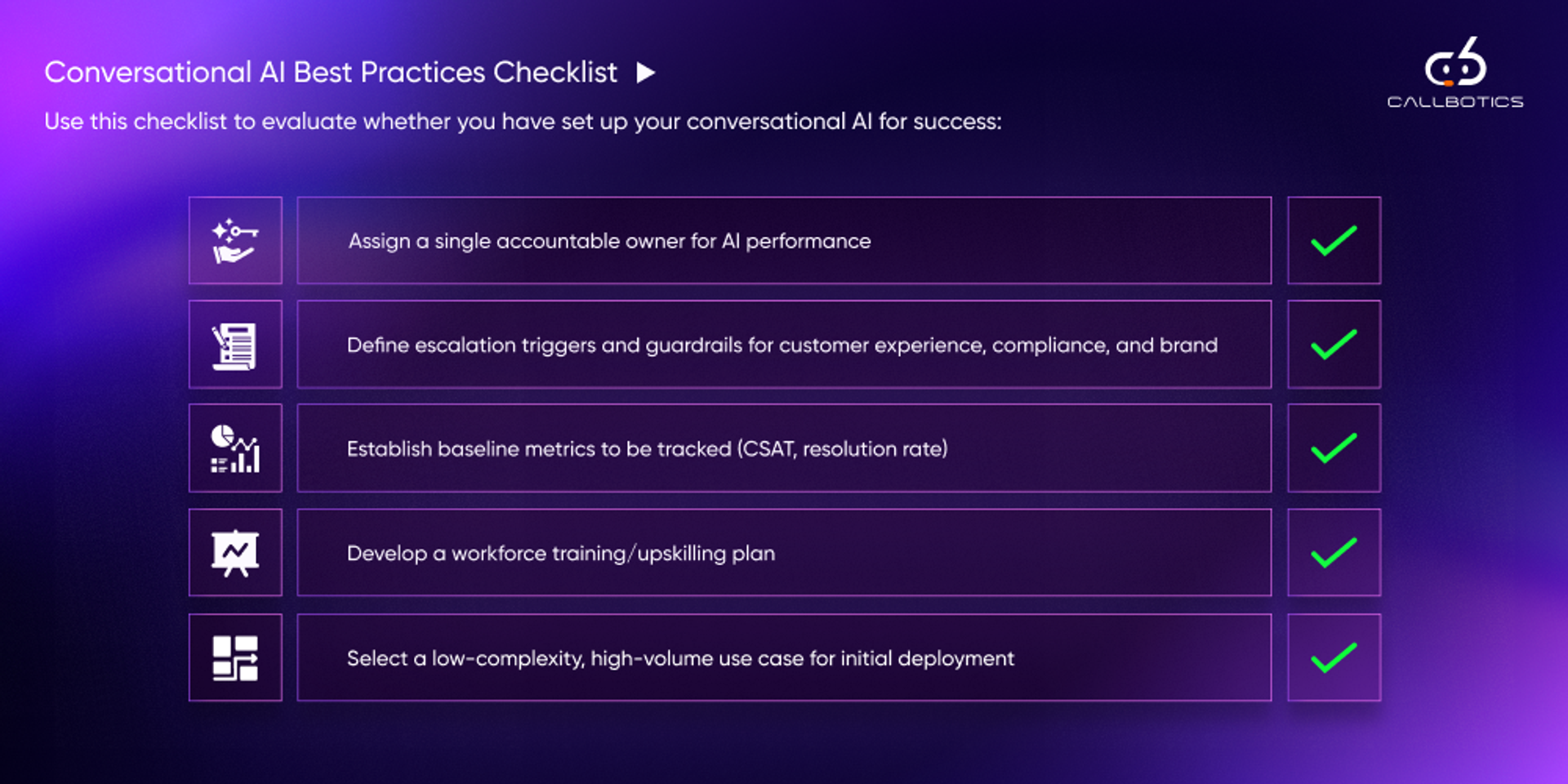
To implement conversational AI successfully, organizations need more than just the right technology. The following practices set high-performing deployments apart from disappointing pilots.
Without clear ownership, technology initiatives stall and die out. As a leader, you must define ownership for questions such as who owns AI performance metrics, who approves changes to conversation flows, and who is accountable if resolution rates drop. The most effective model would have a CX leader as the primary owner, with well-defined PoCs from teams such as Analytics and IT.
Leadership typically needs to define guardrails for entities such as CX, brand, and compliance.
For example:
These boundaries need to be documented before going live, not after an incident occurs.
There might be dozens of metrics to track, but leadership needs to align on those that directly tie to their business priorities.
Examples of metrics include:
Once these metrics are frozen, track them regularly and ensure AI performance is captured in these outcomes.
With conversational AI in the picture, agents are no longer forced to perform mundane tasks. Their work evolves into higher-order thinking, strategy, and escalation management. Human agents will need deeper product knowledge, stronger de-escalation skills, and the ability to handle ambiguous cases.
Leadership needs to ensure that the roadmap is clear. How will the support specialist’s role evolve? What sort of training investments are required?
Don’t try to automate everything at once. Choose use cases that allow you to test the waters before you dive deep, preferably high-volume, low-complexity queries that conversational AI can tackle easily.
Once the AI reaches a certain threshold (Number of issues resolved autonomously, number of days without an escalation, etc.), you can begin expanding into more complex areas.
Conversational AI’s role is to change how customer service work is structured, and this will not result in removing humans from the equation. Gartner’s research strengthens this statement – it predicts that by 2028, none of the top Fortune 500 companies will have eliminated human customer service.
Roles focused on routine, repetitive tasks are already being replaced by AI in many contact centers. But human agents are still essential for complex problem-solving, emotional situations, and meaningful conversations where customers want human judgment.
The bigger change is how AI changes the work of human agents. When AI handles routine tasks, agents can focus on more challenging and varied work. They become escalation specialists, handle complex cases, and manage relationships instead of just following scripts. Many agents find this work more engaging and meaningful.
This evolution is also creating new categories of work for human agents. Forrester predicts that 30% of enterprises will include roles such as managers responsible for onboarding and coaching AI agents, operational teams focused on optimizing AI performance, and specialists who step in when AI systems falter.
CallBotics provides enterprise AI voice agents, purpose-built for contact centers and call-heavy workflows, designed by teams with over 17 years of hands-on contact center experience to remove the operational friction that stalls most AI initiatives in endless pilots. The platform takes a practical, production-first approach, enabling voice agents to go live in roughly 48 hours, handle large volumes of routine customer calls independently, and deliver measurable outcomes through built-in visibility, quality controls, and performance tracking. For contact centers ready to move beyond experimentation and into real automation. Callbotics isn't a black box; it gives contact center leaders the visibility they need to demonstrate ROI and continually improve performance.
Key Differentiators
Conversational AI is a major change in how contact centers work. The technology is now mature. Modern voice AI delivers human-like conversations, connects with enterprise systems, and can be deployed faster than many organizations expect.
The benefits are clear: 24/7 availability without extra staffing costs, higher resolution rates thanks to consistent AI performance, less agent burnout by automating repetitive tasks, and real cost savings as AI handles more calls.
Success with conversational AI depends on having realistic expectations, strong knowledge bases, clear ways to reach human support, and a commitment to ongoing improvement. Organizations that treat conversational AI as a strategic capability and not just a hype project set themselves up for long-term advantage.
For contact center leaders, the question is no longer whether conversational AI works; it is whether it works well. It's whether their organization will take advantage of these benefits or let faster competitors get ahead.

Urza Dey (She/They) is a content/copywriter who has been working in the industry for over 5 years now. They have strategized content for multiple brands in marketing, B2B SaaS, HealthTech, EdTech, and more. They like reading, metal music, watching horror films, and talking about magical occult practices.
See how enterprises automate calls, reduce handle time, and improve CX with CallBotics.
CallBotics is an enterprise-ready conversational AI platform, built on 18+ years of contact center leadership experience and designed to deliver structured resolution, stronger customer experience, and measurable performance.